
Why Travel Adapters Don't Convert Voltage and What Actually Does
Key takeaways
- A travel adapter only changes the physical shape of your plug so it fits a foreign outlet; the voltage passes through unchanged.
- Most phones, laptops, and tablets are dual voltage (100-240V) and need only an adapter, never a converter.
- Single-voltage appliances such as many hair dryers need a true voltage converter abroad, or they can be damaged or become a fire risk.
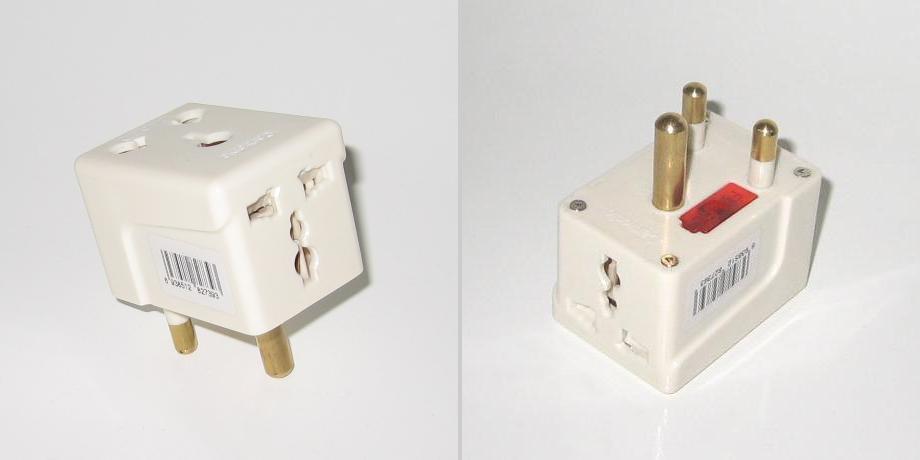
A Type M travel adaptor, the kind used in parts of southern Africa. It changes plug shape only.
Image Credits: Wikimedia Commons
A travel adapter is a small fitting that lets a plug from one country physically fit into a wall socket in another. It changes the shape of the connection and nothing else. The electricity that comes out of the wall passes straight through it, at whatever voltage the local grid supplies.
That surprises a lot of travelers. The adapter in your bag looks like it should handle the electrical differences between countries, but it contains no transformer and no electronics capable of changing voltage. This article explains what a travel adapter does, why it cannot convert voltage, what a voltage converter does instead, and how to check whether your devices need one.
What a travel adapter actually does
Think of a plug adapter as a translator for your plug, not for the electricity. It reshapes the prongs of your device's plug so they fit the socket shapes used in another country, according to Going In Style's adapter guide. A US plug with two flat pins becomes compatible with a European socket with two round pins, for example.
Plug shapes vary widely even within a single continent. Europe mostly runs on 220-240 volts, yet France, the UK, Italy, and Switzerland all use different socket shapes, so you will almost always need an adapter even when the voltage matches your device. The Roaming Historian's travel power guide notes that an adapter is needed in Europe regardless of voltage, purely because of plug-shape differences.
Adapters do have limits. They are typically rated for connections up to 240 volts, and grounded adapter plugs preserve the ground path from the outlet to the appliance.
Many include small safety features such as shutters that block single-pin insertion, fire-retardant housings, and fuses. None of these features changes the voltage, as Going In Style's guide stresses.
Why voltage conversion needs different hardware
Countries do not agree on voltage. The United States and Canada supply 110-120 volts at 60 Hz, while most of Europe, Asia, Africa, and Australia supply 220-240 volts at 50 Hz, according to the Roaming Historian. A device built for 120 volts that receives 240 volts is being fed double the electrical pressure it was designed for.
Changing that pressure requires a transformer or power-electronics circuit, which is what a voltage converter contains. A converter actively steps 220-240V down to 110-120V (or steps it up in the other direction), India Airports explains.
That is real electrical work, and it needs copper windings or switching circuitry plus heat dissipation. This is why a true converter is a solid, heavier piece of equipment and costs noticeably more than an adapter.
That size and weight difference is also a useful buying signal. The Roaming Historian warns that many small, inexpensive plug-style products sold online are incorrectly labeled as converters. If it is small and cheap, it is almost certainly an adapter and will not convert voltage.
How to check what your device needs
The good news is that most modern travel electronics handle voltage differences by themselves. Smartphones, tablets, laptops, cameras, and USB chargers are usually dual voltage, meaning they accept anything from 100 to 240 volts at 50 or 60 Hz and adjust automatically, according to Volta Charger. For these devices, a simple plug adapter is all you need.
Check the fine print on the charger or the device itself Look for a line reading "Input: 100-240V, 50/60 Hz " If you see that range, the device is dual voltage and no converter is needed
If the label lists only "110V" or "120V," the device is single voltage and must not be plugged into a 220-240V outlet without a proper converter
The appliances that most often cause trouble are heating devices and motorized ones. Many hair dryers, curling irons, and older electric shavers are single voltage, and India Airports notes that hair dryers in particular often need a step-down converter in 220-240V countries. There is one more subtlety: the US grid runs at 60 Hz while most of the world runs at 50 Hz, and Going In Style points out that a 60 Hz motor may run slightly slower on 50 Hz power, though most modern electronics are unaffected.
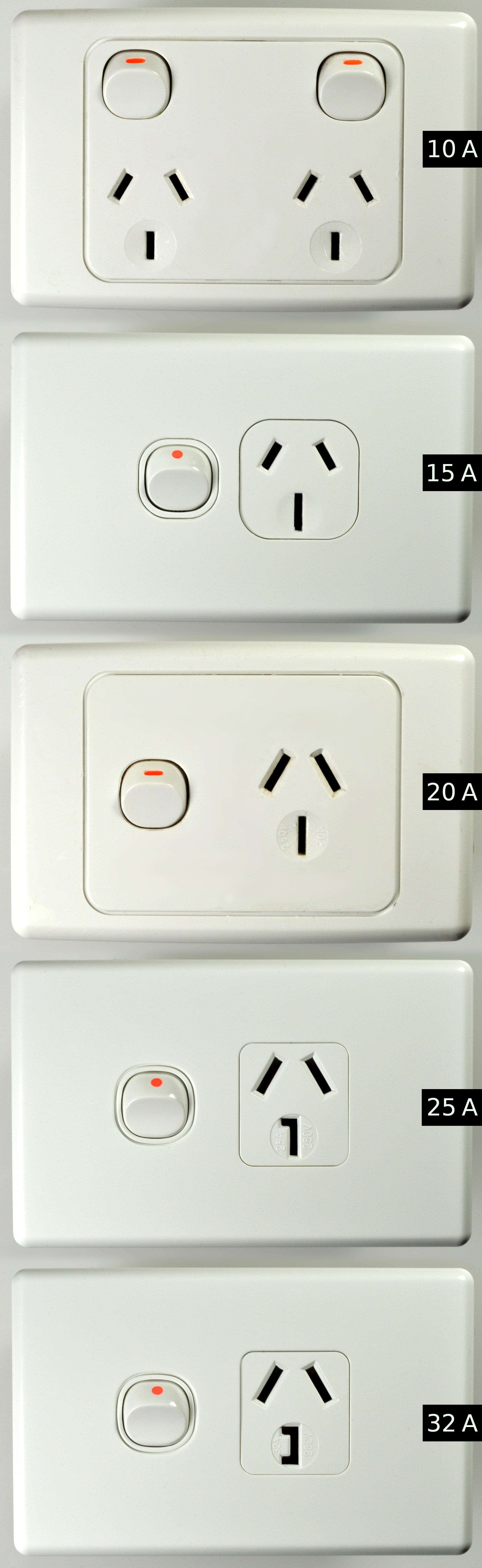
Different socket standards, such as these Australian outlet styles, show why plug shape and voltage are separate problems.
Image Credits: Wikimedia Commons
What happens when you mix them up
Plugging a single-voltage 110-120V device directly into a 220-240V outlet without a converter can permanently damage it, sometimes instantly, the Roaming Historian warns. The excess voltage overheats components, and with heating appliances the result can be a blown fuse, a tripped hotel circuit, or in the worst case a fire hazard. Oreta AI's power guide puts it bluntly: plugging a 120V device into a 240V outlet without conversion overloads it and creates a genuine fire risk.
This is also why the adapter-versus-converter confusion is dangerous rather than merely annoying. An adapter lets the wrong voltage reach your device just as easily as the right one. The physical fit of the plug tells you nothing about whether the electricity is safe for the appliance.
If you travel with single-voltage appliances, you have three safe options: bring a true voltage converter rated for the appliance's wattage, buy a dual-voltage travel version of the appliance, or leave it home and use the hotel's. For everything with a 100-240V label, pack the adapter and stop worrying.
Frequently asked questions
Do I need a voltage converter for my phone or laptop charger?
Almost certainly not. Most phone, tablet, laptop, and camera chargers are dual voltage (100-240V, 50/60 Hz), so they adjust to local voltage automatically. Check the fine print on the charger to confirm, then bring only the correct plug adapter for your destination.
Can I use my hair dryer abroad with just a travel adapter?
Only if the dryer is dual voltage. Many hair dryers are single voltage, and using one on 220-240V with just an adapter can destroy it or start a fire. Check the label; if it says 120V only, you need a step-down converter or a dual-voltage travel dryer.
What is the difference between a voltage converter and a transformer?
For travelers the terms overlap heavily. A converter changes the voltage level supplied to your device, typically stepping 220-240V down to 110-120V. Some use transformer windings, others use electronic switching.
Either way, it does what an adapter cannot: alter the electricity itself.
Will a voltage converter also fix the plug shape?
Not always. Some converters include plug adapters, but many do not. Check the product description before you buy.
You may need both a converter for the voltage and an adapter for the plug shape.
Does the 50 Hz versus 60 Hz difference matter?
For most modern electronics, no. Battery chargers, phones, and laptops are unaffected. It can matter for older appliances with AC motors, which may run slightly slower on 50 Hz power than on the 60 Hz they were designed for.
The bottom line
A travel adapter solves a mechanical problem: your plug does not fit the foreign socket. It does not solve the electrical problem of different national voltages, because it contains no circuitry that can change voltage.
Check every device for a 100-240V label. If it is there, an adapter is enough. If it is not, bring a real converter or leave the appliance at home.
That single label check is the difference between a smooth trip and a fried hair dryer.
Latest in Travel
- Planning what goes in your carry-on? Read our explainer on the 3-1-1 rule for liquids on planes.
- Why passports come in different colours and what the colours signal.
- Avoid surprise charges with our guide to exchange money abroad without losing money to fees.
- Ear pressure on descent is another common flight annoyance: why your ears pop on planes and how to stop it.
Subscribe to the Rive News newsletter for one practical travel explainer every morning.
Related stories

The 3-1-1 liquids rule for planes: what each number means
TSA's 3-1-1 rule limits carry-on liquids to 3.4-ounce containers in one quart bag. Where the 2006 rule came from, what counts, and how

Why Is Airplane Food So Bland at Altitude?
A 2010 Fraunhofer study found altitude cuts sweet and salty perception by up to 30 percent. Low humidity, cabin pressure, and noise all

Carry-on size limits: why airlines each set their own
Airlines set their own carry-on limits because the FAA only requires each carrier to have a policy, not one global size. Why 22 x 14 x