
How to Jump Start a Car Safely: Step-by-Step Guide
Key takeaways
- The safe cable order is: red to dead battery positive, red to donor positive, black to donor negative, black to a metal ground on the dead car.
- Never connect the last black clamp to the dead battery itself. Ground it on unpainted metal to keep sparks away from battery gases.
- After starting, disconnect in reverse order and keep the engine running for at least 15 to 20 minutes.

Red and black jumper cable clamps; the color coding keeps positive and negative connections straight. Photograph: Wikimedia Commons contributor
Image Credits: Wikimedia Commons
A dead battery is one of the most common reasons a car will not start. A jump start is the standard roadside fix. The whole job takes about ten minutes. The part that matters is the order you attach the cables. Getting it wrong can cause sparks, short circuits, or damage to the car's electronics.
This article walks through the preparation, the exact cable order, how to start both cars, how to disconnect safely, and what to do if the car still will not start.
Before you touch the cables
Park the working car (the donor) close enough that the jumper cables reach both batteries. Do not let the two cars touch. Turn off both engines. Switch off headlights and accessories. Set both parking brakes.
Find both batteries and identify the terminals. The positive terminal is marked with a plus sign and usually has a red cover. The negative has a minus sign and is usually black. If a terminal is coated in white or greenish corrosion powder, clean it off first. That gives a solid electrical connection.
Now the safety rules, from the American Tire Depot guide:
- Never jump-start a battery that is cracked, leaking, or frozen. It can rupture or explode.
- Never lean over the battery while connecting cables. Batteries release hydrogen gas, which can catch fire.
- No smoking or open flames near the battery. Remove metal jewelry and watches. They can cause a short if they touch both terminals.
If your battery keeps dying overnight instead of just once, the problem may be a drain or a failing battery. See why your car battery keeps dying overnight.
Connect the cables in this exact order
This is the critical sequence. Memorize it as a phrase: red to dead, red to donor, black to donor, black to metal.
- Red clamp to the dead battery's positive (+) terminal. Attach the red clamp firmly to the positive post of the battery that will not start.
- Other red clamp to the donor battery's positive (+) terminal. The second red clamp goes to the positive post of the working car's battery.
- Black clamp to the donor battery's negative (-) terminal. One black clamp goes to the negative post of the good battery.
- Other black clamp to unpainted metal on the dead car. This is the ground connection and the most important safety step. Clamp it to a clean, unpainted bolt on the engine block or the metal frame, as far from the dead battery as possible. Never connect it to the dead battery's negative terminal.
Why the ground matters: the final connection always makes a small spark. Keeping that spark on the engine block instead of at the battery keeps it away from the flammable hydrogen gas that batteries release. Before starting anything, double-check that no clamp touches another. Make sure cables are clear of belts and fans, and that positive and negative were never reversed.
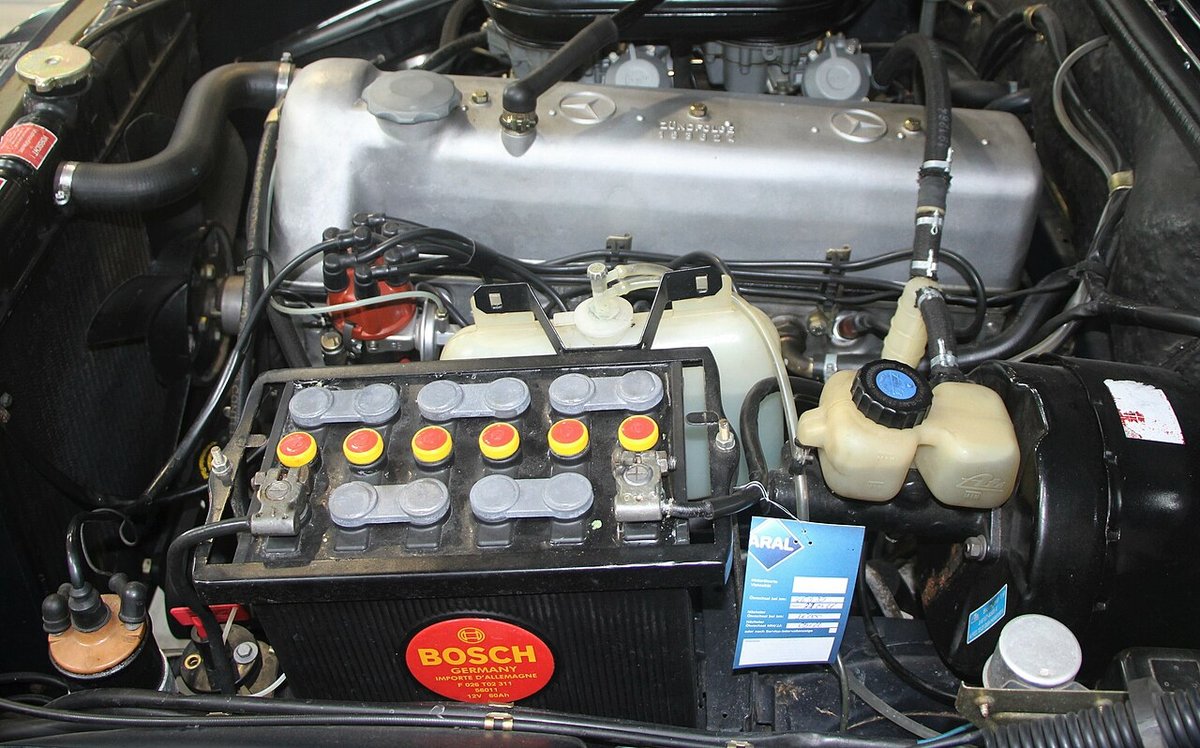
A car battery in the engine bay; the positive terminal usually carries a red cover. Photograph: Wikimedia Commons contributor
Image Credits: Wikimedia Commons
Start the donor car, then the dead car
Start the working car first and let it idle for a few minutes. AAA's jumper cable guidance says to let the booster vehicle run for several minutes, so the dead battery gets some charge before you try a start. Do not rev the engine hard. A steady idle is all you need.
Now try to start the dead car. If it turns over slowly or does not start, stop and wait a couple of minutes, then try again. Do not crank the starter for more than 5 to 10 seconds at a time. Wait about 30 seconds between attempts, or you risk overheating the starter motor.
If the car starts after several attempts but dies again, or never starts at all, the problem may be beyond the battery: a failed alternator, a bad starter, or corroded cables. At that point, call for roadside assistance instead of repeating the process endlessly.
Disconnect in reverse order, then protect the electronics
Once the dead car is running, remove the cables in the exact reverse of how you attached them:
- Black clamp off the metal ground on the formerly dead car.
- Black clamp off the donor battery's negative terminal.
- Red clamp off the donor battery's positive terminal.
- Red clamp off the formerly dead battery's positive terminal.
One step most guides skip comes from fleet-vehicle safety training: before disconnecting, turn on the headlights and the heater blower in the jumped car. This gives voltage spikes a harmless place to go when the cables come off, protecting the car's electronics. Turn them off again once the cables are removed.
Keep the jumped car's engine running for at least 15 to 20 minutes, ideally with some driving, so the alternator can recharge the battery. A jump start is a rescue, not a full recharge. The battery needs real running time to recover.
What if it still will not start?
Run through this quick checklist before calling for help:
- Clicking sound but no crank: the battery may be too far gone, or a terminal connection is loose. Recheck every clamp.
- No sound at all: check that the donor car is actually running and the cables are making metal-to-metal contact.
- Starts, then dies within minutes: the alternator may not be charging. The battery got you going but nothing is refilling it.
- Repeated dead batteries: look for a parasitic drain or an aging battery, covered in our car battery drain guide.
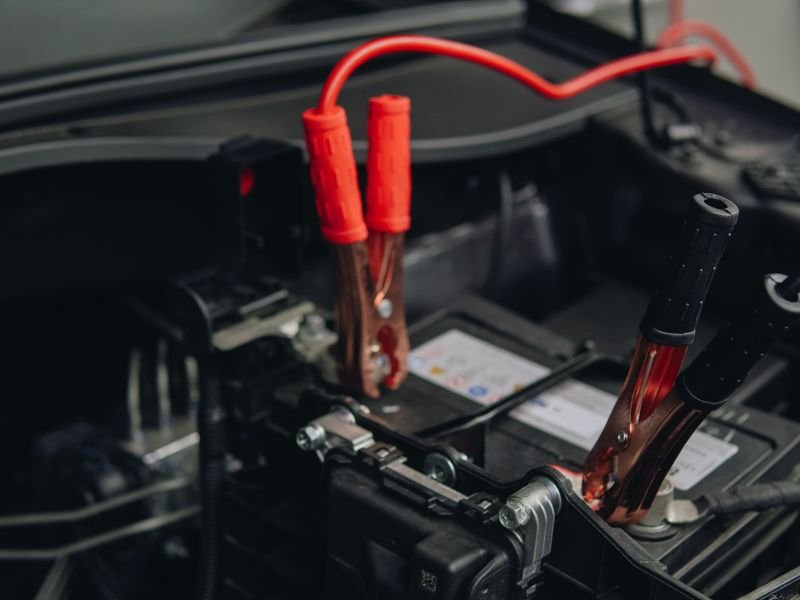
Jumper cable clamps attached to battery terminals during a jump start. Photograph: Wikimedia Commons contributor
Image Credits: Wikimedia Commons
Frequently asked questions
Can jump starting damage my car?
Done correctly, no. The risks come from reversed cables, which can fry electronics, or from sparks near a damaged battery. Follow the order (red to dead, red to donor, black to donor, black to metal) and the process is the standard roadside procedure mechanics use daily.
How long should I let my car run after a jump start?
At least 15 to 20 minutes, per most roadside guides. Driving is better than idling because higher engine speed charges the battery faster. If the battery dies again after a long run, it probably needs replacement, not another jump.
Can I jump start a car in the rain?
Yes, with care. Water on the ground is not the main hazard. The battery terminals and your cable connections are. Keep connections as dry as you can, stand clear of puddles where possible, and never touch both terminals at once. If lightning is active, wait.
Do I need to turn the donor car off before connecting cables?
No. Both engines should be off while you connect the cables. Then you start the donor car and let it idle before starting the dead one. Connecting with either engine running adds unnecessary risk.
What gauge jumper cables should I buy?
For most passenger cars, 4-gauge or 6-gauge cables about 20 feet long are a solid choice. Thicker (lower number) is better for larger engines and cold weather. Avoid the thinnest bargain cables. They cannot carry enough current to crank a dead engine.
The bottom line
Jump starting a car is safe when you respect the order: red to dead, red to donor, black to donor, black to metal ground. Keep sparks away from the battery, disconnect in reverse, and give the engine 15 to 20 minutes of running time afterward.
Keep a set of decent jumper cables in your trunk and practice finding your battery terminals before you need them in the dark. The ten minutes you spend now will save you an hour of stress later.
---
Rive News's research desk covers automotive how-tos. Articles cite named public sources; no claims are invented.
Latest in Auto
- Why Your Car Battery Keeps Dying Overnight
- The 3,000-Mile Oil Change Myth
- Do Brake Rotors Really Warp?
- Why Tire Pressure Drops in Cold Weather
Subscribe for weekly car-care explainers.
Rive News follows a corrections policy: factual errors are corrected promptly with a visible update note.
Related stories

Why Does Tire Pressure Drop in Cold Weather?
Cold weather can cut tire pressure by 1 psi for every 10°F drop, thanks to the ideal gas law. Here is what happens inside the tire and what

Why Do Brake Rotors Warp, or Do They Actually?
Mechanics rarely see a truly warped rotor. The shudder usually comes from uneven pad deposits a few thousandths of an inch thick. Here

How to Buy a Used Car Without Getting Scammed: The Checklist
Over 450,000 cars a year have rolled-back odometers, NHTSA says. This checklist covers VIN checks, title washing, and the inspection that