
Why does the steering wheel shake only between 60 and 70 mph?
Key takeaways
- Speed-sensitive shake in a narrow band like 60 to 70 mph is usually tire imbalance, wheel runout, or tire force variation hitting a suspension resonance.
- A bent wheel can pass a standard spin balance, so persistent shake after balancing points to runout or a road-force problem.
- Misalignment causes pulling and uneven wear, not vibration, so an alignment alone will not fix a shaking steering wheel.

A steady highway cruise is exactly where a speed-sensitive vibration shows itself. Photograph: Arkady Lifshits overdriv3/Wikimedia Commons
Image Credits: Wikimedia Commons / Arkady Lifshits overdriv3
Few driving annoyances are as specific as this one. The car feels fine around town, fine at 50, then the steering wheel starts trembling as the needle climbs past 60. Push through to 75 and it often settles down again.
That narrow window is not random. It is a strong diagnostic clue pointing at the rotating parts of the car.
A shake that appears only in a tight speed band almost always comes from the wheels and tires exciting a resonance in the steering or suspension. The task is figuring out which wheel or tire problem is doing the exciting. This article explains why the vibration lives at 60 to 70 mph, how to separate balance problems from bent wheels, and what actually fixes each cause.
Why the shake lives in a narrow speed band
Every rotating assembly generates a force that pulses once per revolution. As speed rises, that pulsing frequency rises with it. According to EngineerFix, a small imbalance at 30 mph can feel like a violent shake at 65 mph because the force grows exponentially with speed.
The narrow band appears when the tire's rotational frequency matches the natural resonant frequency of the vehicle's suspension or steering system. EngineerFix explains that vibrations from simple imbalance typically peak between 45 and 70 mph, then smooth out slightly at higher speeds, because the shaking becomes amplified exactly where the two frequencies overlap.
Below the band the force is too weak to feel. Above it the frequencies separate and the amplification fades.
DailyCarCheck cites AA1Car's rule of thumb: most balance vibrations show up above about 45 to 50 mph, and speed-sensitive vibrations are an out-of-balance wheel "nine out of ten times." That tenth time is usually runout, a bent or out-of-round wheel or tire, or tire force variation. The band itself is the clue that the problem is rotational rather than, say, an engine mount or a brake issue.
Tire imbalance: the most common cause
Tire imbalance means the weight of the wheel and tire assembly is unevenly distributed around its circumference. Even a slight weight difference creates an irregular rotation that applies a periodic force to the axle. A missing wheel weight, mud or ice packed into the wheel barrel, or a sloppy previous balance job can all create it.
The fix is dynamic balancing, which addresses imbalance in two planes: the vertical up-and-down hop and the lateral side-to-side wobble. EngineerFix notes that modern wide tires need dynamic balancing to counter both forces. Static balancing, which only corrects a single heavy spot, is generally not enough for today's wider wheels.
A useful field test: if the shake appeared suddenly after driving through mud, snow, or a car wash, check for debris caked inside the wheel barrels first. Cleaning it out sometimes cures the vibration for free.
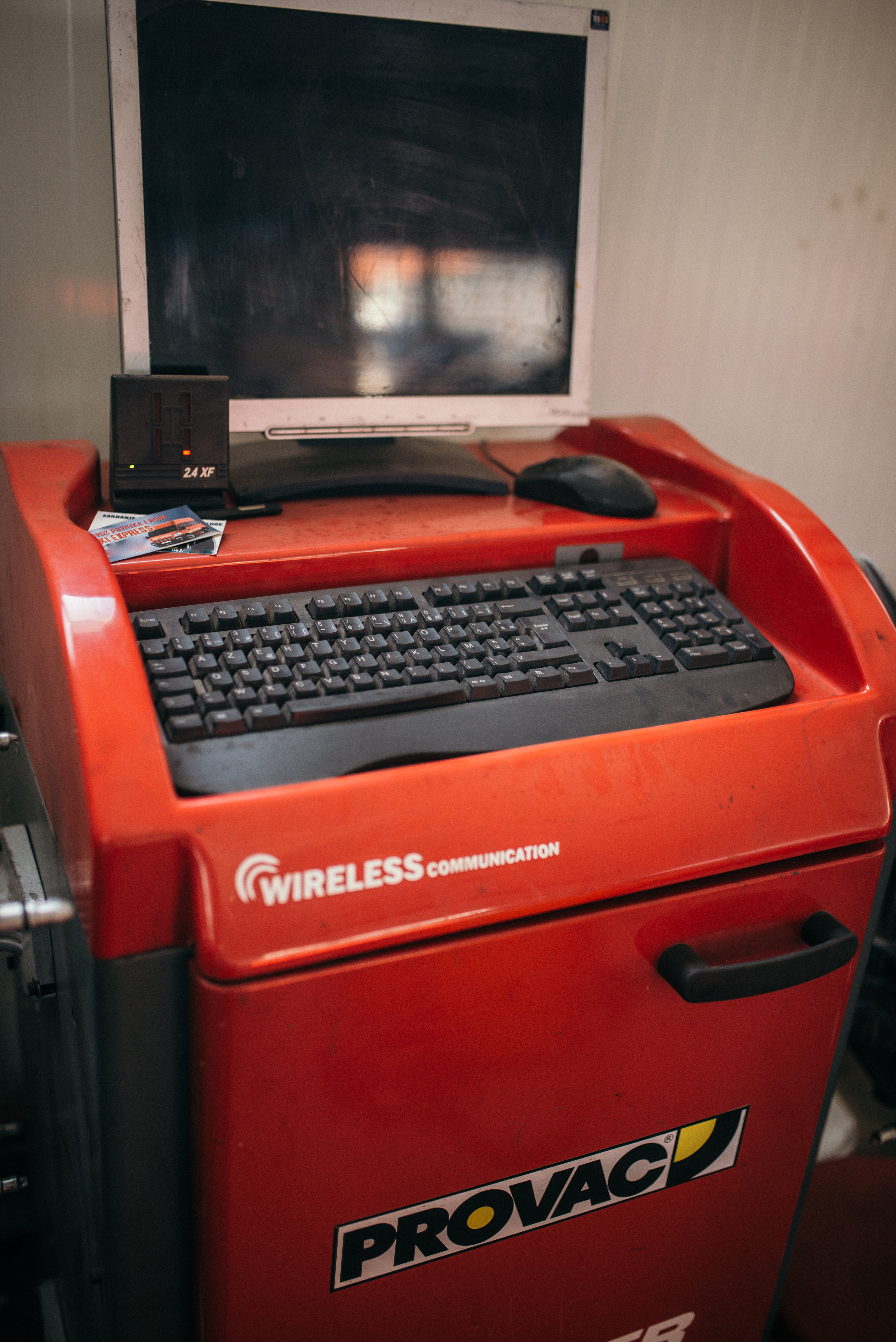
A dynamic balancing machine measures imbalance in two planes to correct hop and wobble. Photograph: Shixart1985/Wikimedia Commons
Bent wheels, runout, and tire force variation
Here is the trap that catches many drivers: a bent wheel can be "balanced" perfectly on a standard machine and still shake. DailyCarCheck warns that standard balancing does not rule out a wheel problem, because a bent wheel can still be balanced. What a spin balancer cannot see is runout, the deviation of the wheel or tire from a perfect circle, and road force variation, the stiffness differences around the tire's circumference.
When the shake is strongest in a narrow band and fades above and below it, runout or force variation is the prime suspect. A pothole strike is the classic trigger. Internal tire damage such as belt separation, often from a hard curb or pothole hit, can also cause harmonic shudder while looking normal from the outside.
The proper diagnosis is a road-force balance on a machine such as a Hunter GSP9700, which presses a roller against the spinning tire to simulate road load. According to a Honda Accord vibration guide from CarInterior, only a road-force balancer can detect force variation, the true culprit behind vibration that survives a "perfect" standard balance. The guide lists Honda's own thresholds: lateral runout beyond 0.030 inches (0.76 mm), radial runout beyond 0.040 inches (1.02 mm), and dynamic imbalance above 6 oz-in (210 g-cm) all merit correction.
Two quick checks help at home. Move the front wheels to the rear: if the shake disappears from the steering wheel, the problem is in the front axle. And briefly lift off the throttle at the shaking speed on a flat road: if the vibration persists unchanged, it is rotational, but if it fades fast, the driveline or engine mounts deserve a look.
What does not cause this shake
Wheel alignment is the most common misdiagnosis. As the CarInterior guide puts it, alignment affects tracking and tire wear, not vibration.
Camber, caster, and toe settings cannot induce a harmonic shake. Paying for an alignment to cure a 65 mph tremor is money spent on the wrong repair.
Wheel bearings are another red herring for pure highway shake. A failing bearing usually announces itself with a growling or humming noise that changes with steering input, not a clean speed-band vibration. That said, a stethoscope check at the front knuckle while a helper drives is cheap insurance.
Brake rotors deserve a mention because warped front rotors do cause steering wheel vibration, but the signature differs: rotor-induced shake appears or worsens when braking, while the 60 to 70 mph shake happens at steady cruise. If the wheel only trembles under the brake pedal, suspect the rotors instead. Our related guide on steering wheel vibration at high speed covers the broader diagnostic picture.
Can unbalanced tires shake only at 65 mph and not at 55 or 75?
Yes. The CarInterior guide confirms that resonance frequency varies with wheel and tire mass and suspension tuning, and 65 mph is a common harmonic node for many setups. The shake peaks where the tire's rotational frequency overlaps the suspension's natural frequency.
Will rotating my tires fix the vibration?
Sometimes, temporarily. Moving a problem wheel to the rear axle often moves the vibration from the steering wheel to the seat, which confirms the diagnosis but does not fix the wheel. Proper balancing or runout measurement is still needed.
How much does a road-force balance cost?
Prices vary by market, but a road-force balance typically costs more than a standard spin balance because the equipment is specialized. Given that it catches the bent wheels and defective tires a standard machine misses, it is the economical choice when a regular balance has already failed once.
Is it safe to drive with a shaking steering wheel?
A mild, steady shake is usually not an emergency, but it should not be ignored for weeks. The underlying cause, whether a bent wheel or a separating tire belt, can worsen, and the vibration accelerates wear on suspension bushings and tie rod ends. Tires with visible bulges or damage need immediate attention.
The bottom line
A steering wheel that shakes only between 60 and 70 mph is telling you something precise: a rotating imbalance is resonating with your suspension. Start with a dynamic balance, and if the shake survives, ask for a road-force balance with runout measurement rather than a second standard balance or an alignment. Matching the repair to the actual cause saves both money and return trips to the tire shop.
Latest in Automotive
- Steering wheel vibration at high speed: causes and diagnosis
- How run-flat tires work and their tradeoffs
- All-wheel drive vs four-wheel drive: the difference
Subscribe for weekly car maintenance explainers in plain English.
Related stories

Why Does Tire Pressure Drop in Cold Weather?
Cold weather can cut tire pressure by 1 psi for every 10°F drop, thanks to the ideal gas law. Here is what happens inside the tire and what
Why Do Brake Rotors Warp, or Do They Actually?
Mechanics rarely see a truly warped rotor. The shudder usually comes from uneven pad deposits a few thousandths of an inch thick. Here

How to Buy a Used Car Without Getting Scammed: The Checklist
Over 450,000 cars a year have rolled-back odometers, NHTSA says. This checklist covers VIN checks, title washing, and the inspection that