
Why does your steering wheel vibrate at high speed?
By Rive News / Research desk | Rive News / Published October 24, 2026 at 9:00 AM PKT
Key takeaways
- The most common cause of steering-wheel vibration at speed is wheel imbalance: uneven weight makes the tire hop as it spins faster.
- When it shakes matters: vibration that starts around 55-65 mph points to balance; shaking only while braking points to warped rotors.
- Worn suspension parts like ball joints and tie rods let the wheels wobble. Check them if balancing does not fix it.

[A driver holding a car steering wheel with both hands.] Photograph: Wikimedia Commons
Image Credits: Wikimedia Commons
A steering wheel vibrates at high speed because something in the front end is no longer spinning or moving the way it should. The most common culprit is wheel imbalance: even a small unevenness in a tire-and-wheel assembly creates a wobble that grows with speed, and your hands feel it first through the steering wheel. Worn tires, bad alignment, tired suspension parts, and warped brake rotors can produce the same symptom.
This article walks through each cause in diagnostic order, starting with the cheapest fix and ending with the ones that need a lift. It also covers how the speed where the shaking starts tells you which part is guilty, and when vibration is a safety issue rather than an annoyance.
Why is wheel imbalance the most common cause?
A car wheel is an assembly of tire plus rim, and manufacturing never distributes the mass perfectly evenly. A tiny heavy spot, sometimes just grams, matters little at 20 mph. At 70 mph, the wheel is spinning roughly 12 times per second, and that heavy spot yanks the wheel outward with every rotation.
The result is a rhythmic vibration that climbs with speed. Tire Depot, in its April 2024 diagnostic guide, lists wheel imbalance first: it "can lead to vibrations, especially at higher speeds," caused by uneven tire wear, a bent wheel, or a missing wheel weight.
Weights fall off. Potholes bend rims.
Tires wear unevenly. Any of these can unbalance an assembly that was fine last year.
The diagnostic clue is the speed band. As one mechanical guide puts it: if the shake begins around 55-65 mph and intensifies with speed, suspect tire balance or tire roundness. That band is the sweet spot where imbalance harmonics get strong enough to feel but before everything is just vibrating anyway.
Balancing is also the cheapest fix. A tire shop spins each wheel on a machine, finds the heavy spot, and clips small weights to the rim to even it out. It is the first thing any mechanic checks, and it resolves the majority of highway-speed vibration complaints.
How do tire problems cause vibration?
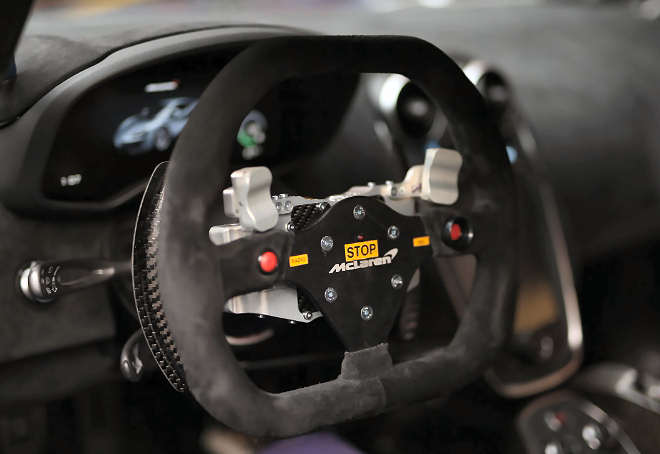
[A steering wheel fitted with hand controls.] Photograph: Wikimedia Commons
Image Credits: Wikimedia Commons
Sometimes the tire itself is the problem, not the balance. An out-of-round tire, one with a bulge, a flat spot, or tread separation, thumps against the road with every rotation. The contact patch changes shape as it rolls, and the steering wheel transmits the wobble straight to your hands.
Bulges in the sidewall are the serious version. They mean the tire's internal structure has failed, often after a pothole strike, and a bulged tire can blow out. Uneven wear is the slower version: tires that have been run misaligned or underinflated wear into patterns that roll unevenly.
Significantly low tire pressure can contribute too, by changing the tire's shape and contact patch, which produces irregular rolling characteristics. Before paying for anything, check your pressures against the door-jamb sticker. It is free and occasionally the whole fix.
Look at your tires in daylight. Run a hand over the tread (carefully, checking for embedded nails or wire).
Look for cupping (scalloped dips around the tread), feathering on the edges, or a visible bulge in the sidewall. If the tires look wrong, balancing alone will not fully fix the shake.
This pairs with other tire-and-wheel diagnostics: why brakes squeak in the morning explains a different front-end noise, and what it means when your car burns oil but does not leak covers another "something is off but I can't see it" symptom.
Why do worn suspension parts make the wheel shake?
Suspension components hold the wheels in their proper geometry. When they wear, they develop play: tiny amounts of slack that let the wheel move where it shouldn't. At speed, that slack becomes oscillation, and oscillation becomes a shake you feel in the wheel.
The usual suspects are ball joints, tie rod ends, and control arm bushings. The Bristol Museums mechanical guide phrases it well: these parts "introduce excessive play into the suspension system.
This play allows the wheels to oscillate and vibrate, transmitting the movement to the steering wheel. " A damaged shock absorber or a loose control arm does the same thing through a different route.
Here is the diagnostic difference: suspension wear often shows up at lower speeds too, or as looseness and wandering rather than a pure speed-dependent shake. If the car feels vague in corners, clunks over bumps, or the steering feels disconnected, the suspension is the suspect list. BitAuto's repair wiki adds that this pattern is common in vehicles poorly repaired after accidents, where chassis geometry was never fully restored.
Suspension wear is also a safety issue, not a comfort one. A failed ball joint can separate, and then the wheel is no longer attached to the car in any meaningful sense. If balancing and tire checks do not resolve a shake, a suspension inspection is not optional.
Why would the brakes make the steering wheel vibrate?
Brake rotors are big flat discs that the pads squeeze. If a rotor warps, developing thickness variation across its face, the pads grab unevenly as it turns. Each rotation produces a pulsing force that travels through the suspension and into the steering column.
The tell is timing: vibration that appears or worsens only when you press the brake pedal. Balance problems shake at speed regardless of braking.
Warped rotors shake when you brake, sometimes violently, and go quiet when you release the pedal. That distinction alone diagnoses most cases.
Rotors warp from heat cycling: hard braking from speed, then sitting at a stop with the hot pads clamped on one spot, deposits pad material unevenly and eventually distorts the disc. The fix is resurfacing (machining the rotor flat again) or replacement, plus new pads.
If your car also makes a grinding noise when braking, read that guide too. Grinding and vibration often arrive together.
What about alignment, steering, and drivetrain parts?
Wheel alignment, the angles of the wheels relative to the car and the road, is a secondary suspect. Misalignment makes tires scrub sideways against the road, creating lateral forces and uneven wear.
It rarely causes vibration on its own, but it amplifies existing imbalance and destroys tires fast enough to create new imbalance. If you hit a pothole or curb hard and the shake started after, get the alignment checked along with the balance.
Steering-system wear in the tie rods (which are also suspension parts), the steering rack, and universal joints can add instability. Worn tie rod ends are the crossover part: they are both steering and suspension, and they are a common source of shake.
Drivetrain parts live further down the list for steering-wheel-specific vibration. Faulty CV joints, worn U-joints, or a driveshaft problem usually vibrate the whole car or the seat and floor rather than the wheel. Tire Depot's guide notes drivetrain issues tend to show up during acceleration.
If the whole car shudders but the wheel is calm, look rearward: rear-wheel imbalance shakes the seat, front-wheel imbalance shakes the wheel. That is a useful rule of thumb.
Engine problems can vibrate the wheel at idle, and power-steering faults (low fluid, a dying pump) can add shudder, usually with heavier steering. But if the wheel is fine at idle and in town and only shakes on the highway, the engine and power steering are almost never the cause.
The bottom line
Start with the cheap and common: check tire pressures, then get the wheels balanced. That resolves most highway-speed steering vibration, especially if the shake starts around 55-65 mph and grows with speed. If it shakes only under braking, suspect warped rotors.
If balancing does not fix it, inspect the tires for damage and the suspension for play in the ball joints, tie rods, and bushings. Work the sequence in that order and you will spend the least money finding the real cause.
Is it safe to drive with a vibrating steering wheel?
A mild balance-related shake is an annoyance you can drive on briefly, but it wears tires unevenly and stresses suspension parts. A violent shake, a sidewall bulge, or shaking with clunking noises is a safety issue.
Get it inspected before highway driving. Vibration is a symptom; the underlying cause decides the risk.
Why does my steering wheel shake at 60 but not 40?
Because the vibration is speed-dependent. Imbalance forces grow with the square of wheel speed, so a small heavy spot is invisible at 40 and obvious at 60-70. That speed band is the classic signature of wheel imbalance or an out-of-round tire.
Will an alignment fix steering wheel vibration?
Usually not by itself. Alignment corrects wheel angles and prevents uneven tire wear, but it does not fix imbalance. Get the balance done first; add an alignment if you hit something hard, the car pulls to one side, or the tires show uneven wear.
How much does wheel balancing cost?
Prices vary by market, but a standard balance is typically one of the cheapest shop services, far less than a suspension repair or a set of rotors. Many shops bundle it with rotation. Call two local tire shops for current pricing rather than relying on old figures.
Tags: steering, wheel balance, suspension, tires, car maintenance
Rive News's research desk covers work, technology, and everyday science in plain language.
Related
- Why Do EVs Lose Range in Winter? Causes and Fixes
- Why Do Brakes Squeak in the Morning? The Overnight Rust Story
- Why Does the Check Engine Light Come On and Off by Itself?
- Why Does My Car Hesitate When Accelerating From a Stop?
Subscribe for one practical car-maintenance explainer every morning.
Rive News follows a no-fabrication standard: every fact above traces to a named public source.
Related stories
Why does your car make a squealing noise when starting
A squeal at startup usually means a slipping serpentine belt. Learn the causes, the checks you can do, and when to get a mechanic involved
Why Does Your Car Smell Like Petrol After Starting
A brief petrol smell at startup can be normal cold-start enrichment, but a strong or lingering smell can mean a fuel leak. Learn the causes

What is the difference between petrol, diesel and hybrid cars?
Petrol, diesel and hybrid cars differ in fuel use, torque and running costs. Diesel uses 15-20% less fuel, hybrids win in town, and rules