
How sleep consolidates what you studied into lasting memory
By Rive News / Research desk | Rive News / Published October 27, 2026 at 9:00 AM PKT
Key takeaways
- Sleep actively replays what you studied, shifting it from temporary hippocampal storage into lasting neocortical networks.
- Deep slow-wave sleep carries most of this transfer, while REM sleep supports other kinds of strengthening.
- People who slept after learning remembered more vocabulary at a 48-hour retest than people kept awake.

[A person sleeps, while the brain replays and reorganises what was studied during the day.] Photograph: Wikimedia Commons contributor
Image Credits: Wikimedia Commons
Sleep consolidation is the process by which the brain stabilises a new memory after learning. When you study something, the memory starts out fragile and easy to lose, and sleep is the period when it gets strengthened and reorganised into lasting knowledge.
This is not passive rest. During sleep, the brain replays patterns of activity from the day, and that replay gradually moves memories from one brain system to another.
This article explains what consolidation means, how the two-store memory system works, what slow-wave sleep does, what REM sleep adds, why the timing of sleep matters, and how to use this when studying.
What consolidation means
A memory is not fixed the moment you learn something. It starts as a fresh trace that can be disrupted, and consolidation is the name for the changes that make it stable and durable over time.
The classic evidence comes from comparing people who sleep after learning with people who stay awake. In one study reported in PMC, participants learned vocabulary and were retested 48 hours later, and those who had slept during the night after learning remembered clearly more words than those who had stayed awake.
The researchers also ruled out simple tiredness as the explanation. The sleep-deprived group was allowed recovery sleep before the retest, yet the advantage for the group that slept right after learning remained.
The two-store memory system
The standard model behind this research, described by Jan Born and Ines Wilhelm in their 2012 review, assumes two memory stores that learn at different speeds. The hippocampus learns fast but holds information only temporarily, while the neocortex learns slowly but forgets slowly too.
New information is encoded in both stores at once. During later consolidation, the traces are repeatedly reactivated, and the slow-learning long-term store is gradually strengthened until it can hold the memory on its own.
Born and Wilhelm describe the hippocampus as acting like an internal trainer for the neocortex. By replaying new memories alongside related older ones, it helps the new material fit into existing knowledge networks instead of overwriting them.
The model also explains why consolidation is selective. Sleep does not strengthen every memory equally, and the review notes that sleep, and slow-wave sleep in particular, preferentially consolidates memories with relevance for future plans.
What slow-wave sleep does
System consolidation takes place mainly during slow-wave sleep, the deep stage of non-REM sleep, rather than during REM sleep. During this stage, the neocortex produces slow oscillations, rhythmic waves that occur at roughly 0.75 Hz in human sleep.
These slow oscillations set the timing for the whole process. Their rising phases drive the reactivation of hippocampal memory traces, together with sharp-wave ripples in the hippocampus and sleep spindles from the thalamus, which oscillate between 12 and 15 Hz.
When these rhythms line up, reactivated memory information reaches the neocortex at the right moment to strengthen its connections. Repeated across the night, this dialogue gradually redistributes the memory from the temporary store into distributed long-term networks.
The transfer also changes the memory itself. Born and Wilhelm report that memories transferred to the long-term store undergo qualitative changes, including the extraction of explicit knowledge from implicitly learned material.
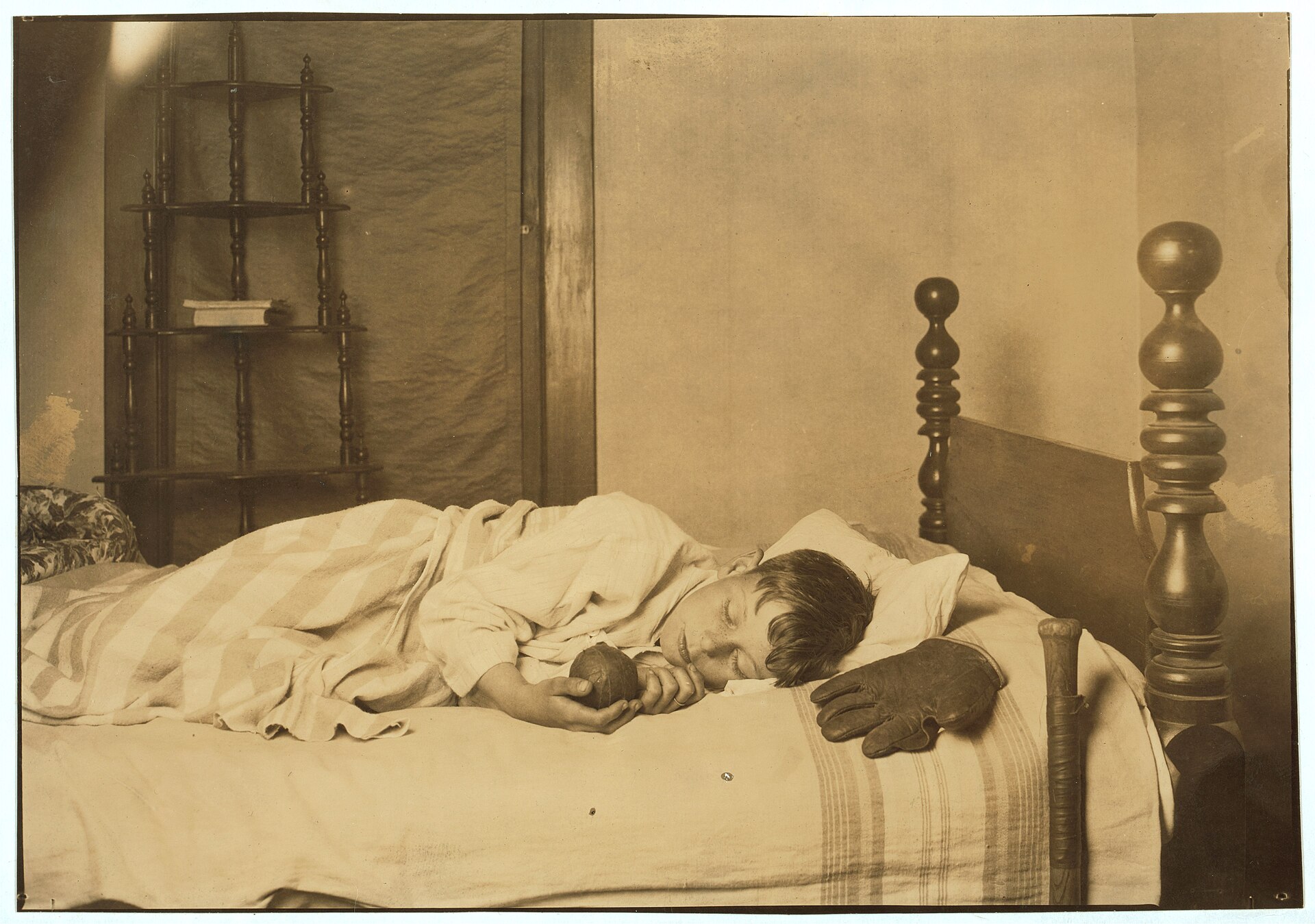
[A person asleep in bed, during the deep slow-wave stages where most memory transfer takes place.] Photograph: Wikimedia Commons contributor
Image Credits: Wikimedia Commons
What REM sleep adds
REM sleep plays a different part in the story. While slow-wave sleep carries the transfer of fact-based, declarative memories, reviews of the field describe REM sleep as supporting a separate kind of strengthening at the level of connections between neurons.
That division has practical implications for learners. Fact-heavy study, such as vocabulary or concepts you must describe, leans most on the deep sleep of the first half of the night, while physical and procedural skills lean more on the REM-rich sleep of the early morning hours.
The two stages are not rivals. A full night contains both, cycling through them several times, and each cycle gives the brain another chance to replay, reorganise and prune what was learned.
There is also a pruning side to sleep. The synaptic homeostasis hypothesis, discussed in the sleep and memory literature, proposes that wakefulness strengthens synapses across the brain, and that slow-wave sleep scales that strengthening back down, keeping the reinforced traces while weakening the rest.
Why the timing of sleep matters
Sleep helps most when it follows learning closely. The vocabulary study found that sleep was most effective when it followed within a few hours after learning, without longer periods of intervening wakefulness.
That finding explains a familiar trap. Cramming late into the night can feel productive, but it trades away the very sleep the brain would use to lock the material in, and a shorter session followed by a full night can serve memory better than a longer session that eats into sleep.
The same logic applies to review timing. Material reviewed shortly before bed gets a head start entering the consolidation queue, since the sleeping brain begins its replay work soon after encoding rather than hours later.
Sleep does not replace effort, though. Consolidation can only strengthen what was actually practised, and a night of sleep after no study consolidates nothing new at all.
How to use this when studying
Treat the study session and the night after it as one unit. Study actively, by testing yourself rather than rereading, and then protect the night of sleep that follows instead of treating it as spare time.
Space your sessions across days rather than stacking them into one night. Each night of sleep gives the brain another round of replay, which is one reason spaced practice beats cramming for long-term retention.
Review briefly before bed, but keep it short and calm. A focused pass over the day's key ideas is enough to flag them for overnight processing, while a frantic late session risks cutting into the sleep itself.
"We've known for a long time that sleep plays an important role in learning and memory. If you don't sleep well you won't learn well," Wen-Biao Gan, professor of neuroscience and physiology at NYU Langone, said. His team's work in mice showed that sleep after learning encouraged the growth of dendritic spines, the tiny connections between brain cells, during deep sleep.

[A girl asleep beside her dog, an ordinary night of sleep doing quiet work on the day's learning.] Photograph: Wikimedia Commons contributor
Image Credits: Wikimedia Commons
Frequently asked questions
Does sleeping after studying really improve recall?
Yes, in controlled studies. People who slept on the night after learning vocabulary remembered more of it at a 48-hour retest than people who stayed awake, even after the awake group caught up on sleep.
Is a nap enough, or does it need to be a full night?
Naps can help, but a full night covers more sleep cycles and more slow-wave sleep, which carries most of the transfer. A nap is better than no sleep, yet it is not a substitute for a full night before an exam.
Should I study right before bed?
A short review before bed can help, since sleep soon after learning works best. Keep it brief and avoid turning it into a long session that cuts into your sleep time.
Does sleep help physical skills too, or only facts?
Both, but through different stages. Fact-based memories lean on slow-wave sleep, while procedural skills, such as playing an instrument or a sport, benefit from REM sleep as well.
The bottom line
Sleep consolidates what you studied by replaying it during slow-wave sleep and gradually moving it from temporary hippocampal storage into lasting neocortical networks. The night after a study session is part of the learning, not a break from it.
Study actively, space sessions across days, and protect the sleep that follows. That combination gives the brain the material and the offline hours it needs to make learning stick.
Tags: sleep, memory, studying, learning science
Rive News's research desk covers everyday motoring, home and work topics from published sources and official guidance.
Related
- How spaced repetition actually works
- Why cramming is ineffective for long-term learning
- Why all-nighters feel productive but lead to worse test scores
- How exercise improves memory and learning
Subscribe to Rive News for one practical explainer in your inbox each morning.
Rive News publishes research-based explainers and corrects errors promptly when readers point them out.
Related stories

Why Do I Blank Out During Tests Despite Studying: Test Anxiety and Retrieval Failure
Blanking out in exams is retrieval failure, not missing knowledge. Anxiety drains working memory; rereading builds false confidence. Here

How to Study for Exams Without Burning Out
Sleep 7-8 hours, study in 25-50 minute blocks, and exercise daily. The science-backed way to study for exams without burning out, and what

Why Do I Forget What I Just Read? Science Has an Answer
You forget what you just read because of the forgetting curve, mapped by Ebbinghaus in 1885. Science explains why memory fades fast and how