
How to stop a wooden chopping board from sliding
By Rive News / Research desk | Rive News / Published October 26, 2026 at 9:00 AM PKT
Key takeaways
- A damp, well-wrung towel or paper towel under the board is the fastest fix, and it works on almost any countertop.
- A thin rubber shelf liner or silicone mat cut to size is the permanent version of the same trick, with no dampening needed.
- If a wooden board still rocks or slides, check for warping and wet feet, since a flat, dry board grips far better than a bowed one.

[Freshly chopped vegetables on a wooden cutting board.] Photograph: Wikimedia Commons
Image Credits: Wikimedia Commons
A wooden chopping board that slides across the counter is more than an annoyance. Every shift under the knife changes the angle of the cut at the moment precision matters most, and it forces you to grip harder and brace the board with your body instead of focusing on the food. The fix is almost embarrassingly simple, and it has been standard practice in professional kitchens for decades: put something grippy between the board and the counter.
This article explains how to stop a wooden chopping board from sliding, including the damp-towel method, the permanent mat options, the grip-and-weight tricks for heavy prep, and the board-care rules that keep the fix working.
Why wooden boards slide
Wood is smooth, and most countertops are smooth too. Two smooth surfaces with a little moisture between them have very low friction, and a freshly washed board is the worst case: lingering water on the underside turns the board into a sled. Add the sideways force of chopping, especially with dense foods like sweet potato or winter squash, and the board creeps across the counter a little with every cut.
Weight helps but does not solve it. A heavy end-grain block resists sliding better than a thin board, because friction scales with weight, but a heavy board on a wet, glossy counter will still move. The reliable fix is to change the interface between board and counter, not to buy a heavier board.
Fix 1: the damp towel, done properly
The classic method is a damp towel under the board, and the details matter more than they seem. Simply Recipes describes it as a two-second habit taught in culinary school: wet a dishcloth or a few sheets of paper towel, wring it out so it is damp rather than dripping, lay it flat on the counter, and set the board on top.
Three details decide whether it works. First, wring thoroughly. A sopping towel adds water under the board and makes sliding worse, not better.
Second, use a thin towel. The Times of India guide warns that a thick, fluffy towel compresses unevenly and can make the board rock slightly as you cut, while a thin cotton towel or paper towel sits flat. Third, lay it flat with no folds or wrinkles, and give the board a wiggle to confirm it is locked before you start cutting.
Taste of Home notes the same method works with a paper towel, which has a bonus: when prep is done, the towel can wipe the counter and gather scraps before it goes in the bin. For a wooden board, the damp-towel method is safe as long as the towel is well wrung. A barely damp towel will not soak the wood, but a dripping one left under the board can raise the grain and encourage warping over time.
Lift the board and let both surfaces dry after prep.
Fix 2: a rubber mat or shelf liner, cut to size
If you cook daily, the permanent version of the towel trick is better. A thin non-slip shelf liner, the rubber mesh sold for lining drawers, can be cut to the exact size of your board and stored with it. It needs no dampening, it grips on both sides, and it can be rinsed clean.
The Times of India guide lists it as the best permanent fix for exactly this reason.
Silicone baking mats work the same way and have the advantage of being washable in the dishwasher. Either option costs very little and removes the daily ritual of wetting a towel. Keep the mat slightly smaller than the board so it does not peek out and catch on your knife hand, and replace it when the rubber goes smooth with age and washing.
Fix 3: silicone feet and rubber bands
Some wooden boards come with feet, and if yours does not, stick-on silicone feet are cheap and effective. They raise the board slightly, which also helps with airflow underneath, and they grip hard on stone and laminate. The trade-off is that feet make the board wobble if they wear unevenly, so check them occasionally and replace the set together rather than one at a time.
For a quick fix on a small or light board, the Times of India guide suggests stretching a couple of thick rubber bands around the board near the edges. The bands grip the counter at two points and add friction without any extra equipment. It looks improvised, and it is, but it works well for boards too light to stay put under their own weight.
Fix 4: grip-and-weight tricks for heavy prep
Dense ingredients and long prep sessions test every fix. Two extra tricks help. First, fold the damp towel once or twice for extra cushion when cutting something hard, as Tasting Table suggests: the added thickness creates more resistance to slipping, which matters when you are pushing down hard on a squash or a large root vegetable.
Second, use the board's own weight deliberately. Place the board so its centre is over the mat or towel, not hanging off the edge, and keep the cutting zone near the middle of the board. Cutting at the far edge levers the board up and breaks the grip, which is why boards seem to slide most when you are working at a corner.
A damp cloth under the board plus centred cutting handles almost any home prep.
When the board itself is the problem
If a board slides even with a mat underneath, inspect the board. Wooden boards warp, especially if they are soaked, dried on one side only, or stored leaning against a wall. A warped board rocks on two corners instead of sitting flat, and no mat can fix a board that only touches the counter at two points.
Hold a straight edge across the board in both directions to check.
Minor warping sometimes settles if the board is stored flat with weight on it for a few days, but a badly bowed board may need sanding flat or replacing. Also check the underside for a waxy or oily film: boards conditioned with mineral oil can feel slick underneath if excess oil was not wiped off. Wipe the underside clean and let it dry before the next use.
One more check: the counter itself. A very glossy or wet counter defeats most fixes. Dry the counter before you start, and if you rinse vegetables over the board, wipe up splashes promptly.
A dry counter, a flat board and a thin grip layer together are nearly immovable.
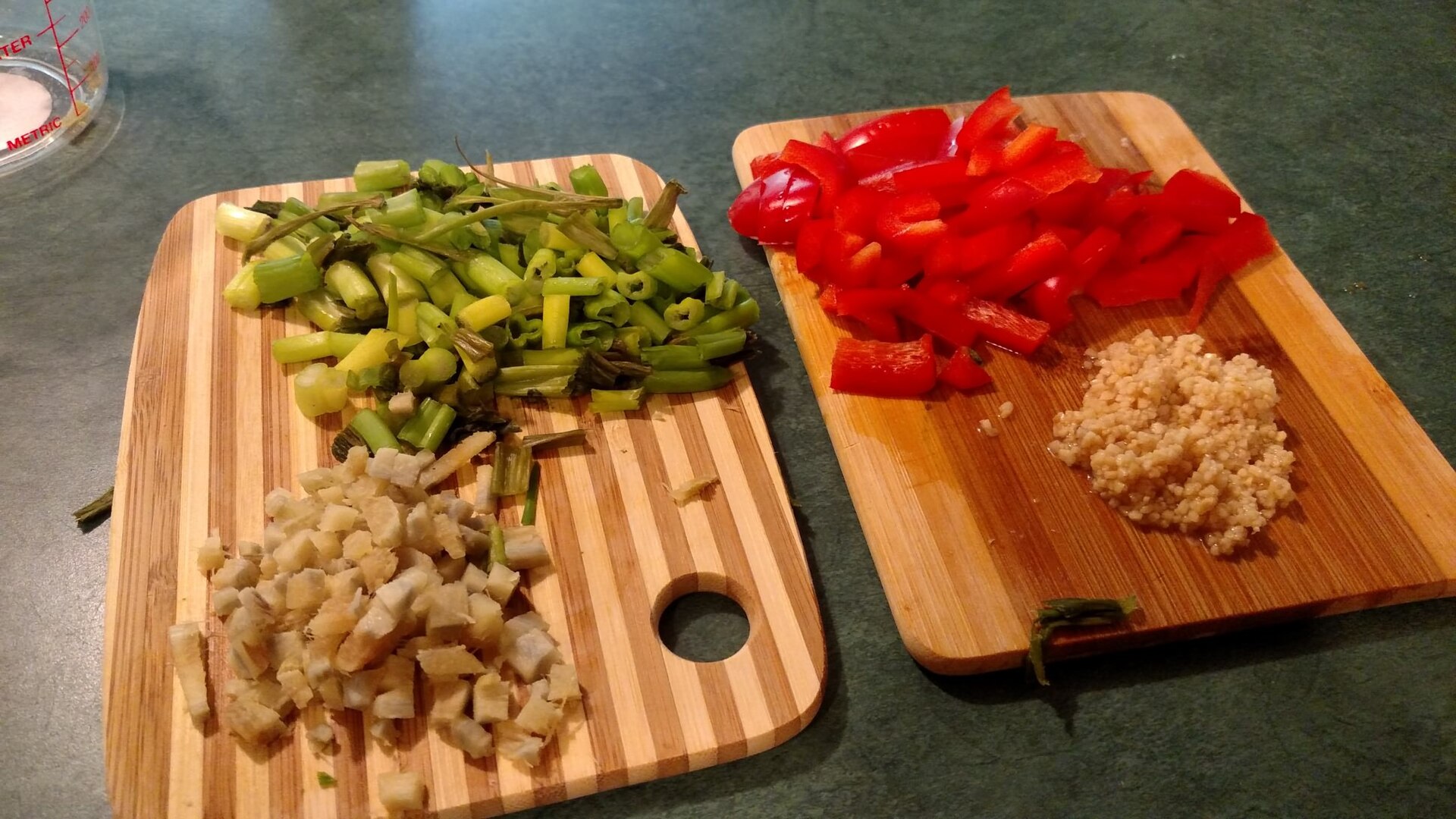
[Chopped vegetables on a cutting board.] Photograph: Wikimedia Commons
Image Credits: Wikimedia Commons
Frequently asked questions
Will a damp towel damage a wooden board?
Not if it is well wrung. A barely damp towel adds almost no moisture to the wood. Avoid leaving a soaking towel under the board, and let both surfaces dry after prep to prevent warping.
What is the best permanent fix?
A thin rubber shelf liner or silicone mat cut to the board's size. It grips without dampening, rinses clean, and lives with the board so there is nothing to set up.
Why does my board slide even with a towel under it?
The usual causes are a towel that is too wet, too thick or folded, a warped board that rocks on two corners, or a wet counter. Fix those in order: wring the towel, use a thin one, lay it flat, dry the counter and check the board for warp.
Do rubber bands really work?
Yes, for small or light boards. Two thick rubber bands stretched around the board near the edges add grip points on the counter. It is a stopgap, not a replacement for a mat.
Should I buy a board with feet?
Feet help on smooth counters and improve airflow underneath, but they wear unevenly and can cause wobble. Replace the whole set at once when they wear.
The bottom line
Stopping a wooden chopping board from sliding comes down to one idea: change what sits between the board and the counter. A well-wrung damp towel does it in seconds, a rubber liner or silicone mat does it permanently, and silicone feet or rubber bands cover the awkward cases. Keep the board flat, the counter dry and the cutting near the middle of the board, and the board will stay where you put it, which lets you focus on the cut instead of wrestling the surface underneath it.
Tags: chopping board, kitchen safety, kitchen tips, wooden board
The Rive News research desk writes plain-English explainers from published sources, with every key claim traceable to its source.
Related
- How to sharpen a kitchen knife without a sharpener
- Onions make you cry: the chemistry and how to stop it
- How to keep herbs fresh longer in the fridge
- How to tell if cooking oil has gone bad
Subscribe for one practical kitchen explainer each week.
Rive News standards: every factual claim is sourced; corrections are published when a source is shown to be wrong.
Related stories
Why Does Bread Go Stale Faster in the Refrigerator?
Bread goes stale faster in the fridge because starch recrystallizes fastest near 4°C. Here is the retrogradation science and the right way

Baking soda and baking powder: what's the difference?
Baking soda is pure sodium bicarbonate; baking powder adds two dry acids for double-acting lift. Learn when to use each, plus exact
What Is the Maillard Reaction in Simple Terms?
The Maillard reaction is the browning chemistry between amino acids and sugars above 140 C that creates the crust, color, and rich flavor