
Why carrots grow forked sometimes, and what fixes it
By Rive News / Research desk | Rive News / Published October 29, 2026 at 9:00 AM PKT
Key takeaways
- A forked carrot is a taproot that hit an obstacle, got damaged, or was crowded, then branched instead of growing straight down.
- Stones, compacted soil, fresh manure, and excess nitrogen are the most common causes, with pests and uneven moisture also involved.
- Forked carrots are safe to eat and usually taste fine; straight roots come from loose, deep, stone-free soil and even watering.
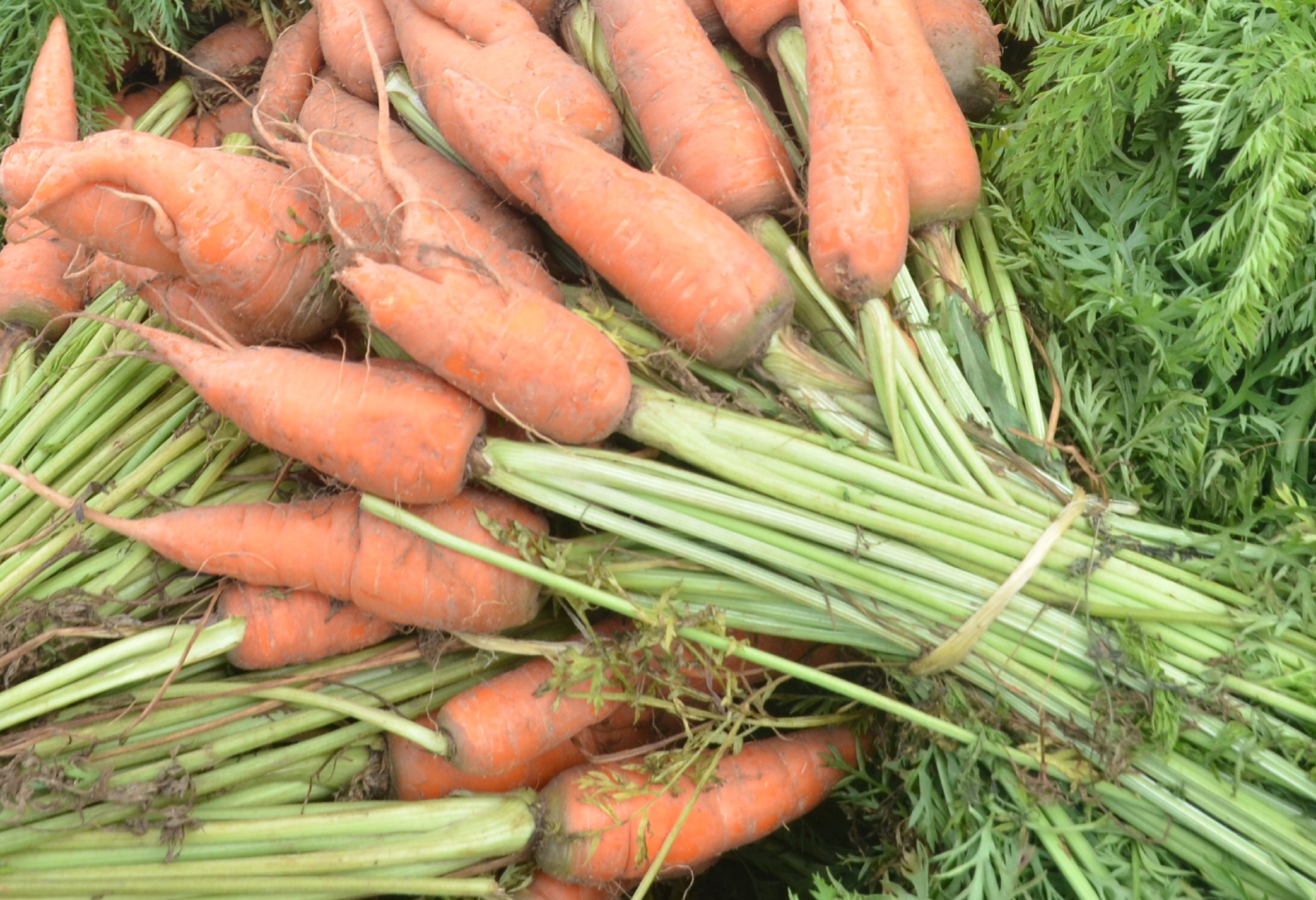
[Freshly harvested carrots with soil still on their roots.] Photograph: Shark2025
Image Credits: Wikimedia Commons
A forked carrot looks like a mistake, but it is really a record of what happened underground. The carrot's taproot starts drilling downward within days of germination, and anything that blocks, injures, or redirects that growing tip changes the shape of the root you pull months later.
This article explains why carrots grow forked sometimes, including what forking is, how stones and compaction cause it, why fresh manure and excess nitrogen matter, the roles of pests and crowding, and how to grow straighter carrots next time.
What forking is
Forking, also called fanging, is what happens when the main taproot stops growing straight and one or more side roots take over. Utah State University Extension's guide to physiological problems in root crops describes it plainly: when the taproot is damaged, secondary roots grow and fill in, giving the root its forked look.
The growing tip is the sensitive part. It is a small zone of dividing cells at the very end of the root, and it sets the direction of growth. If that tip is deflected by an obstacle, pinched by compacted soil, or eaten by a pest, the plant responds by branching.
The result can be a neat two-pronged fork, a tangle of several prongs, or a short, stubby root that stopped growing downward altogether.
A single oddly shaped carrot in an otherwise straight row usually means that one root hit one stone. When most of the bed comes up forked, the problem is bigger: the whole bed's soil, feeding, or watering is working against straight growth. Reading that pattern before changing anything keeps you from fixing the wrong thing.
Stones, compaction, and blocked taproots
Physical obstruction is the first suspect, and extension services agree on it. The University of Minnesota Extension's carrot diagnosis guide lists rocky or cloddy soil and compaction among the leading causes of forked roots. Utah State's guide names dense, compact soils and root obstructions such as rocks as direct causes.
The University of California's IPM programme gives the same advice for home landscapes: dense or rocky soil deflects root growth.
The mechanism is simple. A taproot cannot dissolve a stone, push through a hardpan layer, or force its way through a dense clay clod. It deflects sideways, splits, or stalls.
A bed that feels loose at the surface can still hide a firm layer a few inches down, left by foot traffic, heavy rain, or an earlier compaction event, and a young root meets that layer exactly when it is most vulnerable.
Research backs the link between soil resistance and deformity. Work published in the Journal of the American Society for Horticultural Science found that increasing soil strength measurably reduced early carrot root growth, and related field work connected soil compaction with higher rates of forked roots at harvest. Those studies come from controlled or commercial settings, so they do not give a precise threshold for a backyard bed, but they confirm the mechanical relationship is real rather than gardening folklore.
The practical fix starts after harvest. Push a trowel or soil probe 10 to 12 inches straight down into the bed and notice where it meets unexpected resistance. That resistance is often the story behind the harvest.
For the next sowing, fork the bed deeply, remove stones and undecomposed woody debris, and avoid walking on the bed once it is prepared.
Fresh manure and excess nitrogen
Not every cause of forking is physical. What you feed the bed matters too. Minnesota Extension lists fresh manure among the leading causes of forked roots, and Utah State's guide names excess nitrogen and fertilizer placement alongside it.
Fresh manure causes two problems. First, it is rich in nitrogen that releases quickly, pushing soft, fast top growth at the expense of a strong taproot. Second, undecomposed lumps in the manure act as physical obstacles, just like stones.
The combination gives roots that branch and distort.
The same logic applies to heavy synthetic feeding. Too much nitrogen produces lush green tops and tender roots that fork more readily under stress. Carrots are light feeders compared with leafy crops, and a bed that was manured for a previous crop usually carries enough fertility for them.
If you do feed, use well-rotted compost worked in well before sowing, and keep fresh manure away from the carrot bed entirely.
Fertilizer placement can also injure roots directly. Concentrated bands of fertilizer near the young taproot can burn or damage the growing tip, and the plant answers with branching. Spreading fertility evenly through the bed, rather than in a strip beside the row, avoids that injury.
Pests, crowding, and other causes
Pests that attack the root tip cause the same branching response as a stone. Root-knot nematodes, tiny soil worms that feed on roots, are named by Minnesota Extension among the possible causes of forking. Carrot fly larvae tunnel into young roots, and the root grows around the damaged section, producing a misshapen harvest.
Wireworms and root maggots do similar damage.
The pattern helps with diagnosis. Pest damage often shows as forked roots with small tunnels, discoloured patches, or rusty staining, and it may affect only part of the bed. Nematode problems tend to return in the same spot year after year.
Rotating carrots to a fresh bed and avoiding planting them where related crops grew recently both reduce the pressure.
Crowding is a quieter cause. When carrots are sown too thickly and never thinned, their roots compete for space, water, and nutrients, and the stress can cause branching. Iowa State University Extension lists overcrowding among the factors that produce irregular roots, alongside irregular moisture, excessive nitrogen, nematode pressure, and disease.
Uneven moisture contributes as well. A dry spell followed by heavy watering can crack roots, and fluctuating moisture during development adds stress that shows up as distortion. Variety plays a smaller role: some types are naturally shorter or more blunt-tipped, and Minnesota Extension notes that uniform deformity across many plants points more to bed conditions than to seed genetics.
Transplanting carrots also causes bent roots, because the taproot is disturbed at exactly the stage when it sets its direction. Carrots should always be sown where they will grow.
How to grow straight carrots next time
Start with the bed. Choose loose, well-drained soil that holds consistent moisture, and prepare it to the full depth the variety needs. Remove stones, break up clods, and do not walk on the bed after preparation.
Raised beds work well because they stay loose and drain freely.
Skip fresh manure and heavy nitrogen. Use well-rotted compost, applied and mixed in before sowing, and let a previously manured bed rest a season before planting carrots in it. Keep fertilizer spread evenly rather than banded beside the row.
Sow thinly and thin early. Give each seedling room to form one taproot without neighbours pressing in. Water evenly through the season so the soil never swings from dry to soaked, and mulch lightly to hold moisture steady.
Rotate the bed each year to break pest cycles, and consider shorter varieties if your soil is shallow or stony. A short, round variety in a shallow bed will out-perform a long variety forced into ground it cannot penetrate. The goal is a root zone that stays open, moist, and obstacle-free from the surface down.
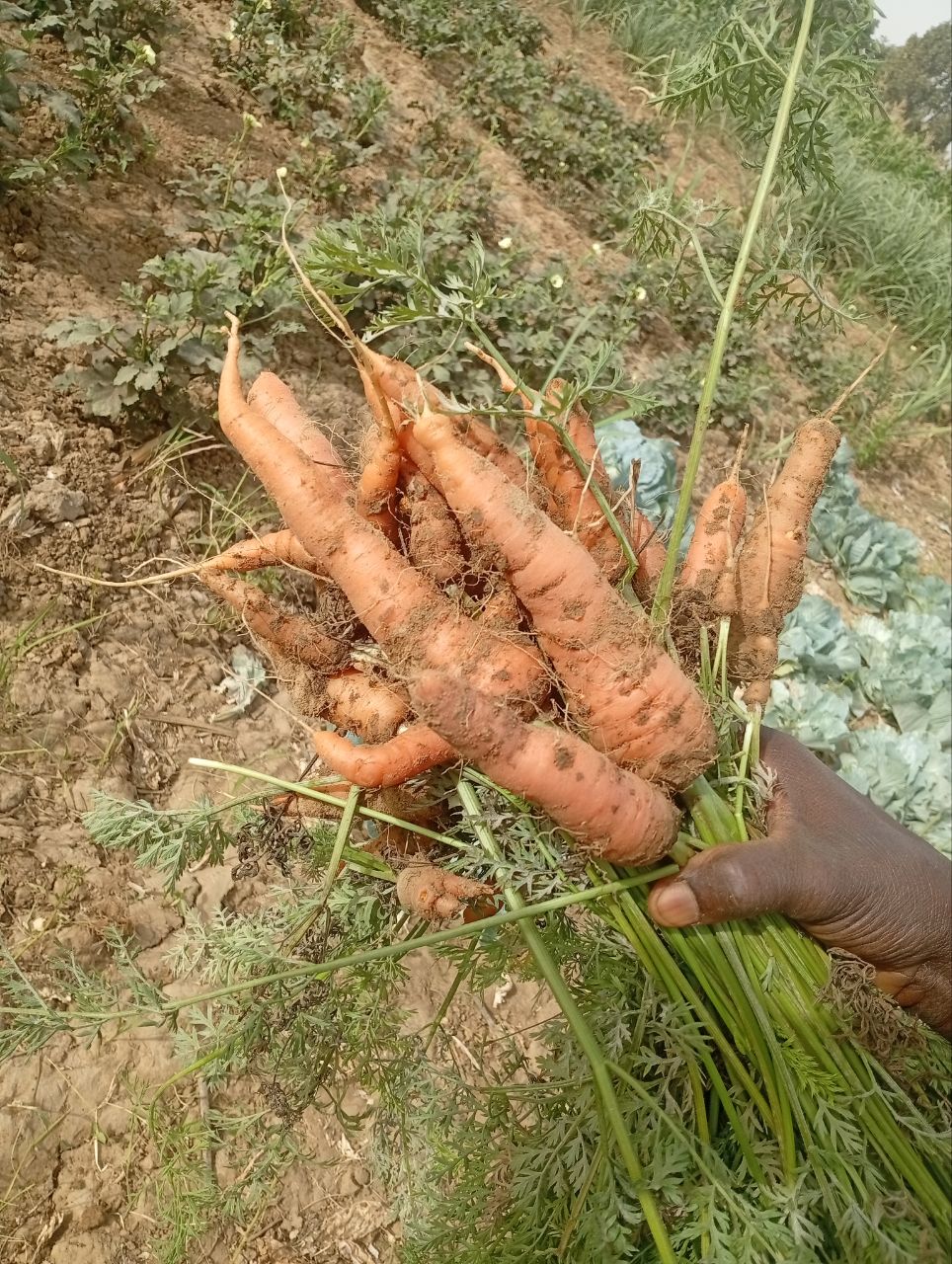
[Carrots being pulled from the soil at harvest.] Photograph: Sirjat
Image Credits: Wikimedia Commons
Frequently asked questions
Are forked carrots safe to eat?
Yes. Forking is a shape problem, not a safety problem. Wash forked carrots well, since soil collects in the crevices, and cut away any parts damaged by pests or rot. The rest is perfectly good food.
Do forked carrots taste different?
Generally no. A forked carrot from healthy soil tastes the same as a straight one from the same bed. Roots damaged by pests may have bitter or woody patches, but those can be trimmed away.
Can you fix forking mid-season?
Not for roots already growing. Once a taproot has branched, the shape is set. What you can do mid-season is even out watering and avoid further stress, then fix the bed properly before the next sowing.
Do short varieties fork less?
Short and round varieties cope better with shallow or stony soil, because they need less depth to mature. In a deep, loose bed, long varieties grow straight too, so variety choice matters most where the soil is limited.
The bottom line
Carrots fork when something interrupts the taproot's downward journey: a stone, a compacted layer, fresh manure, excess nitrogen, a pest, or a crowded row. Most of the time the bed is the culprit, and most of the time the fix is unglamorous groundwork: deep, loose, stone-free soil, well-rotted compost instead of fresh manure, even watering, and room for each root to grow. Forked carrots are still good eating, and a bed prepared properly gives you straight ones next season.
---
Rive News's research desk covers practical gardening, home, and how-things-work explainers, drawing on university extension services and published research.
Related
- Why do carrots fork and grow weird shapes in home gardens?
- How to Grow Carrots in Containers Without Forked Roots
- How to improve clay soil for gardening
- What Does NPK on Fertilizer Actually Mean: Nitrogen, Phosphorus, and Potassium
Subscribe to Rive News for one practical explainer in your inbox each morning.
Rive News publishes research-desk explainers from public sources. Corrections: contact the desk and cite the article and the fact in question.
Related stories
What Is Companion Planting and Does It Work?
Marigolds work as a nematode cover crop, but the basil flavor claim failed repeated tests. An honest evidence review of what companion
Determinate vs. indeterminate tomatoes: growth, pruning, and harvest differences
Determinate tomatoes grow to a set size and ripen all at once, while indeterminate types vine all season. That one difference shapes
How to improve clay soil for gardening
Gypsum will not fix ordinary clay soil, say extension experts. What actually works: 2 to 3 inches of compost, mulch, better drainage,