
Why Is Morning Watering Better for Plant Disease Than Evening?
Key takeaways
- Most fungal pathogens need a film of free moisture on leaves for about 9 hours before they can germinate and infect.
- Morning watering lets foliage dry within hours as the sun rises, while evening watering keeps leaves wet through the whole night.
- Watering at soil level with drip or soaker lines beats overhead sprinklers at any hour, because dry leaves cannot be infected.
Every gardener has heard the rule: water in the morning, not the evening. It sounds like folklore, but it rests on a precise piece of plant pathology.
The clock is not what matters. What matters is how long your plants' leaves stay wet, because leaf wetness is the fuse that lights most garden diseases.
Mississippi State University Extension puts the mechanism plainly: fungal spores are small and delicate, and like seeds they need moisture to germinate.
Many fungi require a film of free moisture for at least 9 hours to germinate and penetrate the leaf. Once they germinate, drying out kills them. Your watering schedule decides whether spores get their 9 hours or die trying.
This article explains how leaf wetness drives disease, why morning watering breaks the cycle, what evening watering does wrong, and how to water so leaves stay as dry as possible.
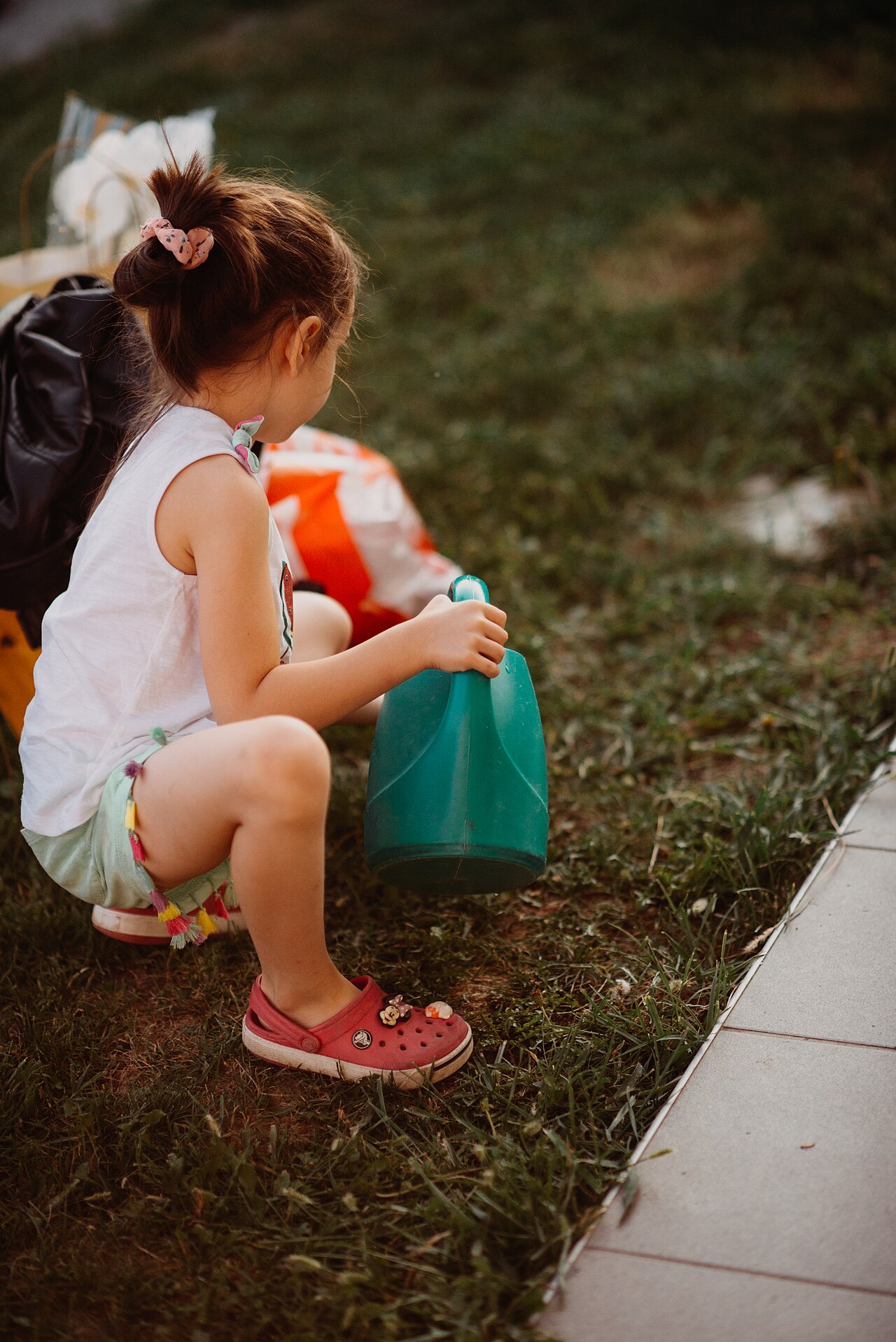
Watering in the morning sun. Foliage wetted early dries within a few hours, before fungal spores can finish germinating. Photograph: Shixart1985
Image Credits: Wikimedia Commons / Shixart1985, Félix Leblanc
How leaf wetness becomes disease
Most garden diseases are caused by fungi, with bacteria responsible for the rest. Both travel as microscopic spores or cells that land on leaf surfaces and wait.
The wait ends when free water, droplets or a thin film on the leaf, persists long enough for the spore to germinate and push into the tissue. No sustained wetness, no infection. It really is that direct.
Mississippi State's plant pathology team emphasizes two controllable variables: the number of wet periods and how long each one lasts. Every overhead watering adds a wet period.
Watering deeply but infrequently adds fewer of them than daily sprinkling. And critically, watering at the wrong time stretches each wet period past the germination threshold.
Dew complicates the picture, because dew is water too. In Mississippi State's region, dew typically sits on canopies from about midnight to 8 in the morning.
Smart scheduling works with the dew rather than against it: watering while dew is still present does not extend the total wet period much, since the leaves were already wet. Watering just as the dew is drying, or just before dew forms in the evening, stretches wetness into the danger zone.
Temperature sharpens the effect. Research published in PLOS ONE on bacterial leaf spot of stone fruits found that as little as 5 hours of continuous leaf wetness at 77 to 95 degrees Fahrenheit produced high disease severity.
At cooler temperatures the threshold rose past 10 hours. A warm, humid July evening is therefore a far riskier watering window than a cool May one, which is why the morning rule matters most in midsummer.
Why morning watering wins
Water between roughly 5 and 9 in the morning and the physics works in your favor. The sun is rising, temperatures are climbing, humidity is falling, and any water on foliage evaporates within two to three hours. Spores that landed overnight get a brief drink and then dry out and die, well short of their 9-hour requirement.
There is a second benefit people overlook. Plants watered in the morning face the day's heat with full turgor, so they wilt less at midday.
Less wilt means less stress, and stressed plants are more susceptible to the pathogens that do get a foothold. Morning watering also loses less to evaporation than midday watering, so more of each gallon reaches the roots.
The evidence is old and consistent. In a 1933 study of brownpatch on putting greens, researcher Arnold Dahl watered plots in the morning and evening and measured the diseased area.
The evening-watered plots consistently showed more disease, and the patches were more severely affected. Across his readings, morning watering materially reduced brownpatch compared with evening watering at the same volume.
Purdue University's turf pathologists reached the same conclusion from the disease side. In their lawn disease guidance they name early evening, 6 to 9 pm, as the worst possible irrigation window, because it adds hours to the leaf-wetness period.
Their warning is vivid: an increase in leaf wetness by just a few hours can mean the difference between a severe outbreak and mild symptoms. If you are deciding between overwatering and underwatering, remember that timing matters nearly as much as volume.
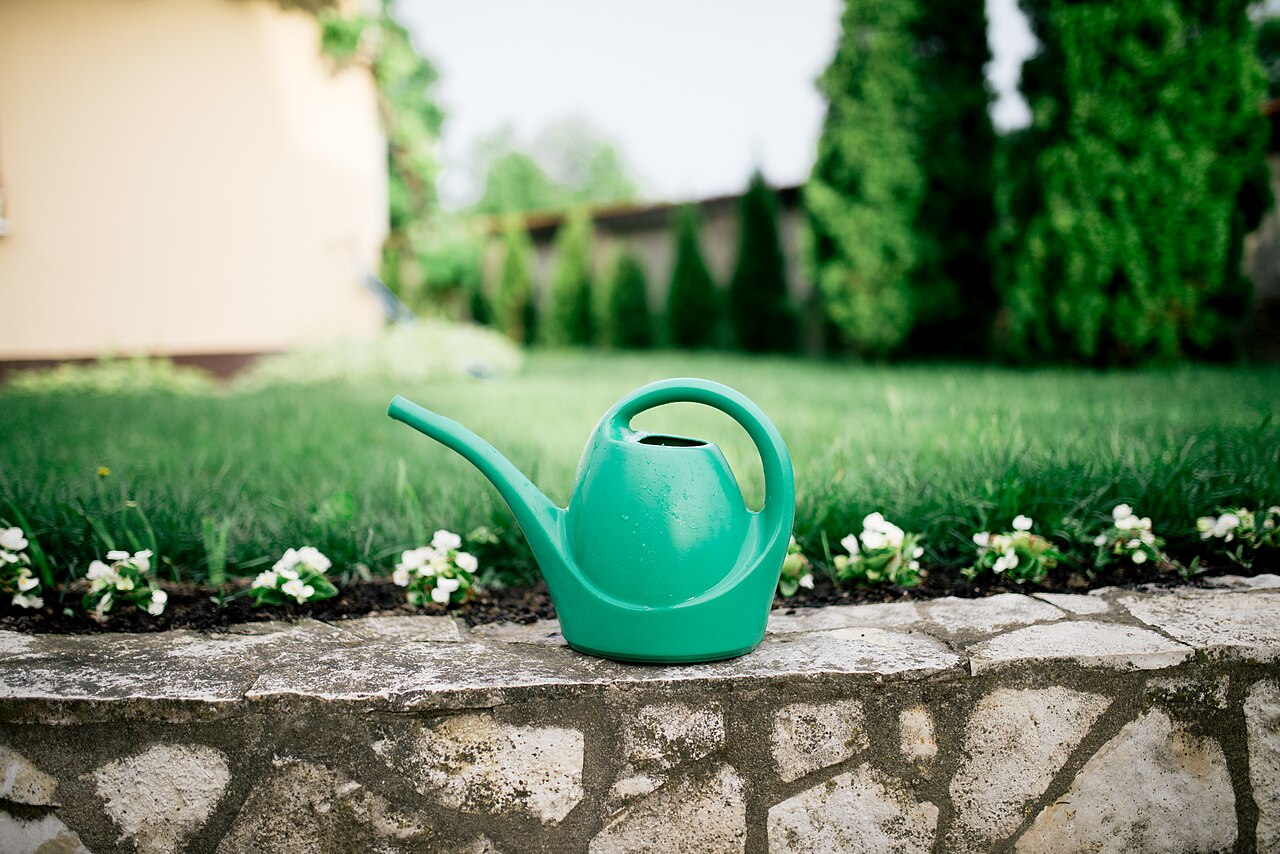
A watering can aimed at the soil. Directing water at the base keeps foliage dry, which matters more than the hour you water. Photograph: Shixart1985
What evening watering does wrong
Run the sprinkler at 8 in the evening and trace what happens. The sun is down, so nothing dries.
Temperatures fall, relative humidity climbs, and dew begins forming around midnight, adding a second coat of moisture before the first has gone. By sunrise the leaves have been continuously wet for 10 hours or more, sailing past the 9-hour germination threshold with room to spare.
That long wet night is exactly what leaf spot, anthracnose, early blight, and gray mold are waiting for. These pathogens follow the classic pattern: extended free moisture on the leaf surface, then penetration. Evening watering does not just fail to prevent disease; it actively manufactures the conditions disease needs.
There are narrow exceptions. In very hot, dry, windy climates, evening watering can cut evaporation losses, and some gardeners accept the trade.
Drip irrigation also changes the calculus: Purdue and other extension services note that evening drip is far less risky than evening sprinklers, because the foliage never gets wet in the first place.
The rule, stated precisely, is not "never water at night." It is "never leave foliage wet overnight."
One more caveat: powdery mildew breaks the pattern. Unlike most fungi it does not need free water to germinate; high humidity alone suffices, and Clemson Extension notes that leaf wetness can actually inhibit its spores. Morning watering still helps against powdery mildew by lowering humidity faster, but it is not the silver bullet it is for other diseases.
Watering so leaves stay dry
The best schedule is the one that wets the soil and spares the leaves. Drip lines and soaker hoses deliver water to the root zone with the foliage untouched, and USDA-cited research has found drip can cut disease incidence sharply compared with overhead watering. If you must use a sprinkler, run it early enough in the morning that the canopy dries at the same time as, or before, unwatered areas, which is Mississippi State's exact recommendation.
Water deeply and infrequently rather than with daily sprinkles. Deep watering drives roots downward and adds fewer wet periods per week. Check soil moisture with your finger before deciding to water at all; many disease outbreaks begin not with bad timing but with plain overwatering that keeps the whole environment soggy.
Finally, give the air a chance to work. Space plants for airflow, prune dense canopies, and water the base, not the leaves.
A garden that dries quickly after rain or irrigation is a garden where spores routinely fail their 9-hour exam. Companion planting can improve airflow and biodiversity, but no planting scheme rescues chronically wet foliage.
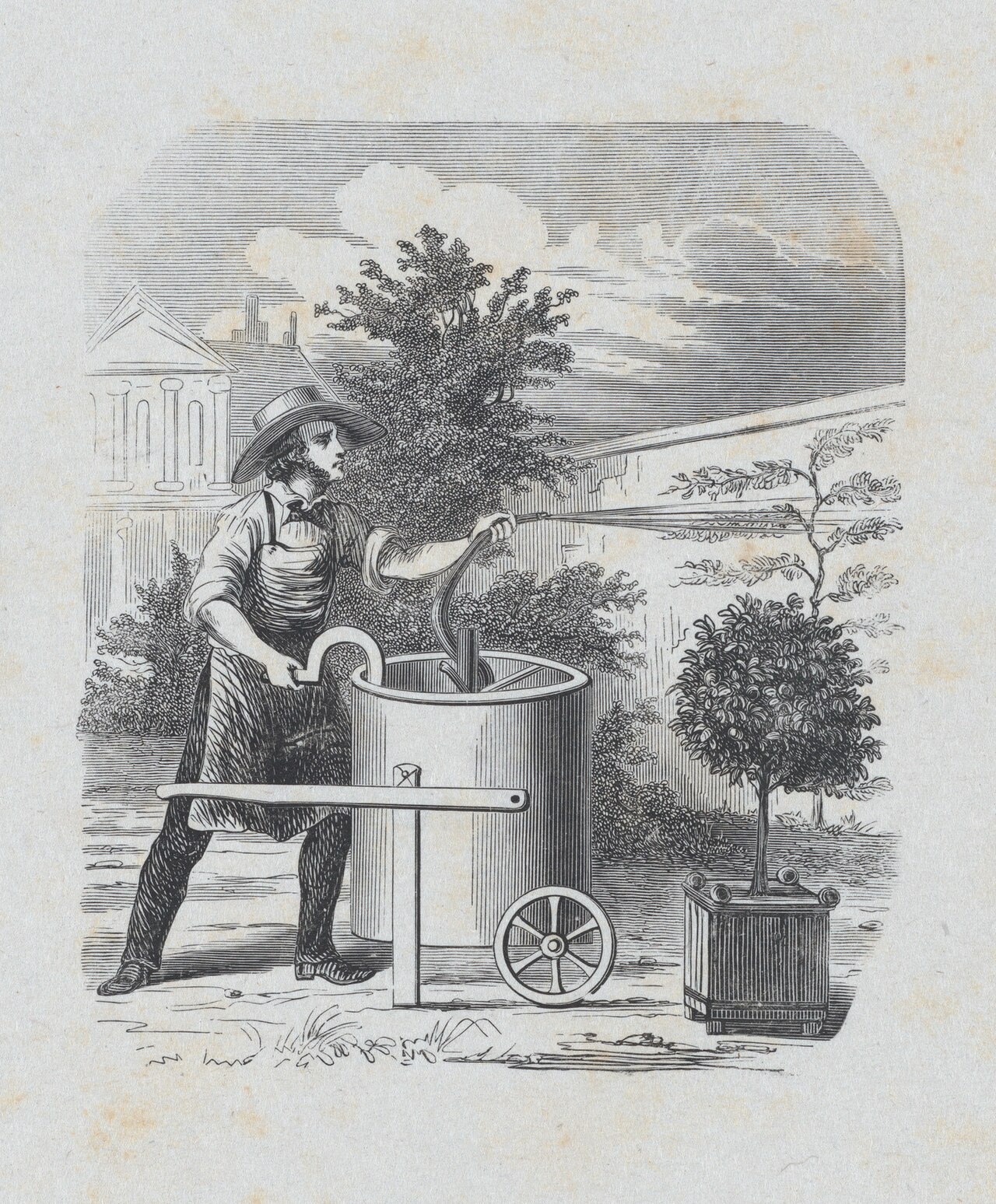
A 19th-century gardener watering by hand at the base of plants. Targeting the soil, not the leaves, is the oldest disease-prevention trick there is. Photograph: Félix Leblanc
Is it ever okay to water plants in the evening?
Yes, with conditions. Evening drip irrigation that keeps foliage dry is low-risk, and in hot arid climates the evaporation savings can be worth it. What you should avoid is overhead watering in the evening, which leaves foliage wet through the cool, humid night when fungal spores germinate most readily.
What time in the morning is best?
Between 5 and 9 am is the standard extension recommendation. That window lets you work with the existing dew rather than extending wetness, and gives the foliage the full day to dry. Earlier is generally better than later in humid climates.
Does morning watering really prevent powdery mildew?
Only partly. Powdery mildew germinates in high humidity without free water, so timing helps less than it does for leaf spot or blight. Spacing, airflow, resistant varieties, and keeping humidity down matter more for this particular disease.
Should I water the leaves to wash off pests?
Occasional overhead rinsing can dislodge aphids and mites, but do it in the morning so leaves dry fast. Make it the exception, not the routine: chronic overhead watering trades a small pest benefit for a large disease risk.
The bottom line
Morning watering beats evening watering for one reason: it controls how long leaves stay wet. Fungal spores need roughly 9 hours of continuous leaf moisture to infect, and morning sun denies them that window while evening irrigation hands it to them on a platter. Water early, water deeply, water the soil rather than the leaves, and you will prevent more disease with your hose timer than with any spray bottle.
Latest in Gardening
- Companion planting: does it actually work?
- Overwatering vs underwatering: the finger test
- Why tomato leaves turn yellow at the bottom
- What NPK fertilizer numbers mean
Get one practical gardening explainer like this every morning. Subscribe to the Rive News newsletter.
Related stories
What Is Companion Planting and Does It Work?
Marigolds work as a nematode cover crop, but the basil flavor claim failed repeated tests. An honest evidence review of what companion
Determinate vs. indeterminate tomatoes: growth, pruning, and harvest differences
Determinate tomatoes grow to a set size and ripen all at once, while indeterminate types vine all season. That one difference shapes
How to improve clay soil for gardening
Gypsum will not fix ordinary clay soil, say extension experts. What actually works: 2 to 3 inches of compost, mulch, better drainage,