
Why Are My Tomato Leaves Turning Yellow at the Bottom?
Key takeaways
- Bottom-up yellowing on tomatoes is usually caused by nitrogen deficiency, fungal disease, or overwatering, and the exact pattern tells you which one it is.
- Uniform yellowing of older leaves points to nitrogen; yellow halos around dark spots point to early blight or septoria; wilting with wet soil points to water.
- Most causes are fixable or stoppable once identified, but yellowed leaves rarely turn green again, so act on what is still healthy.
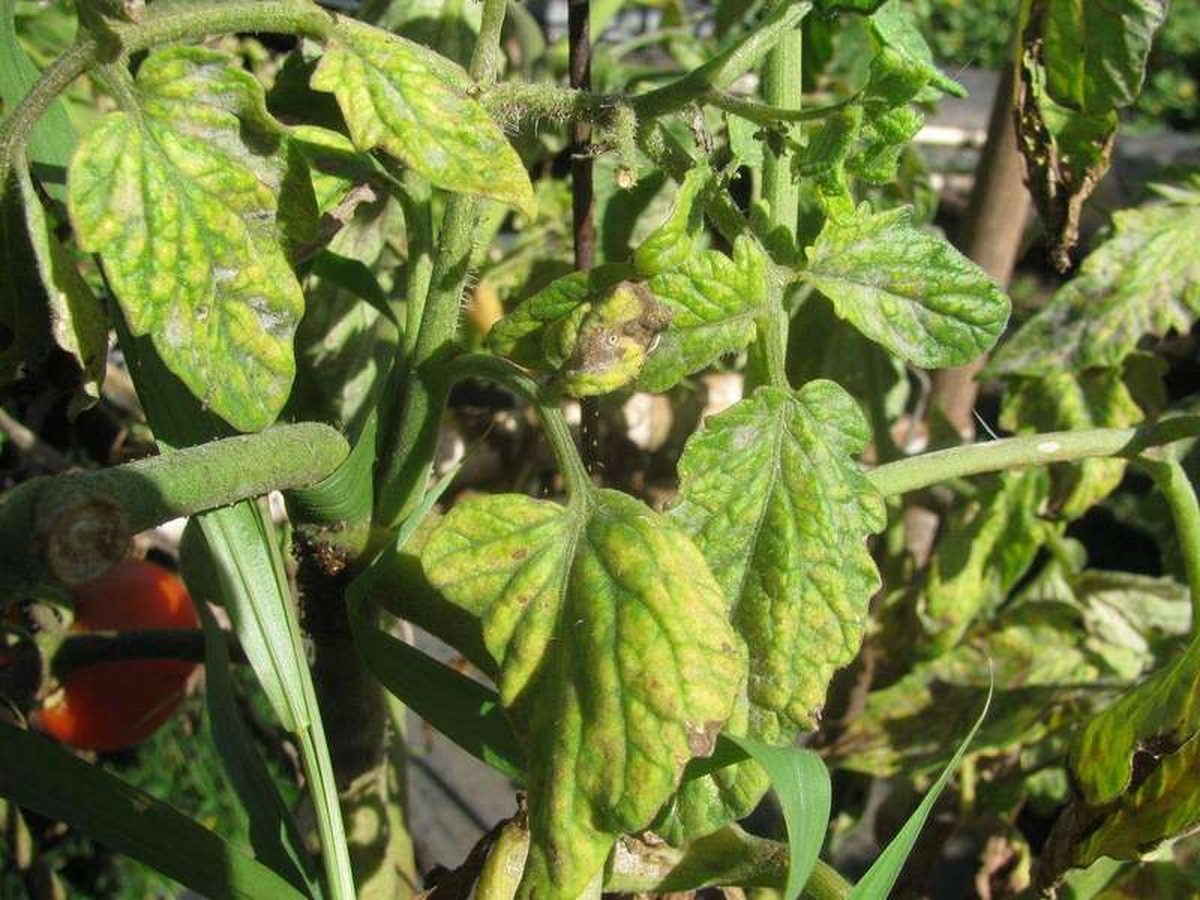
A tomato plant showing classic bottom-up yellowing on its lower leaves. Photograph: Forest and Kim Starr/Wikimedia Commons
Image Credits: Wikimedia Commons
When the lowest leaves on a tomato plant turn yellow while the top still looks green, the plant is telling you something. The color change means chlorophyll (the green pigment that powers photosynthesis) is breaking down, and on tomatoes that process almost always starts where the trouble starts.
Bottom-up yellowing has a short list of usual suspects. The plant may be pulling nitrogen out of its oldest leaves, a fungal disease may be climbing up from the soil, or the roots may be sitting in too much water. A few yellow lower leaves late in the season can be plain old aging, but a fast-spreading pattern is not.
This article explains yellow lower leaves on tomatoes, including how to read the pattern, the main nutrient deficiencies involved, the fungal diseases that start at the bottom, common watering mistakes, and what to do next.
What the location of yellowing tells you
Plants move some nutrients around and keep others locked in place, and that decides where symptoms show up first. Nitrogen and magnesium are mobile, so when the plant runs short, it pulls them from the oldest leaves to feed new growth. That is why a nutrient shortage usually starts at the bottom and works upward.
Spots and rings tell a different story. Fungal diseases such as early blight and septoria leaf spot live in or on the soil, so their spores reach the lowest leaves first. When yellowing comes with dark markings, disease moves to the top of the suspect list.
Water problems affect the whole plant, but the lower leaves often show it first because they are closest to the wet soil. If the soil is soggy and the plant is wilting at the same time, the roots are the problem, not the leaves.
Nutrient problems: the most common cause
Nitrogen deficiency is the single most common reason tomato leaves yellow from the bottom up. The first sign is pale green or yellow color on the oldest leaves, which later spreads to newer growth if the shortage continues.
Nitrogen is needed to build chlorophyll, the green pigment that powers photosynthesis. Without enough of it, leaves cannot stay green. According to the Food Gardening Network, nitrogen deficiency is worsened by sandy soils, drought, heavy rainfall, and low organic matter, all of which either drain nitrogen away or lock it up.
Tomatoes prefer soil pH (soil acidity level) between 6.0 and 6.8. Outside that range, nutrients already in the soil can become unavailable to the roots, so a soil test matters before you reach for fertilizer. A general-purpose liquid fertilizer or an addition of composted manure can correct a genuine shortage.
Be careful with the dose. Too much nitrogen pushes the plant into lush leafy growth at the expense of fruit, which is the opposite of what a grower wants.
Magnesium deficiency looks different. Instead of uniform yellowing, the leaf turns yellow between the veins while the veins stay green, a pattern called interveinal chlorosis. It also starts on lower leaves.
A foliar spray of 1 tablespoon of Epsom salt per gallon of water is a commonly recommended treatment. It only helps if magnesium is truly the missing nutrient.
Disease: when spots appear with the yellow
If the yellowing comes with spots, think fungus. Early blight is a soil-borne fungal disease that typically shows up soon after the first tomatoes appear. The first markings look brown, then develop into a bull's-eye shape surrounded by yellowing leaves, as described by the Food Gardening Network.
The University of Minnesota Extension identifies early blight as one of the most common tomato diseases and notes that it spreads in warm, humid conditions. Infected leaves weaken the plant and leave the fruit exposed to too much sun, which causes its own damage.
Septoria leaf spot is another lower-leaf starter. It shows up as small dark spots with yellow halos on the oldest foliage and climbs the plant in wet weather. Like early blight, it spreads when water splashes soil onto the leaves.
Fungal wilts are more serious. Fusarium wilt causes yellowing that starts on one side of the plant, followed by wilting and browning leaves. It is soil-borne, survives in soil for years, and is most dangerous when soil temperatures approach 80 degrees Fahrenheit.
Verticillium wilt shows yellow splotches and brown veins and prefers cooler climates.
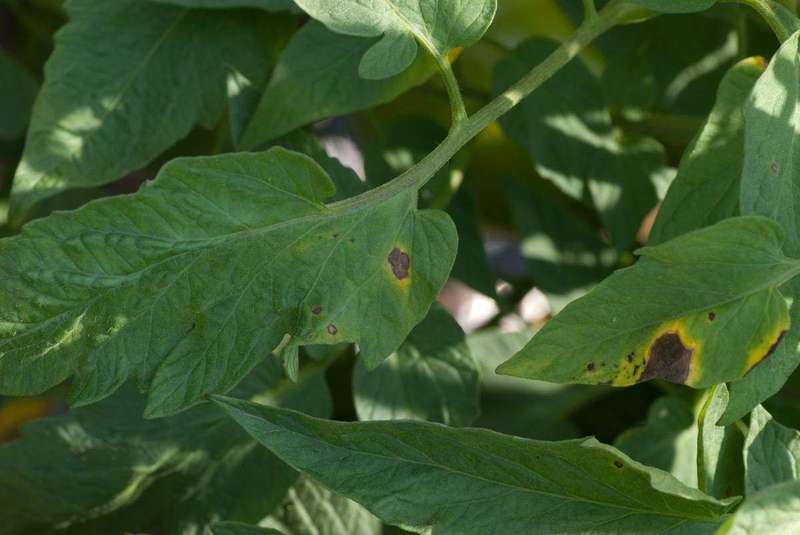
Early blight lesions on tomato leaves, showing the dark concentric spots surrounded by yellowing tissue. Photograph: Dwight Sipler/Wikimedia Commons
Image Credits: Wikimedia Commons
Disease control starts with sanitation. Remove affected leaves as soon as you spot them, and do not compost them. Mulch or straw around the base of the plant stops soil from splashing onto leaves during watering or rain.
Water at the base of the plant with a soaker hose or drip line rather than spraying from overhead. Overhead watering is one of the fastest ways to spread leaf-spot diseases. Choosing resistant varieties and giving plants enough spacing for air flow also reduce pressure.
Watering: too much or too little
Overwatering is a common culprit behind yellow leaves. Too much water drives air out of the soil, roots begin to rot, and the damaged roots cannot take up nutrients. The result is leaves that yellow and wilt even though the soil is wet.
One simple test: if a puddle forms at the base of the plant after watering and is still there later, the plant is getting too much water. Container plants are easy to check by lifting the pot or pulling the root ball out gently to look for soggy mix.
Water tomatoes in the morning so the foliage and soil surface dry during the day. Deep, less frequent watering is better than a daily sprinkle, which keeps the top wet and the roots shallow.
Underwatering is less common as a cause of bottom-up yellowing, but drought stress can also trigger leaf drop from the base. Check the soil a few inches down with your finger. If it is dry at that depth, the plant is thirsty.
What to do next
Work through this sequence the next time you see yellow at the base of a plant:
- Look at the pattern. Uniform yellowing on old leaves means nutrients. Spots or rings mean disease.
Wet soil plus wilting means water. 2. Check the soil. Push your finger a few inches down.
Soggy means back off the water. Dry means water deeply. 3. Remove damaged leaves.
Snip off badly yellowed or spotted leaves so disease cannot spread and the plant stops feeding dying tissue. 4. Add mulch. A few inches of straw or shredded leaves around the base keeps soil off the foliage and steadies moisture.
- Feed only if the pattern points to nutrients. A balanced fertilizer or composted manure helps nitrogen shortage. Epsom salt spray helps confirmed magnesium shortage.
- Treat disease early. Fungicides labeled for tomatoes can slow early blight if applied at the first signs. Read the label and follow it exactly.
If only one or two bottom leaves are yellow and the rest of the plant is vigorous, it is probably natural aging. Tomatoes shed their oldest leaves as the season goes on, and a healthy plant keeps producing above them.
Frequently asked questions
Can yellow tomato leaves turn green again?
Usually not. Once a leaf has lost its chlorophyll because of nutrient shortage or disease, it rarely greens back up. Fixing the underlying problem stops the yellowing from spreading and protects the healthy new growth that follows.
Should I remove yellow leaves from my tomato plant?
Yes, remove leaves that are mostly yellow or spotted. This slows disease spread and redirects the plant's energy toward healthy foliage and fruit. Use clean shears or scissors and avoid touching healthy plants afterward without washing your hands.
Is Epsom salt good for yellow tomato leaves?
It helps only when magnesium shortage is the cause, which shows as yellowing between green veins on lower leaves. A spray of 1 tablespoon per gallon of water is the standard home remedy. If the yellowing is uniform, the problem is more likely nitrogen, and Epsom salt will not help.
How often should I water tomato plants?
Water deeply one to two times per week, giving roughly 1 to 2 inches of water, and adjust for weather. Hot, dry spells need more; cool or rainy periods need less. Water in the morning at the base of the plant.
The bottom line
Yellow leaves at the bottom of a tomato plant are a symptom, not a diagnosis, and the pattern is the best diagnostic tool you have. Uniform yellowing says nutrients, spots say disease, and wet soil with wilting says water.
It's a good idea to inspect your plants weekly once fruit sets, since that is when early blight usually arrives. Catch the cause early, remove the damaged leaves, fix the water or feeding, and the plant will usually keep producing.
Topics: tomatoes, vegetable gardening, plant care, pest and disease, soil health
Rive News's research desk covers practical how-to topics with sourced, verifiable information.
Latest in Gardening
- How to Tell Overwatering vs Underwatering in Plants: Finger Test and Weight Method
- Leggy Seedlings: Why They Stretch, How Light Fixes Them, and When to Start Over
- Do Houseplants Raise Indoor Humidity? What the Research Says
Subscribe to the Rive News newsletter for weekly practical guides.
Sources:
- Food Gardening Network (foodgardening.mequoda.com)
- University of Minnesota Extension (extension.umn.edu)
- NC State Extension (plants.ces.ncsu.edu)
Corrections: we correct errors promptly. Contact the newsroom with documentation.
Copyright 2026 Rive News. All rights reserved.
Related stories

What Is Companion Planting and Does It Work?
Marigolds work as a nematode cover crop, but the basil flavor claim failed repeated tests. An honest evidence review of what companion

Determinate vs. indeterminate tomatoes: growth, pruning, and harvest differences
Determinate tomatoes grow to a set size and ripen all at once, while indeterminate types vine all season. That one difference shapes

How to improve clay soil for gardening
Gypsum will not fix ordinary clay soil, say extension experts. What actually works: 2 to 3 inches of compost, mulch, better drainage,