
Leggy Seedlings: Why They Stretch, How Light Fixes Them, and When to Start Over
Key takeaways
- Seedlings go leggy when light is too weak or too far away, so they stretch tall and pale toward the nearest source.
- Hang grow lights 2 to 4 inches above the seedlings and run them 14 to 16 hours a day for compact, sturdy growth.
- Cool the room to 60-70°F (16-21°C) after sprouting, add gentle airflow, and bury leggy tomato stems deeper at transplant time.
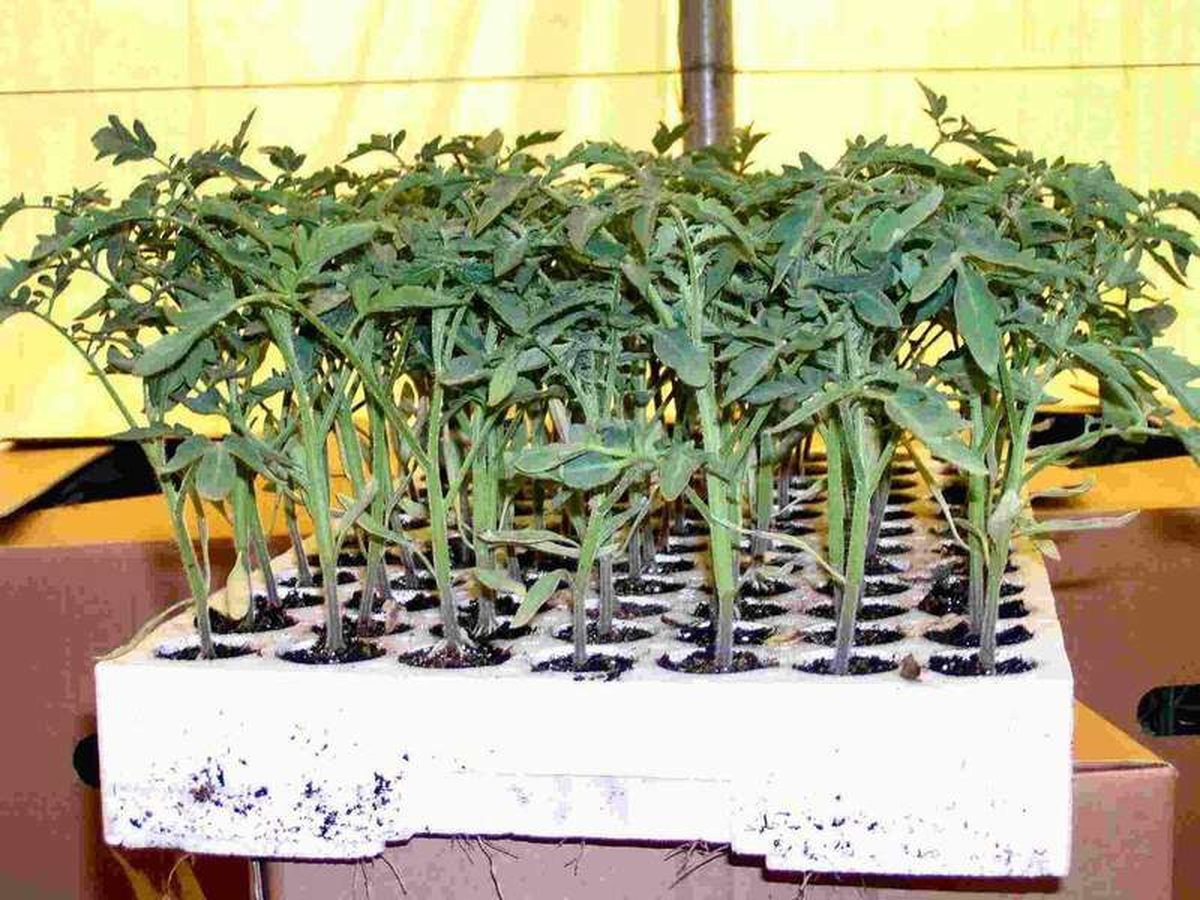
Young tomato seedlings in a propagation tray, the stage when legginess first shows. Photograph: Apapac/Wikimedia Commons
Image Credits: Wikimedia Commons
A leggy seedling is a young plant that has grown tall, thin, and pale instead of short, sturdy, and green. Its stem stretches upward with long bare gaps between the leaves, and it often flops over under its own weight.
Gardeners call this stretching etiolation (the plant's pale, stretched response to darkness). It is the plant's emergency response to dim conditions: sensing that it is shaded, the seedling pours its energy into growing taller to reach a brighter spot, sacrificing stem thickness to do it.
This article takes a closer look at what legginess actually means, why light distance matters so much, how to fix leggy seedlings right now, and how to prevent legginess next time.
What "leggy" actually means
The classic signs are easy to spot once you know them. Stems look thin and wiry, the color is pale or yellowish instead of deep green, and the spaces between leaf sets are unusually long. Seedlings on a windowsill often lean hard in one direction, a response botanists call phototropism: growth toward light.
Almost any seedling can go leggy, but fast growers show it first. Tomatoes, peppers, brassicas like broccoli and cabbage, and many annual flowers are the usual victims, according to Homes and Gardens. Slow growers like peppers and onions are less dramatic, but they suffer the same way in dim light.
Legginess is not a disease, and it is not your fault as a gardener. It is physics and biology doing exactly what they always do. The good news is that the fix is mechanical and fast: change the light, and the plant changes course.
Why light distance matters so much
Here is the detail most guides gloss over: it is not just how much light you have, it is how close it sits. Light intensity falls off sharply as the distance between the fixture and the plant grows.
A grow light blazing at 2 inches above the leaves delivers far more usable energy than the same light hanging at 12 inches. That is why seedlings under a distant shop light can still stretch even though the room looks bright to your eyes.
Human eyes are terrible judges of this. We adjust to dim rooms automatically, but a seedling measures raw light particles (photons). A sunny windowsill feels bright to us, yet even a south-facing window delivers only a fraction of the light seedlings need, which is why windowsill starts lean and stretch almost every time.
The working rule from experienced growers is simple: keep fluorescent or LED grow lights 2 to 4 inches above the tops of the seedlings. Harvest to Table recommends 2 to 4 inches for LEDs, and Homes and Gardens, quoting the American Horticultural Society's Senior Director of Horticulture, gives the same range.
As the plants grow taller, raise the fixture to hold that gap. Check it every couple of days, because a seedling can add noticeable height in 48 hours.
Duration matters as much as distance. Most vegetable seedlings need 14 to 16 hours of bright light per day, with a dark rest period overnight. A cheap outlet timer makes this automatic, and it is one of the highest value purchases in seed starting.
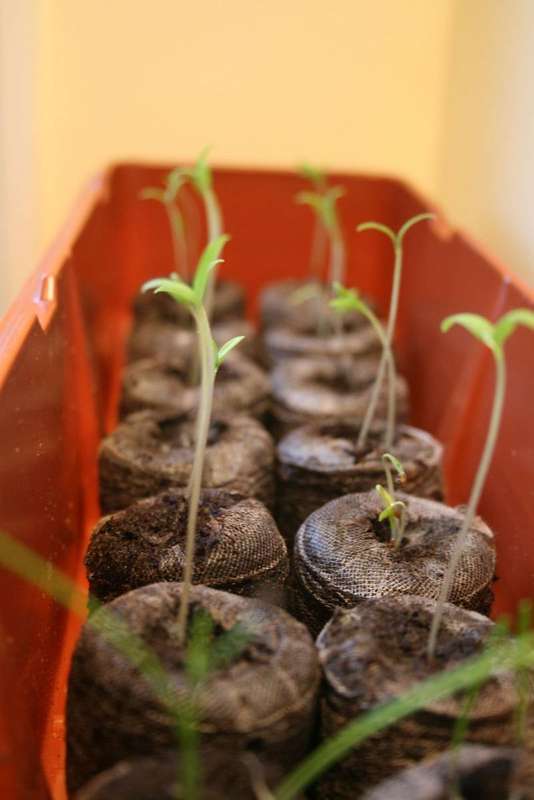
Young tomato sprouts stretching upward, an early sign of insufficient light intensity. Photograph: Cdw victoria/Wikimedia Commons
Image Credits: Wikimedia Commons
How to fix leggy seedlings right now
If your seedlings are already stretched, work through these fixes in order. Most trays recover within a week or two.
Lower the lights today. This is the single highest impact move. Drop your grow lights to 2 to 4 inches above the plant tops and set the timer for 14 to 16 hours. If you have no grow light yet, move the tray to the sunniest window you own and order one. Seedlings that were stretching will not shrink back, but all new growth comes in shorter and thicker.
Cool the room and remove the heat mat. Warmth speeds germination (sprouting), but after sprouting, heat without strong light produces fast, weak growth. Once about half to two-thirds of the seeds have emerged, turn off the heat mat and remove it. Most vegetable seedlings grow stockiest at 60 to 70°F (16 to 21°C), according to Harvest to Table. Keep trays away from radiators and warm appliances too.
Add gentle airflow. A small fan on its lowest setting, placed a few feet from the tray, does two jobs at once. The moving air dries leaf surfaces, which discourages damping-off fungus, and the constant light flexing tells stems to grow thicker. No fan handy? Lightly brush your open hand back and forth over the seedlings a few times a day. Growers report that this simple touch stimulus produces visibly sturdier stems.
Transplant leggy stems deeper. Tomatoes are the easiest rescue in the garden because their stems sprout new roots wherever they touch soil. When you pot them up, bury the stretched stem up to the first set of true leaves. The buried section grows a fresh root system and the plant anchors itself firmly. This also works for peppers, brassicas, and many annual flowers, according to Homes and Gardens. Skip it for crops like lettuce and onions, which do not root along buried stems.
Thin the crowd. Overcrowded cells force seedlings to compete for the same light, and every plant stretches a little further trying to outgrow its neighbor. Snip the weakest sprouts at soil level rather than pulling them, which disturbs the roots of the keepers.
Know when to start over instead. Seedlings with collapsed, mushy, or snapped stems at the base rarely recover, and that pinched, thread-thin base is usually damping-off (a fungal disease of seedlings), rather than simple legginess. If more than half the tray is flat on the soil, resowing is faster than nursing the survivors.
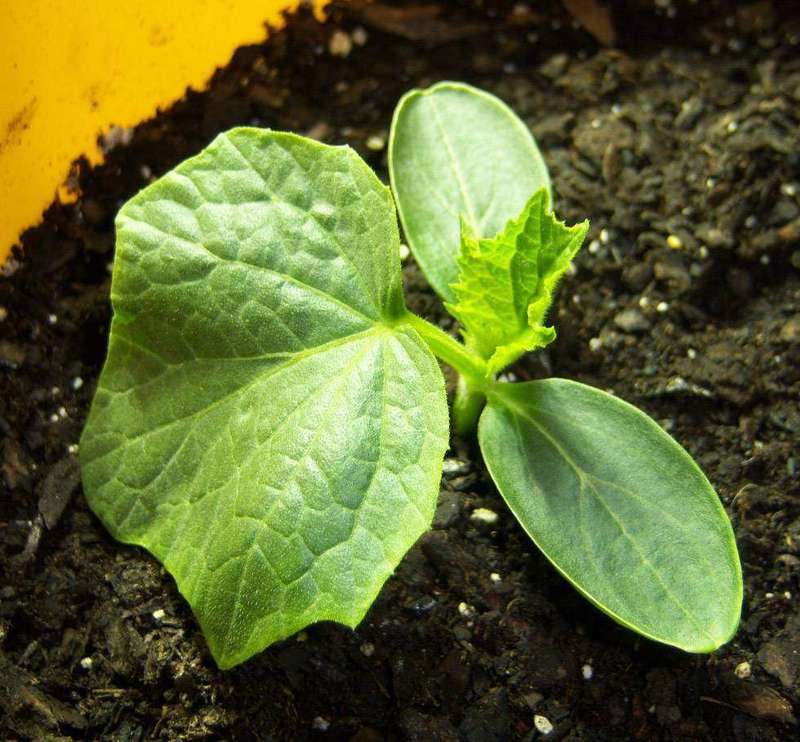
A two-week-old cucumber seedling: fast growers like this show legginess within days of sprouting. Photograph: Dennis Brown/Wikimedia Commons
Image Credits: Wikimedia Commons
How to prevent legginess next time
Prevention is just the fixes, applied from day one. Hang the lights 2 inches above the soil surface before the seeds even sprout, and start the 14 to 16 hour timer the moment the first green loop breaks the surface. Do not wait until you see stretching, because by then the stem is already built.
Pull the heat mat the moment most of the tray has emerged. Cool air slows stem growth and pushes the plant to invest in roots and leaf thickness instead. If your seed starting area runs warm, a small fan from day one keeps air moving and stems stocky.
Go easy on fertilizer early. Wait until the first set of true leaves appears, then feed at half or quarter strength. Heavy feeding pushes soft, rapid growth that goes leggy at the slightest light shortfall, as Fraser Valley Rose Farm notes.
Finally, rotate the tray a quarter turn every day or two if light comes mainly from one side, and consider lining the sides of your shelf with white cardboard or foil. Reflected light reaches the lower leaves and the shaded side of each stem, which keeps growth even instead of one-sided.
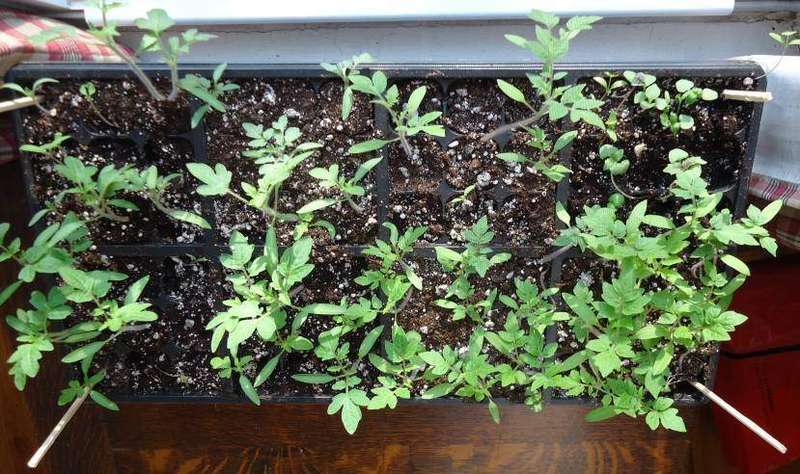
Tomato and basil seedlings sharing a tray: even light on all sides keeps mixed plantings compact. Photograph: Tomwsulcer/Wikimedia Commons
Image Credits: Wikimedia Commons
Frequently asked questions
Can leggy seedlings still be planted?
Yes, in most cases. Mildly stretched seedlings with firm green stems recover well once they get strong light, and tomatoes, peppers, and brassicas can be planted deeper so the buried stem grows extra roots. Only seedlings with collapsed or mushy stems are usually beyond saving.
How close should grow lights be to seedlings?
Two to 4 inches above the tops of the plants for most fluorescent and LED fixtures, according to Harvest to Table and Homes and Gardens. Raise the light as the seedlings grow to hold that gap. If leaves start to bleach or crisp, the light is too close or too hot, so lift it an inch.
Should I remove the heat mat after seeds sprout?
Yes. Heat mats are for germination only. Once roughly half to two-thirds of the seeds have sprouted, turn the mat off and remove it, since continued bottom heat encourages the fast, weak growth that causes legginess.
Does brushing seedlings with your hand really work?
Growers widely report that it does. Gently brushing the tops a few times daily, or running a small fan nearby, flexes the stems and triggers them to grow thicker, mimicking outdoor breeze. It also improves air circulation, which helps prevent fungal disease.
The bottom line
Leggy seedlings are reaching for light they cannot quite get, and the fix is almost always about distance, not buying a stronger lamp. Drop the fixture to 2 to 4 inches, run it 14 to 16 hours a day, cool the room after germination, and give stems a little breeze.
Do that, and the next tray will come up short, dark green, and sturdy. If this batch is already stretched, bury tomato stems deeper at transplant time and give the rest a week under close light before you decide anything is lost.
Tags: seed starting, leggy seedlings, grow lights, indoor gardening, gardening tips
Rive News is the research desk behind this publication, covering practical gardening, home, and how-to topics with sourced, tested guidance.
Related stories
- How to Negotiate Salary When They Ask for Your Expectations First
- How Spaced Repetition Actually Works: The Forgetting Curve and Optimal Intervals
- How Often Should You Really Change Engine Oil? The 3,000-Mile Myth
- How to Start Running When You Hate Running: The Walk-Run Way In
Subscribe for one practical gardening guide in your inbox every week.
Related stories

What Is Companion Planting and Does It Work?
Marigolds work as a nematode cover crop, but the basil flavor claim failed repeated tests. An honest evidence review of what companion

Determinate vs. indeterminate tomatoes: growth, pruning, and harvest differences
Determinate tomatoes grow to a set size and ripen all at once, while indeterminate types vine all season. That one difference shapes

How to improve clay soil for gardening
Gypsum will not fix ordinary clay soil, say extension experts. What actually works: 2 to 3 inches of compost, mulch, better drainage,