
Why roses have thorns that protect their stems
By Rive News / Research desk | Rive News / Published October 28, 2026 at 9:00 AM PKT
Key takeaways
- Roses have prickles, not true thorns, since prickles grow from surface tissue only.
- Prickles deter hungry animals and help climbing roses grip nearby supports.
- A 2024 study traced prickle loss in roses and other plants to LOG gene changes.
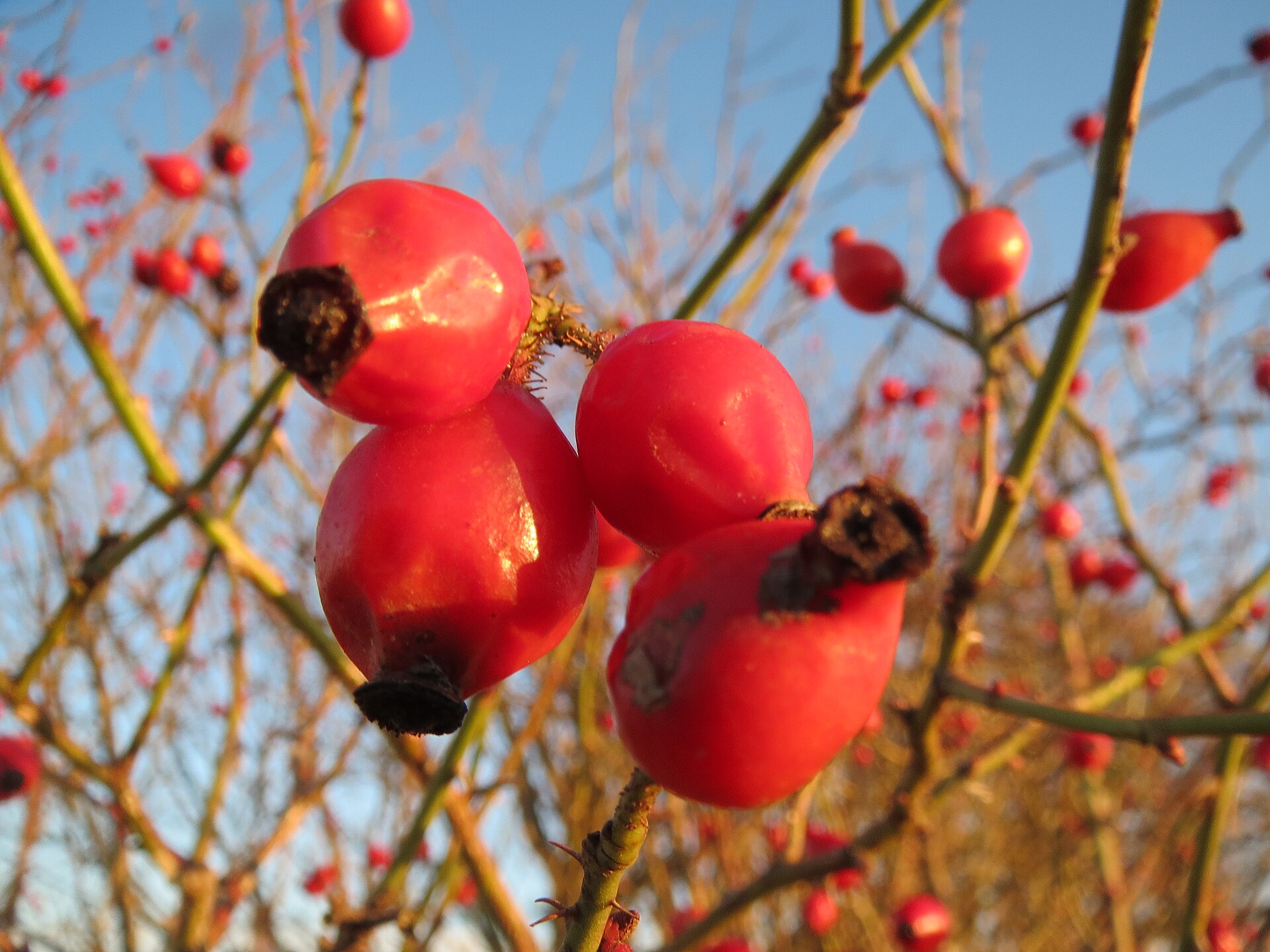
[Red rose hips hang from a dog rose branch, with leaves still attached. Photograph: AnRo0002]
Image Credits: Wikimedia Commons
Every rose has its thorns, or so the saying goes. The saying is wrong in two ways.
Botanists call the sharp points on a rose prickles, not thorns, and not every rose has them. The distinction matters, because it explains what the points are made of, how they evolved, and why some roses lost them.
This article explains the difference between thorns, spines, and prickles, why roses evolved prickles, how a single gene family controls them, and what thornless varieties and safe handling mean for gardeners.
Thorns, spines, and prickles are not the same
Plant sharp points fall into three groups by origin. Thorns are modified branches, with woody tissue and a blood supply of their own, in plant terms a vascular connection to the stem.
Honey locust trees and gooseberries carry true thorns. Spines are modified leaves, also with vascular tissue, as seen in cacti and holly.
Prickles are different. They grow from the outer layers of the stem, the epidermis and cortex, and they contain no vascular tissue.
The New York Botanical Garden's plant information service states the point plainly: roses have prickles, not thorns. Because prickles sit on the surface, they snap off sideways with a push, while a true thorn resists removal and tears the stem when forced.
The difference shows up in how the points are arranged. Thorns and spines appear at nodes, the points where leaves and branches emerge, because they are modified versions of those organs.
Prickles appear irregularly between nodes, in no fixed pattern, because they are surface outgrowths rather than converted organs. Anyone who has run a hand along a rose cane knows the random spacing from experience.
Defence against hungry animals
The main job of rose prickles is defence. A rose bush offers tender stems, leaves, and buds, all attractive to deer, rabbits, and other grazing animals.
Prickles make that meal painful and awkward. An animal that bites a prickly cane gets a mouthful of sharp points along with the leaf, and most learn to browse elsewhere.
The defence works best against larger animals. A deer cannot strip a cane without pressing its muzzle into prickles, and a rabbit faces the same problem at ground level. Small insects are less affected, since they can walk between prickles or feed on leaves from the edge.
Other rose troubles, such as black spot on the leaves, still need attention in their own right. Prickles are a large-herbivore defence, not an insect defence, and roses still need other protection against aphids and sawfly larvae.
Prickle shape varies with that job. Many rose prickles curve downward, like small hooks, which makes it hard for a climbing animal to ascend the stem.
Others stand straight out, which suits a bush that needs a bristling barrier in every direction. Dense prickles on lower stems protect the base, where rabbits feed, while sparser prickles higher up still guard the flowers.
The defence is not perfect, and roses show it. Deer still browse roses in hard winters when other food is scarce, and they eat the flower buds first.
Prickles raise the cost of eating a rose, but they do not make it impossible. In a hungry winter, cost matters less than calories.
Help for climbing roses
Prickles do a second job for climbing roses. Their hooked shape catches on nearby plants, fences, and trellises, letting a long cane anchor itself as it grows upward.
A climbing rose does not twine like a vine or grip with tendrils. It leans, sprawls, and hooks its way up, and prickles are the hooks.
This explains why climbing roses often have strongly curved prickles. A straight spike would push a support away, while a hook catches and holds. Gardeners who tie climbing roses to a support are working with this habit, guiding canes horizontally so the hooks catch and the plant covers the structure evenly.
Wild roses use the same trick in hedgerows. A wild rose scrambles over neighbouring shrubs, using prickles to stay in place while it reaches for light.
The rose gains height without building a thick trunk, which saves energy for flowering. That scrambling habit is why wild roses appear tangled in hedges rather than standing alone.
The climbing role also explains a trade-off. A rose bred for a tidy, upright bush may carry fewer or smaller prickles, since it does not need to climb.
A rose bred for a wall or pergola keeps its hooks. Prickle density is part of the variety's character, not a flaw to be judged on its own.
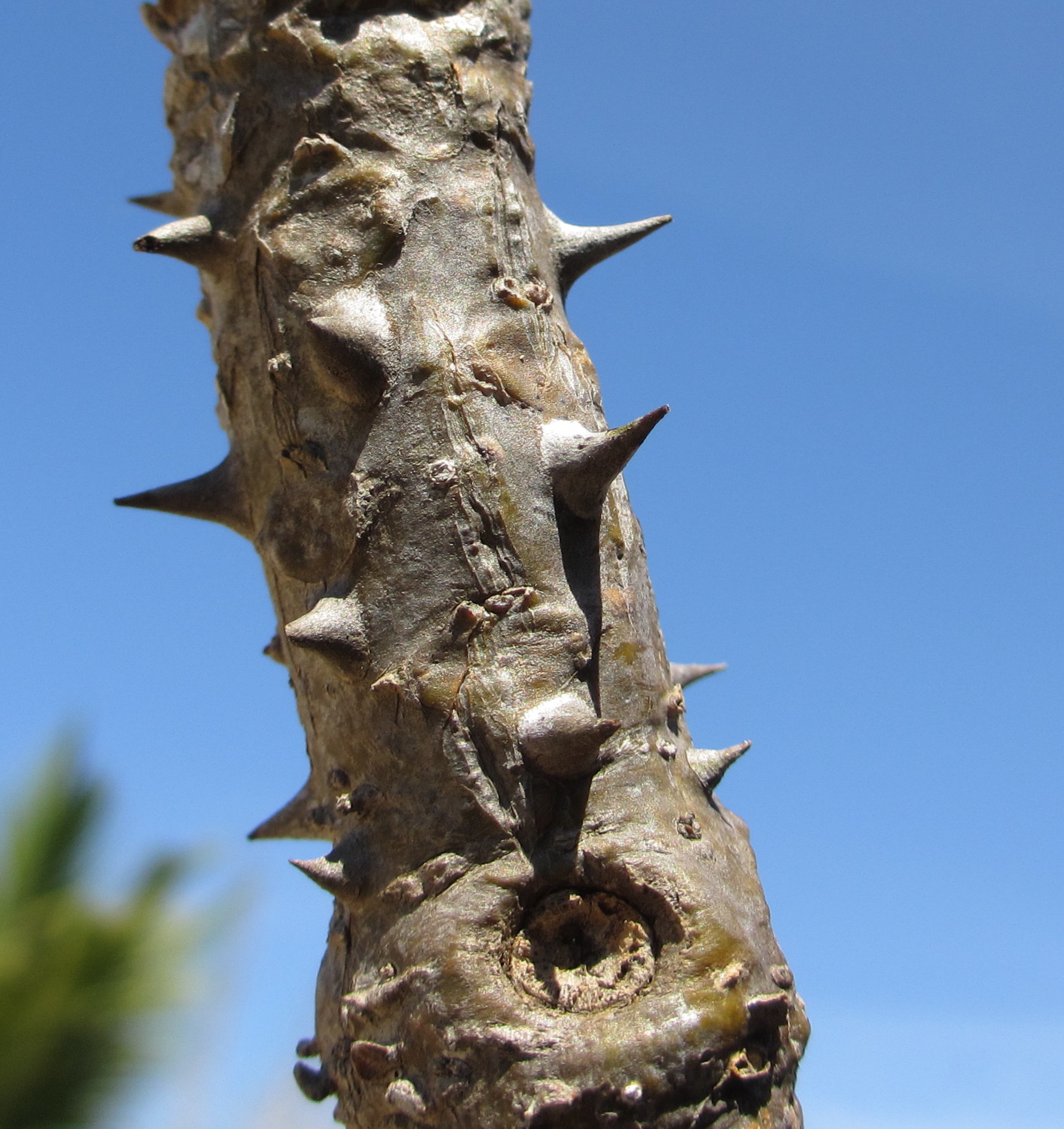
[Sharp prickles stand out along a branch, the same kind of surface outgrowth roses carry. Photograph: Wikimedia Commons contributor]
Image Credits: Wikimedia Commons
A gene story spanning millions of years
Prickles evolved more than once. The Howard Hughes Medical Institute (HHMI) reports that, over 400 million years, more than two dozen flowering plant species independently evolved prickles, including certain roses, eggplants, and Chinese pears. Each lineage arrived at sharp surface outgrowths on its own, which shows how useful the defence is.
The surprise came from the losses. Over at least 150 million years, prickle-less forms emerged independently in many of those same lineages, including a thornless rose.
Scientists wondered whether the same gene could explain both the gain and the loss. A study published in August 2024, led by plant geneticist Zachary Lippman at Cold Spring Harbor Laboratory, gave an answer.
The study found that mutations in the LONELY GUY, or LOG, gene family drove independent prickle losses in at least 16 cultivated and wild species. LOG genes were also responsible for prickle gain and loss in at least three other plants, including the thornless rose. In other words, one gene family acts as a switch for a structure that evolved many times.
Turn the switch one way and prickles appear. Turn it the other and they vanish.
That finding matters beyond botany trivia. Breeders who want thornless eggplants or roses can now look at the same genetic switch rather than breeding blindly for the trait.
It also shows that evolution reuses the same tools. Different plants, separated by millions of years, lost their prickles through changes in the same gene family.
Thornless roses and what they give up
Thornless roses exist, and they are popular for good reason. Varieties such as Zephirine Drouhin, a Bourbon rose, carry few or no prickles, which makes pruning and picking flowers far pleasanter. Gardens with children, narrow paths, or frequent cutting suit thornless types well.
A thornless rose gives up the defence its prickles provided. In a garden with deer or rabbits, a thornless rose is an easier meal than a prickly one, and it may need fencing or repellent where a prickly variety would cope alone. The trade is straightforward: comfort for the gardener against safety for the plant.
Thornless does not mean defenceless in every sense. A thornless rose still has the same leaves, scent, and growth habit, and it still attracts pollinators when in flower.
It simply lacks one layer of physical protection. Gardeners who choose it should plan for that gap, either by planting it in a sheltered spot or by protecting it during the seasons when grazing animals are hungriest.
Buyers should also check the variety description rather than the name. Some roses sold as thornless carry a few small prickles on young growth, and some prickly varieties carry the word smooth in their name for other reasons.
Handling prickly roses safely
Prickles deserve respect even from experienced gardeners. Thick gloves, long sleeves, and eye protection turn pruning from a scratching session into a routine job. Gauntlet-style gloves that cover the forearm help most, since rose canes whip back when cut and the forearm takes the worst of it.
Clean cuts matter for the plant as well as the gardener. A sharp pair of secateurs cuts a cane cleanly, while a blunt pair crushes it and leaves a wound that heals slowly.
Cut just above an outward-facing bud, so new growth heads away from the centre of the bush. For step-by-step technique, see how to prune a rose bush without killing it.
Prickle punctures can occasionally cause infection. The best-known risk is sporotrichosis, sometimes called rose thorn disease, caused by a fungus that can enter through a puncture.
It is uncommon, but a puncture that becomes red, swollen, or slow to heal deserves medical attention rather than home treatment. Washing punctures promptly and keeping tetanus vaccination up to date are simple precautions.
Disposal needs care too. Prickly prunings snag in compost and catch hands during later handling.
Bag them or chop them before composting, and keep them out of paths where bare feet or pets pass. A tidy pruning pile is a safety habit, not just tidiness.
Frequently asked questions
Do all roses have prickles?
No. Most garden roses carry prickles, but thornless varieties exist, and some wild roses carry very few. The 2024 LOG gene study showed that prickle loss evolved independently in several lineages, including the thornless rose, so the absence of prickles is a real trait, not a defect.
Are rose prickles the same as cactus spines?
No. Cactus spines are modified leaves with vascular tissue, while rose prickles are surface outgrowths without it. The two structures look similar and both deter animals, but they evolved from different plant parts and behave differently when removed.
Why do some roses have more prickles than others?
Prickle density varies by variety, age of cane, and position on the plant. Lower stems often carry denser prickles, where ground-level browsers feed, while upper stems carry fewer. Breeding for climbing habit, tidy bush shape, or thornlessness also changes density, since each goal favours a different prickle pattern.
Can I remove prickles from a rose stem?
Yes, and florists do it routinely when preparing cut roses. Prickles snap off sideways because they lack vascular tissue, so stripping a stem causes only shallow surface wounds.
The plant itself keeps its prickles, and new growth will carry them again, so stripping is a one-time fix for a bouquet, not a permanent change. For keeping cut stems fresh, see how to keep cut flowers alive longer in a vase.
The bottom line
Roses carry prickles, not thorns, and those prickles earn their keep. They deter grazing animals, help climbing roses grip their supports, and vary by variety in ways that reflect each rose's habit.
A single gene family, LOG, controls their presence across many plant lineages, which explains why thornless roses exist at all. Gardeners who know the difference can choose varieties with open eyes, prune with proper protection, and enjoy the flowers without cursing the stems that carry them.
Tags: roses, plant defences, prickles, garden plants
The Rive News research desk covers plant science and practical gardening, summarising published research for home gardeners without claiming field trials of its own.
Related
- How to prune a rose bush without killing it
- Why do your roses have black spots on the leaves
- Why roses stop flowering in midsummer and how to fix it
- How to keep cut flowers alive longer in a vase
Subscribe for one practical gardening explainer each week.
Rive News standards: facts are checked against public sources listed above; corrections are welcomed and applied promptly.
Related stories
What Is Companion Planting and Does It Work?
Marigolds work as a nematode cover crop, but the basil flavor claim failed repeated tests. An honest evidence review of what companion
Determinate vs. indeterminate tomatoes: growth, pruning, and harvest differences
Determinate tomatoes grow to a set size and ripen all at once, while indeterminate types vine all season. That one difference shapes
How to improve clay soil for gardening
Gypsum will not fix ordinary clay soil, say extension experts. What actually works: 2 to 3 inches of compost, mulch, better drainage,