
Why strawberries have seeds on the outside, explained
By Rive News / Research desk | Rive News / Published October 29, 2026 at 9:00 AM PKT
Key takeaways
- The dots on a strawberry are not seeds. Each is an achene, a tiny dry fruit holding one seed.
- The red flesh is the flower's receptacle, swollen and sweetened, not the ovary wall of a true fruit.
- A single strawberry carries about 200 achenes, which is why it counts as an aggregate accessory fruit.
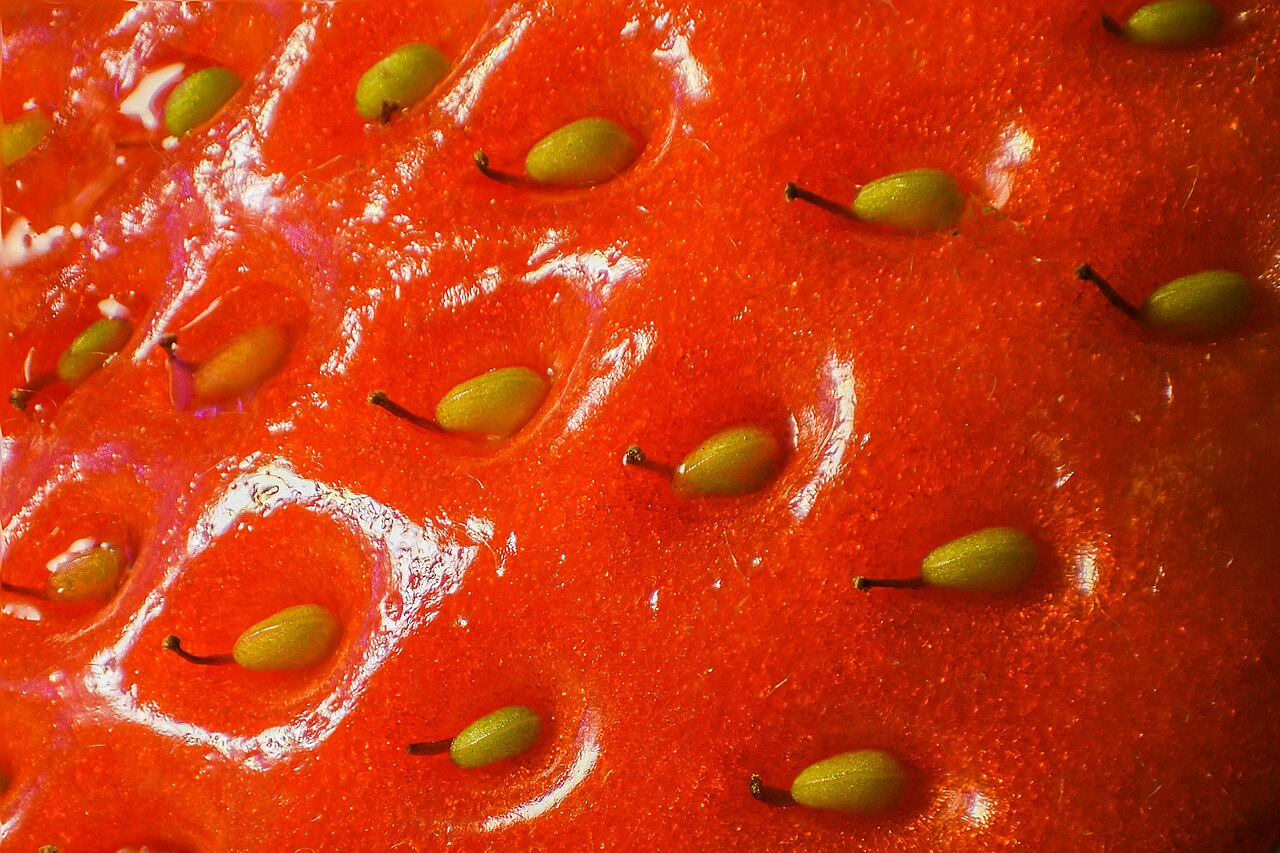
[A close-up of a strawberry surface showing its achenes.] Photograph: the strawberry
Image Credits: Wikimedia Commons
Almost every fruit hides its seeds inside. Cut open a grape, an apple, or a peach, and the seeds sit in the middle, wrapped in flesh. A strawberry breaks the pattern.
Its seeds appear to sit on the outside, dotted across the red skin like studs. The reason is that what you are looking at is not quite what you think.
This article explains the strawberry's anatomy, including achenes, the receptacle, and why the arrangement helps the plant spread, and why botanists say a strawberry is not a berry at all.
The dots are fruits, not seeds
The small yellow-brown specks on a strawberry are called achenes. An achene is a type of dry fruit that contains a single seed. Each speck is therefore a complete fruit in miniature, with its own seed sealed inside a hard wall.
A single strawberry usually carries about 200 achenes. That means eating one strawberry means eating about 200 tiny fruits at once, all stuck to the surface of something else. The "seeds on the outside" are really fruits on the outside, and the true seeds are hidden one layer deeper, inside each achene.
This flips the usual fruit structure. In a grape, the fleshy tissue is the ovary wall itself, and the seeds sit inside it.
In a strawberry, the ovary walls are the achenes on the surface. The flesh is something else entirely.
The red part is the flower's base
A strawberry flower starts with a cone-shaped receptacle in the centre, ringed by petals. Scattered across that cone are anywhere from about 150 to 400 separate pistils, each with its own ovary. After pollination, each ovary matures into one achene.
Meanwhile, the receptacle tissue underneath swells dramatically. It fills with water, sugars, and aromatic compounds, turning soft, red, and sweet. The achenes end up embedded in the surface of this enlarged receptacle, which is why the strawberry looks as though it wears its seeds outside.
Botanists call the strawberry an accessory fruit, or false fruit, because the edible portion develops from tissue other than the flower's ovary. Apples and pears are accessory fruits too.
In an apple, the fleshy part comes from the hypanthium, a cup of fused tissue at the base of the flower, while the core is the true fruit. The strawberry makes the split more dramatic because its true fruits sit right on the surface for everyone to see.
The growth of the receptacle is driven by the achenes themselves. As they develop, they produce hormones that signal the receptacle to swell and ripen. Without fertilised achenes, the receptacle stays small and misshapen, which is why poorly pollinated strawberries grow lumpy and deformed.
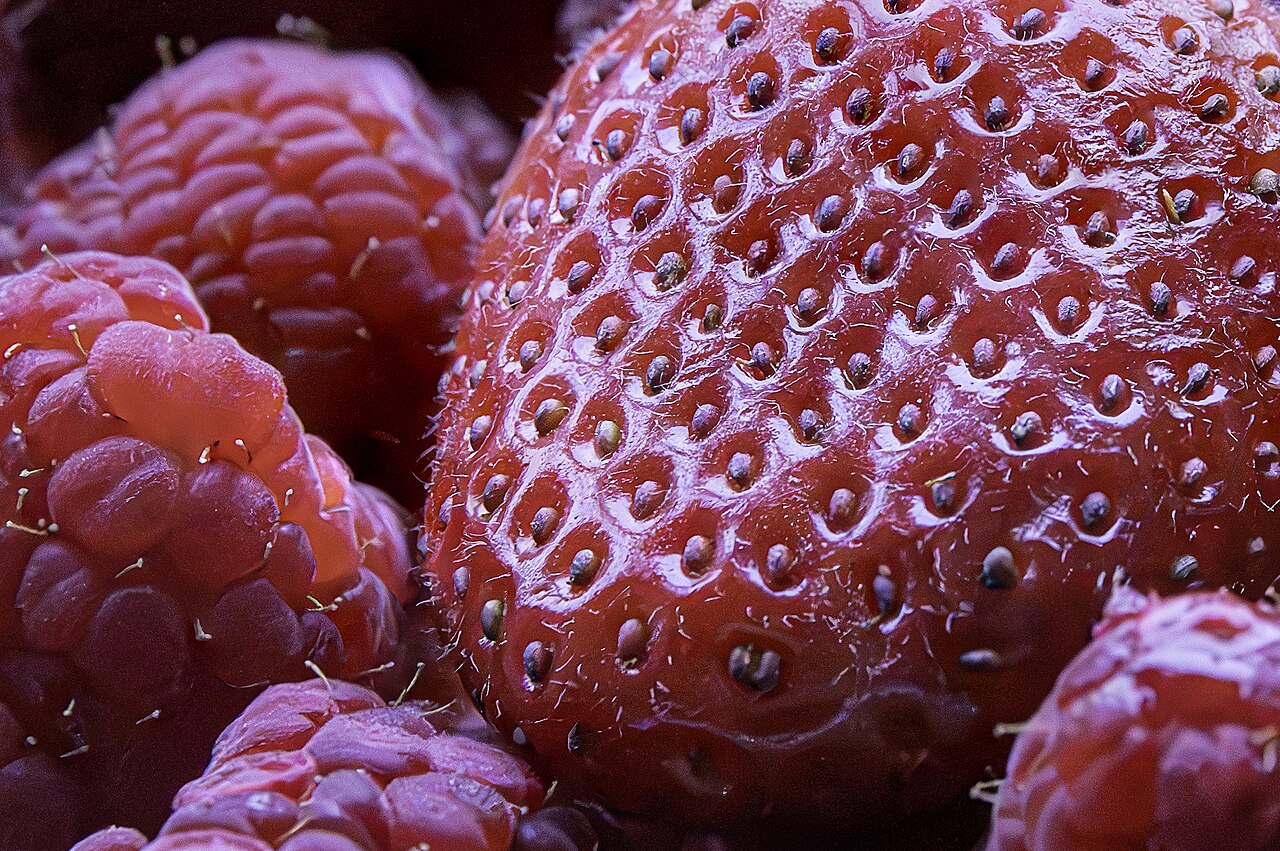
[A macro view of a ripe strawberry and its achenes.] Photograph: the strawberry
Image Credits: Wikimedia Commons
Why the genes moved house
The deeper explanation sits in the plant's genes. In most fruits, the genes that make flesh soft, sweet, and colourful switch on in the ovary wall. In the strawberry, those same genes are expressed in the receptacle instead.
Aaron Liston, a botanist cited by Live Science, put it plainly: the genes that would typically be expressed in the fruit are now expressed in the receptacle. The result is a sweet, red structure that does the job of a fruit, attracting animals, even though it is not one in the botanical sense.
Gene expression analysis backs this up. Achene tissue and receptacle tissue are highly distinct at the molecular level, with large proportions of their active genes differing by more than fourfold between the two tissue types.
The seed and the flesh are not just different structures. They run different biological programs side by side.
Why outside beats inside
The arrangement works well for spreading seeds. The sweet receptacle attracts birds, mammals, and reptiles, which eat the strawberry and carry the achenes away. Aardra Kachroo, a program director in the Directorate for Biological Sciences at the US National Science Foundation, told Live Science that the achenes are not attached very strongly to the receptacle, and that loose attachment promotes dispersal.
Some achenes pass through an animal's gut and land in new ground with a dose of fertiliser. Others fall off while the fruit is being eaten, or drop near the parent plant. Either way, the seeds travel further than they would if they were locked inside a pit.
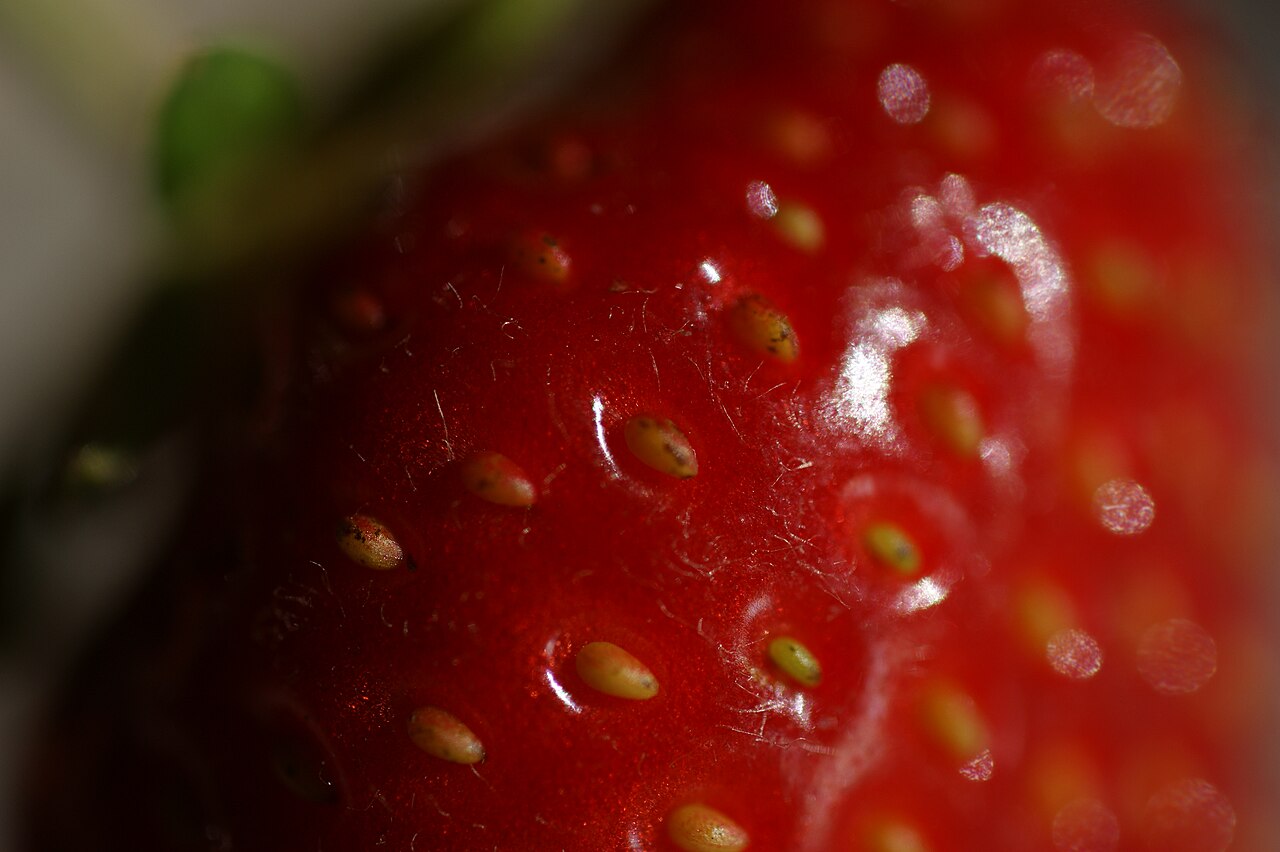
[A macro view of a strawberry's dotted surface.] Photograph: the strawberry
Image Credits: Wikimedia Commons
The strategy has paid off. Liston noted that wild strawberries can now be found all over the globe, and called the arrangement a very good evolutionary trick. The strawberry genus, Fragaria, has spread across continents on the back of a fruit that is not a fruit.
The plant does not rely on seeds alone. If conditions are poor and seed spread fails, a strawberry plant can send out runners, horizontal stems that root and start new plants. Seeds give genetic variety.
Runners give reliable copies. The combination is part of why strawberries are so common in gardens and in the wild.
Why a strawberry is not a berry
Botanists define a berry narrowly: a fleshy fruit from a single ovary, with seeds embedded in the flesh. Grapes and bananas qualify.
Strawberries fail on both counts. They come from many ovaries, not one, and their seeds sit outside the flesh, not inside it.
That makes the strawberry an aggregate accessory fruit. Aggregate, because it forms from many ovaries of one flower.
Accessory, because the part you eat is not ovary tissue. The mock strawberry, Duchesnea indica, a distant relative, looks almost identical and shares the same structure, though Liston notes it tastes like styrofoam rather than sweet.
The everyday word "berry" is broader than the botanical one, so calling a strawberry a berry at the table is harmless. In a botany class, it is wrong, and the outside seeds are the giveaway.
Frequently asked questions
Can you grow strawberries from the seeds on the outside?
Yes, but it takes patience. You can scrape off achenes, dry them, and plant them in soil.
Seed-grown plants may not match the parent, because cross-pollination mixes traits. Most growers prefer runners, which produce genetically identical plants faster.
How many seeds does a strawberry have?
About 200 achenes sit on a typical strawberry, though counts range from roughly 150 to 400 depending on variety and size. Each achene holds one true seed, so one strawberry carries about 200 seeds in total.
Are strawberry seeds safe to eat?
Yes. The achenes are small, hard, and harmless, and they pass through the gut intact. They add the slight crunch and texture that makes a strawberry feel different from a smooth-skinned fruit.
Why are some strawberries lumpy or misshapen?
Lumpy berries usually mean uneven pollination. Each achene drives the swelling of the receptacle beneath it, so areas with unfertilised ovaries stay small while fertilised areas swell. The result is a berry with dents and bulges rather than an even shape.
The bottom line
Strawberries have seeds on the outside because the dots are achenes, tiny true fruits, and the red flesh is the flower's receptacle, swollen and sweetened by the genes that normally build a fruit. The arrangement looks backwards, but it works: animals eat the sweet receptacle, the loosely attached achenes travel, and the plant spreads across the globe.
Next time you eat a strawberry, remember you are eating about 200 fruits at once, stuck to a flower base pretending to be a berry. The trick has worked for millions of years, and it is still working in gardens everywhere.
Tags: gardening, strawberries, plant science
The Rive News research desk writes plain-language explainers from published research and institutional sources.
Related
- How to Grow Strawberries From a Hanging Basket
- Why Do Plants Lean Toward the Window? Phototropism Explained
- Why Do Apple Trees Fruit Heavily Only Every Other Year?
Subscribe for one plain-language gardening explainer each morning.
Rive News standards: every factual claim in this article traces to a named public source listed above; corrections are published, never silently edited.
Related stories
What Is Companion Planting and Does It Work?
Marigolds work as a nematode cover crop, but the basil flavor claim failed repeated tests. An honest evidence review of what companion
Determinate vs. indeterminate tomatoes: growth, pruning, and harvest differences
Determinate tomatoes grow to a set size and ripen all at once, while indeterminate types vine all season. That one difference shapes
How to improve clay soil for gardening
Gypsum will not fix ordinary clay soil, say extension experts. What actually works: 2 to 3 inches of compost, mulch, better drainage,