
Why won't my hydrangea bloom? Causes and how to fix each one
Key takeaways
- Bigleaf and oakleaf hydrangeas set flower buds on last season's wood, so fall or spring pruning cuts off next summer's blooms.
- Late frosts can kill old-wood buds even when pruning is perfect. That is the other classic cause of a leafy, flowerless shrub.
- Too much nitrogen fertilizer, deep shade, and last year's drought also suppress blooms. Identify your hydrangea's type before touching the shears.
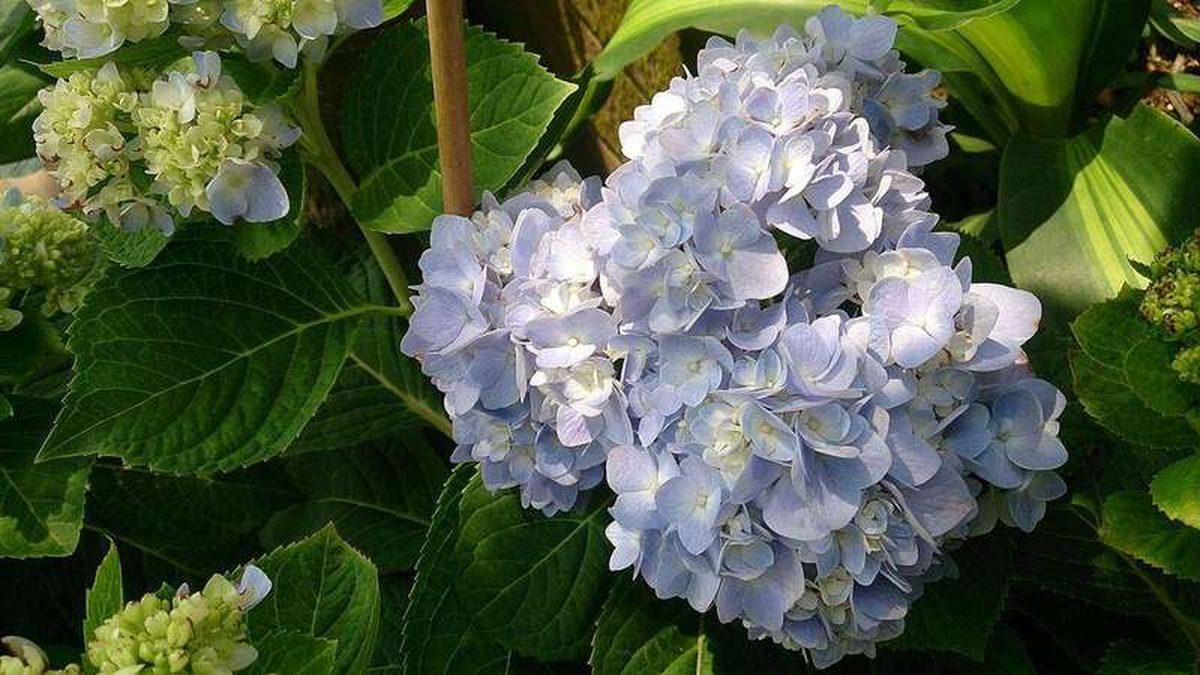
A bigleaf hydrangea in full bloom, the result that mistimed pruning quietly steals from you. Photograph: Mokkie/Wikimedia Commons
Image Credits: Wikimedia Commons
A hydrangea that refuses to bloom is almost never a sick plant. It is usually a healthy plant whose flower buds were removed, frozen, or never formed in the first place. The leaves look lush, the stems look fine, and the flowers simply never arrive.
The single most important fact about hydrangeas is that different types set their buds on different wood. Get that wrong and every "tidy-up" cut in fall or spring deletes next summer's display. Get it right and the fix is usually to do less, not more.
This article takes a closer look at why hydrangeas fail to bloom. It covers which types bloom on old wood, how pruning timing destroys buds, what late frosts and shade do, and how to get your shrub flowering again.
Your hydrangea's type decides everything
Hydrangeas fall into two flowering groups, and the group determines when you can safely prune. Bigleaf hydrangeas (Hydrangea macrophylla) and oakleaf hydrangeas (Hydrangea quercifolia) bloom on old wood, meaning stems grown during the previous season.
Smooth hydrangeas (H. arborescens) and panicle hydrangeas (H. paniculata) bloom on new wood, the current season's growth.
According to NC State Extension's Macon County Center, the two main reasons bigleaf hydrangeas fail to bloom are a cultivar developed for a warmer climate than the local one, and pruning at the wrong time of year. Old wood develops in late summer and fall, and any pruning after buds form removes the next summer's blooms.
Reblooming cultivars blur the line but do not erase it. The University of Maryland Extension classifies some bigleaf and mountain hydrangeas as remontant, meaning they can flower on both old and new wood. That gives a safety net on fresh growth, but the old stems still hold buds for the first flush, so treating a rebloomer like a new-wood type can cost you the early show.
If you do not know which type you have, do not guess with the shears. Penn State Extension and UGA Extension both advise the conservative approach: remove only wood that is clearly dead, diseased, or damaged, and wait a season to see where buds form. One year of evidence beats a confident cut made in ignorance.
Pruning at the wrong time is the number one cause
For old-wood types, the safe pruning window is short. NC State Extension says the safest time to prune bigleaf hydrangeas is immediately after flowering, because buds for the next season begin forming soon after. Cut in late summer, fall, or early spring and you are cutting off flowers, not encouraging them.
Extension Master Gardener Marti Engelke describes the classic version of this mistake: she pruned her large blue hydrangea in early March, and not a single bloom emerged that year despite a healthy plant. For H. macrophylla, pruning right after flowering (usually August) is the correct move, and harsh pruning is not recommended.
Deadheading is different from pruning and does not carry the same risk. NC State's woody ornamentals guidance, cited by Complete Gardening, says to cut just the spent flower stem back to a healthy set of leaves or a strong lateral bud. That cosmetic cut leaves next year's buds intact.
New-wood types are the forgiving ones. UGA Extension advises pruning smooth and panicle hydrangeas in late winter or early spring, before new growth begins, since they flower on wood that does not exist yet. Some growers cut 'Annabelle' types to the ground each winter and still get full bloom on straight stems the following summer.
Late frosts and winter cold kill buds you never touched
Sometimes you did everything right and still got no flowers. Late spring frosts are the likely culprit. NC State Extension notes that some regions get a false early spring, and then a cold snap hits the tender new growth.
Buds on old wood are exposed and vulnerable. One hard freeze can end the season before it starts.
Severe winter cold and freeze-thaw cycles can do the same damage earlier. Complete Gardening, drawing on Penn State and UGA Extension guidance, notes that a temporary cover over bigleaf hydrangea stems when a hard freeze threatens can reduce bud injury. Remove it when temperatures rise.
A 3 to 5 inch layer of pine straw, bark, or dry leaves over the root zone helps the plant come through winter in better shape, according to the same extension-backed guidance. Keep the mulch away from the stems and crown, where trapped moisture invites rot.
Note that even careful preparation cannot eliminate every risk. Severe cold, late frosts, and wind can still damage buds despite your best efforts. That is the honest limit of what fall preparation can do.
Too little light and too much fertilizer
Hydrangeas have a reputation as shade plants, and that reputation causes no-bloom problems. The Chicago Botanic Garden calls it a common misconception that hydrangeas thrive in full shade with no direct sun. They can survive there, but they will not bloom well.
Some species need full sun with adequate moisture. Others prefer afternoon shade when the sun is strongest.
Fertilizer is the other quiet bloom-killer. The Chicago Botanic Garden advises against fertilizing hydrangeas at all unless a nutrient deficiency shows up. Too much nitrogen produces excessive green growth at the expense of flowers, which is exactly the symptom many frustrated gardeners describe: huge lush leaves, zero blooms.
If you do fertilize, know what the numbers on the bag mean. A high-nitrogen lawn fertilizer drifting onto a hydrangea bed can be enough to push foliage over flowers.
Our guide to what NPK numbers on fertilizer actually mean explains how to read the label so you stop guessing.
Soil chemistry affects color, not blooming, but it is worth knowing since it confuses the diagnosis. Acidic soil around pH 5.0 to 5.5 turns bigleaf blooms blue. Higher pH around 6.0 to 6.5 turns them pink, according to NC State Extension. A color change is a pH story, not a bloom story.
Last year's drought may be this year's empty shrub
Old-wood hydrangeas prepare next year's display during the previous summer and fall. Severe drought, excessive heat, transplant shock, or root trouble during that window can reduce bud formation. As GFL Outdoors puts it, the reason for this summer's missing flowers may have happened months ago.
A newly planted bigleaf hydrangea may also spend its first season building roots instead of flowers. That is normal establishment behavior, not a defect. Avoid trying to force it with extra fertilizer or repeated pruning. Both make the situation worse.
Consistent, deep watering during dry spells matters more than frequent sprinkling. Hydrangeas dislike both bone-dry soil and roots sitting in constantly soggy ground.
If you are unsure which problem you have, the two-step soil check for watering problems gives a fast field diagnosis.
How to get your hydrangea blooming again
Start by identifying the plant. Look for the cultivar name on the original tag or in your purchase records, or take photos to your local extension office. Once you know the type, you know the rules.
For old-wood types, stop all shaping cuts and prune only immediately after flowering. Remove dead, diseased, or broken branches any time, since that wood was never going to bloom. Watch where buds form next spring before making another decision.
Move the plant out of deep shade if it gets almost no direct sun. Hydrangeas need morning sun and afternoon shade in hot climates, or more sun in cool ones.
Also improve drainage if the soil stays soggy. Fixing heavy clay soil helps roots stay healthy enough to set buds.
Cut back the fertilizer, especially high-nitrogen formulas. If the leaves look normal green and healthy, the plant is not starving. Feeding it more just grows bigger leaves. Mulch 2 to 3 inches over the root zone to keep moisture even through summer.
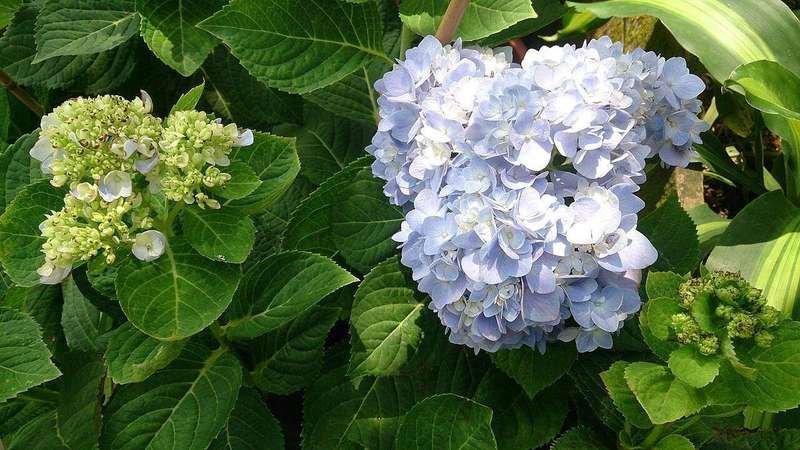
Flower buds forming on a healthy bigleaf hydrangea, the structures that fall pruning would remove. Photograph: Mokkie/Wikimedia Commons
Image Credits: Wikimedia Commons
Finally, protect the buds through winter. Mulch the root zone, and in freeze-prone areas, cover the shrub when a hard freeze is forecast.
Then leave it alone. Many gardeners' no-bloom problem resolves the first year they simply stop cutting.
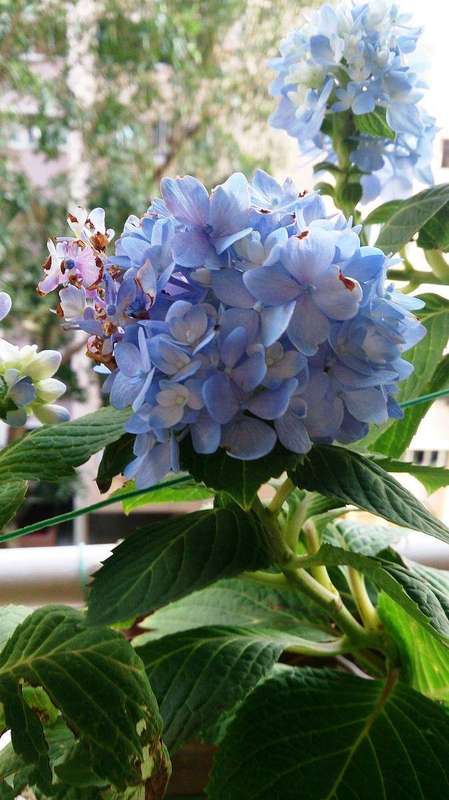
Healthy blue blooms on a mature shrub, what the right pruning schedule and a frost-free spring produce. Photograph: Mokkie/Wikimedia Commons
Image Credits: Wikimedia Commons
Frequently asked questions
Why does my hydrangea have lots of leaves but no flowers?
The most likely cause is pruning an old-wood type at the wrong time, or a late frost killing the buds. Both leave the foliage untouched while the flowers never appear. Check whether your variety blooms on old or new wood before doing anything else.
Should I prune my hydrangea in the fall?
Not if it is a bigleaf or oakleaf type. Fall pruning removes the buds that were set during summer, and you will get no blooms the next season. Only smooth and panicle hydrangeas, which bloom on new wood, tolerate fall or late-winter pruning.
Will my hydrangea bloom again if I just leave it alone?
Often, yes. If the cause was bad pruning timing, one full season of growth with no cutting usually restores the bud supply. If the cause is a late frost that killed the buds, the shrub will try again next year on its own.
Does fertilizer help a hydrangea bloom?
Rarely, and it often hurts. Too much nitrogen pushes leafy growth at the expense of flowers, and extension guidance says not to fertilize unless a deficiency is visible. Fix light, water, and pruning timing first.
The bottom line
Identify the type, time the pruning, and protect the buds. Most no-bloom hydrangeas are not broken plants. They are healthy plants whose flowers were cut off or frozen off.
Do less, but do it at the right moment: prune bigleaf and oakleaf types right after flowering, give new-wood types their late-winter cut, and leave everything else alone. The blooms usually come back on their own schedule.
Rive News is the research desk behind the Rive News production run, writing practical explainers across gardening, careers, education, and more.
Latest in gardening
- How to tell overwatering vs underwatering in plants: finger test and weight method
- What NPK fertilizer numbers actually mean
- How to improve clay soil for gardening
- Why tomato leaves turn yellow from the bottom
Get one practical explainer in your inbox every morning. Subscribe to the Rive News newsletter.
Corrections: spotted an error in this article? Email the research desk and we will verify and fix it promptly.
Related stories

What Is Companion Planting and Does It Work?
Marigolds work as a nematode cover crop, but the basil flavor claim failed repeated tests. An honest evidence review of what companion

Determinate vs. indeterminate tomatoes: growth, pruning, and harvest differences
Determinate tomatoes grow to a set size and ripen all at once, while indeterminate types vine all season. That one difference shapes

How to improve clay soil for gardening
Gypsum will not fix ordinary clay soil, say extension experts. What actually works: 2 to 3 inches of compost, mulch, better drainage,