
Why babies grab your finger so tightly after birth
By Rive News / Research desk | Rive News / Published October 29, 2026 at 9:00 AM PKT
Key takeaways
- The tight grip is the palmar grasp reflex, an automatic response, not a deliberate choice by the baby.
- Pressure on the palm pulls tendons that curl the fingers shut, which is why the grip feels far stronger than a newborn's muscles suggest.
- The reflex appears before birth and usually fades between 2 and 6 months as voluntary control takes over.
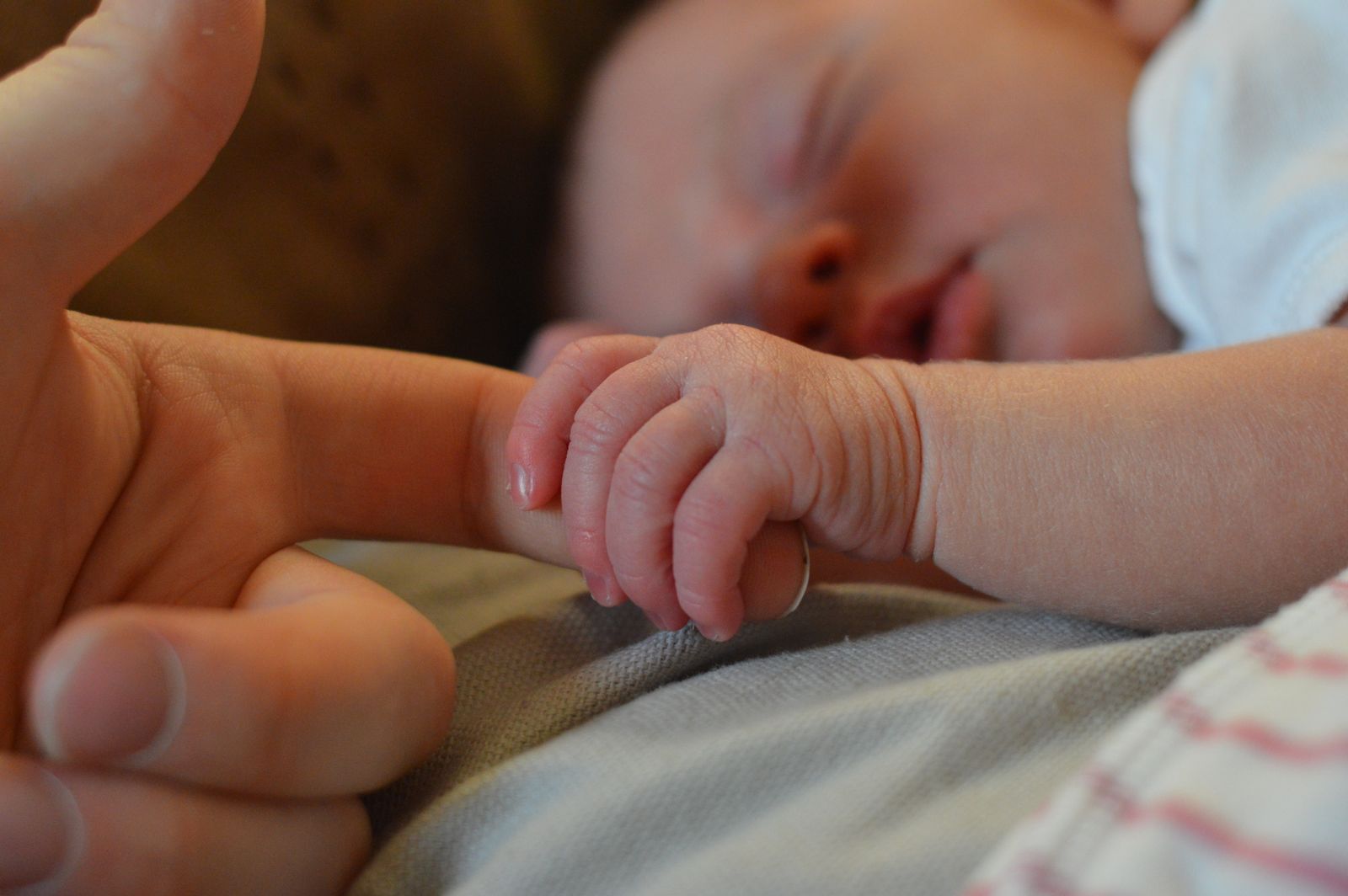
[A newborn's tiny hand wraps around an adult's finger in a close-up.] Photograph: Wayne Evans
Image Credits: Pexels
Offer a newborn your finger and the tiny hand clamps down with surprising force. The grip can feel strong enough to hold on, and in a sense it is, because it is not powered by a baby's decision or by bulky muscle.
It is a reflex, wired to fire automatically when something presses into the palm. This article explains how that reflex works, why it is so strong, and when it normally disappears.
What the palmar grasp reflex is
The palmar grasp reflex is one of the primitive reflexes babies are born with. When an object, such as an adult finger, is placed in an infant's palm, the infant's fingers reflexively grasp it, according to the reflex's description on Wikipedia.
The key word is reflexively. The baby is not choosing to hold on, and cannot choose to let go. The signal runs through a spinal reflex, triggered by stimulation of tendons in the palm and transmitted through motor neurons in the median and ulnar sensory nerves.
That routing matters. The signal bypasses the conscious, voluntary brain centres, which is why the response is instant and why it appears before a baby can do almost anything on purpose.
The reflex is not unique to humans. It is found in infants of humans and most primates, and biologists link it to the way young primates cling to a fur-carrying parent while the parent moves and forages.
Why the grip feels so strong
A newborn's grip seems out of proportion to its size, and the explanation is mechanical rather than muscular. When something presses against the palm, the pressure tugs on the tendons running to the fingers, and that traction pulls the fingers shut and keeps them clamped.
ScienceABC describes the response as unfolding in two stages. First comes finger closure, where the fingers flex to wrap around the object. Then comes clinging, where continued pressure on the palm locks the grip in place.
The thumb mostly sits out the early reflex, which is why the grip looks like four fingers curling rather than a full adult-style grasp. Even without the thumb, the lock is firm enough to surprise most adults the first time they feel it.
The strength is not a modern anecdote. As far back as 1891, a researcher named Louis Robinson tested the grip directly, having more than 60 infants under a month old grip a horizontal rod.
Nearly all of them could hang from their own hands for at least 10 seconds. One newborn held on for 2 minutes and 35 seconds, supporting its entire body weight. That is a reflex doing the work, not a baby showing off strength it understands.
When the reflex appears and disappears
The reflex starts before birth. A fetus exhibits it in the womb by 28 weeks into gestation, and sometimes as early as 16 weeks, according to the sources cited on Wikipedia.
After birth, it persists until rudimentary fine motor skills develop, generally between 2 and 6 months of age. Heloa's paediatric summary puts the typical window at 4 to 6 months, when maturation of the brain's higher regions tips the balance from reflex to intention.
The handover is gradual. Around 4 months, a baby begins an ulnar palmar grasp, holding an object placed in the palm while wrapping one or two fingers around it, without the thumb taking part yet.
Later, voluntary grasping replaces the reflex entirely. The baby reaches, chooses, holds, and, crucially, releases. Release is the skill the reflex never had, because a reflex cannot decide to stop.
Why the reflex fades at all
Fading is not a loss of ability. It is a promotion. As the cerebral cortex matures, it gains control over the hands, and the automatic pattern gives way to purposeful movement.
That control is what lets a baby progress from clutching whatever touches the palm to reaching for a chosen toy, transferring it between hands, and eventually using a pincer grip between thumb and finger.
If the reflex lingers well past 6 months, or if one hand grips much more strongly than the other, Heloa advises checking with a paediatrician about neurological development. Asymmetry and persistence are the two signs worth a professional look, not the grip itself.
Parents should also never test the old hanging experiment at home. The 1891 result is a historical finding, not a game, and a baby cannot protect itself if the grip releases.
What the grip is not
The grip is not affection in the adult sense, even though it feels like it. A newborn cannot intend a gesture of love, and the reflex fires whether the finger belongs to a parent, a sibling, or a doctor.
That does not make the moment meaningless. The reflex creates interaction and contact, and researchers have noted that it lays the foundation for voluntary grasping later. Bonding grows around these early contacts, even when the contact itself is automatic.
It is also not a sign of unusual strength or advanced development. A strong reflex is normal, and so is a slightly weaker one on a sleepy day. Reflexes vary with state, just as adult responses do.
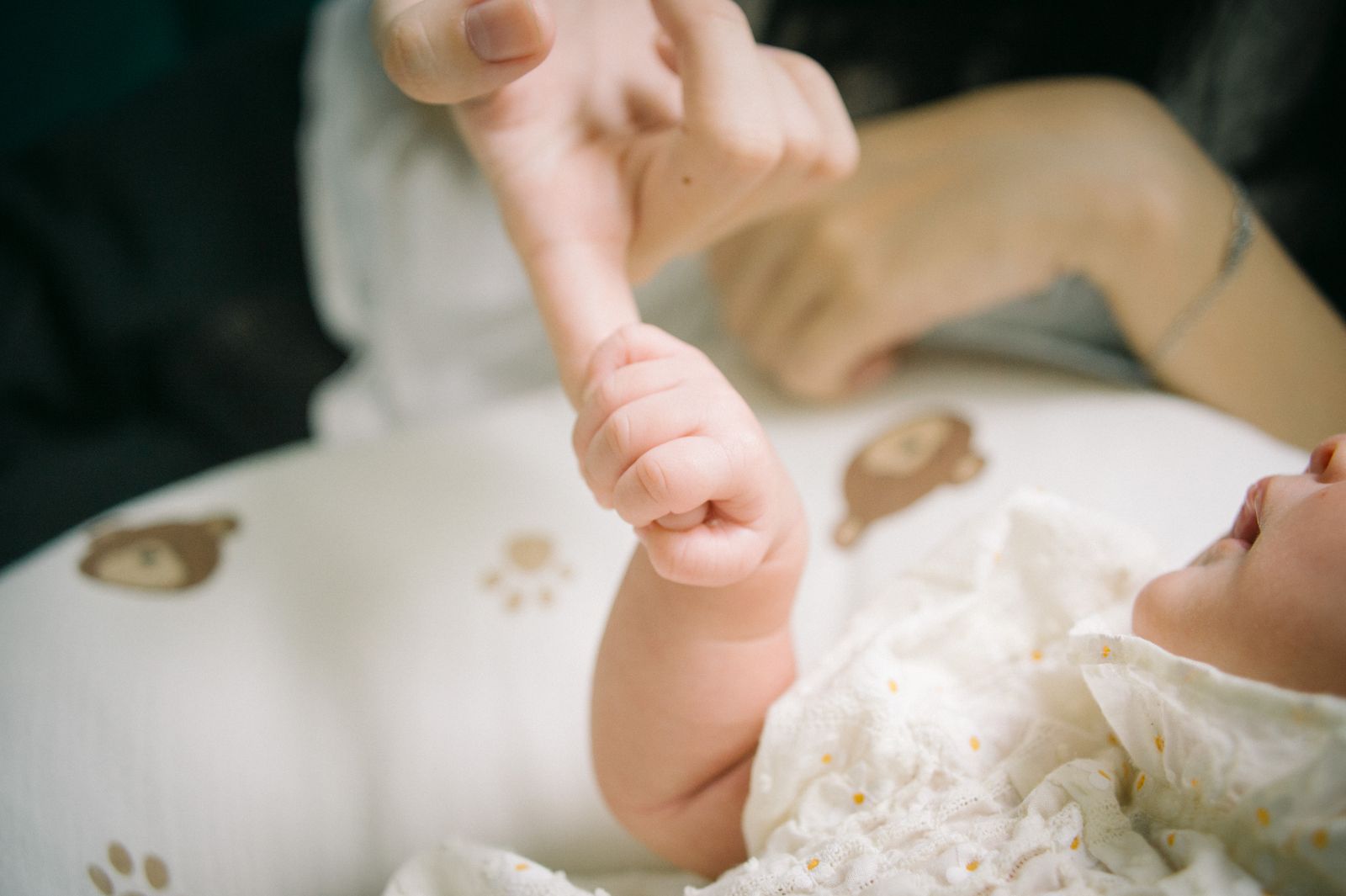
[A baby's hand grips a parent's finger, showing the automatic palmar grasp reflex in action.] Photograph: a baby holding a parent's finger
Image Credits: Pexels
How the reflex fits with other newborn reflexes
The palmar grasp is one member of a family of primitive reflexes, alongside rooting, sucking, the Moro reflex, the tonic neck reflex, and the stepping reflex. Each is an automatic pattern that helps a newborn survive and learn before conscious control arrives.
A related reflex lives in the feet. The plantar grasp reflex curls the toes when the sole of the foot is pressed, and it typically sticks around longer, until about 9 to 12 months.
Doctors check these reflexes at routine visits because their presence, symmetry, and timing give a simple window into how the nervous system is maturing. No single check decides anything on its own, but the pattern across checks is informative.
Frequently asked questions
Is it normal for a baby's grip to feel painfully tight?
Yes, within reason. The reflex grip is firm because tendon traction locks the fingers shut, and it can feel surprisingly strong for such a small hand.
When should a baby start letting go on purpose?
Voluntary release develops gradually from around 3 to 5 months, as the reflex fades and cortical control grows. Early on, prising the fingers open gently, or stroking the back of the hand, can help release the grip.
What if the reflex lasts past 6 months?
A reflex that clearly persists well beyond 6 months, or that is much stronger on one side, is worth raising with a paediatrician. Persistence alone is a prompt for a check, not a diagnosis.
Can a baby really support its own weight with this grip?
Historically, yes, briefly. Louis Robinson's 1891 tests found newborns hanging from a rod for 10 seconds or more, with one holding on for 2 minutes and 35 seconds. Never test this at home.
The bottom line
Babies grab your finger so tightly because the palmar grasp reflex turns palm pressure into a locked finger curl, using tendon traction rather than deliberate muscle effort. The reflex appears before birth, peaks in the early weeks, and hands over to voluntary grasping between about 2 and 6 months.
Enjoy the grip for what it is: an early piece of wiring doing its job, and the first step toward a hand that will one day reach, choose, and let go on purpose.
Tags: babies, child development, reflexes
The Rive News research desk covers everyday science and parenting questions, checking claims against published sources before writing.
Related
- Why babies babble before they can talk at all
- Why do babies put everything in their mouths?
- Why babies cry when you leave the room
- Why toddlers hide by covering their own eyes
Subscribe for one clear, sourced answer to an everyday question in your inbox each morning.
Rive News publishes explainers checked against public sources; corrections are welcomed and noted on the article.
Related stories
Why babies cry more in the evening: the witching hour explained
The witching hour is the fussy evening stretch most newborns hit daily. Why overtiredness, cluster feeding, and overstimulation stack up
When Do Babies Start Sleeping Through the Night by Month?
Most babies sleep through the night between 3 and 6 months, with regressions at 4 and 8 to 10 months. See the month-by-month table
Why Your Baby Wakes Up the Second You Put Them Down
Newborns wake when put down as the startle reflex, light sleep, and lost warmth hit at once. It is normal and peaks early, fading