
Why cats stare at walls for no apparent reason
By Rive News / Research desk | Rive News / Published October 27, 2026 at 9:00 AM PKT
Key takeaways
- A cat staring at a wall is usually listening or watching something too small, faint, or high-pitched for a person to notice.
- Cats hear sounds up to about 64,000 hertz, roughly three times the upper limit of human hearing.
- Occasional staring is normal, but frequent blank episodes with twitching or unresponsiveness deserve a veterinary check.
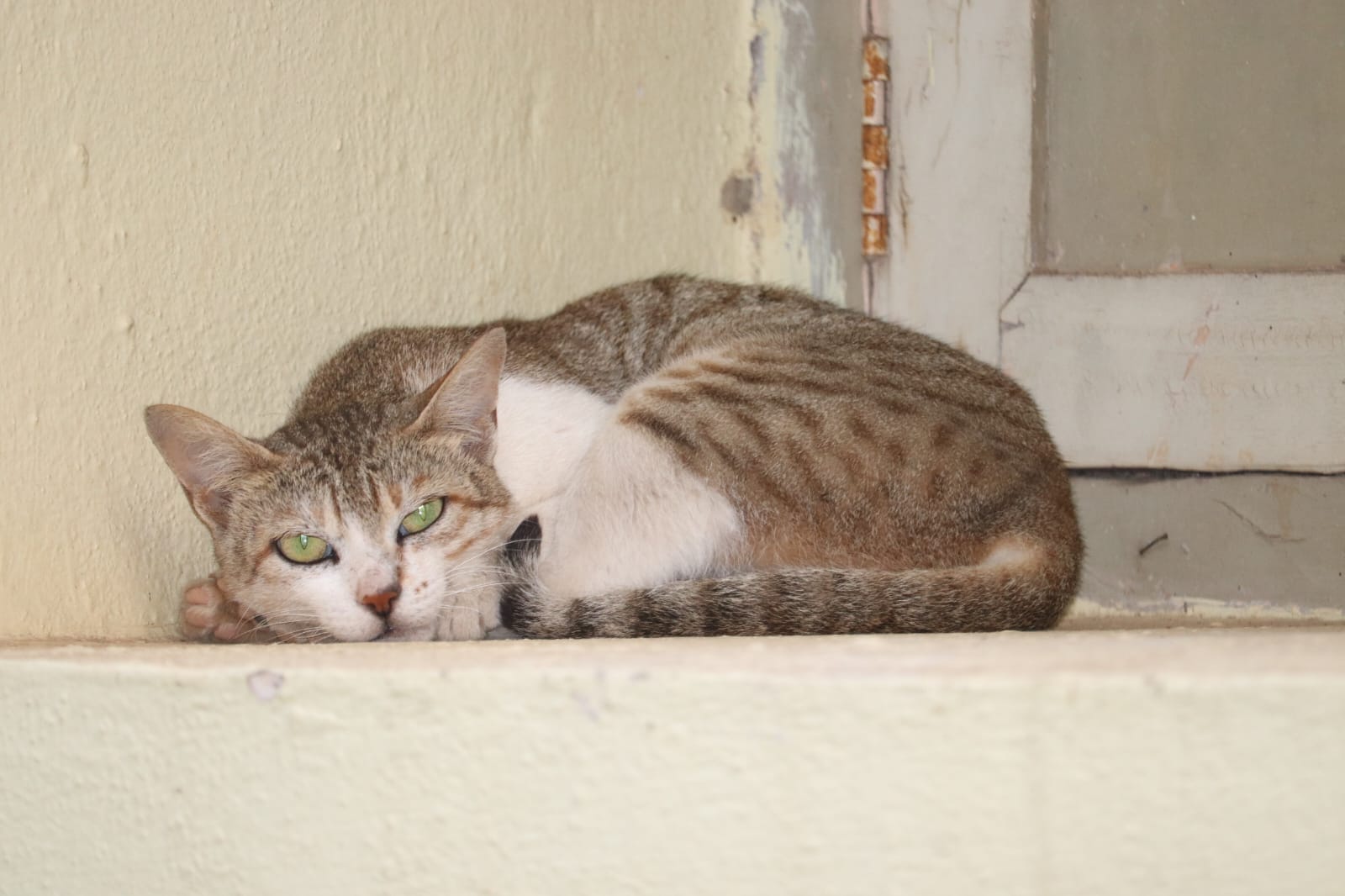
[A cat sits upright on a wall, ears forward and gaze fixed on something out of frame.] Photograph: Wikimedia Commons contributor
Image Credits: Wikimedia Commons
A cat staring at a blank wall is almost never staring at nothing. The wall looks empty to you because your senses miss most of what is happening on and behind it. Your cat's ears, eyes, and hunting brain pick up a different version of the same room.
This article explains what your cat is probably sensing when it locks onto a wall, including the hearing and vision behind the behaviour, and the rare cases where staring is a medical warning sign.
What wall staring actually is
Wall staring is a fixed gaze at a spot where a person sees no obvious target. The cat may sit still, crouch low, or stand with its body tense. Its ears often rotate independently, and its pupils may widen.
Behaviour specialists describe this as attention, not daydreaming. The cat has detected a stimulus and is deciding whether it matters. That stimulus might be a sound behind the plaster, a dust mote drifting through light, or a shadow shifting as a cloud moves past the sun.
The behaviour shows up most at night because cats are most active around dawn and dusk, and because a quiet house at night leaves faint sounds with less competition. A cat that stares at the same wall section repeatedly may also be returning to a spot where it once heard or saw something interesting.
Hearing things you cannot hear
Hearing is the most likely explanation for most wall staring. Cats can hear sounds up to about 64,000 hertz, while human hearing tops out near 20,000 hertz. That gap covers the high-pitched squeaks of mice, the faint scratching of insects, and the hum of some electronics.
A cat's ears are built for this job. Each outer ear holds about 32 muscles, compared with six in a human ear, and the ears can swivel up to 180 degrees to pinpoint a source. Research summarised in the Cat senses literature reports that cats can judge the location of a sound made one metre away to within about 8 centimetres.
That precision explains the classic scene: a cat faces a wall, ears twitching, while the owner hears silence. Behind the plaster there may be a mouse in a wall cavity, water moving through a pipe, or wiring humming. The cat is not looking at the wall so much as listening through it.
If your cat's ears point at the wall while its eyes look slightly unfocused, hearing is the likelier channel. Ears that swivel while the head stays still are a strong tell.
Seeing movement you would miss
A cat's eyes are tuned for movement, not detail. The retina carries a high density of rod cells, the cells that work in dim light and detect motion. That trade-off means cats see less sharp detail and colour than people do, but they notice tiny shifts that a human eye skips.
A speck of dust drifting in a sunbeam, a cobweb trembling near a vent, or a small spider crossing paint can hold a cat's full attention. Light reflections from a passing car or a phone screen can also throw moving patterns onto a wall. To the cat, the wall is not blank.
It is a surface with texture, light gradients, and small moving points.
This is also why wall staring can look so intense. A predator that ignores small movements misses meals. Domestic cats kept that wiring even though their food arrives in a bowl.
The stare is the first step of a hunting sequence: spot, track, and prepare to move.
Cats that stare without blinking at their owners use the same visual system in a social context. The fixed gaze is a tool, and its meaning depends on what the cat is looking at.
The hunting instinct behind the freeze
Even a well-fed indoor cat runs hunting software. The sequence usually starts with stillness. The cat freezes so its own movement does not mask the prey's sound or motion.
Then it creeps forward, crouches, and pounces.
Wall staring fits the first stage of that sequence. A faint noise or flicker triggers the freeze, and the cat waits for the signal to resolve into something chaseable. If nothing appears, the cat eventually loses interest and walks away.
That is normal, and it is why most staring episodes end on their own within a minute or two.
Play can redirect this instinct. A cat that stares at walls often and then chases a wand toy with enthusiasm is probably just an under-stimulated hunter. Regular play sessions that end with a small meal mimic a hunt and tend to reduce random fixation around the house.
When staring is worth a vet visit
Most wall staring is harmless. A few patterns change that assessment, and they are worth knowing so you can act early rather than worry late.
Repeated episodes of blank staring with no visible trigger can, in a small number of cats, reflect focal seizures. These are brief events, often under a minute, that may include lip-smacking, a fixed gaze, or sudden freezing. They differ from normal staring because the cat seems unreachable during the episode and may act confused afterwards.
Other possible medical causes include feline hyperesthesia syndrome, which can involve rippling skin along the back and sudden bursts of agitation, and cognitive decline in senior cats, which can bring disorientation and changed sleep patterns. None of these can be diagnosed from staring alone. They are reasons to book a veterinary appointment, not reasons to panic.
Watch for these specific red flags: episodes that happen many times a day, staring paired with twitching or drooling, a cat that does not respond to its name or a touch during the episode, and any sudden change in an older cat's behaviour. A video of an episode helps a vet far more than a description, so record one if you can do so safely.
What to do when your cat stares at the wall
Start by checking the obvious. Look for insects near the baseboard, listen for pipes or appliances, and note whether the staring happens near a vent or a window. If the episodes cluster in one spot, that spot probably holds the stimulus.
Do not punish the behaviour. Startling a focused cat can damage trust and does nothing about the cause. Instead, wait a few seconds, then offer a toy or a treat a short distance away.
If the cat snaps out of it easily and engages, the episode was ordinary attention.
Keep a simple log for a week if the staring worries you. Note the time, the spot, how long it lasted, and whether the cat responded to you. Patterns in that log, such as episodes only at night or only beside one wall, give a vet useful information and often reveal an environmental trigger you had missed.
Enrichment helps most cats. Rotate toys, add a window perch, and schedule two short play sessions a day. A cat with outlets for its hunting drive has less reason to fixate on faint stimuli.
If you suspect pests inside a wall, deal with that separately, since the cat will keep reporting the problem until it is gone.
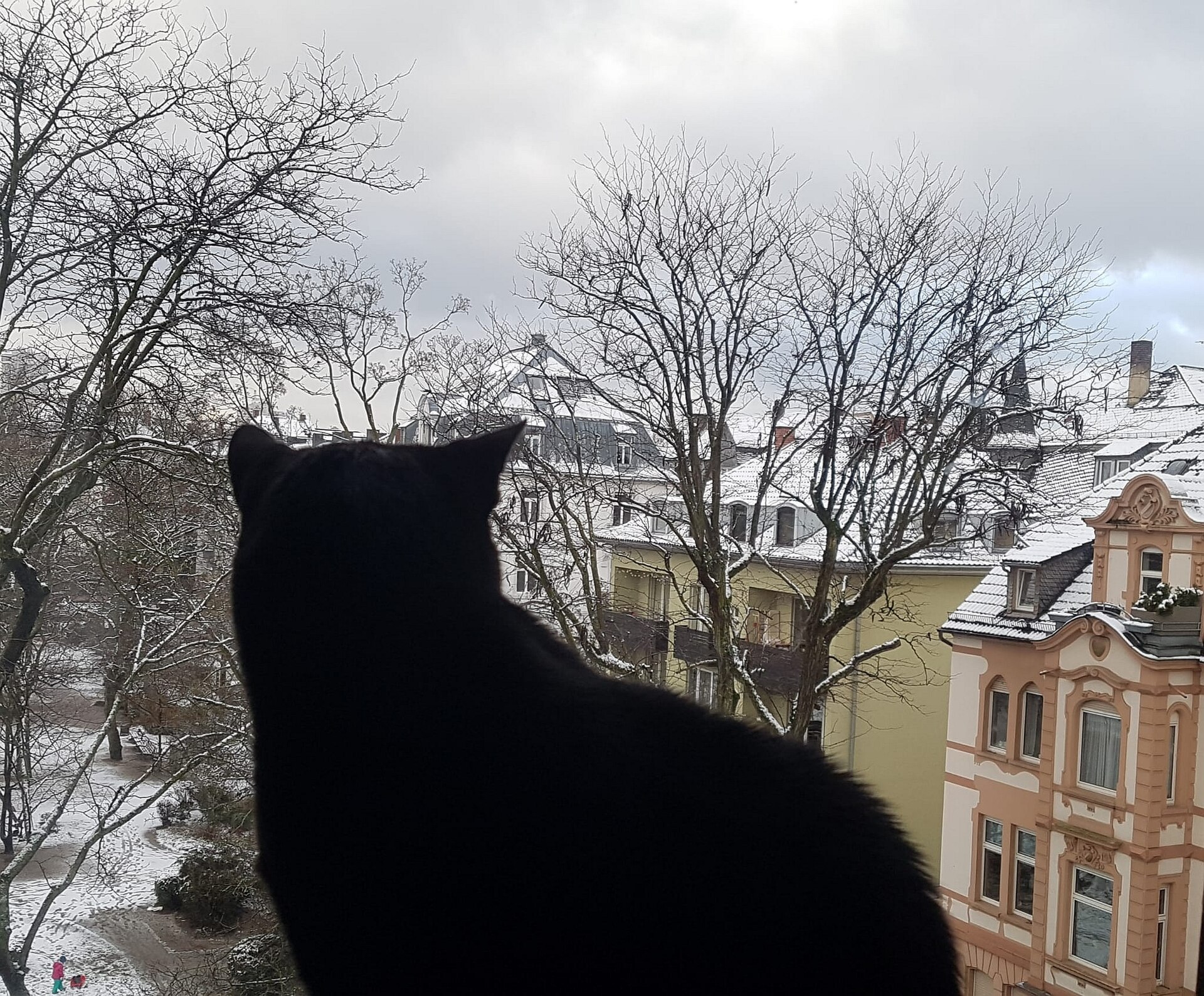
[A cat sits by a window, gaze fixed outward on movement beyond the glass.] Photograph: Wikimedia Commons contributor
Image Credits: Wikimedia Commons
Frequently asked questions
Can cats see ghosts?
There is no scientific evidence that cats sense ghosts or spirits. The documented explanations involve hearing, vision, and instinct, all of which operate on stimuli that humans cannot perceive. A ghost story is more entertaining than a mouse in a wall cavity, but the mouse is the explanation with evidence behind it.
Why does my cat stare at the wall at night?
Night is when cats are naturally more alert, and a quiet house makes faint sounds stand out. Shadows from passing cars, reflections, and household sounds such as pipes also become more noticeable after dark. Night staring is usually the same behaviour as daytime staring, just easier to notice.
Why does my cat stare at the same spot every day?
Cats remember places where they previously heard or saw something interesting. A spot where a spider once crossed the wall or a mouse once scratched can become a regular checkpoint. If the spot never changes and the cat seems distressed there, check for pests or wiring noise behind that section of wall.
Should I worry if my cat stares and does not blink?
A single unblinking stare is usually normal focus, especially during play or hunting behaviour. Worry is warranted when the episodes repeat often, last unusually long, or come with twitching, drooling, or unresponsiveness. In that case, a veterinary visit and a video of the episode are the right next steps.
The bottom line
Your cat is not staring at nothing. It is using ears that hear up to about 64,000 hertz and eyes built to catch the smallest movement, and it is running a hunting program older than domestication. Most wall staring ends on its own and needs no action beyond a quick check for insects or noises.
The exception is a pattern: frequent blank episodes, twitching, or a cat that cannot be reached during the stare. That pattern belongs in a vet clinic, not in a ghost story. For everything else, the simplest response is to let the cat finish its investigation, then offer a toy and a game.
Tags: cats, cat behaviour, pet senses, cat health
Rive News is a research desk that explains everyday questions from published sources and expert guidance, without invented case studies or first-hand claims.
Related
- Why cats stare without blinking at their owners
- Why do cats chatter at birds through the window
- Why cats sleep so much and when it is too much
Subscribe for one everyday explainer in your inbox each morning.
Rive News publishes research-based explainers and corrects errors when readers point them out.
Related stories
Why Does My Dog Eat Grass and Vomit?
A UC Davis study of 1,571 owners found grass eating is normal dog behavior, not self-medication: only 10% were ill first. What the science

Why Does My Dog Stare at Me While I Eat?
Dogs stare at you while you eat because it has worked before, and mutual gaze raises bonding hormones. Learn the reinforcement science
Foods toxic to dogs: the list, with reasons
Chocolate, xylitol, grapes, onions: common foods can harm dogs. Learn what makes each one toxic, the warning signs, and what to do if your