
Why Do Cats Always Land on Their Feet: The Righting Reflex
Key takeaways
- The righting reflex rotates the cat feet-down using the inner ear, a flexible spine, and angular momentum.
- Kittens show the reflex from about 3 weeks and master it by about 7 weeks of age.
- A 1987 study of 132 fallen cats found about 90 percent survived, but falls still cause serious injuries.
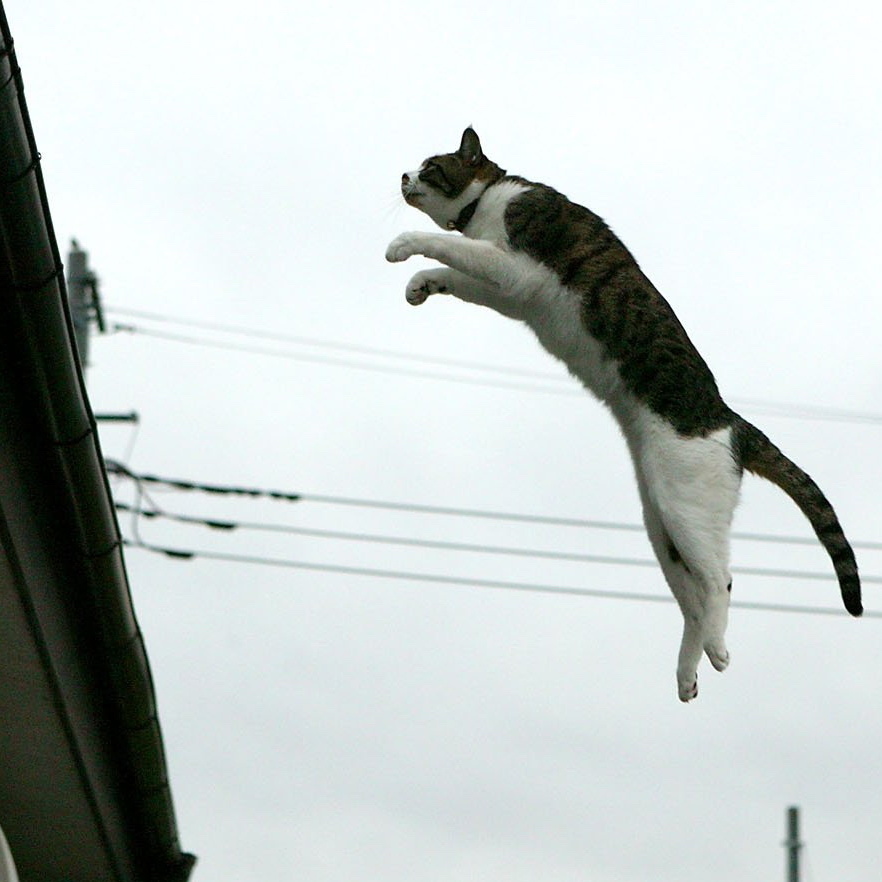
Cats do not always land on their feet, but they come close enough that the exceptions are famous. Behind the feat is an automatic response called the righting reflex, powered by a balance system in the inner ear, a spine of about 30 flexible vertebrae, and a neat exploitation of the laws of physics. It puzzled scientists for a century, and it still injures plenty of cats.
The short answer is that the cat turns itself over in midair without anything to push against. The longer answer involves figure-skater physics, a minimum fall distance, and some sobering veterinary statistics about what happens when the reflex meets a high-rise window.
The reflex: inner ear, flexible spine, no collarbone
The sequence starts the instant the cat begins to fall. The vestibular apparatus in the inner ear detects the head's orientation and tells the brain which way is up. The cat's body then executes a rapid, automatic rotation that requires no conscious thought.
Three anatomical features make the move possible. First, the spine's roughly 30 vertebrae give the body exceptional twist.
Second, the shoulders are not locked in place by a functional collarbone, so the front and back halves can rotate on different axes. Third, the tail and limbs act as adjustable counterweights.
According to Scientific American, the cat tucks its front paws close to its body, reducing its moment of inertia so the upper body rotates quickly, like a figure skater pulling in her arms. At the same time, it stretches its hind legs to maximise their moment of inertia, so the lower body rotates less in the opposite direction. Once the upper body faces the ground, the cat reverses the move: extend the front paws, tuck the hind legs, and bring the rear around to match.
Kittens develop this machinery early. Meowant reports that kittens usually start showing the flip at around three weeks old and have it mostly mastered by about seven weeks. That is an impressively early age for such a complex manoeuvre, and it explains why even young cats can look acrobatic.
The physics problem that stumped the 1890s
The righting reflex was a genuine scientific puzzle in the late 19th century. In 1894, the French physiologist Étienne-Jules Marey presented chronophotographs of a falling cat to the French Academy of Sciences.
The images showed a person holding a cat by its legs with its back facing the ground, then releasing it. The cat floated upside down for an instant, then turned and landed on its paws.
The problem was the conservation of angular momentum. An object that is not spinning cannot suddenly start rotating without an external push, yet the photographs showed exactly that. Physicists assumed the cat must be pushing off the holder's hands.
The resolution is that the cat is not one rigid object but two coupled halves that can twist against each other. By rotating the front and rear in opposite directions with different moments of inertia, the total angular momentum stays at zero while the body reorients. The 1890s photographs captured the effect before the mathematics of it was fully understood, and the so-called falling cat problem kept physicists occupied for decades.
How much fall does a cat need
The reflex needs room to work. Behaviour and physics experts estimate that cats generally need at least about 2.5 to 3 feet of drop to complete the flip reliably, and Tailstalks puts the figure at roughly 12 inches, about 30 centimetres. Below that, there simply is not time to rotate, which is why a cat sliding off a low coffee table can land in an undignified heap while the same cat drops cleanly from the top of a wardrobe.
This minimum explains a counterintuitive pattern in fall injuries. Very short falls can look clumsier than higher ones, even though they are usually less dangerous overall. The cat does not fail to try; it fails to finish.
Overweight cats have a harder time, with less flexibility and more impact on landing. Senior cats may have stiffer spines and slower reactions. Kittens have the drive but not yet the polished reflex.
The system is excellent but bounded, which is why window screens matter in homes with cats, just as introducing a new cat to a resident cat needs a managed environment rather than hope.
High-rise syndrome: the 132-cat study
The most famous data on feline falls comes from veterinary medicine, not physics. In 1987, two New York City veterinarians published a study in the Journal of the American Veterinary Medical Association covering 132 cats that fell from high-rise buildings between June and November 1984, from heights up to the 32nd floor.
Overall, about 90 percent of the cats survived with veterinary care, according to Scientific American's account of the study. Injuries were real and common: broken jaws, chest trauma, and multiple leg fractures. Roughly one-third of the cats would probably have died without emergency treatment.
The study also reported a strange pattern. The severity of injuries increased up to about seven stories, then seemed to decrease for higher falls. The proposed explanation was elegant: given enough time, a cat reaches its terminal velocity of about 60 mph (a human's is roughly 120), stops accelerating, relaxes, and spreads out flat like a flying squirrel, increasing drag and distributing the impact.
That hypothesis is all over the internet, but it should not be stated as settled fact. Meowant and other reviewers warn that the numbers only include cats that survived long enough to reach a vet, which likely overestimates how safe high falls really are.
A cat that died on impact never entered the study. Survival drops sharply beyond about 21 metres even though most cats survive shorter falls, according to Tailstalks.
One documented case shows both the reflex and its limits. In New York City in 2018, a cat reportedly fell from a 32nd-floor apartment window onto hard asphalt and survived. After a two-day stay at the vet, who treated a collapsed lung and broken teeth, the cat went home.
Survival is not the same as safety.
What the reflex cannot do
The righting reflex points the feet down. It does not absorb the landing. Spreading impact forces across all four limbs helps, and the flexible shoulders add shock absorption, but lungs, teeth, jaws, and spines still break in high-rise syndrome cases.
Owners sometimes read "cats always land on their feet" as a safety guarantee. It is more myth than guarantee.
The famous line should really be "cats usually rotate feet-down, and still get hurt." That framing respects the physics and the veterinary records at the same time.
This is the same kind of demystification as learning that cats staring without blinking is communication, not rudeness. The behaviour is real and remarkable; the folk summary around it just needs updating.
FAQ
Do cats really always land on their feet?
No. Usually, yes, and often spectacularly, but not always.
The gap between usually and always is exactly where cats get hurt. Short falls lack time for the flip, and high falls cause injuries despite it.
At what age do kittens develop the righting reflex?
The flip typically appears at about three weeks and is mostly mastered by about seven weeks. Before that, kittens should be kept away from heights entirely.
Is it true that higher falls are safer for cats?
The 1987 study suggested injuries decreased above seven stories, but that finding is disputed and suffers from survivorship bias. Falls from any significant height can kill or maim a cat. Secure your windows.
Why does my cat sometimes land badly from the sofa?
The sofa is below the minimum distance for a reliable flip. The cat starts the rotation but runs out of time. It is not a malfunction; it is physics with an insufficient runway.
The bottom line
The righting reflex is a genuine marvel: a vestibular sensor, a 30-vertebra spine, and angular-momentum physics rotating a falling cat feet-down in a fraction of a second. It appears at three weeks, needs about a foot of fall to work, and has saved countless cats from mid-height drops. But the 132-cat study's 90 percent survival rate came with broken jaws and collapsed lungs attached.
Admire the reflex, and keep the windows shut.
Latest in Pets
- Why do cats stare without blinking?
- How to introduce a new cat to a resident cat
- Why do guinea pigs freeze when picked up?
- Why do dogs bury bones and toys?
Subscribe for weekly pet science explainers in plain English.
Image Credits: Wikimedia Commons
Related stories

Why Does My Dog Eat Grass and Vomit?
A UC Davis study of 1,571 owners found grass eating is normal dog behavior, not self-medication: only 10% were ill first. What the science

Why Does My Dog Stare at Me While I Eat?
Dogs stare at you while you eat because it has worked before, and mutual gaze raises bonding hormones. Learn the reinforcement science

Foods toxic to dogs: the list, with reasons
Chocolate, xylitol, grapes, onions: common foods can harm dogs. Learn what makes each one toxic, the warning signs, and what to do if your