
Why parrots copy human speech and what it means
By Rive News / Research desk | Rive News / Published October 29, 2026 at 9:00 AM PKT
Key takeaways
- Parrots are vocal learners: they hear a sound, practise it, and reproduce it, a skill only three bird groups share.
- Their voice box, the syrinx, sits at the base of the windpipe and can shape two sounds at once.
- A 2015 Duke study found a shell-and-core brain system unique to parrots, larger in the best mimics.
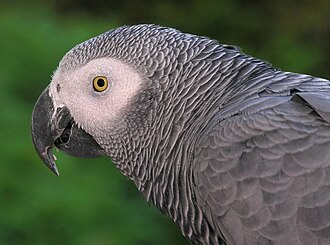
[An African grey parrot in close-up.] Photograph: the parrot
Image Credits: Wikimedia Commons
Parrots copy human speech because they are vocal learners with the right hardware and the right brain wiring. A vocal learner is an animal that can change its calls based on what it hears, rather than relying only on sounds it was born with. Among birds, only parrots, songbirds, and hummingbirds have this ability.
This article explains how parrots make speech-like sounds, including the syrinx, the brain system behind vocal learning, and the social reason a pet parrot copies its owner.
What vocal learning actually is
Most animals produce the calls they are born with. A dog barks, a cow moos, and neither can learn a new call from a neighbour.
Parrots work differently. They listen to a sound, try a rough copy, hear how it came out, and adjust until the copy is close.
That loop of listen, practise, and correct is the same loop human babies use when they babble. It is why a parrot can pick up a word it hears often in a home, and why it can also pick up a doorbell, a phone ring, or a laugh.
The bird is not born knowing those sounds. It learns them from its surroundings.
Vocal learning is rare in the animal kingdom. Humans have it, and so do dolphins, bats, and elephants, but most mammals do not.
That rarity is part of why a talking parrot feels so strange. The bird is doing something only a handful of species can do at all.
The syrinx: the organ that makes the sound
Birds do not have vocal cords like mammals. They have a syrinx, an organ at the base of the trachea where the windpipe splits into the bronchi. Air passing through the syrinx makes membranes vibrate, and muscles around the organ control the tension and airflow.
The syrinx gives parrots two advantages. It can produce two different sounds at the same time, one from each side, which allows complex tones. Parrots also have strong motor control over the organ, plus a muscular, flexible tongue and a beak that help shape the sound into something close to a word.
Humans shape speech with a larynx, tongue, and lips. Parrots reach a similar result with different parts.
The syrinx makes the raw sound, and the tongue and beak mould it. That is why a parrot can sound startlingly like its owner, even though its anatomy is nothing like ours.
The brain system behind the mimicry
The deeper answer came from a study published on June 24, 2015, in the journal PLoS ONE. A team led by Duke University researchers examined gene expression and neural connections in parrot brains and found something no one had seen before. The parrot brain contains a song system within a song system.
Songbirds and hummingbirds have defined brain centres for vocal learning, called cores. Parrots have those cores too, but they also have outer rings around them, called shells, that are also involved in vocal learning. No other vocal-learning bird has this shell system.
The shells were relatively bigger in the parrot species known for the best imitation, including Amazon parrots, the African grey, and the blue-and-gold macaw. Mukta Chakraborty, a postdoctoral researcher in the lab of Erich Jarvis at Duke, said the finding "opens up a huge avenue of research in parrots, in trying to understand how parrots are processing the information necessary to copy novel sounds and what are the mechanisms that underlie imitation of human speech sounds."
The study also traced the system back in time. The kea of New Zealand, one of the only living parrots from a basal split with all other parrots, had a core with only rudimentary shell regions. That suggests parrots evolved vocal learning systems at least 29 million years ago.
Why a pet parrot copies people, not parrots
In the wild, parrots are intensely social. They form strong bonds, often mate for life, and stay in constant contact with a partner and a flock. Contact calls let individuals recognise each other in noisy forests, and learning the calls of close associates keeps the group together.
A pet parrot has no parrot flock. It has a human household instead.
When it starts copying words, it is treating its owners the way a wild parrot treats its flockmates. It learns the sounds of its group because belonging to the group depends on sounding like the group.
That also explains why repetition matters. A word said often, with attention and a reaction, gets practised more.
A parrot that says "hello" and gets a laugh or a treat has a reason to say it again. Social feedback sharpens the copy, just as a wild parrot's calls sharpen through contact with its flock.
Wild grey parrots show how far this goes. Two greys sound-recorded while roosting in the Democratic Republic of the Congo had a repertoire of over 200 different calls, including nine imitations of other wild bird songs and one imitation of a bat.
Copying is not a party trick for these birds. It is their normal way of living in a group.
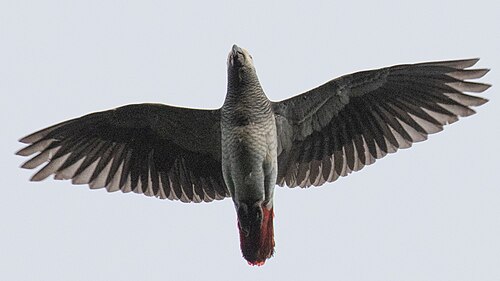
[A wild grey parrot in flight, wings spread.] Photograph: the parrot
Image Credits: Wikimedia Commons
Do parrots understand what they say?
This is where careful wording matters. A parrot can use a word in the right context, such as saying a greeting when someone walks in.
That shows it has linked a sound to a situation. It does not prove the bird understands language the way a person does.
Researchers draw a line between association and comprehension. A parrot that says "want food" when hungry has associated a sound with an outcome.
That is real learning, and it is impressive. It is not the same as grasping grammar or meaning in the human sense.
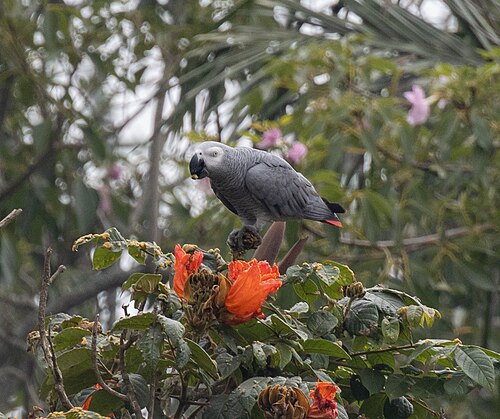
[A wild grey parrot feeding on buds in Uganda.] Photograph: the parrot
Image Credits: Wikimedia Commons
Some parrots go further than simple association, using words flexibly across situations. Even then, the honest description is that they use sounds with intent in context, not that they speak a language. Keeping that distinction is what separates a good explanation from hype.
Why other birds and apes cannot do this
Songbirds can learn songs, but their imitation of human speech is limited. They lack the shell system that parrots have, and their vocal learning is tuned to their own species' songs. Hummingbirds learn their songs too, but they are not known for copying human words.
Great apes present the opposite puzzle. They have the physical machinery to make speech-like sounds, but their brains lack the vocal-learning circuits that parrots have.
They also carry a slightly different version of the FOXP2 gene, missing the two amino-acid changes seen in the human protein. The result is that apes can learn sign systems but do not copy speech the way a parrot does.
The comparison shows that two things must line up: the hardware to make the sound, and the brain wiring to learn it. Parrots have both. Most animals have neither, or only one.
Frequently asked questions
Can all parrots talk?
No. All parrots are vocal learners, but species differ in how well they copy human speech.
African greys, Amazons, and macaws are among the strongest mimics, while some smaller species copy less clearly or not at all. Individual birds differ too, even within a species.
At what age do parrots start copying words?
Young parrots practise sounds much like human babies babble, and many start producing recognisable words in their first year. The exact timing varies by species and by how much the bird hears people talking. Birds that hear the same words daily tend to pick them up sooner.
Is it cruel to teach a parrot to talk?
Copying words is a natural behaviour for a parrot, not something forced on it. Problems come from isolation and boredom, not from speech itself. A parrot that copies its owners is usually a parrot that is socially engaged, which is a good sign.
Why does my parrot copy sounds I wish it would not?
Parrots copy what they hear most, including swearing, alarms, and arguments. They do not judge the content. If a sound gets a big reaction, the bird learns that the sound matters and repeats it more.
The bottom line
Parrots copy human speech because evolution gave them a syrinx that can shape complex sounds, a brain with a unique shell-and-core vocal system, and a social life built on learning the calls of their group. A pet parrot copies its owners because, to the bird, its owners are the flock.
If you live with a parrot, the practical lesson is simple. Talk to it often, keep sessions short and positive, and expect it to copy the sounds that get the most attention.
The bird is not performing a trick. It is doing what parrots have done for at least 29 million years: learning the voice of its group.
Tags: parrots, animal behaviour, pet birds
The Rive News research desk writes plain-language explainers from published research and institutional sources. It does not keep parrots and does not offer veterinary advice.
Related
- Why Do Parrots Mimic Human Speech: Syrinx, Brain, and Flock
- Why pets yawn when you yawn back at owners
- Why Do Dogs Tilt Their Heads When You Talk?
Subscribe for one plain-language animal explainer each morning.
Rive News standards: every factual claim in this article traces to a named public source listed above; corrections are published, never silently edited.
Related stories
Why Does My Dog Eat Grass and Vomit?
A UC Davis study of 1,571 owners found grass eating is normal dog behavior, not self-medication: only 10% were ill first. What the science
Why Does My Dog Stare at Me While I Eat?
Dogs stare at you while you eat because it has worked before, and mutual gaze raises bonding hormones. Learn the reinforcement science
Foods toxic to dogs: the list, with reasons
Chocolate, xylitol, grapes, onions: common foods can harm dogs. Learn what makes each one toxic, the warning signs, and what to do if your