
How Do Birds Navigate During Long Migrations? Their Tools Explained
Key takeaways
- Birds navigate with a layered toolkit: a sun compass, a star compass, a magnetic compass, smell-based maps, and landmark memory.
- A Bar-tailed Godwit can fly 12,000 km nonstop across the Pacific, guided partly by quantum effects in its eyes.
- Young birds inherit compass directions genetically, then build a true mental map during their first migration.

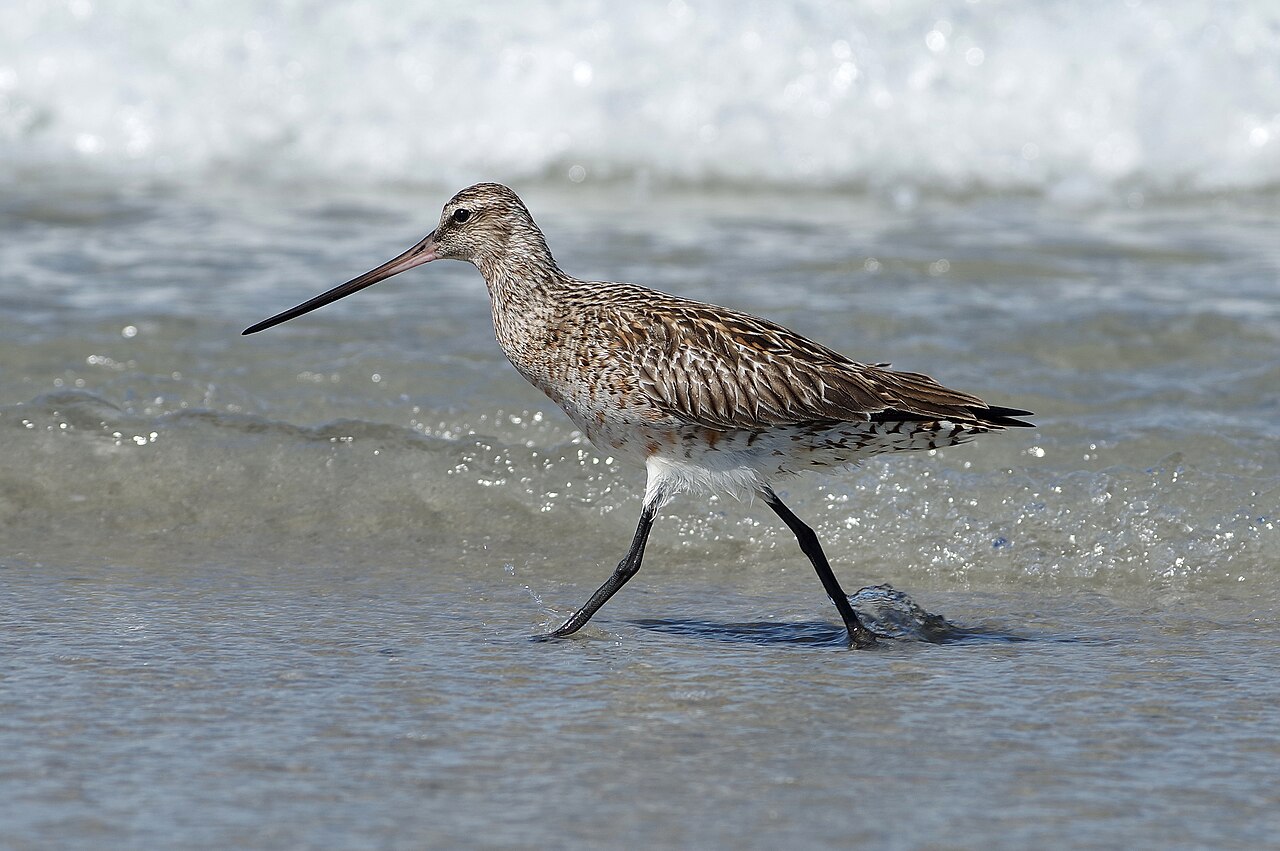
Every year, billions of birds travel thousands of kilometers between breeding and wintering grounds. A young Bar-tailed Godwit, hatched on the Alaskan tundra, will fly nonstop across the Pacific Ocean to New Zealand, a journey of about 12,000 kilometers lasting at least seven days and nights. It makes the trip with no guide, no map, and no prior experience.
Birds do not rely on a single sense to pull this off. They carry a layered navigation system, more like a backup-equipped instrument panel than a lone compass. This article explains how birds navigate long migrations, including the sun compass, the star compass, the magnetic inclination compass, smell-based maps, and how young birds learn their routes.
The sun compass and the internal clock
During daylight, many birds orient by the sun. This sounds simple until you remember that the sun moves.
A fixed bearing relative to the sun at dawn points somewhere completely different by afternoon. Birds solve this with an internal 24-hour circadian clock that compensates for the sun's movement across the sky.
The classic proof came from clock-shift experiments. Researchers kept migratory birds on an artificial light cycle, shifting their internal clocks several hours ahead or behind.
When released, the birds oriented as if the sun were in the position corresponding to their shifted time, making predictable errors. The sun compass was proven real, and so was its dependence on the biological clock.
Homing pigeons show how birds switch tools with conditions. On sunny days they lean on the sun compass. On overcast days, with the sun hidden, they fall back on magnetic cues.
As Cornell neurobiologist Charles Walcott put it, "Birds, like people, use a whole variety of cues to find their way. " Which tool they use depends on which one works best in the moment.
The sun compass has a limitation: it gives direction, not position. It tells a bird which way is south, not where south will take it. For the map part of navigation, birds need other senses.
The star compass
Many songbirds migrate at night, when the sun is useless. They use the stars instead.
Young birds learn the center of celestial rotation, the point around which the night sky appears to turn, and treat it as north. Experiments in planetariums confirmed this: when researchers altered the projected star patterns, the birds' departure directions shifted with them.
Remarkably, birds do not seem to need individual constellations the way human navigators did. They learn the geometry of rotation itself.
Expose a young bird to a planetarium sky rotating around a false center, and it will adopt that false point as its north. The compass is calibrated by experience, not hardwired to the real Polaris.
The star compass also works in combination with the sun compass. Birds use one to calibrate the other, cross-checking as conditions change through dusk and dawn. Robins migrating at twilight appear to use a band of polarized light stretching north to south across the sky at sunrise and sunset, a cue that bridges the day and night systems.
The magnetic inclination compass
The strangest of the bird compasses is the magnetic one. Birds can sense Earth's magnetic field, a phenomenon called magnetoreception. But their compass does not work like a ship's compass needle.
Experiments show that reversing the field's polarity has no effect on a caged bird's orientation. What the bird detects is the field's axis and the angle it makes with Earth's surface, known as the inclination compass.
Even stranger, the magnetic compass is light-dependent. It works through the eyes, not through some iron filing in the beak.
The leading explanation is genuinely quantum. In 1978, Klaus Schulten of the Max Planck Institute proposed that the compass relies on radical pairs, short-lived molecular fragments formed when blue light strikes a protein called cryptochrome in the bird's retina.
Here is the simplified version. When cryptochrome absorbs blue light, it creates a pair of molecules with unpaired electrons.
The spins of those electrons waltz between quantum states millions of times per second, and Earth's weak magnetic field subtly alters the dance. That alteration changes the chemistry in a direction-dependent way, effectively letting the bird see magnetic field lines overlaid on its vision.
The evidence has been building for decades. In 2012, researchers at Oxford showed that cryptochrome proteins could have their chemistry tuned by Earth-strength magnetic fields.
Later work on European Robin cryptochrome-4a found the protein's levels rise during migration seasons, exactly when a compass would be needed. Earth-strength fields are 10 to 100 times weaker than a fridge magnet, yet the chemistry responds to them.
Recent experiments added another twist. Eurasian reed warblers appear to use magnetic information not just as a compass but as a map, sensing magnetic inclination and declination to estimate their actual position. As Bangor University's Richard Holland explained, the birds seem to detect how magnetic cues change along their route, giving them a rough sense of where they are, not just which way to head.
Smell maps and landmarks
Birds smell their way home too, at least some of them. Italian biologist Floriano Papi argued for decades that pigeons build olfactory maps from odors carried on prevailing winds. Experiments that blocked pigeons' sense of smell impaired their homing, supporting the idea that familiar scents mark familiar places.
Seabirds ranging over featureless ocean likely use smell the same way. Characteristic odors of coastlines, upwellings, and islands give them checkpoints where landmarks are absent.
Near home, vision takes over. Birds memorize coastlines, rivers, and mountain ranges, and experienced adults return to the exact same nest box or the same wintering perch year after year.
Memory has a dedicated brain region. The hippocampus, the brain's spatial memory center, is highly developed in migratory birds.
They remember nesting sites and thousands of food cache locations. This is the map that experience builds, and it is why adult birds navigate with far more precision than juveniles.
How young birds learn the route
First-time migrants face a special problem. They have never seen the wintering grounds, so they cannot navigate to them from memory. Evolution's solution is an inherited program: fly a genetically encoded direction for a set time, then change heading.
A famous crossbreeding experiment proved the genetics. When a southwest-migrating bird was crossed with a southeast-migrating bird, the offspring headed due south, an intermediate direction.
The compass heading is in the genes. The star compass gets calibrated during the weeks before departure, when the young bird watches the sky rotate.
If a young bird is blown off course, it usually cannot recover, because it has no map yet, only a compass and a timer. This is one reason only about 30 percent of small songbirds survive their first migration and return.
During that first journey, the survivors build a mental map of landmarks, smells, and magnetic gradients. On later trips, that map lets them navigate with precision measured in centimeters over thousands of kilometers, and about 50 percent of adults make it back to their breeding site each year.
Social learning helps too. Young birds of some species migrate with experienced adults and learn routes and stopover sites by following. Cranes and geese are famous for this, with family groups traveling together and the young memorizing the way for future solo trips.

FAQ
Can birds really see Earth's magnetic field?
Not as a visible picture, as far as anyone knows. The radical-pair mechanism would modulate visual signals in the retina, creating something more like a shading or pattern overlaid on normal vision. Researchers describe it as the bird being able to sense field direction through its eyes, which is as close to seeing magnetism as biology gets.
Do all birds migrate?
No. Many species are resident year-round, and even within migratory species some populations stay put. Migration evolves where the payoff, abundant summer food at high latitudes, outweighs the enormous cost and danger of the journey.
How do birds know when to start migrating?
An internal annual clock, tuned by changing day length, triggers restlessness and physiological preparation. Fat stores build up, and in nocturnal migrants the urge to fly at night intensifies. Weather fine-tunes the exact departure, but the schedule itself is endogenous.
What happens if a bird's magnetic sense is disrupted?
Laboratory experiments show that weak oscillating magnetic fields can scramble the inclination compass, leaving birds disoriented. In the wild, birds simply fall back on their other compasses. The redundancy of the system is the point: sun, stars, magnetism, smell, and landmarks back each other up.
The bottom line
Birds navigate long migrations with a layered system: a sun compass corrected by an internal clock, a star compass calibrated in youth, a quantum-linked magnetic compass in the eyes, smell maps, and landmark memory. No single sense does the job alone, and that redundancy is what lets a godwit cross an ocean it has never seen.
Tags: ornithology, animal behavior, migration, biology, science explainer
Latest in Science
- Why flocks of birds fly in V formation
- Why we see shimmering mirages on hot roads
- How touchscreens detect your finger
- How scientists pinned down the age of the Earth
Get one clear science explainer in your inbox every morning. Subscribe for free.
Related stories

Why diamond is hard and graphite is soft when both are carbon
Diamond and graphite are both pure carbon, yet diamond is 10 on the Mohs scale and graphite is 1 to 2. The difference is not the atoms;

Why Hot Water Can Freeze Faster Than Cold: The Mpemba Effect Explained
Hot water can freeze faster than cold under specific conditions. The Mpemba effect, named for a 1963 schoolboy experiment, still divides

How Magnets Work at the Atomic Level: Spins, Domains, and Iron
Magnetism comes from electrons: their spin and orbits make each atom a tiny magnet. In iron, quantum forces align these atomic magnets into