
Why Do Flocks of Birds Fly in V Formation? Upwash Science Explained
Key takeaways
- Birds fly in V formation to ride the upwash, rising air pushed up from the wingtips of the bird ahead, which gives free lift.
- A 2014 study of ibises showed birds position themselves precisely and time their wingbeats to catch that lift.
- The leader gets no help and works hardest, so flocks rotate the front position to share the effort.
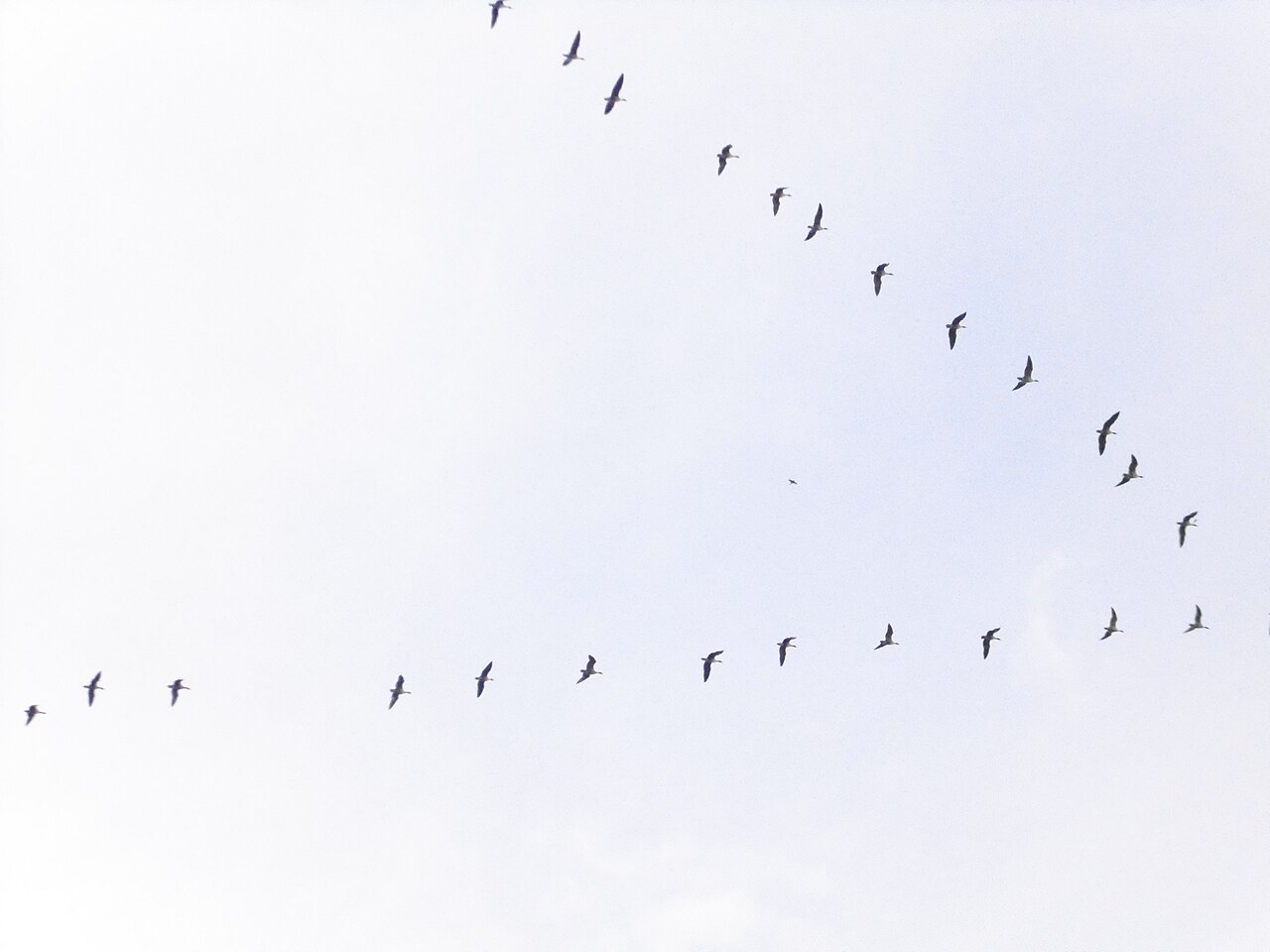
Look up on an autumn evening and you may see it: a skein of geese slicing across the sky in a crisp V, each bird holding its place with uncanny precision. The pattern is beautiful, but it is not decoration. It is an energy-saving strategy, refined by evolution and confirmed by experiment.
Geese, pelicans, ibises, cranes, and other large migrants use the formation to fly farther on less fuel. This article explains why flocks fly in V formation, including the upwash effect, the ibis study that proved the mechanism, who leads the flock and why it changes, and why small birds rarely bother.
The upwash effect
Flight is expensive. A bird's wings must generate lift continuously, and the air they push down does not vanish.
As a bird flaps, air is forced downward beneath the wings, the downwash, and then curls upward around the wingtips. That rising air on either side is the upwash.
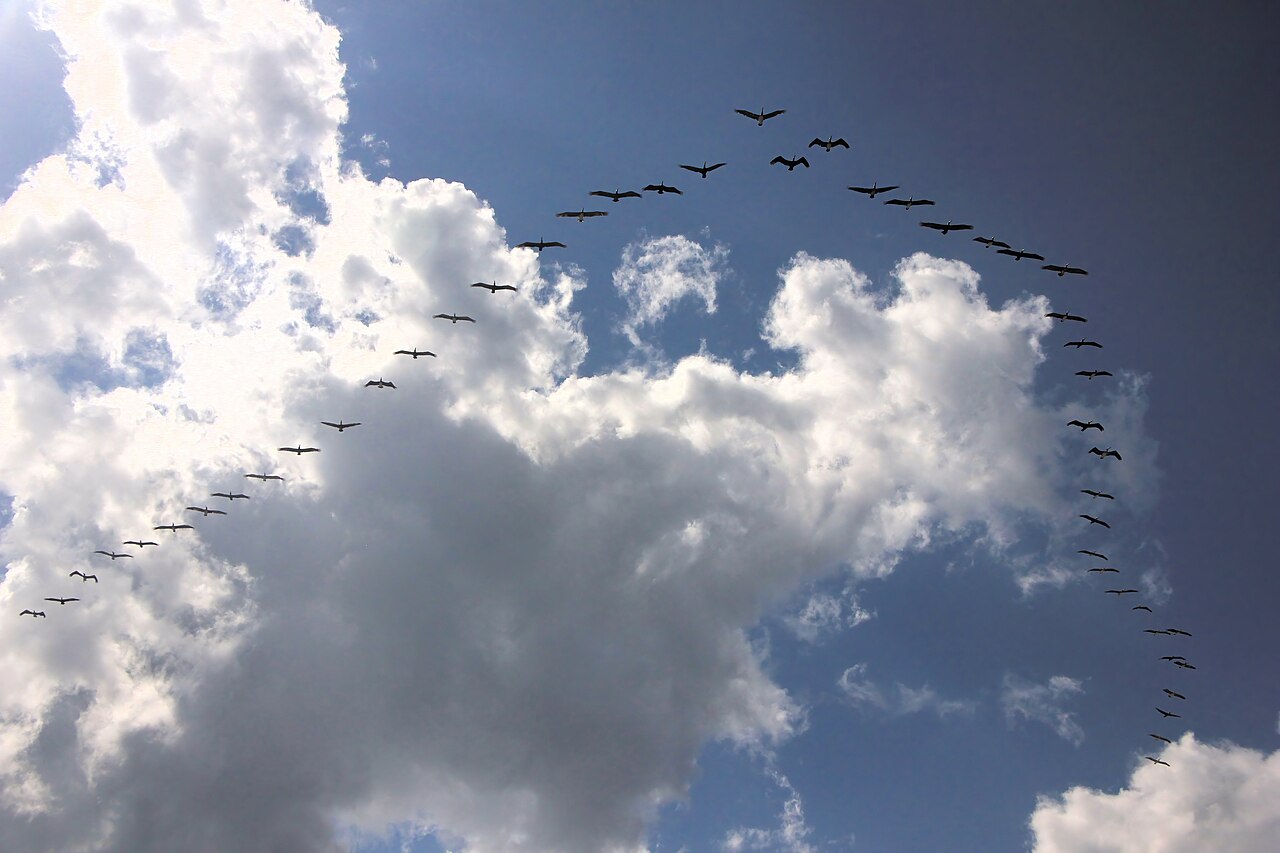
A bird flying slightly behind and to the side of another bird sits in that upwash zone. The rising air gives it a small but real boost of lift, so its wings work a little less hard. Stack the effect across a whole flock and you get the V: each bird rides the upwash of the one ahead and to the inside, forming two diagonal lines of free lift.
The geometry matters. Fly directly behind another bird and you sit in the downwash instead, fighting sinking air.
The V is the shape that keeps every follower in the good air and out of the bad. BBC Science Focus describes the technique as drafting, the same principle cyclists and race cars use, adapted for the sky.
There is also a social payoff. The V keeps every bird in clear view of the others, which helps the flock stay coordinated and lets followers track the leader's movements during long migrations. Communication and aerodynamics reinforce each other in the same shape.
The ibis study that proved it
For decades, the upwash explanation was a theory with no direct proof. It was hard to measure exactly where wild birds position themselves and how they flap. That changed in 2014, when researchers from the University of London's Royal Veterinary College and partner institutions published results in Nature based on a remarkable experiment.
The team worked with 14 northern bald ibises, large endangered birds enrolled in a conservation program that taught them to migrate by following an ultralight aircraft. Each bird carried a tiny GPS device that recorded its position and every single wingbeat. It was, as one outside expert called it, an astonishing feat of data collection from free-flying birds.
Analyzing a seven-minute stretch of formation flight, the researchers found the ibises positioned themselves exactly where aerodynamic theory said the upwash would be strongest. More surprising, the birds timed their wingbeats to the bird ahead. Each bird's wingtip traced nearly the same undulating path through the air as the wingtip of the bird in front, staying inside the moving zone of rising air through the whole flap cycle.
Lead researcher Steven Portugal described the precision with a homely analogy: it is like a child walking in a parent's footprints through snow, stepping where the work is already done. The team had expected the birds to hit the good air only about 20 percent of the time. Instead, they tracked it continuously, a far more active and skillful process than anyone had predicted.
The study also caught birds flying single file doing something clever. A bird stuck directly behind another, in the downwash, adjusted its flapping into the opposite phase to minimize the damage.
The flock was not just passively sitting in good air. It was actively sensing the wake and responding, flap by flap.
Biomechanist James Usherwood of the Royal Veterinary College, quoted in coverage of the study, marveled at the difficulty of the physics involved. "Air gets pretty darn wiggy behind a flapping wing," he said, noting that the birds' precision exceeded what the researchers thought possible.
Who leads the flock and why it changes
The V has a built-in unfairness. The bird at the point of the V flies in clean air and gets no upwash help from anyone.
It faces the full wind resistance and works the hardest. Every other bird gets at least some assistance.
Flocks solve this with rotation. The leader drops back when tired and another bird takes the point. Observers of migrating geese have long reported this changing of the guard, and the ibis study confirmed the underlying logic: the aerodynamic benefit is real, so sharing the costly position is worth the coordination.
There is no permanent captain. Unlike a cycling team with a designated domestique, a goose flock is democratic about suffering. Birds on the arms of the V also get slightly different amounts of help depending on their exact position, which may explain why individuals shuffle along the line during long flights.
Honk if you have heard the folk claim that geese honk to encourage the leader. It is a charming story with no scientific backing. The rotation is better explained by simple fatigue and the measurable energy savings of drafting.
Why small birds skip the V
Not every bird flies in formation. The V is mostly a big-bird strategy, used by geese, swans, pelicans, cranes, cormorants, and ibises. Small songbirds migrate in loose flocks or alone, and the physics explains why.
Small wings beat fast and create more chaotic, turbulent wakes. The upwash behind a sparrow is a messy, short-lived thing compared to the clean rolling lift off a goose's long wing. Researchers believe the energy payoff for small birds is too small and too fiddly to be worth the precision flying.
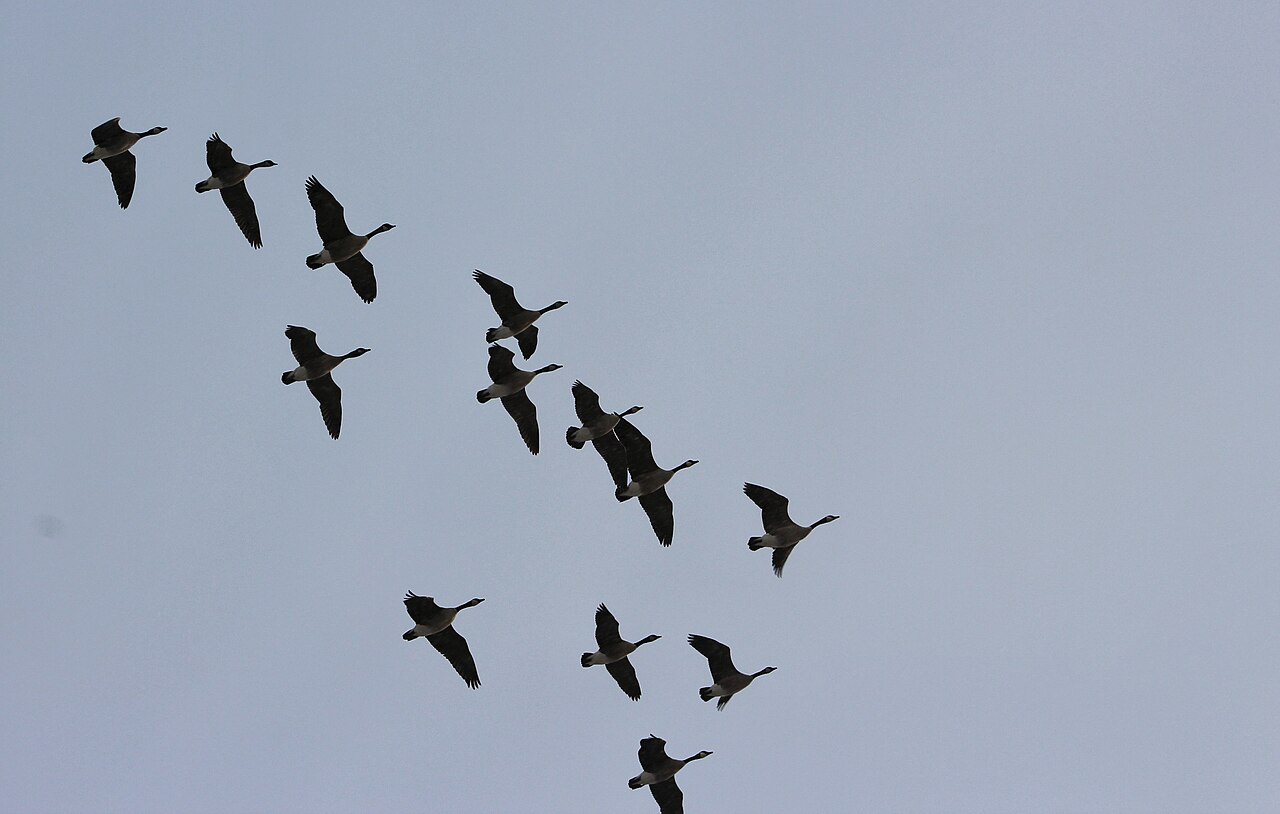
Wing shape matters too. Long, broad wings like a pelican's produce strong, stable tip vortices.
Short, rounded wings like a wren's do not. The V formation is an adaptation to a particular aerodynamic regime, not a universal law of flocking.
Starling murmurations show the other extreme. Thousands of starlings swirl in shape-shifting clouds with no V in sight, because their goal is predator confusion, not fuel economy. Formation follows function: save energy when the journey is long, confuse hawks when the danger is near.
FAQ
Do birds ever fly in other formations?
Yes. Geese sometimes fly in a J, an echelon, or a straight line depending on wind and flock size.
The V is the classic shape because it is the most efficient for a large group, but birds adjust constantly. Single-file lines appear when the flock is small or the wind demands it.
How much energy does the V actually save?
The ibis study demonstrated the mechanism but did not put a single clean percentage on the savings. Earlier wind-tunnel and modeling work suggested savings in the range of 10 to 15 percent for followers, which compounds enormously over a multi-thousand-kilometer migration. Even a few percent matters when the fuel is body fat.
Do airplanes use the same trick?
Military jets fly in formation partly for the same aerodynamic reason, and researchers have studied automated formation flight for airliners to cut fuel burn. The physics is identical: ride the upwash off the leader's wingtips. Birds just worked it out millions of years earlier.
Why is it called a skein of geese?
A group of geese in flight is traditionally called a skein, from an old word for a wound hank of yarn, because the long V resembles a thread pulled across the sky. On the ground or water, the same birds are a gaggle. English has always been generous with collective nouns for birds.
The bottom line
Flocks fly in V formation because each bird after the leader rides rising air spilling off the wingtips ahead, turning a long migration into a relay of shared effort. The ibis experiment proved the birds do not just sit in the right place, they actively time their wingbeats to the wake. It is teamwork written in aerodynamics.
Tags: ornithology, aerodynamics, migration, animal behavior, science explainer
Latest in Science
- How birds navigate during long migrations
- Why helium makes your voice squeaky
- Why salt melts the ice on winter roads
- Why we see shimmering mirages on hot roads
Get one clear science explainer in your inbox every morning. Subscribe for free.
Related stories

Why diamond is hard and graphite is soft when both are carbon
Diamond and graphite are both pure carbon, yet diamond is 10 on the Mohs scale and graphite is 1 to 2. The difference is not the atoms;

Why Hot Water Can Freeze Faster Than Cold: The Mpemba Effect Explained
Hot water can freeze faster than cold under specific conditions. The Mpemba effect, named for a 1963 schoolboy experiment, still divides

How Magnets Work at the Atomic Level: Spins, Domains, and Iron
Magnetism comes from electrons: their spin and orbits make each atom a tiny magnet. In iron, quantum forces align these atomic magnets into