
Why bubbles in fizzy drinks rise in streams
By Rive News / Research desk | Rive News / Published October 29, 2026 at 9:00 AM PKT
Key takeaways
- Bubbles form at fixed rough spots on the glass, called nucleation sites, not at random in the liquid.
- Each site releases bubble after bubble, which is why the bubbles line up in a stream.
- Bubbles grow as they rise because dissolved gas diffuses into them, and they speed up as they grow.
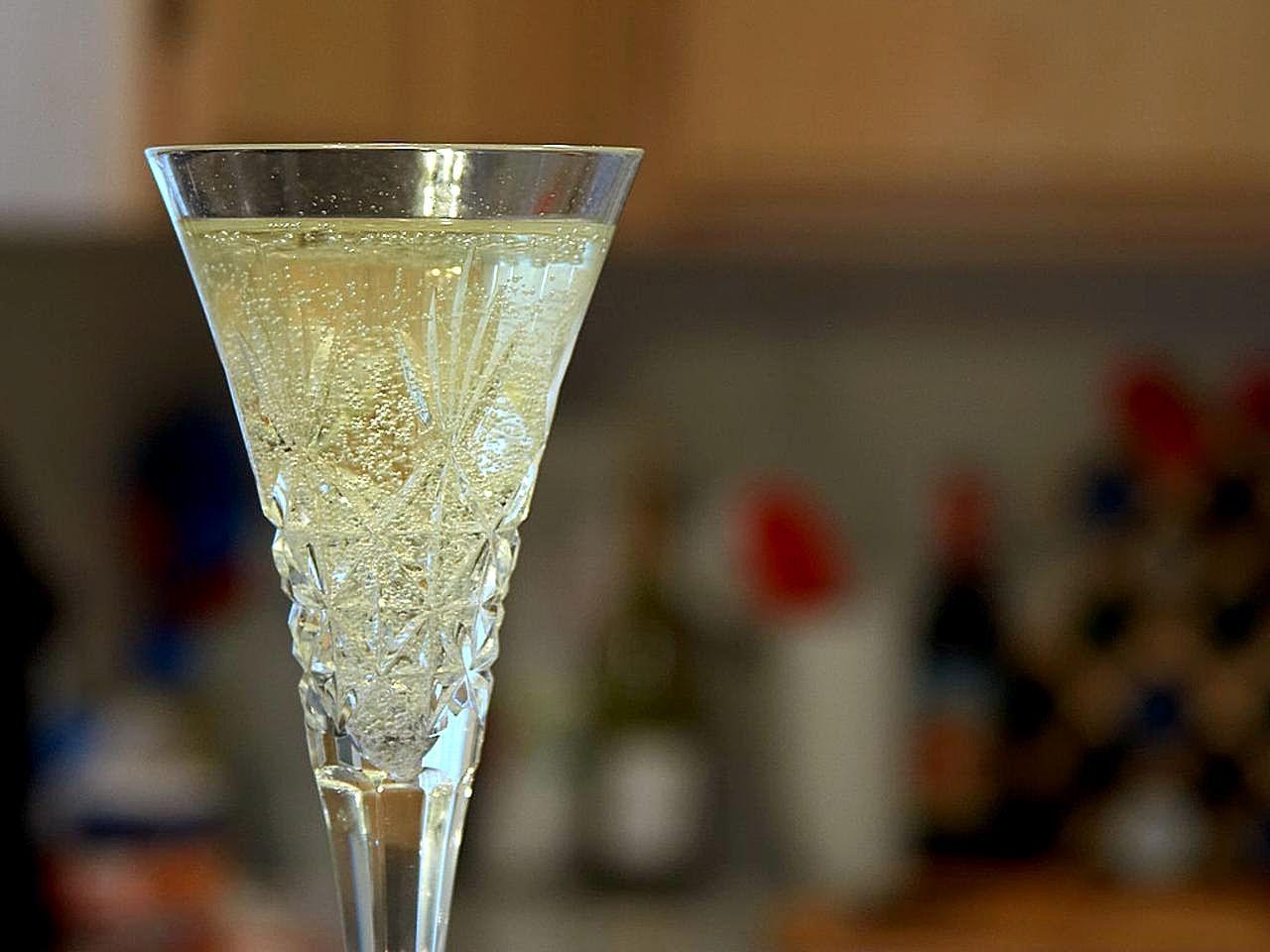
[Champagne flutes filled with a sparkling drink; the fine streams of bubbles rise from fixed points on the glass.] Photograph: the sparkling drink
Image Credits: Wikimedia Commons
Pour a fizzy drink and watch the glass. The bubbles do not appear everywhere at once.
They rise in neat, steady lines from particular points, like tiny fountains fixed to the glass. Those lines are the clue to the whole process.
A fizzy drink is water holding far more carbon dioxide than it can keep at normal air pressure. The gas wants out, but it cannot simply appear as bubbles in the middle of the liquid. It needs a starting point, and once it has one, it keeps using it.
This article explains why bubbles in fizzy drinks rise in streams, including how carbonation works, what nucleation sites are, why bubbles grow as they climb, and why the streams slow as the drink goes flat.
A drink holding more gas than it should
At the factory, fizzy drinks are filled with carbon dioxide under several times normal air pressure. Pressure forces far more gas to dissolve than water could hold at ordinary pressure. Seal the bottle and the gas stays dissolved.
Open the bottle and the pressure above the liquid drops to normal air pressure. The drink now holds more gas than it can keep, a state called supersaturation. The excess gas has to leave, and it leaves as bubbles.
The same principle explains why a warm drink goes flat faster. Carbon dioxide dissolves better in cold liquid than in warm liquid, so a chilled drink holds its gas longer. Warm it up and more gas escapes, which is why a warm soft drink fizzes hard at first and then tastes flat.
Shaking does not create extra gas. It mixes the liquid and creates many small disturbances and potential starting points, so when the bottle opens, the dissolved gas escapes much faster through those points. The foam is gas that was already in the drink.
Why bubbles need a starting point
Forming a bubble from nothing in the middle of a liquid is hard. A new bubble has a curved surface, and surface tension squeezes a tiny bubble so hard that it tends to dissolve again before it can grow. Creating that first surface costs energy.
A nucleation site skips the hard first step. These are tiny imperfections on the glass surface, microscopic scratches, pits, dust particles, or fibres, and trapped pockets of air in small crevices. They offer a ready-made gas-liquid surface where dissolved carbon dioxide can collect.
Scientific American's classroom activity on fizziness demonstrates the point directly. Adding sugar or salt to soda makes it fizz, because the grains carry tiny bumps that act as nucleation sites.
Adding oil, whose molecules have fewer rough spots, has little effect. The gas was waiting in both cases; only the starting points differed.
This is also why a scratched or etched glass produces more streams than a perfectly smooth one. Some beer glasses are deliberately etched on the base to create nucleation sites and keep a steady head of foam. A very clean, smooth glass may show almost no streams at all.
Why the bubbles line up in streams
Once a bubble forms at a site, it grows by collecting dissolved gas from the surrounding liquid, becomes buoyant, and rises. As it leaves, another bubble quickly forms at the same site, because the site itself has not changed. The result is a continuous line of bubbles from a fixed point.
Each stream is therefore a record of one site working over and over. Different sites produce streams at different rates, depending on their size and shape. A large crevice may release big bubbles slowly, while a fine scratch releases a rapid thread of small ones.
The streams look so regular because the process repeats with little variation. Gas diffuses into the growing bubble at a steady rate, the bubble detaches at roughly the same size each time, and the next one starts. That rhythm is what makes the lines look drawn rather than random.
Why bubbles grow as they rise
A rising bubble does not stay the same size. The Hong Kong Observatory's explainer on soft-drink bubbles notes that a bubble acts as a nucleation site itself during its ascent: dissolved carbon dioxide keeps diffusing into it, and newly formed bubbles join it, so it grows bigger and bigger as it climbs.
The pressure change on the way up plays only a small part. The trip from the bottom of a glass to the surface is short, so the drop in surrounding pressure is small. Diffusion of gas into the bubble is the main cause of growth, as Shafer and Zare showed in their 1991 Physics Today analysis of bubbles in a beer glass.
Growth changes the motion. A bubble rises because gas is less dense than the drink, so buoyancy pushes it up. Drag from the liquid pushes back.
As the bubble grows, buoyancy increases faster than drag, so the bubble accelerates upward. That acceleration has a visible effect: the gaps between bubbles in a stream widen as they climb, because each bubble speeds away from the one behind it.
Why the streams slow and stop
Streams fade for a simple reason: the drink runs out of excess gas. Every bubble carries dissolved carbon dioxide out of the liquid, and the amount dissolved falls toward a new equilibrium with the surrounding air. As the excess shrinks, bubbles form more slowly and grow less.
Pouring speeds the process, because it exposes more liquid to air and creates fresh nucleation sites. Leaving a drink open has the same effect over a longer time. Recapping a bottle slows the loss but cannot restore it, because much of the gas has already escaped and the pressure never builds back to the factory level.
Temperature matters here too. A cold drink keeps its streams longer, because cold liquid holds gas better. A drink left in the sun loses its streams quickly, then tastes flat even though it still looks like the same drink.

[A bubble in sparkling wine; each bubble grows as dissolved gas diffuses into it on the way up.] Photograph: the sparkling wine bubble
Image Credits: Wikimedia Commons
Frequently asked questions
Why do bubbles rise in lines instead of all over?
They form at fixed rough spots on the glass called nucleation sites. Each site releases bubble after bubble, so the bubbles line up in a stream from that one point.
Why does sugar make soda fizz more?
Sugar grains carry tiny bumps that act as extra nucleation sites. They give the dissolved gas many new places to start forming bubbles, so the gas escapes faster.
Do bubbles get bigger as they rise?
Yes. Dissolved carbon dioxide diffuses into the bubble as it climbs, and smaller bubbles join it, so it grows. Buoyancy then grows faster than drag, and the bubble accelerates.
Why does a cold drink keep its fizz longer?
Carbon dioxide dissolves better in cold liquid. A chilled drink holds more gas at the same pressure, so it takes longer for the excess to escape as bubbles.
Why does shaking a bottle make it foam?
Shaking creates many small disturbances and starting points in the liquid. When the bottle opens, gas escapes rapidly through all of them at once, producing foam. Shaking does not add any gas.
The bottom line
Bubbles rise in streams because a fizzy drink is a supersaturated liquid looking for a way out, and the way out is a fixed rough spot on the glass. Each nucleation site releases bubble after bubble, each bubble grows and speeds up as it climbs, and the streams fade only when the excess gas is gone.
That is why the pattern looks so orderly. It is not random fizz. It is the same few starting points doing the same job, over and over, until the drink goes flat.
Tags: bubbles, carbonation, physics, drinks
The Rive News research desk writes plain-English explainers on how everyday things work, based on published sources and manufacturer guidance.
Related
- Why does hot water sometimes freeze faster than cold water
- Why does a balloon shrink in cold air
- Why transparent glass lets light through but metal stops it
- What causes thunder and why lightning comes first
Subscribe for one practical science explainer each morning.
Rive News standards: every factual claim is tied to a named public source listed above; corrections are noted on the article.
Related stories
Why diamond is hard and graphite is soft when both are carbon
Diamond and graphite are both pure carbon, yet diamond is 10 on the Mohs scale and graphite is 1 to 2. The difference is not the atoms;
Why Hot Water Can Freeze Faster Than Cold: The Mpemba Effect Explained
Hot water can freeze faster than cold under specific conditions. The Mpemba effect, named for a 1963 schoolboy experiment, still divides
How Magnets Work at the Atomic Level: Spins, Domains, and Iron
Magnetism comes from electrons: their spin and orbits make each atom a tiny magnet. In iron, quantum forces align these atomic magnets into