
Why transparent glass lets light through but metal stops it
By Rive News / Research desk | Rive News / Published October 24, 2026 at 9:00 AM PKT
Key takeaways
- Glass is transparent because its band gap of about 9 eV dwarfs the 1.6 to 3.1 eV carried by visible-light photons, so they pass through without being absorbed.
- Metals have free electrons that soak up every visible photon and instantly re-emit it, which is why metal reflects light instead of letting it through.
- Glass is not clear to everything: it blocks ultraviolet light and the infrared heat inside a greenhouse, both invisible to human eyes.

[Sunlight that passed through glass spreads into a rainbow on the ground, because the photons crossed the glass without being absorbed. Photograph: GabrielleMerk]
Image Credits: Wikimedia Commons
Light is a stream of tiny packets called photons, and whether a material looks clear or solid comes down to one thing: what its electrons do when a photon arrives.
Glass looks clear because its electrons simply cannot absorb visible-light photons, so the photons sail on through. Metal looks solid because its electrons grab every photon and fling it straight back, which your eyes read as shine and glare.
This article explains how photons carry energy, including what a band gap is, why glass sets that gap far too high for visible light to cross, why metals absorb and reflect light instead, and what everyday proofs show the theory working.
Photons arrive in fixed packets of energy
Every photon carries a fixed amount of energy, and color is just a name for that energy level: red light is low energy, blue light is high.
A physics reference at True Geometry puts red-light photons at about 1.6 electronvolts (eV) and blue-light photons at about 3.1 eV. An infrared photon at 800 nanometers carries roughly 2 eV, according to an expert-verified answer on Transtutors.
The rule is simple: higher frequency means more energy, written as E = hf. The University of California, Santa Barbara's Science Line, in an answer dated August 5, 2021, names this relationship as the key to transparency.
So each color arriving at a window is really a crowd of photons, each carrying its own small, fixed punch of energy. What happens next depends on whether the material's electrons can take that punch.
The band gap is a toll every photon must pay
Inside a solid, electrons live in stacked energy bands. The lower band, the valence band, is where electrons sit at rest; above it lies the conduction band, where electrons roam freely and carry electric current.
Between them sits a forbidden zone called the band gap. An electron can only jump across it if something hands it exactly enough energy. A photon trying to be absorbed must pay that toll in full.
If the photon's energy is smaller than the gap, the electron cannot make the jump, and the photon is not absorbed. If the photon's energy matches or beats the gap, the electron leaps and the photon is swallowed.
That is the whole test. Transparency is not about density, hardness, or how solid something feels. It is about whether incoming photons can afford the toll the material charges.
Glass sets the toll far above visible light
The main ingredient of window glass is silicon dioxide, the same compound as sand and quartz. Its electrons sit in strong bonds between silicon and oxygen atoms, and those bonds demand a steep price to break.
According to a PhysicsGurus Q&A, the band gap of silicon dioxide is in the range of 8 to 9 eV. An expert-verified answer on Transtutors gives 9.3 eV for fused silica glass. Visible-light photons, carrying only 1.6 to 3.1 eV, do not come close.
The mismatch is total. It is like trying to pay a nine-dollar toll with three dollars. The photons cannot be absorbed, so they continue through the glass almost untouched, slowing and bending slightly at the surface.
Glass is clear only in the colors your eyes can see. PhysicsGurus notes that silicon dioxide absorbs ultraviolet light below about 150 nanometers in wavelength. Ordinary window glass, as a Scribd explainer on glass physics describes, blocks most ultraviolet between 10 and 400 nanometers while passing the 400-to-700-nanometer visible range.
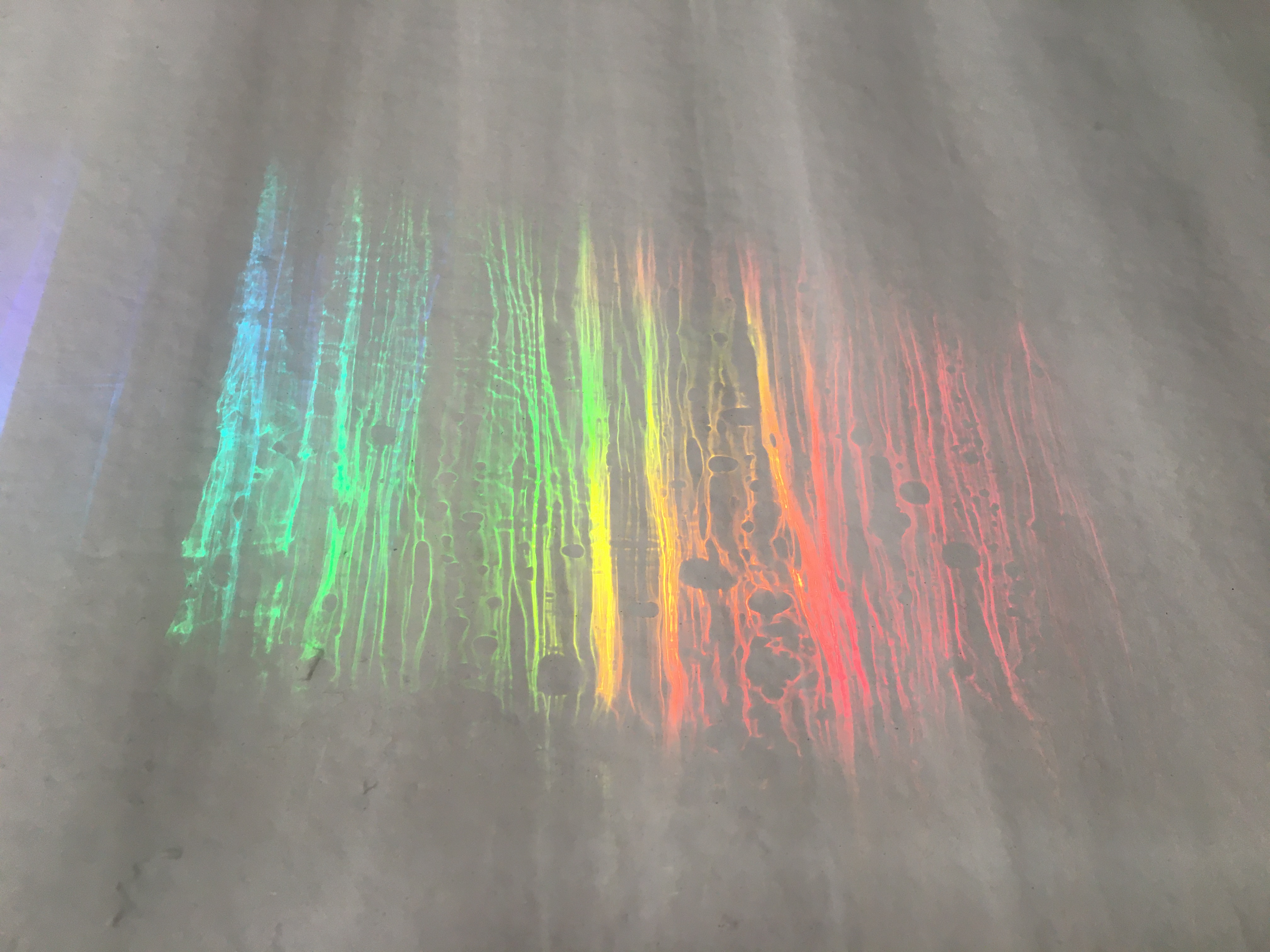
[Sunlight passing through a glass prism spreads into a spectrum on a white wall, proving every visible photon made it through the glass. Photograph: Pittigrilli]
Image Credits: Wikimedia Commons
Impurities change the story, which is why stained glass glows red and blue. PhysicsGurus explains that transition metal or rare earth ions introduce energy levels inside the band gap, letting some visible photons get absorbed. The result is color.
Window makers also add sodium oxide to lower the melting point, plus calcium and aluminum oxides depending on the recipe, according to the same Q&A.
Metals collect the toll and throw the light back
Metals are the mirror image of this setup. Their valence and conduction bands overlap, so there is no gap at all, and their electrons roam free through the whole structure.
A free electron has no toll to pay. It can absorb a photon of any visible energy and immediately fall back, spitting the photon out again. That instant re-emission is what we call reflection.
As the UCSB Science Line puts it: "The same is true for metals. This is why metals are opaque." In plasmas, where electrons are also free to move, light meets the same fate.
This explains the shine: a metal spoon looks bright because nearly every photon that hits it is absorbed and re-thrown in a fraction of a second.
Not every photon escapes as light, though. Some absorbed energy becomes heat, which is why a sun-baked car door can burn your hand. Heat is just molecules jiggling faster, the same physics behind why a balloon shrinks in cold air.
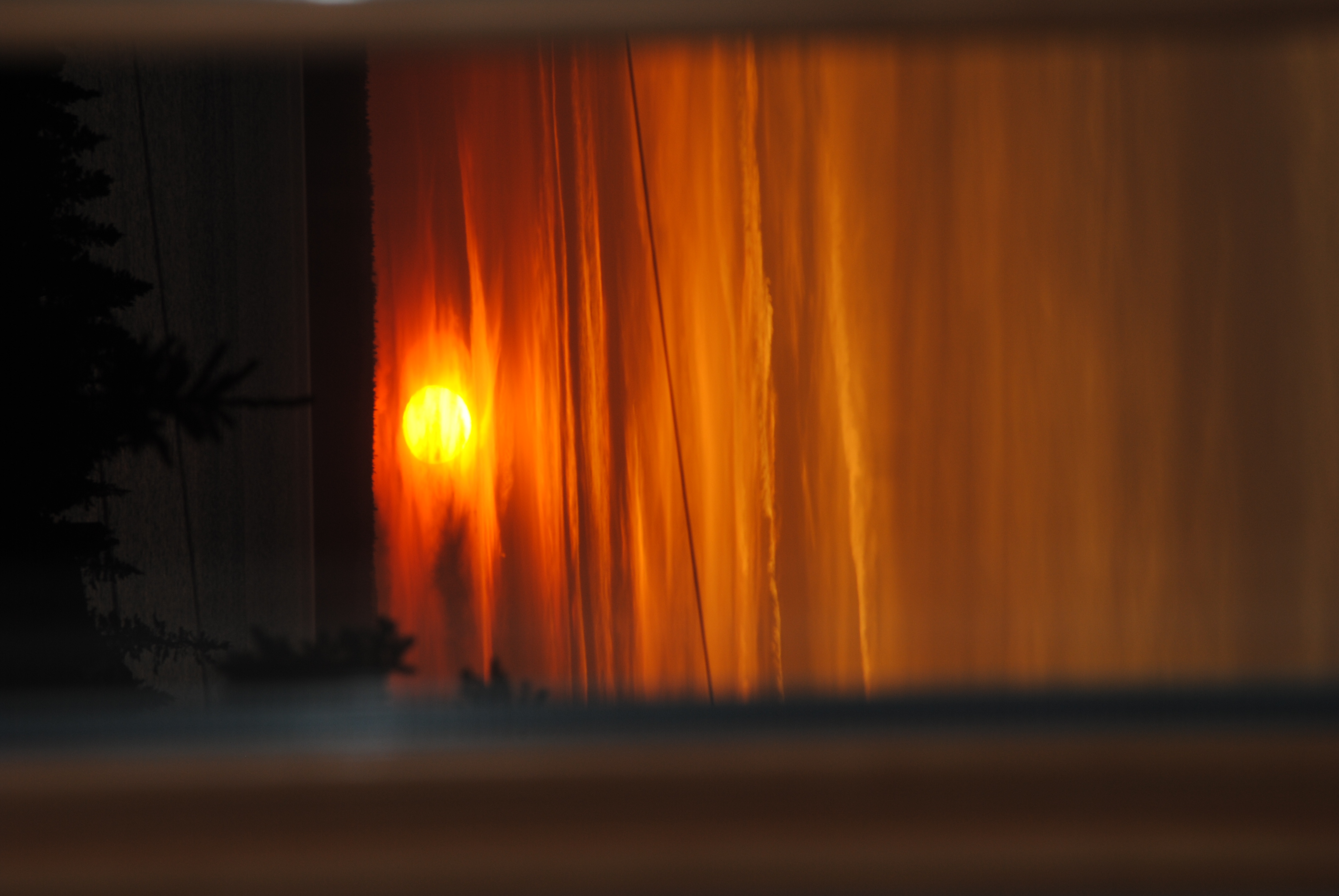
[A sunset seen through an ordinary window pane, with visible light crossing the glass almost untouched. Photograph: Mindmatrix]
Image Credits: Wikimedia Commons
Everyday proofs of the photon rule
The greenhouse effect is the most famous demonstration. The UCSB Science Line explains that visible sunlight shines through greenhouse glass, but the infrared heat from warm objects inside cannot get back out.
The page adds a memorable line: glass is opaque in ultraviolet and infrared, and "the only reason it looks clear to you is because your eyes cannot see those colors." The same sunlight also drives the planetary cycle behind why the Earth has seasons, though that runs on the 23.5-degree tilt rather than on glass.
Deep water shows the other end of the rule. Even a transparent material absorbs a little light, so a few hundred meters down the ocean turns dark, as the same UCSB answer notes. Given enough thickness, everything goes opaque.
As one physics video explainer notes, diamond and certain plastics stay transparent for the same reason glass does. Wood and other opaque solids absorb visible light because their band gaps are smaller than the photons' energy, according to physics references.
Physics is full of small surprises, like why hot water sometimes freezes faster than cold water. The transparency question rewards the same curiosity.
Frequently asked questions
Why is glass transparent but metal is not?
Glass is transparent because its band gap of about 8 to 9 eV is far larger than the 1.6 to 3.1 eV carried by visible-light photons, so the photons pass through unabsorbed. Metals have no band gap and free electrons that absorb and re-emit every photon, which we see as reflection.
Is glass actually opaque to some kinds of light?
Yes. Glass blocks most ultraviolet light and the infrared heat given off by warm objects, even though it passes visible light freely. As the UCSB Science Line says, it looks clear only because human eyes cannot see those other colors.
Why does metal feel hot in sunlight if it reflects light?
Reflection is not perfect. Metals re-emit most absorbed photons as light, but some of the energy turns into heat. That is why a metal railing in direct sun can be too hot to touch while a glass window stays cool.
What is the band gap of glass?
Pure silicon dioxide has a band gap of 8 to 9 eV, according to PhysicsGurus, and fused silica glass measures 9.3 eV in an expert-verified Transtutors answer. Everyday window glass has a slightly narrower effective gap because of added oxides and impurities.
Can impurities make glass absorb visible light?
They can. Transition metal or rare earth ions create energy levels inside the band gap that visible photons can reach, according to PhysicsGurus. That is how ordinary clear glass becomes stained glass: the impurities eat specific colors and let the rest through.
The bottom line
Glass is transparent because its electrons demand about 9 eV to jump their band gap while visible photons offer only 1.6 to 3.1 eV, so the light passes through. Metals have free electrons with no gap at all, so they absorb every photon and throw it back as reflection.
Try this at home: hold a glass prism in sunlight and watch the spectrum it throws, because every color in that rainbow is a crowd of photons that crossed the glass untouched.
Tags: glass, physics, materials science
The Rive News research desk writes plain-English explainers on science and everyday phenomena, checking every claim against public sources rather than repeating textbook slogans.
Related
- Why Does Hot Water Sometimes Freeze Faster Than Cold Water
- What Is Gravity in Simple Words: A Plain Guide
- Why does the earth have seasons? The 23.5-degree tilt
- Why Does a Balloon Shrink in Cold Air? Charles's Law Explained
Get one plain-English science explainer like this in your inbox every morning. Subscribe to the Rive News newsletter.
Rive News articles are researched from public sources, checked against verifiable facts, and written for human readers.
Related stories
Why diamond is hard and graphite is soft when both are carbon
Diamond and graphite are both pure carbon, yet diamond is 10 on the Mohs scale and graphite is 1 to 2. The difference is not the atoms;

Why Hot Water Can Freeze Faster Than Cold: The Mpemba Effect Explained
Hot water can freeze faster than cold under specific conditions. The Mpemba effect, named for a 1963 schoolboy experiment, still divides
How Magnets Work at the Atomic Level: Spins, Domains, and Iron
Magnetism comes from electrons: their spin and orbits make each atom a tiny magnet. In iron, quantum forces align these atomic magnets into