
Why your ears ring when the room goes silent
By Rive News / Research desk | Rive News / Published October 26, 2026 at 9:00 AM PKT
Key takeaways
- Ringing in silence is often not a sound in the room at all. It is a phantom sound your brain produces.
- When hearing input drops, the brain turns up its own gain, and that amplified neural noise can cross into awareness.
- Most people with normal hearing also hear a faint phantom sound in a soundproofed silent room.

[A hearing screening in progress, with a child's ear being examined.] Photograph: Wikimedia Commons contributor
Image Credits: Wikimedia Commons
This article is for general information only and is not medical advice; talk to a clinician about any symptoms.
Ringing in complete silence is a sound with no outside source. Sit in a quiet room, and a high tone, a hiss, or a buzz may appear from nowhere. It can be faint enough to ignore or loud enough to notice every time the room goes quiet.
This article explains why your ears ring in complete silence, including how hearing loss changes the brain, what the gain theory says, why even healthy ears can ring in a silent room, and when ringing deserves a check.
The sound is not in the room
The condition behind most persistent ringing is called tinnitus. It is a perception of sound without an external sound source. The sound can be a ring, a buzz, a hiss, or a hum, and it can sit in one ear, both ears, or seem to come from inside the head.
The important shift in understanding is where the sound is made. For a long time, tinnitus was treated mainly as an ear problem. Research over the past two decades has moved the centre of the story into the brain.
Harvard Health describes the mechanism in plain terms. When the auditory pathways do not receive the signals they expect from the cochlea, the brain "turns up the gain" on those pathways to detect the signal. The resulting electrical noise takes the form of tinnitus.
Think of a car radio searching for a station. Turn the volume up to catch a weak signal, and you hear static. The brain does something similar with its own wiring when part of the input goes quiet.
How hearing loss turns into ringing
Hearing starts in the inner ear. Tiny hair cells in the cochlea turn sound waves into electrical signals, which travel along the auditory nerve to the brain. Damage to those hair cells is one of the most common causes of tinnitus, according to Harvard Health.
The damage can come from ageing, loud noise, some medications, earwax blockage, middle ear problems, or conditions such as Meniere's disease. In each case, the brain receives less signal than it expects, usually starting with the high pitches.
The brain does not simply accept the quieter input. Nerve cells in the auditory pathway adjust their own sensitivity to keep activity at a familiar level. Researchers call this a homeostatic adjustment: the system defends its normal activity level by boosting its gain.
That is why tinnitus often sits at a similar pitch to the frequencies a person has lost. The boosted region is the region that went quiet. The brain amplifies background neural noise there until it becomes audible.
Brain imaging supports this picture. Researchers at Georgetown University Medical Center tested 22 volunteers, half with chronic tinnitus, using functional magnetic resonance imaging. They found moderate hyperactivity in the primary and posterior auditory cortices of tinnitus patients, and the greatest hyperactivity in the nucleus accumbens, a limbic region, in response to sounds matched to the frequencies patients had lost.
The study's lead investigator, neuroscientist Josef P. Rauschecker, put the conclusion plainly. "We believe that a dysregulation of the limbic and auditory networks may be at the heart of chronic tinnitus," he said.
The findings were published in the journal Neuron in January 2013.
Why silence makes it louder
Silence does not create the ringing. It removes the competition.
During the day, ordinary sounds mask the phantom tone, the way daylight hides stars. At night, or in a quiet room, the masking sounds drop away and the phantom sound stands out.
That is also why tinnitus often seems worse at bedtime. The house goes quiet, the day's noise fades, and the brain's amplified background activity is suddenly the loudest thing in the room.
The same masking effect explains a curious finding about healthy hearing. According to ENT and Audiology News, over half of normal-hearing individuals hear a faint tinnitus-like sound when concentrating on their hearing in a silent, soundproofed environment.
In other words, a faint phantom sound in total silence is not by itself proof of damage. Every auditory pathway carries some spontaneous activity. In a soundproofed room, with nothing else to listen to, that activity can cross the threshold of awareness.
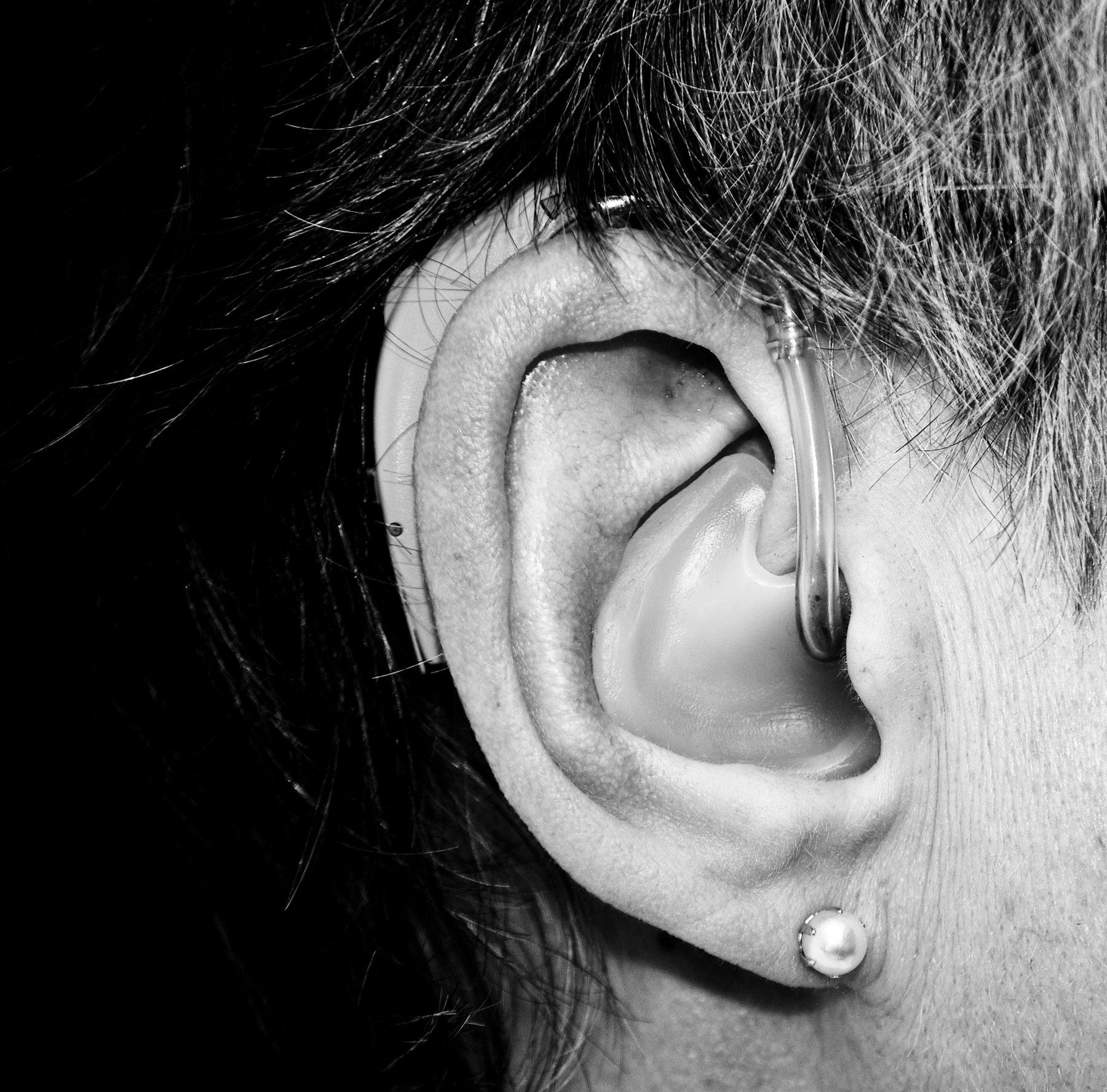
[A close-up of an ear fitted with a behind-the-ear hearing aid.] Photograph: Wikimedia Commons contributor
Image Credits: Wikimedia Commons
Why some people notice it and others do not
If the gain mechanism were the whole story, everyone with hearing loss would have tinnitus. They do not. Gain alone does not seem to explain the condition fully, as ENT and Audiology News notes.
The Georgetown research points to a second step. The limbic system, which processes emotion, appears to act as a gate.
In people with chronic tinnitus, the limbic system fails to stop the phantom signal from reaching conscious awareness. In others, the same boosted signal may be filtered out before it is noticed.
This also helps explain why tinnitus bothers some people far more than others. Once the limbic system flags the sound as a threat, attention locks onto it. Stress and poor sleep can then strengthen the loop, making the sound harder to ignore.
The scale of the condition is large. The Georgetown researchers reported that about 40 million people in the United States hear phantom ringing sounds. The US National Institute on Deafness and Other Communication Disorders reports that about one in three Americans aged 65 to 74 has hearing loss, and nearly half of those over 75 have difficulty hearing.
What helps, in plain terms
There is no single cure for chronic tinnitus, and honest explainers should say so. What exists are ways to lower its impact.
Background sound, such as a fan or low music, can mask the tone. Hearing aids can help when hearing loss is part of the picture, by restoring some of the missing input the brain is compensating for.
Antidepressants appear to help some patients, according to the Georgetown researchers, and masking noise can reduce focus on the ringing. These are options to discuss with a clinician, not self-treatment plans.
Some forms of ringing do need prompt attention. Ringing in only one ear, ringing that pulses with the heartbeat, sudden hearing loss alongside ringing, or ringing after a head injury are all reasons to seek care sooner rather than later. Sudden one-sided symptoms can point to causes that need checking, and early assessment matters.
The bottom line
Your ears ring in silence because your brain is filling a gap. When hearing input fades, the brain turns up its own gain, and the amplified neural noise becomes a sound you can hear. Silence simply removes the everyday noise that usually covers it.
A faint ring in a very quiet room is common, even with healthy hearing. A persistent, one-sided, or pulsing ring is a different matter, and that is worth raising with a clinician.
Tags: tinnitus, hearing, brain science
Rive News is a research desk that writes plain-language explainers from published studies and public sources.
Related
- Why do ears ring after a loud concert, explained
- What causes ringing in your ears after a concert
- Why does your voice sound different on recordings
Subscribe for one plain-language science explainer each week.
Rive News publishes explainers based on public sources. Corrections are made promptly when a source is shown to be wrong.
Related stories

Why diamond is hard and graphite is soft when both are carbon
Diamond and graphite are both pure carbon, yet diamond is 10 on the Mohs scale and graphite is 1 to 2. The difference is not the atoms;

Why Hot Water Can Freeze Faster Than Cold: The Mpemba Effect Explained
Hot water can freeze faster than cold under specific conditions. The Mpemba effect, named for a 1963 schoolboy experiment, still divides
How Magnets Work at the Atomic Level: Spins, Domains, and Iron
Magnetism comes from electrons: their spin and orbits make each atom a tiny magnet. In iron, quantum forces align these atomic magnets into