
Why Is Mars Red and Venus Yellowish? Planetary Colors Explained
Key takeaways
- Mars is red because its dust is coated in iron oxide, essentially rust, spread across the whole planet by dust storms.
- Venus looks yellowish from afar because its thick atmosphere is wrapped in clouds of sulfuric acid that tint reflected sunlight.
- Venus's actual surface is reddish-brown volcanic rock, but the clouds are opaque, so telescopes never see the ground directly.
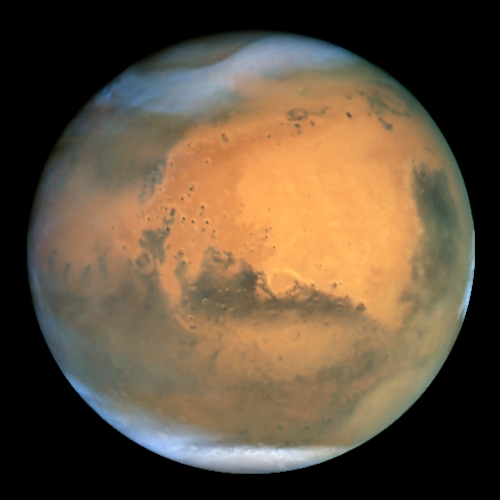
Mars glows red and Venus shines a creamy yellow-white in the night sky, and neither color comes from what you might expect. Mars is red because of rust. Venus looks yellowish because of clouds.
The two planets get their colors from completely different mechanisms, one from the ground up and one from the sky down.
This article takes a closer look at both planets' colors, including why Mars rusted, what Venus's clouds are made of, why the two planets look so different through a telescope, and what new spacecraft data has revealed.
Why Mars is red: rust on a planetary scale
The red of Mars is iron oxide. The planet's surface dust is rich in iron minerals that have oxidized over time, the same chemistry that turns an old nail orange. Because Martian dust is extremely fine-grained, it acts like a thin coat of red pigment spread across the landscape.
Doug Archer, a planetary scientist at NASA's Johnson Space Center, explained it on NASA's official podcast in a 2017 episode devoted to Mars. The red color, he said, comes from oxidized iron: rust, or hematite, the specific mineral form.
He added an interesting detail: the red is mostly skin deep. Brush or blow the bright dust away and the ground underneath looks much darker. Global dust storms keep redistributing that bright dust, which is why the whole planet wears the same coat.
Measurements from NASA's Curiosity rover put numbers on it. Iron oxides make up roughly 20 percent by weight of the dusty, non-crystalline material in Martian soils, according to an analysis of rover data. Hematite is the heavyweight: gray or black as a solid chunk, but vivid red in powdered form.
A wetter history: the ferrihydrite finding
The story got fresher recently. Combining European Space Agency and NASA spacecraft data with laboratory experiments, researchers found that the red dust is better matched by ferrihydrite, a water-bearing iron oxide, than by dry-formed hematite.
Ferrihydrite forms quickly in the presence of cool water, which means Mars likely rusted early in its ancient past, when liquid water was still widespread on the surface.
The study's lead author, Adomas Valantinas, a postdoc at Brown University who began the work with ESA's Trace Gas Orbiter data, said: "We were trying to create a replica martian dust in the laboratory using different types of iron oxide. We found that ferrihydrite mixed with basalt, a volcanic rock, best fits the minerals seen by spacecraft at Mars." The research was published in Nature Communications and reported by BBC Sky at Night Magazine.
Rusting without rain or much air
How did a planet with almost no liquid water and very little oxygen rust at all? One major pathway is ultraviolet photooxidation.
The Sun's UV radiation hits the Martian surface largely unfiltered because the atmosphere is so thin, and it can directly convert iron into its oxidized, rust-like state. Lab experiments simulating roughly seven years of Martian UV exposure were enough to partially oxidize iron locked inside clay minerals, with no free oxygen required.
Billions of years of that slow chemistry, plus whatever trace water and atmospheric oxidants existed, rusted the entire planet.
Why Venus looks yellowish: it is the clouds, not the ground
Venus is a different story. What you see when you look at Venus is not a surface at all. It is cloud tops.
The planet is wrapped in a thick atmosphere, about 96.5 percent carbon dioxide, with clouds of sulfuric acid droplets. Those clouds give the planet its light yellowish appearance, even though the rocks underneath probably are not yellow.
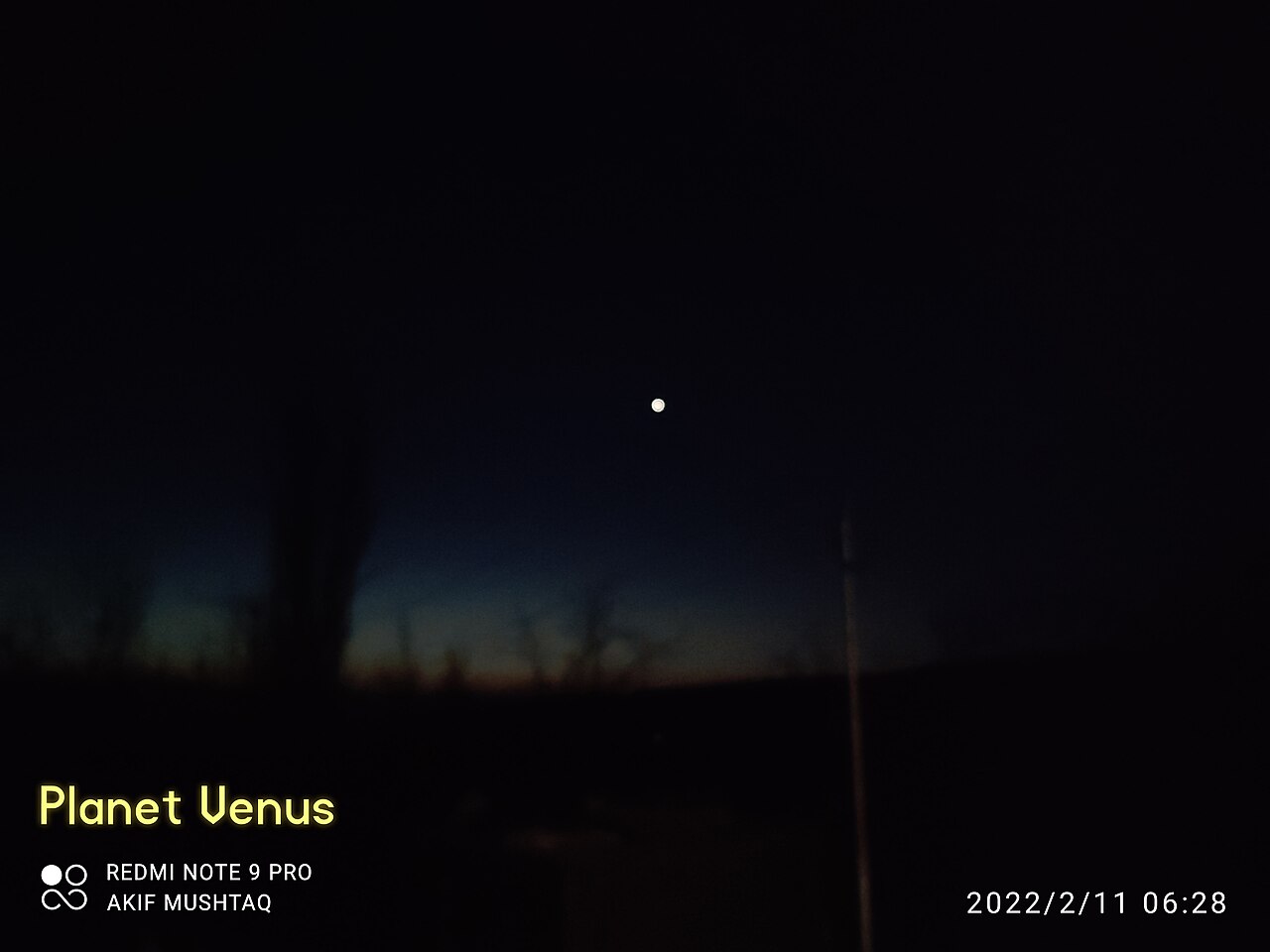
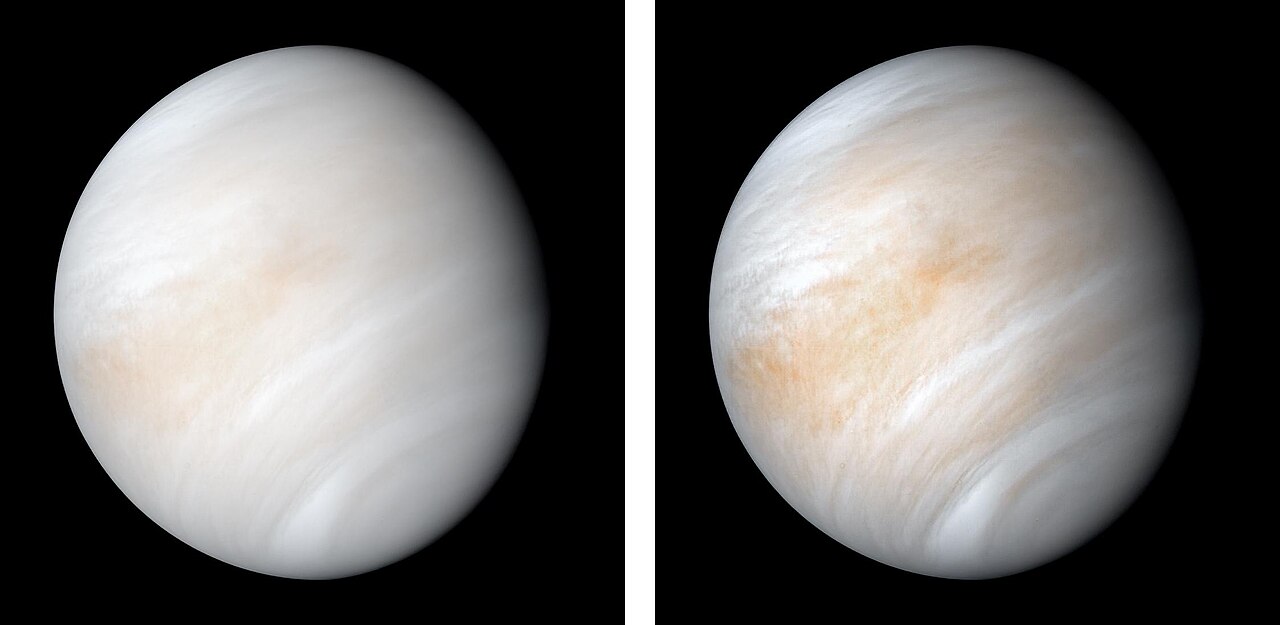
The yellow tint specifically comes from sulfur compounds in the cloud deck. From a distance, Venus presents a creamy yellow-white disk, brighter than any other planet in our sky. Up close in spacecraft images, the cloud tops show swirling patterns in pale yellow and white.
The actual surface tells another story. Beneath the clouds, Venus is covered in volcanic plains and highland regions of iron-rich rock with a stark reddish-brown color.
We know this from radar mapping, which can see through the clouds that block visible light. So Venus is not really yellow. It is a reddish-brown world wearing a yellowish coat of acid cloud.
Surface versus atmosphere: the key difference
The contrast between the two planets comes down to one question: are you looking at ground or sky? Mars has a thin atmosphere, only about 1 percent as dense as Earth's at the surface, so telescopes see straight down to the dusty ground. Its color comes from the surface.
Venus has an atmosphere about 92 times as dense as Earth's at the surface, with a crushing carbon dioxide blanket and a runaway greenhouse effect that holds surface temperatures around 467 degrees Celsius. Visible light cannot punch through that deck. Its color comes entirely from the atmosphere.
Both atmospheres, oddly, are dominated by the same gas. Mars's air is about 95 percent carbon dioxide, and Venus's is about 96.5 percent.
The gas is the same; the thickness is wildly different, and thickness decides everything about what you see.
Dust storms add one more wrinkle for Mars. On occasion the surface experiences planet-wide dust storms, sometimes obscuring the entire surface for weeks at a time. During those storms the planet's disk can look paler and more uniform as the airborne dust smooths out the contrast between dark and bright regions.
What each planet shows through a telescope
Mars through a backyard telescope is a small red-orange disk. When it is near opposition, its closest approach to Earth, dark markings and the white polar caps can resolve in steady air.
The polar caps are water ice and frozen carbon dioxide, and they grow and shrink with the Martian seasons. Telescopes, like eyes, can be fooled by viewing conditions; the Moon, for instance, can look bigger on some nights than others for entirely different reasons.
Venus shows no surface detail at all, only phases. Like the Moon, Venus goes through a full set of phases as it orbits the Sun, from a thin crescent to a nearly full disk.
Galileo's observation of those phases in 1610 was one of the key pieces of evidence that the planets orbit the Sun rather than Earth. In ultraviolet light, spacecraft cameras reveal chevron-shaped cloud patterns racing around the planet, but in ordinary visible light Venus stays a bland, beautiful cream.
Is Venus actually yellow or white?
Both, depending on your eyes and the light. Its disk looks creamy yellow-white, with the yellowish cast coming from sulfur compounds in the sulfuric acid clouds.
Some observers describe it as nearly white. Nobody is seeing the surface, which is reddish-brown.
Is Mars red everywhere?
Mostly, but not uniformly. Bright dust covers much of the planet while darker volcanic regions show through in places, and the red is largely a thin dust coating over darker rock. Planet-wide dust storms can temporarily mute the contrast.
Could Mars lose its red color?
Not on any human timescale. The rust is chemically stable under present Martian conditions, and dust storms keep redistributing it. Only a fundamental change in surface chemistry, over geological time, would alter the hue.
Why can't we see Venus's surface with a telescope?
The cloud deck is opaque to visible light. Astronomers mapped the surface with radar instead, which passes through the clouds and revealed the volcanic plains and highlands beneath.
The bottom line
Mars is red because its dust is rust. Venus looks yellowish because its clouds are acid.
One planet shows you its ground, the other shows you its sky, and that single difference explains the two most distinctive colors in the night sky. New spacecraft data keeps refining the details, but the big picture has held for decades: iron oxide on Mars, sulfuric acid clouds on Venus.
Latest in Science
- Why Is the Sky Blue but Space Black?
- Why Is the Sky Orange at Sunrise and Sunset?
- Why Does the Moon Look Bigger on Some Nights?
- How Do Scientists Measure the Age of the Universe?
Get one plain-English science explainer in your inbox every week. Subscribe to the Rive News newsletter.
Image Credits: Wikimedia Commons / NASA and The Hubble Heritage Team (STScI/AURA), Akif Dar, NASA/JPL-Caltech
Related stories
Why diamond is hard and graphite is soft when both are carbon
Diamond and graphite are both pure carbon, yet diamond is 10 on the Mohs scale and graphite is 1 to 2. The difference is not the atoms;
Why Hot Water Can Freeze Faster Than Cold: The Mpemba Effect Explained
Hot water can freeze faster than cold under specific conditions. The Mpemba effect, named for a 1963 schoolboy experiment, still divides

How Magnets Work at the Atomic Level: Spins, Domains, and Iron
Magnetism comes from electrons: their spin and orbits make each atom a tiny magnet. In iron, quantum forces align these atomic magnets into