
Why the moon looks bigger on some nights than others
Key takeaways
- The giant rising moon is an illusion: photographs prove the moon's width never changes between the horizon and high overhead.
- The horizon moon is actually about 1.5% farther away, roughly one Earth radius of 6,371 kilometres farther.
- After two thousand years of study, scientists still have no fully agreed explanation for why our brains see it as larger.
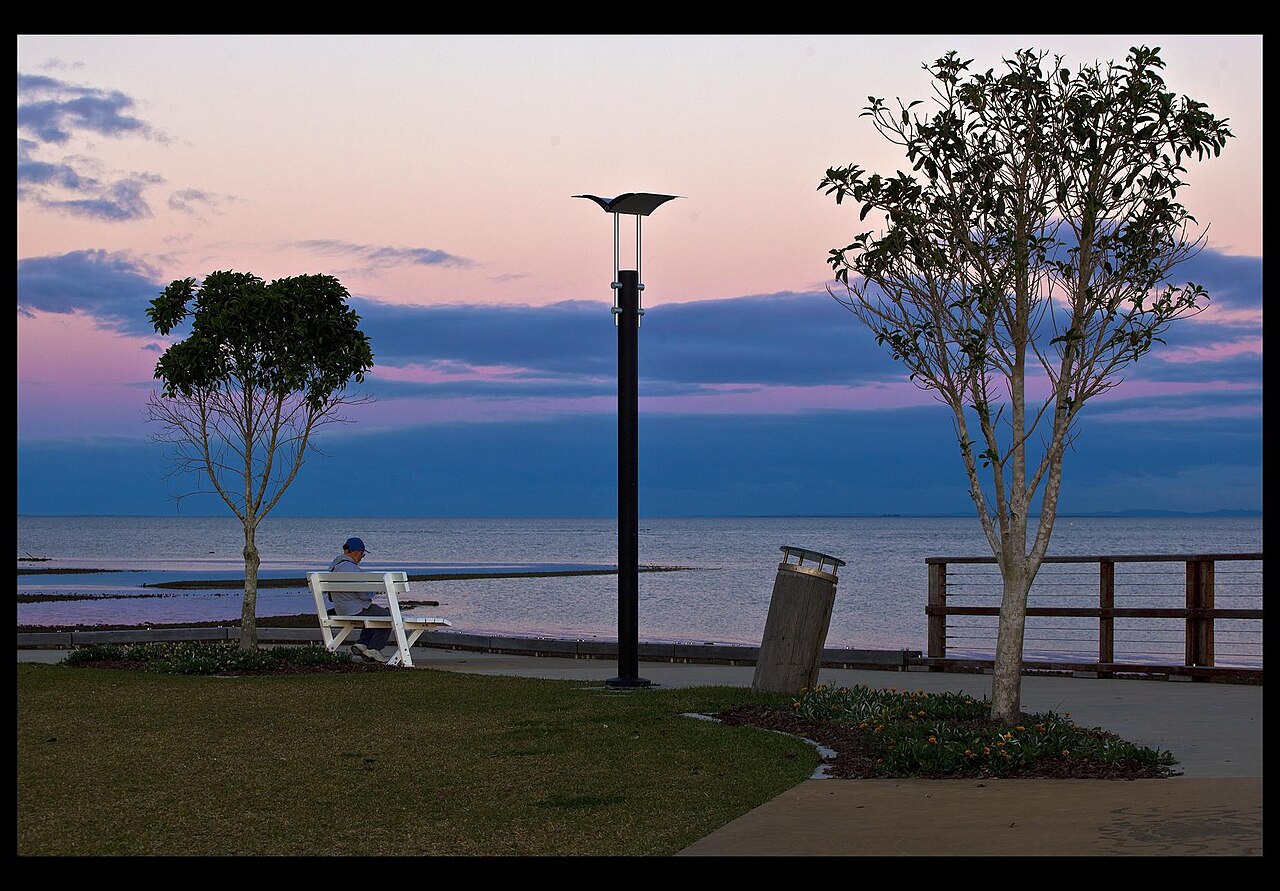
The moon near the horizon can look dramatically larger, but cameras prove the disc is the same size. Image Credits: Wikimedia Commons
A moon rising over the horizon can look enormous, sometimes appearing half again as large as the same moon seen high in the night sky. It is not bigger. It is not closer.
Photographs prove the moon's width stays the same, and geometry shows the horizon moon is actually slightly farther away. The giant moon is happening inside your head.
This article explains why the moon looks bigger on some nights than others, including what NASA's tests prove, why the atmosphere is not responsible, and what scientists still cannot fully explain.
The moon is not bigger near the horizon
NASA states the case plainly: photograph the moon low and high with the same zoom setting and the two discs come out the same width. Nothing about the moon or its distance changes over the few hours it takes to climb the sky. NASA published a do-it-yourself test in February 2025 inviting anyone to photograph the moon rising just above a distant horizon around full moon, then photograph it again high in the sky that same night with the same imaging system.
The geometry actually runs opposite to intuition. When the moon sits on your horizon, you are standing on the side of the planet facing away from it, not the near face of it.
You are one Earth radius, about 6,371 kilometres, farther from the moon than an observer with the moon directly overhead. Against a mean distance of 384,472 kilometres, that adds about 1.5 to 1.7 percent to the range, which narrows the disc by roughly 1.6 percent.
So the horizon moon is smaller. It just does not look like it. Observers often estimate the difference at around 50 percent, a gap between physics and perception that makes this one of the oldest unsolved problems in vision science.
What the atmosphere actually does
It is tempting to blame the air. The low moon's light does travel through a longer path in the atmosphere than the high moon's light.
As it travels that longer path, more of the short, blue wavelengths of light are scattered away, leaving more of the longer, redder wavelengths. That is why the rising moon often glows yellow or orange.
But the atmosphere does not magnify the moon. If anything, refraction slightly flattens it.
NASA puts it plainly: "The atmosphere isn't magnifying the moon. If anything, atmospheric refraction squashes it a little bit."
The moon looks slightly squashed vertically near the horizon because the atmosphere acts like a weak lens, bending moonlight more near the horizon than slightly higher above it. Photographers can confirm this by measuring the diameter of the high moon against the longest horizontal "diameter" of the squashed low moon.
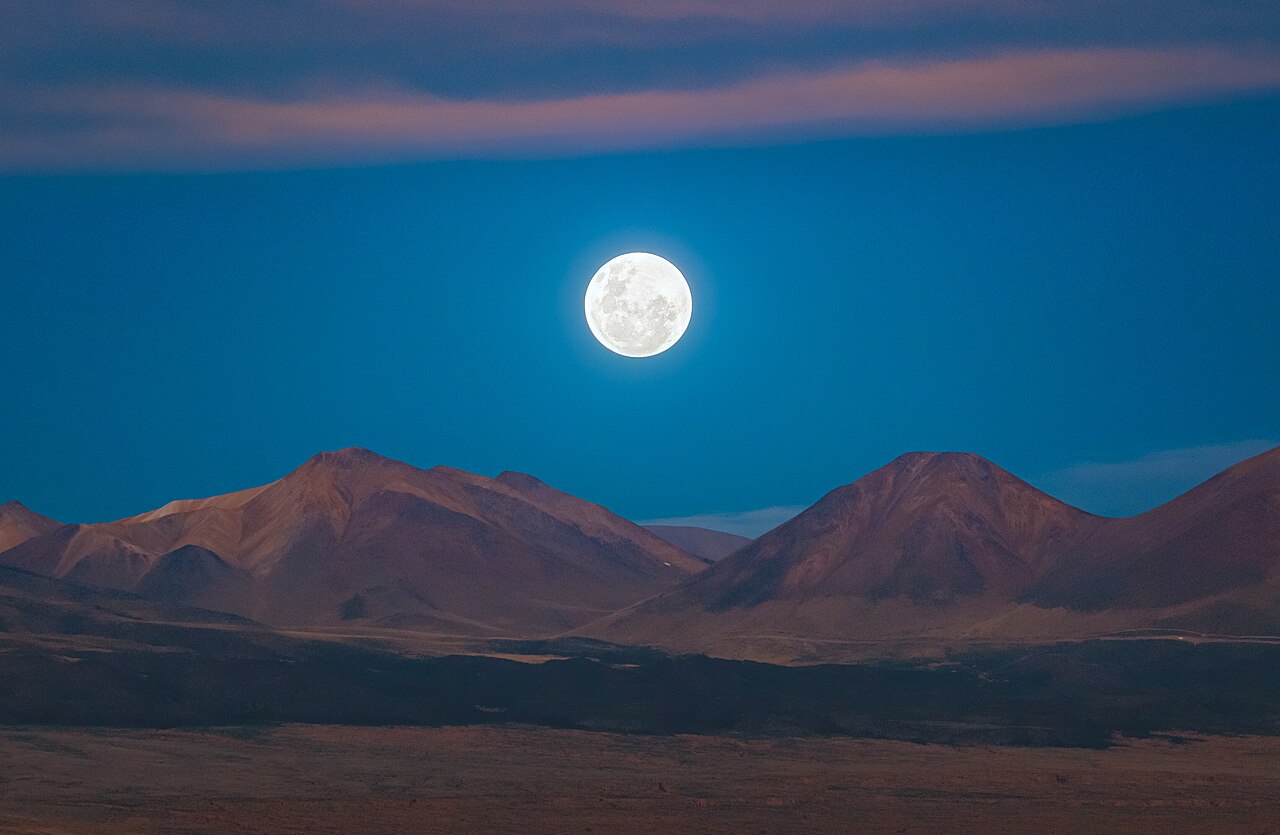
Longer light paths through the atmosphere warm the moon's color without changing its true size. Image Credits: Wikimedia Commons
How the brain gets fooled
The leading explanation is called the apparent distance theory. The brain does not just measure how big an image is on the retina. It combines that with how far away it thinks the object is.
When the moon sits near the horizon, it appears beyond trees, buildings, and hills. Those cues tell the brain the moon must be very far away. Since the moon's image on the eye is the same size as always, the brain concludes it must be enormous.
In a 2000 study published in PNAS, neuroscientist Lloyd Kaufman and his son James, a physicist at IBM, tested this with an artificial moon projected into the sky using a special stereo display. Their results supported the idea that the brain treats the horizon moon as much farther away, which makes it look bigger.
There is a twist. When asked directly, most people say the horizon moon looks closer, not farther, which seems to contradict the apparent distance theory.
A second proposal is size contrast: on the horizon, the moon is surrounded by small-looking objects like distant houses and trees, which may make it seem larger by comparison. Up high, it is surrounded by vast empty sky, which may shrink it. A similar quirk affects how we judge color, as explained in our piece on why the sky is orange at sunrise and sunset.
Neither theory explains every observation. NASA notes that astronauts in orbit also report seeing the illusion, and they have no foreground objects to act as distance clues. Many scientists think more than one effect is at work, and after two thousand years of argument there is still no agreed explanation.
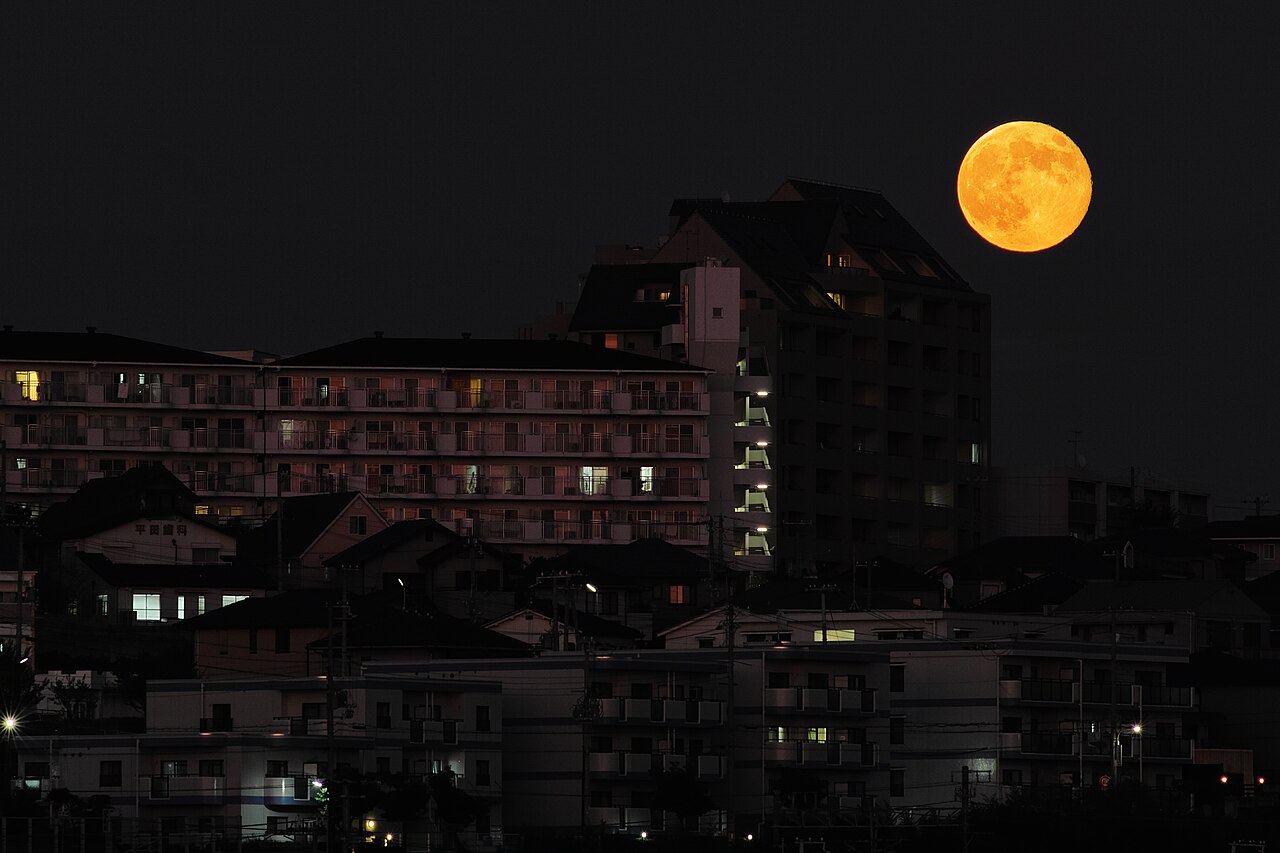
Hold up a finger at arm's length: the moon covers about the same width as your fingernail. Image Credits: Wikimedia Commons
When the moon really is a different size
There is one real, physical way the moon's apparent size changes: its elliptical orbit. At perigee, the moon's closest approach, it is about 356,500 kilometres away; at apogee, the farthest point, about 406,700 kilometres.
A full moon near perigee, the so-called supermoon, can appear up to 14 percent larger in diameter than a full moon at apogee. That is a genuine size change, but it has nothing to do with how high the moon sits in the sky on any given night.
Be skeptical of viral giant-moon photos for a separate reason. Photographers can simulate the moon illusion by taking pictures of the moon low on the horizon using a long lens, with buildings, mountains, or trees in the frame. In other words, the moon looks bigger in those photos because it is a zoomed-in view of distant objects near the ground.
Can I prove the illusion to myself tonight?
Yes. Take a photo of the rising moon, then another a few hours later when it is high in the sky, using the same zoom setting.
In the photos, both moons will be almost exactly the same size. NASA's 2025 guide walks through this test step by step.
Why is the low moon orange?
Its light travels a longer path through the atmosphere, and the air scatters away the shorter blue wavelengths, leaving the longer red and orange ones. Dust or pollution can deepen the reddish color further.
Does everyone see the moon illusion?
Nearly everyone does, including astronauts in orbit, according to NASA. That is one reason landscape-based explanations alone cannot be the whole story.
Will the moon ever look small near the horizon?
It can. The atmosphere's lens effect slightly squashes the disc vertically when it is low, so the rising moon is technically a touch shorter than the overhead moon, even while your brain insists it is bigger.
Why do clouds sometimes look huge near the horizon too?
The same size-constancy machinery applies to clouds and other sky objects. Your brain inflates anything it reads as distant against a rich foreground.
The bottom line
The moon looks bigger on some nights because of the moon illusion, a quirk of how your brain combines retinal image size with distance cues. The disc itself never changes width over the course of an evening, and the low moon is actually about 6,371 kilometres farther away.
What does change is the color, warmed by extra atmosphere in the light path. The next time the rising moon looks impossibly large, you can run the two-photo test and watch the physics disagree with your eyes. For more on how light deceives us after dark, see why the sky is blue but space is black.
Latest in Science
- Why the sky is blue but space is black
- Why the sky is orange at sunrise and sunset
- Why clouds are white and the sky is blue
- Why Mars is red and Venus looks yellowish
One sky-and-space explainer in your inbox every week. Subscribe to the Rive News newsletter.
Related stories
Why diamond is hard and graphite is soft when both are carbon
Diamond and graphite are both pure carbon, yet diamond is 10 on the Mohs scale and graphite is 1 to 2. The difference is not the atoms;

Why Hot Water Can Freeze Faster Than Cold: The Mpemba Effect Explained
Hot water can freeze faster than cold under specific conditions. The Mpemba effect, named for a 1963 schoolboy experiment, still divides
How Magnets Work at the Atomic Level: Spins, Domains, and Iron
Magnetism comes from electrons: their spin and orbits make each atom a tiny magnet. In iron, quantum forces align these atomic magnets into