
Why a mirror reverses left and right but not up and down
By Rive News / Research desk | Rive News / Published October 29, 2026 at 9:00 AM PKT
Key takeaways
- A flat mirror reverses front to back, not left to right; your head stays up and your feet stay down.
- The sideways swap is supplied by your brain, which imagines turning around to face your reflection.
- A mirror on the floor swaps up and down instead, which proves the mirror itself has no favourite direction.

[A reflection in a mirror; the image looks like a person facing you, but the mirror has only reversed depth.] Photograph: the mirror reflection
Image Credits: Wikimedia Commons
Stand in front of a mirror and raise your right hand. The figure facing you raises its left hand.
Yet your head stays at the top of the image and your feet stay at the bottom. The puzzle is why the mirror seems to pick on left and right while leaving up and down alone.
The short answer is that it does no such thing. A flat mirror reverses exactly one direction: the direction pointing into the mirror. Everything else in the puzzle comes from how your brain interprets the result.
This article explains why a mirror reverses left and right but not up and down, including the front-to-back flip, the mental rotation your brain performs, and two simple tests that prove the point.
What a mirror actually reverses
Light obeys a simple rule on a smooth surface: the angle of reflection equals the angle of incidence. For a flat mirror, that rule produces an image behind the glass that matches the object point for point, except along the axis perpendicular to the surface.
Christopher Baird, associate professor of physics at West Texas A&M University, put it plainly in a 2013 explainer. A mirror preserves the position of the sides but exchanges front and back positions. If mirrors truly flipped left to right, he noted, then the green and blue parts of a coloured box in front of a mirror would be exchanged in the image, which they are not.
Walk toward a mirror and your image walks toward you. Step to your right and your image steps to its right, which is your right too.
Move your hand up and the image hand moves up. The only motion that reverses is motion toward or away from the glass.
That is the whole trick, and it is easy to check. Purdue University's physics demonstration 7A-03 makes the same point in a lecture hall.
Move a hand right, and the image hand moves the same way. Move the hand toward the mirror, and the image moves in the opposite direction.
Why your brain adds the sideways swap
If the mirror flips only depth, why does the reflection look left-right reversed? The answer sits in your head, not in the glass.
When you look at the figure in the mirror, your brain treats it as another person facing you. To compare yourself with that person, you imagine turning around to stand where they stand. The natural way to turn is to pivot on your feet, rotating around a vertical axis.
That imaginary rotation swaps left and right. It is the same swap you see when a real person turns to face you: their right hand ends up on your left side. Your brain applies that familiar rule to the mirror image, and the result feels like the mirror did the swapping.
The Hindu's 2025 explainer makes the same point. When you raise your right hand, your reflection raises what appears to be its left hand, but only because your reflection is facing you. If someone else stood facing you and raised their right hand, that would also appear on your left side.
The floor test that settles it
If the mirror truly favoured left and right, it would do so whatever way you mounted it. It does not. Put a mirror flat on the floor and stand over it, and the swap changes direction.
A paper from University College London on mirror reflection and handedness states the rule directly. A mirror on the floor reverses bottom-to-top organisation, a mirror in front of the object reverses back-to-front organisation, and a mirror to the side reverses left-to-right organisation. The paradox, the paper says, is simply that the handedness of an object is reversed wherever you put the mirror.
That handedness point is the deeper physics. A right hand and a left hand are not the same shape seen from a different angle.
No rotation in ordinary space turns a right glove into a left glove. Turning a thin glove inside out does, because that reverses one direction, exactly as a mirror does.
Big Think's explainer draws the same conclusion. Mirrors do not flip up and down or left and right, but rather front and back, and how the mirror is mounted determines the rest. The reversal of handedness is real and independent of the observer, but the direction we call it depends on our viewpoint.
Why text looks backwards
Writing held up to a mirror reads backwards for the same reason. The letters are not flipped sideways by the glass. They are flipped front to back, and you are reading them from behind.
The Purdue demonstration shows this neatly with a transparency printed with the word CAR. Face it toward the mirror with white paper behind it, and the word looks reversed.
Remove the paper without moving the transparency, so you see the word through the back of the sheet, and the reversal vanishes. You were looking at the back of the word all along.
The same effect explains ambulance lettering. The word on the front of an ambulance is painted in reverse so that, after the mirror's front-to-back flip, a driver reading it in a rear-view mirror sees it the right way round.
Curved mirrors and other exceptions
Everything above applies to flat mirrors. Curved mirrors add their own distortions, because different parts of the surface point in different directions.
A convex mirror, like a car's side mirror, shrinks the image and widens the view. A concave mirror can magnify or even flip the image upside down, depending on where you stand relative to its focal point.
Those effects come from geometry, not from a special rule about left and right. Each small patch of a curved mirror still obeys the same reflection law. The overall image is just the sum of many small flat reflections pointing in different directions.
Funhouse mirrors work the same way. Stretch the surface in one direction and the image stretches with it. The fun comes from varying curvature, not from breaking the basic rule.
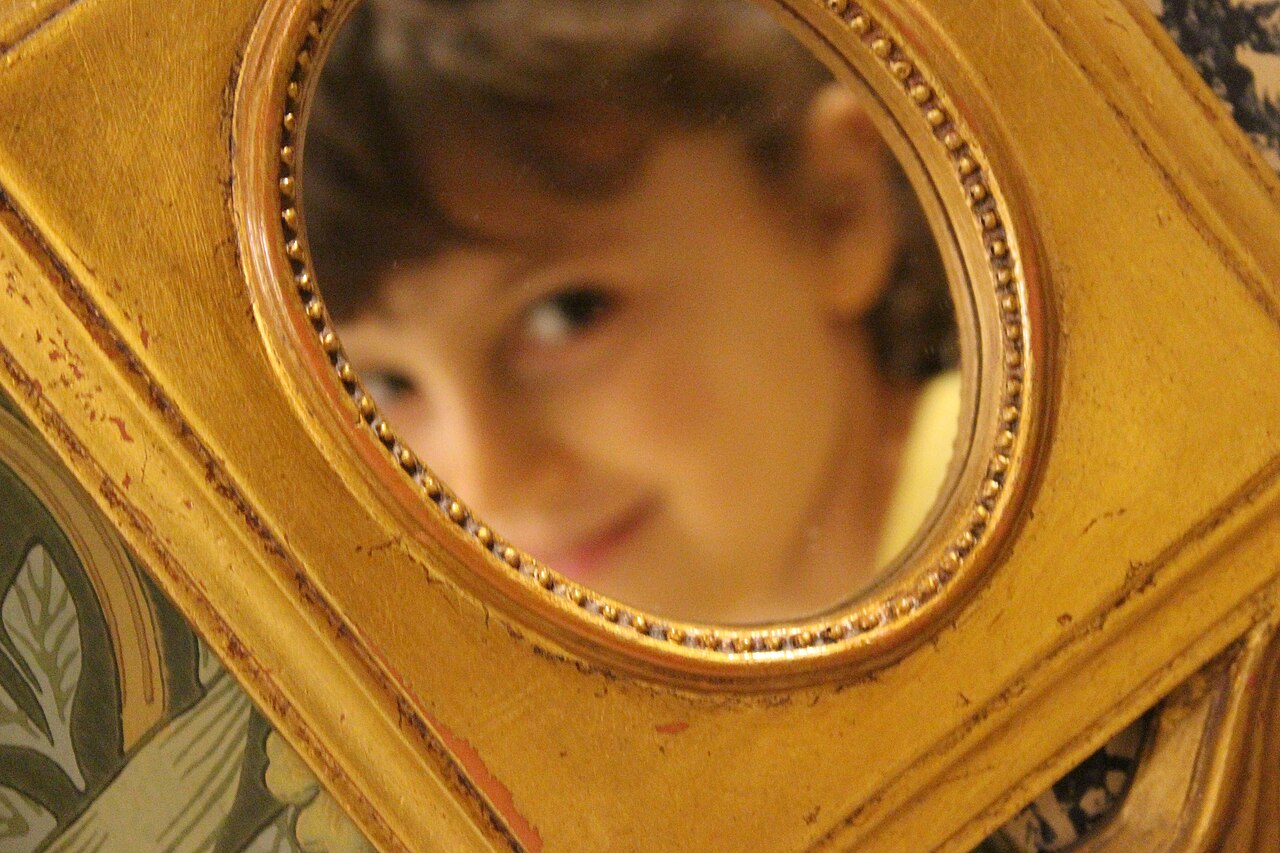
[A girl in front of a mirror; the reflection faces her, which is why the sideways swap feels natural.] Photograph: the mirror
Image Credits: Wikimedia Commons
Frequently asked questions
Do mirrors really flip left and right?
No. A flat mirror flips front to back only. The apparent left-right swap comes from your brain imagining a rotation to face the reflection.
Why does my reflection raise the opposite hand?
Because the figure in the mirror faces you, and any person facing you has their right hand on your left side. Your brain reads the reflection as a person, so it applies that rule.
Would a mirror on the floor flip up and down?
Yes. A mirror on the floor reverses top and bottom, because the axis perpendicular to that mirror runs vertically. The mirror has no favourite direction; the mounting decides which axis flips.
Why is mirror writing backwards?
You are reading the back of the writing. The mirror flips the text front to back, so the side facing you is the reverse of the side you wrote on.
Do animals see the same reversal?
The optics are the same for any viewer, since the mirror only reverses depth. What differs is interpretation: an animal that does not recognise the image as itself may treat it as another animal, which is why some animals react to mirrors as if to a stranger.
The bottom line
A mirror reverses left and right but not up and down only in the sense that your brain says so. The glass itself reverses one thing: depth. Stand a mirror on the floor and the swap moves to up and down, which shows the mirror never cared about sideways at all.
Next time the puzzle bothers you, try the two tests. Move your hand toward the glass and watch the image come toward you, then imagine flipping head over heels instead of turning on your feet. The second rotation swaps up and down, and the puzzle dissolves.
Tags: mirrors, optics, physics, perception
The Rive News research desk writes plain-English explainers on how everyday things work, based on published sources and manufacturer guidance.
Related
- Why transparent glass lets light through but metal stops it
- How does a compass actually find north so reliably
- What is dark matter, explained without jargon or math
- How magnets work at the atomic level
Subscribe for one practical science explainer each morning.
Rive News standards: every factual claim is tied to a named public source listed above; corrections are noted on the article.
Related stories
Why diamond is hard and graphite is soft when both are carbon
Diamond and graphite are both pure carbon, yet diamond is 10 on the Mohs scale and graphite is 1 to 2. The difference is not the atoms;

Why Hot Water Can Freeze Faster Than Cold: The Mpemba Effect Explained
Hot water can freeze faster than cold under specific conditions. The Mpemba effect, named for a 1963 schoolboy experiment, still divides
How Magnets Work at the Atomic Level: Spins, Domains, and Iron
Magnetism comes from electrons: their spin and orbits make each atom a tiny magnet. In iron, quantum forces align these atomic magnets into