
What Is Dark Matter, Explained Without Jargon or Math?
Key takeaways
- Dark matter is invisible material that reveals itself only through gravity.
- It makes up about 27 percent of the universe, and about 85 percent of all matter.
- Nobody has ever directly detected a dark matter particle. The evidence is gravitational, not visual.
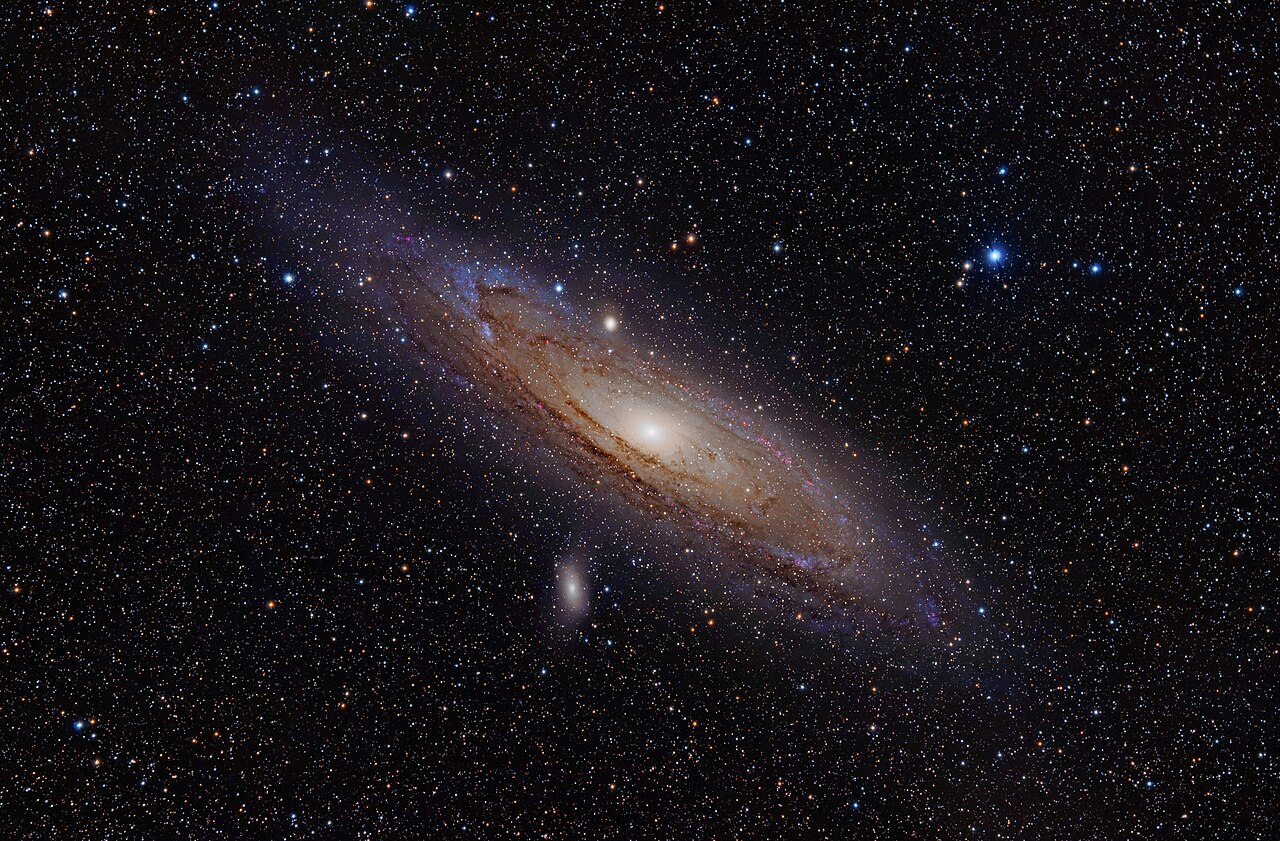
Most of the universe is missing. Not lost, exactly. Astronomers can measure its gravity, map where it sits, and watch it shape galaxies.
They just cannot see it. That invisible material is dark matter, and it outweighs everything we can see by a wide margin.
Dark matter is not a fancy name for empty space. It is real stuff with mass that takes up space. It simply does not interact with light.
It does not absorb light, reflect it, or emit it. A telescope pointed at a cloud of dark matter sees nothing, because there is nothing to catch the eye. Its presence shows up only in how it pulls on the things around it.
This article explains what dark matter is, how much of it exists, the three lines of evidence for it, what it might be made of, and what it is not.
How much dark matter is out there
NASA puts the cosmic budget in plain numbers. Ordinary matter, everything made of atoms, accounts for about 5 percent of the universe. Dark matter accounts for about 27 percent.
The rest, about 68 percent, is dark energy, a separate mystery that drives the accelerating expansion of the universe.
Looked at another way, the numbers are even starker. Of all the matter in the universe, dark matter makes up roughly 85 percent, according to figures reported by CERN. Ordinary matter, the kind that makes stars, planets, and people, is only about 15 percent of the matter total.
The visible universe is a small decoration on a much larger invisible frame.
Those numbers are not guesses. They come from independent measurements that keep landing in the same place. Different methods, different telescopes, different teams, and the same answer: most matter is dark.
The first clue: galaxies spin too fast
The story starts in the 1930s. Astronomer Fritz Zwicky studied the Coma Cluster, a group of galaxies bound together by gravity. He measured how fast the galaxies moved and found they were moving far too fast for the visible mass to hold them together.
By his arithmetic, the cluster should have flown apart. Something unseen had to be adding gravity.
Zwicky's idea was mostly ignored for decades. Then, in the 1970s, Vera Rubin and her colleague Kent Ford measured how stars orbit inside individual galaxies. They started with Andromeda, the nearest large galaxy to our own Milky Way.
Their tool was a spectrograph that Ford had built, which measured the speed of glowing gas at different distances from the galaxy's center.
Basic gravity makes a clear prediction here. Think of the solar system: Mercury, close to the Sun, orbits fast, while distant Neptune orbits slowly. The same rule should apply inside a galaxy.
Stars near the bright center should orbit fast, and stars at the dim edge should orbit slowly, because most of the mass sits in the middle.
Rubin and Ford found the opposite. Stars at the outer edges of Andromeda orbited at about the same speed as stars near the center. The rotation curve, a graph of orbital speed against distance, stayed flat instead of falling.
They checked other spiral galaxies and found the same pattern again and again.
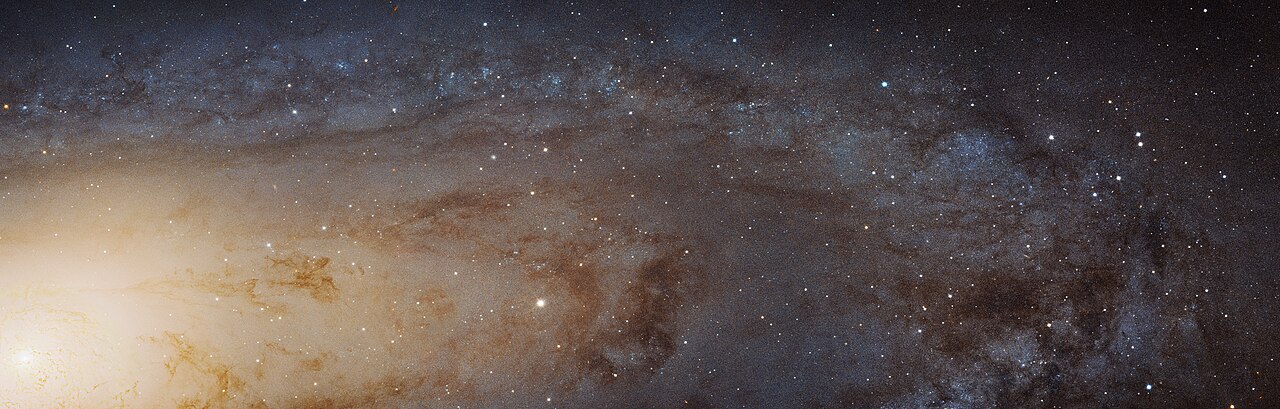
The only way to explain flat rotation curves with ordinary gravity is extra mass spread far beyond the visible galaxy. Rubin concluded that each galaxy sits inside a halo of invisible material. According to Cornell's account of her work, that halo holds five to ten times as much mass as the visible galaxy.
The stars at the edge move fast because they feel the pull of all that unseen mass.
The second clue: light bends around nothing
Gravity bends light. A massive object in front of a distant light source acts like a lens, warping and brightening the light that passes near it. Astronomers call this gravitational lensing, and it gives them a way to weigh things they cannot see.
When researchers map a galaxy cluster with lensing, they often find that the bending is stronger than the visible galaxies can explain. The extra bending traces a clump of mass sitting where few or no galaxies shine. One famous example is the merging cluster Abell 520, where maps show dark matter sitting near the hot gas but far from most of the galaxies.
The light bends around something that emits no light of its own.
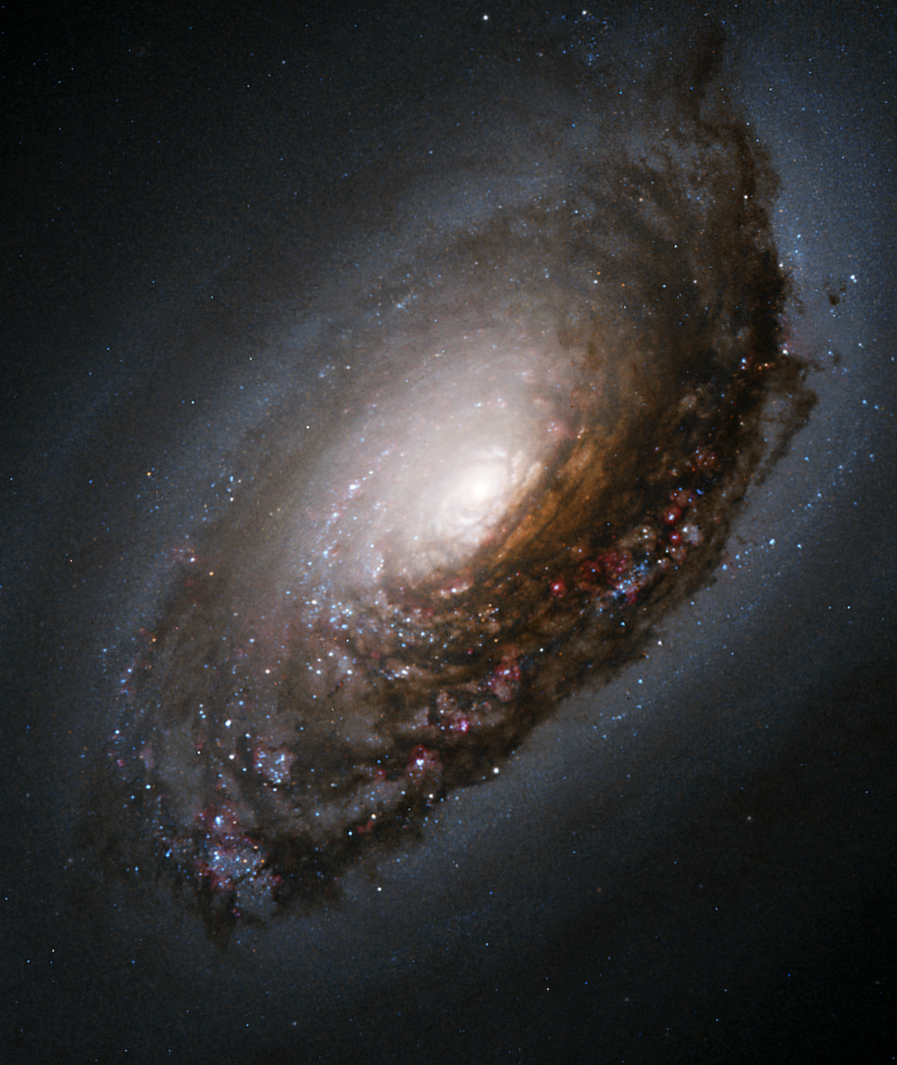
Lensing matters because it is independent of the rotation-curve argument. It does not depend on how stars move. It depends on how light travels.
When two unrelated methods point to the same invisible mass in the same places, the case gets much harder to dismiss.
The third clue: the glow of the early universe
The strongest evidence comes from the oldest light we can see. About 380,000 years after the Big Bang, the universe cooled enough for light to travel freely. That light still fills the sky today as the cosmic microwave background, a faint glow that telescopes have mapped in fine detail.
The glow is not perfectly smooth. It carries tiny temperature ripples, hotter and cooler spots that mark where matter was slightly denser or thinner in the early universe. Those ripples were the seeds of later galaxies.
When scientists analyze the pattern of ripples, they find that ordinary atoms alone cannot explain it. The universe needed far more matter than atoms provide, and that matter had to be the kind that does not interact with light.
Missions such as the Planck satellite measured the ripple pattern with high precision. The result matched the other evidence: ordinary matter about 5 percent, dark matter about 27 percent, dark energy about 68 percent.
That convergence is why most astronomers treat dark matter as real even though no one has caught a particle.
What dark matter might be
If dark matter is real stuff, what is it made of? The honest answer is that nobody knows yet. Researchers have a short list of leading candidates, and experiments around the world are hunting for them.
One candidate is a class of particles called WIMPs, weakly interacting massive particles. These would be heavier than ordinary atoms, and they would pass through normal matter almost without noticing it. Underground detectors, shielded by rock from cosmic rays, wait for a rare collision between a WIMP and an atomic nucleus.
So far, none has produced a confirmed signal.
Another candidate is the axion, a very light particle proposed for a different problem in particle physics. Axions would be so light and so numerous that they could fill galaxies like a fog. Special detectors use strong magnetic fields to coax an axion into turning into a photon, a flash of light.
Those searches are running too, and they have not yet found one.
That failure does not mean dark matter is wrong. It means the particle, if it exists, interacts very weakly with everything except gravity.
What dark matter is not
Dark matter is not dark energy. The two names sound alike, and both are invisible, but they do opposite jobs. Dark matter pulls things together through gravity.
Dark energy pushes the universe apart, driving the accelerating expansion. Confusing them is the most common mistake in popular explanations.
Dark matter is also not ordinary matter in disguise. Early on, astronomers wondered whether the missing mass could be faint stars, cold gas clouds, or wandering planets. Careful checks ruled that out.
If dark matter were made of normal atoms, it would have changed the chemistry of the early universe in ways that clash with measurements of hydrogen and helium. It would also interact with light in subtle ways that telescopes would have caught. Dark matter must be something fundamentally different from atoms.
The missing mass is spread smoothly through halos, not packed into rare dense points.
Why the case stays strong without a detection
It is fair to ask how scientists can be confident about something they have never seen. The answer is the convergence of evidence. Rotation curves, lensing, and the early-universe glow are three different measurements with different assumptions.
All three demand the same extra mass, in the same rough amounts, in the same places. A single measurement could be a mistake. Three independent ones, agreeing for decades, are much harder to explain away.
There is one rival idea worth naming. Some physicists propose that gravity itself behaves differently at galaxy scales, so no extra matter is needed. That idea can reproduce some rotation curves, but it struggles with the lensing maps and the early-universe glow.
Most astronomers regard dark matter as the better fit, while keeping the rival idea in play as a check.
The search for a direct detection goes on. New detectors are more sensitive, and new telescopes map the invisible scaffolding in finer detail. If a particle is found, dark matter moves from a gravitational inference to a laboratory fact.
Frequently asked questions
The two are unrelated ideas that happen to share the word "matter."
Could dark matter be inside our galaxy?
Yes. If dark matter forms a halo around the Milky Way, then Earth sits inside it. Dark matter particles would be passing through your body right now, rarely interacting with anything.
That is one reason underground detectors are built where they are: they sit inside the halo, waiting for a rare hit.
Will dark matter ever be seen?
Not with light, by definition. If it is a particle, it might be detected through a rare collision in a detector, or through radiation produced when dark matter particles collide in space. If no particle exists and the answer is a change in gravity, then there will be nothing to catch.
The next generation of experiments aims to settle that question.
Its importance is cosmic, not personal.
The bottom line
Dark matter is the invisible scaffolding of the universe. It holds galaxies together, bends light around empty-looking space, and shaped the glow of the early universe. It makes up about 27 percent of the cosmos and 85 percent of all matter, yet no one has ever directly detected a particle of it.
The evidence is gravitational, and it is strong enough that most astronomers accept dark matter as real while the search for its identity continues. The universe is mostly something we cannot see, and that fact alone is worth a pause. For more on how evidence can mislead, see why we have fingerprints and what they are for, how lie detector tests work and why courts stay skeptical, and why time feels slower during emergencies.
Tags: dark matter, astronomy, cosmology, space
Latest in Science
- Why do we have fingerprints and what are they for
- How do lie detector tests work and why are courts skeptical
- Why does time feel slower during emergencies
- How do seismographs detect earthquakes from far away
Subscribe to the Rive News newsletter for one clear science explainer each week.
Related stories

Why diamond is hard and graphite is soft when both are carbon
Diamond and graphite are both pure carbon, yet diamond is 10 on the Mohs scale and graphite is 1 to 2. The difference is not the atoms;

Why Hot Water Can Freeze Faster Than Cold: The Mpemba Effect Explained
Hot water can freeze faster than cold under specific conditions. The Mpemba effect, named for a 1963 schoolboy experiment, still divides

How Magnets Work at the Atomic Level: Spins, Domains, and Iron
Magnetism comes from electrons: their spin and orbits make each atom a tiny magnet. In iron, quantum forces align these atomic magnets into