
Why the moon changes shape during each month
By Rive News / Research desk | Rive News / Published October 29, 2026 at 9:00 AM PKT
Key takeaways
- The Moon does not change shape; we see a changing share of its sunlit half.
- Sunlight always lights half the Moon, while the rest sits in darkness.
- One full phase cycle takes about 29.5 days, from one new Moon to the next.
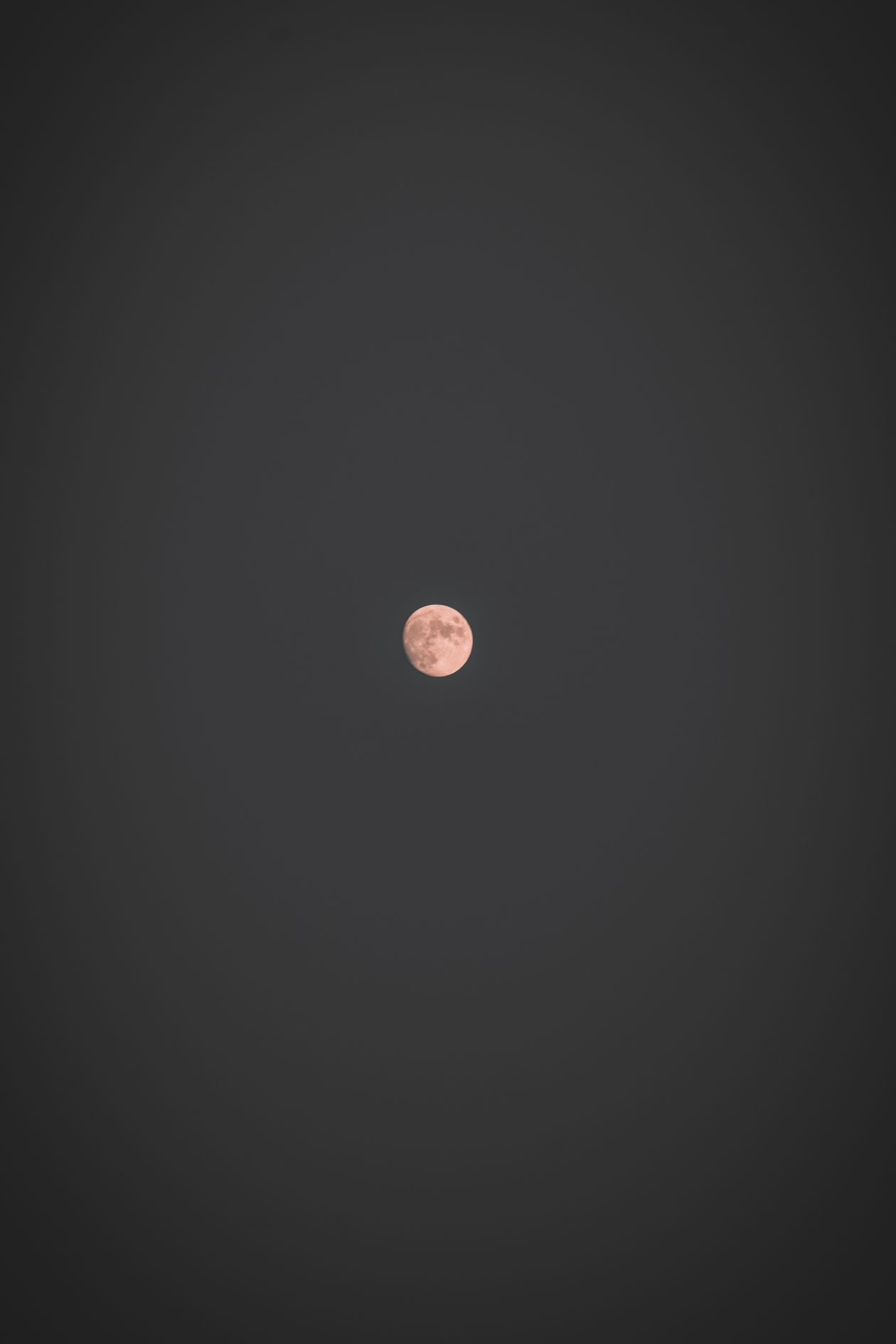
[A full moon glows in a dark night sky.] Photograph: Pexels
Image Credits: Pexels
The Moon never changes shape. It stays a rocky sphere all month, roughly 3,474 kilometres across. What changes is how much of its sunlit half faces Earth on any given night.
Sunlight always lights one half of the Moon, just as it always lights one half of Earth. As the Moon travels around Earth, our viewpoint slides around that lit half, and the bright shape we see grows, shrinks, and flips. This article walks through the eight named phases, explains the 29.5-day cycle, and clears up the two most common mix-ups: Earth's shadow and the missing monthly eclipse.
Half lit, always
The Moon makes no light of its own. Moonlight is sunlight reflected off the lunar surface, as NASA's Moon phases guide states. The Sun beams onto the Moon from one direction, lighting the hemisphere that faces the Sun and leaving the opposite hemisphere dark.
That division never changes. At every moment, half the Moon experiences lunar day and half experiences lunar night. The phases come entirely from geometry: which part of the lit half happens to face Earth.
A simple lamp test shows the geometry. Hold a ball in a dark room with a lamp on one side. Walk around the ball and watch its bright face grow and shrink from your viewpoint.
The ball never changes, and the lamp never moves. Only your angle changes. The Moon's phases work the same way, with the Sun as the lamp and Earth as the walking observer.
The Moon also rotates as it orbits, keeping the same face toward Earth. That is why the dark patches that look like a face, the lunar maria, appear in the same arrangement every night. We always see the same side, but we see different amounts of its lit portion.
The eight phases in order
The cycle begins at new Moon. The Moon sits between Earth and the Sun, so its lit half faces away from us.
The side facing Earth is dark, and the Moon effectively vanishes from the night sky. It is still there, of course, travelling across the daytime sky near the Sun, but its dark face gives us nothing to see.
Over the next few nights, a thin sliver of light appears on the right edge, in the northern hemisphere. This is the waxing crescent, and waxing means growing. Each night the sliver fattens as the Moon moves farther from the Sun in the sky.
About a week after new Moon comes first quarter. Half the face we see is lit, the right half in the northern hemisphere.
The name quarter refers to the Moon's position in its cycle, not to a quarter of the disc being lit. It has completed one quarter of its journey from new to new.
The waxing gibbous follows, with more than half lit and still growing. Gibbous means humped or rounded, and the shape looks like a disc with a small dark bite taken out. Then comes full Moon, when Earth sits between the Sun and the Moon and the entire face we see is lit.
After full Moon, the process reverses. The waning gibbous shrinks night by night.
Last quarter, also called third quarter, shows the opposite half lit from first quarter. The waning crescent thins to a final sliver, and the cycle returns to new Moon.
NASA's Space Place lists the same eight phases in the same order: new, waxing crescent, first quarter, waxing gibbous, full, waning gibbous, third quarter, and waning crescent. The names are labels on a smooth, continuous change, not eight shapes the Moon snaps between.
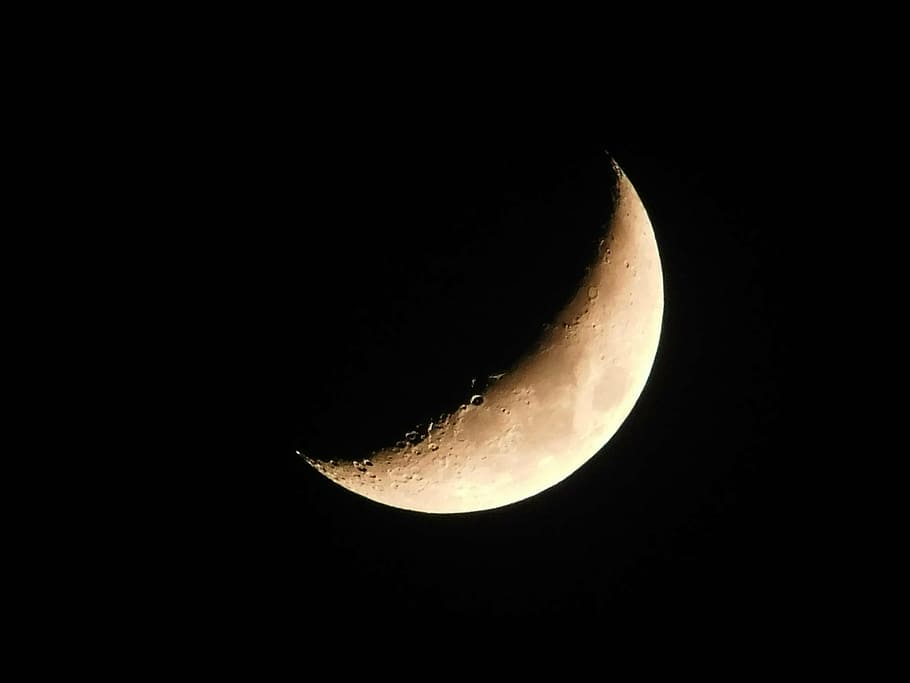
[A crescent moon shows only a sliver of its sunlit half.] Photograph: Hippopx contributor
Image Credits: Hippopx (public domain)
Why the cycle takes 29.5 days
The Moon orbits Earth in about 27.3 days measured against the distant stars. That is the sidereal month.
But the phase cycle, the synodic month, takes about 29.5 days, as NASA notes. The two extra days come from Earth's own motion.
While the Moon completes one orbit, Earth moves along its own orbit around the Sun. The Sun's direction in the sky shifts by about 27 degrees during that time. The Moon must travel a little farther, roughly two extra days, to line up with the Sun again and repeat its phase.
That is why the word month itself descends from Moon. Early calendars tracked the 29.5-day phase cycle because it was visible to everyone, no instruments needed. Twelve such months make about 354 days, which is why purely lunar calendars drift against the seasons unless corrected.
The Moon also moves against the star background by about 12 degrees per day, roughly its own diameter every hour. That eastward drift is separate from the nightly westward sweep that Earth's rotation gives the whole sky. Watch the Moon near a bright star on two successive nights and the shift is plain.
Why there is no eclipse every month
If the Moon passed directly between Earth and the Sun at every new Moon, there would be a solar eclipse monthly. If it passed directly behind Earth at every full Moon, there would be a lunar eclipse monthly. Neither happens, because the Moon's orbit is tilted.
The Moon's path tilts about 5 degrees relative to the plane of Earth's orbit around the Sun. Most new Moons pass slightly above or below the Sun in the sky, so no shadow falls on Earth. Most full Moons pass slightly above or below Earth's shadow, so no eclipse darkens the Moon.
Eclipses happen only when a new or full Moon lands near one of the two points where the Moon's tilted orbit crosses Earth's orbital plane. Those windows, called eclipse seasons, arrive roughly every six months. That is why eclipses cluster in seasons instead of arriving monthly.
Earth's shadow also has nothing to do with ordinary phases. This is the most common misconception about the Moon.
The dark part of a crescent Moon is simply the Moon's own night side, not Earth's shadow falling across it. Only during a genuine lunar eclipse does Earth's shadow darken the Moon, and that event looks quite different, with a copper-red tint from sunlight bent through Earth's atmosphere.
The view from the other hemisphere
Phase names describe the same Moon, but the orientation flips south of the equator. In the southern hemisphere, the waxing crescent lights up on the left edge instead of the right, and the sequence appears mirrored.
The timing is identical. Observers worldwide share essentially the same phase at the same instant.
The Moon's path across the sky differs by latitude too. In the tropics, a crescent Moon can look like a boat, with its horns pointing up. At higher latitudes, the same crescent tilts sideways.
The lit portion is the same. The angle of the viewer changes the picture.
Rise and set times shift with phase as well. A new Moon rises near sunrise and sets near sunset, travelling with the Sun. A full Moon rises near sunset and sets near sunrise, opposite the Sun.
Quarter Moons split the difference, rising around midday or midnight. Knowing the phase therefore tells you roughly when to look.
Frequently asked questions
Does the Moon really change shape?
No. The Moon stays a sphere. Phases show different amounts of its sunlit half as seen from Earth, while the dark portion is simply the Moon's night side.
How long is a full cycle of phases?
About 29.5 days from one new Moon to the next. That is the synodic month, longer than the 27.3-day orbit against the stars because Earth moves around the Sun meanwhile.
Why is there no eclipse at every new and full Moon?
The Moon's orbit tilts about 5 degrees to Earth's orbital plane, so most new and full Moons miss the exact alignment an eclipse needs. Eclipses happen only during eclipse seasons.
Is the dark part of the Moon Earth's shadow?
No, except during a lunar eclipse. In ordinary phases, the dark part is the side of the Moon facing away from the Sun: lunar night, not a shadow cast by Earth.
The bottom line
The Moon changes shape during the month because we see a changing slice of a half-lit sphere. Sunlight always covers one side. The Moon's orbit around Earth turns that lit side toward us and away again, drawing the crescent, the half, the gibbous, and the full disc across about 29.5 days.
Once you see the geometry, the Moon stops looking mysterious and starts looking readable. A thin crescent means new Moon just passed.
A fat gibbous means full Moon is near. The shape is a calendar, written in sunlight, and it has kept time for every culture that ever looked up.
Tags: moon phases, moon, astronomy, night sky
Rive News's research desk covers everyday science questions with sourced explainers, not lab reports.
Related
- Why the moon sometimes looks bigger near the horizon
- Why the moon is sometimes visible during the day
- Why the Earth has seasons if distance is not the cause
Subscribe for one plain-English science explainer each morning.
Rive News publishes sourced explainers; claims are checked against public sources before publication.
Related stories
Why diamond is hard and graphite is soft when both are carbon
Diamond and graphite are both pure carbon, yet diamond is 10 on the Mohs scale and graphite is 1 to 2. The difference is not the atoms;

Why Hot Water Can Freeze Faster Than Cold: The Mpemba Effect Explained
Hot water can freeze faster than cold under specific conditions. The Mpemba effect, named for a 1963 schoolboy experiment, still divides
How Magnets Work at the Atomic Level: Spins, Domains, and Iron
Magnetism comes from electrons: their spin and orbits make each atom a tiny magnet. In iron, quantum forces align these atomic magnets into