
How a rainbow forms after rain when sunlight returns
By Rive News / Research desk | Rive News / Published October 28, 2026 at 9:00 AM PKT
Key takeaways
- A rainbow needs sunlight behind you and rain in front of you at the same time.
- Sunlight refracts into a drop, disperses into colours, reflects inside, and refracts out again.
- Red light reaches your eye at about 42 degrees and violet at about 40 degrees.
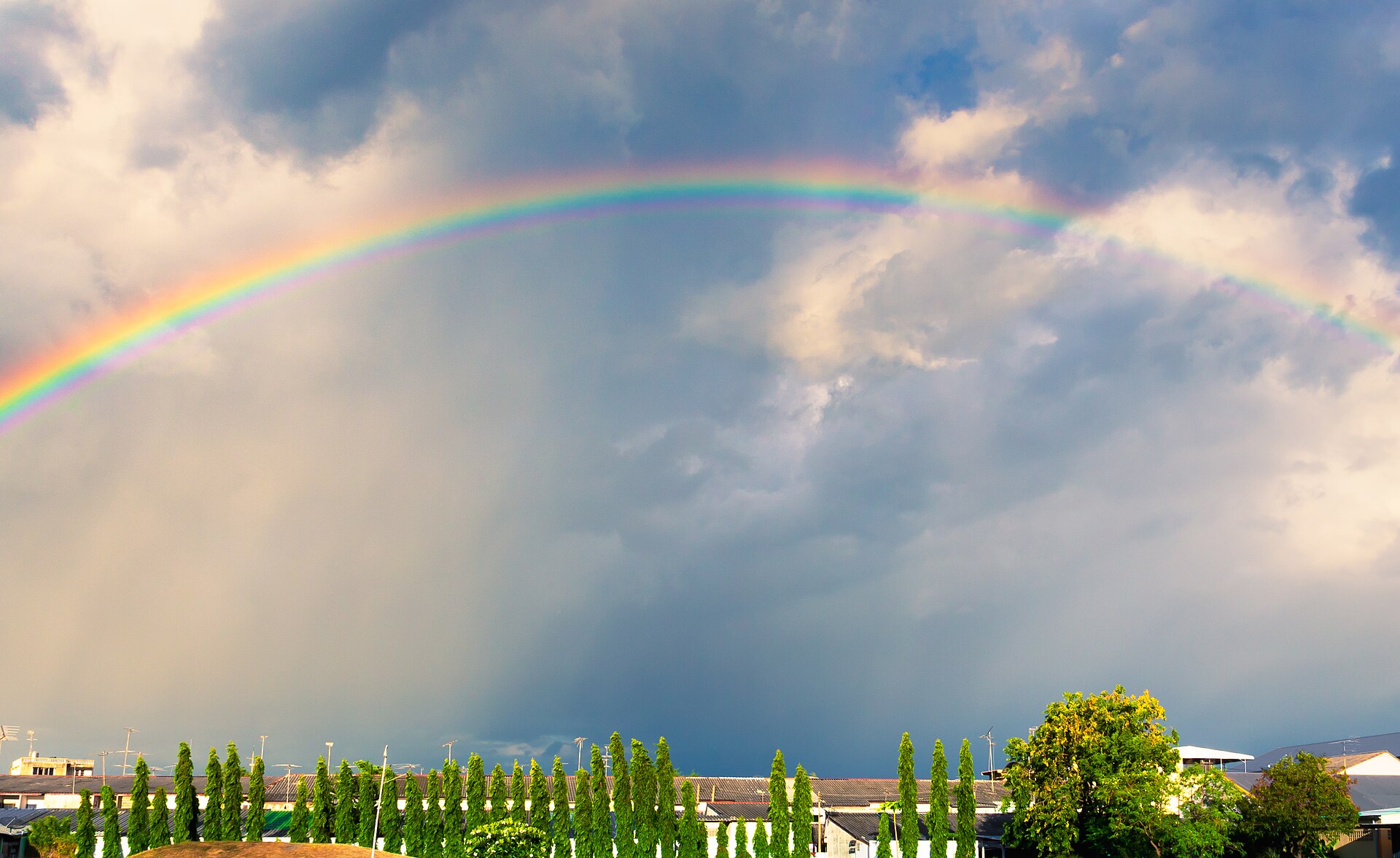
[A rainbow arcing across the sky after a rain shower.] Photograph: Wikimedia Commons contributor
Image Credits: Wikimedia Commons
A rainbow forms after rain when sunlight meets millions of raindrops at just the right geometry. Sunlight enters each drop, bends, splits into its colours, bounces off the back of the drop, and bends again on the way out. Your eye collects one colour from each of countless drops, and the result is the familiar arc of colour against a rainy sky.
This article explains how a rainbow forms after rain, including the light path inside a single raindrop, why the colours always appear in the same order, why you must stand with the sun behind you, and why no two people see exactly the same rainbow.
The two conditions a rainbow needs
A rainbow needs two things at once: rain in one part of the sky and sunshine in another. The sun must be behind the observer, and the rain must be in front of them, so that sunlight passes the observer, enters the rain, and returns to the eye. If the sun is high overhead, the geometry fails, which is why rainbows are most common in the late afternoon or early morning when the sun is low.
Rain after a shower is ideal because the air is full of suspended drops, but any airborne water works. A garden hose sprayed against the sun, a waterfall's mist, or a lawn sprinkler can all produce a small rainbow on the same principle. The physics does not care where the drops came from, only that they are there and the sun is behind you.
The rainbow itself is not an object sitting in the sky. It is an optical effect created by light reaching your eye from many drops at once. Move, and the set of drops sending light to your eye changes, so the rainbow moves with you.
That is why a rainbow can never be reached or stood under in the way a cloud can.
Inside a single raindrop
The light path inside one drop has four steps. First, sunlight enters the drop and refracts, bending as it slows down moving from air into water. Refraction is the change in direction of light as it passes from one medium to another because its speed changes.
Second, the light disperses. Sunlight looks white, but it is made of all the colours of the visible spectrum travelling together, each with a different wavelength. Each wavelength bends by a slightly different amount on entering the water, so the white light spreads into its component colours, much as a prism spreads light.
Third, the separated colours travel to the back inner surface of the drop and reflect internally, bouncing like light off the inside of a mirror. Fourth, the light refracts a second time as it leaves the drop back into the air, which spreads the colours further apart. Encyclopaedia Britannica describes exactly this sequence: sunlight is refracted on entering the drop, disperses into its colours, a portion is internally reflected at the back of the drop, and it is refracted a second time as it re-emerges.
One drop alone sends only a tiny coloured glint toward you. A rainbow appears because millions of drops do this at once, each contributing one colour from its position in the sky.
Why the colours are always in the same order
Red light bends the least and violet light bends the most, so the colours leave each drop in a fixed order. Red ends up on the outer edge of the arc and violet on the inner edge, with orange, yellow, green, blue, and indigo between them. The traditional list, violet, indigo, blue, green, yellow, orange, red, is simply that order read from the inside out.
The viewing angles are precise. Red light reaches the eye at about 42 degrees from the direction opposite the sun, and violet at about 40 degrees.
The two-degree gap between them is the width of the coloured band you see. Drops at other angles send their colours somewhere else, not to your eye, which is why the rainbow has a sharp shape instead of filling the whole rainy sky.
Because the angle is measured from your eye, the rainbow is personal. A person standing beside you sees a rainbow formed by a slightly different set of drops, even though the two rainbows look identical. Two observers never literally share one rainbow, although the difference is too small to notice.

[A rainbow in the sky above fields and trees.] Photograph: Wikimedia Commons contributor
Image Credits: Wikimedia Commons
Why a rainbow is an arc, not a full circle
A complete rainbow is actually a full circle, centred on the point directly opposite the sun, called the antisolar point. From the ground, the horizon cuts off the lower half, so only the arc above the horizon is visible. From a mountain top or an aeroplane, with rain below and sun behind, the full circle can sometimes be seen.
The arc shape also explains why rainbows vanish when the sun climbs too high. When the sun rises above about 42 degrees in the sky, the antisolar point sinks so far below the horizon that the whole circle sits below it, and no part of the rainbow remains visible. Midday summer rain therefore rarely produces a rainbow, even with bright sun and heavy rain.
Secondary rainbows add a further twist. Light that reflects twice inside a drop, instead of once, forms a fainter outer arc with its colours reversed: red on the inside and violet on the outside. The band of darker sky between the primary and secondary bows is called Alexander's band, after Alexander of Aphrodisias, who described it in antiquity.
Why rainbows fade
A rainbow lasts only while its conditions hold. As the rain thins, fewer drops feed light to your eye and the colours wash out. As cloud covers the sun, the light source weakens and the bow dims.
As the sun climbs or the rain moves, the geometry breaks and the arc dissolves.
Drop size also changes the look. Large raindrops produce bright, sharply separated colours, because each drop acts like a clean prism. Very small droplets, such as fine mist, produce paler, broader bands, and can even blur the colours into a white fog bow.
That is why a sharp rainbow after a summer downpour looks so different from a pale bow in sea mist.
For more sky science, see what causes the northern lights, how clouds stay up in the sky, and what causes thunder and why lightning comes first.
Frequently asked questions
Can you see a rainbow at noon?
Rarely. The sun must be low enough that the rainbow's arc rises above the horizon, which usually means morning or late afternoon. When the sun is higher than about 42 degrees, the rainbow sits entirely below the horizon.
Why does a rainbow always have the same colours in the same order?
Each colour bends by a different amount inside a raindrop, with red bending least and violet most. That fixed difference in bending fixes the order, red outside and violet inside, in every rainbow.
Is there really a pot of gold at the end of a rainbow?
No. A rainbow is an optical effect, not an object, and it moves as you move. There is no physical end to reach, so the folklore end point cannot exist.
What is a double rainbow?
A double rainbow adds a fainter secondary bow outside the main one, formed by light reflecting twice inside each drop. Its colours run in reverse order, with red on the inside.
The bottom line
A rainbow forms when sunlight behind you enters rain in front of you and takes a four-step path through each drop: refract, disperse, reflect, refract again. Red light leaves at about 42 degrees and violet at about 40, which fixes the arc's shape and its colour order.
The bow is not an object but an effect in your eye, which is why it follows you, why it vanishes when the sun climbs or the rain thins, and why the person beside you is technically seeing a slightly different rainbow. Next time one appears after rain, check the sun's position behind you: that geometry is the whole trick.
Tags: rainbow, light, weather, optics
Rive News's research desk covers everyday science and home topics from published sources, with no invented experts or first-hand claims.
Related
- What causes the northern lights to appear in the sky
- How do clouds stay up in the sky if they are made of water
- What causes thunder and why lightning comes first
Subscribe to the Rive News newsletter for one practical explainer each week.
Rive News publishes general information only; figures are cited from the sources listed above.
Related stories
Why diamond is hard and graphite is soft when both are carbon
Diamond and graphite are both pure carbon, yet diamond is 10 on the Mohs scale and graphite is 1 to 2. The difference is not the atoms;

Why Hot Water Can Freeze Faster Than Cold: The Mpemba Effect Explained
Hot water can freeze faster than cold under specific conditions. The Mpemba effect, named for a 1963 schoolboy experiment, still divides
How Magnets Work at the Atomic Level: Spins, Domains, and Iron
Magnetism comes from electrons: their spin and orbits make each atom a tiny magnet. In iron, quantum forces align these atomic magnets into