
How scientists date fossils and work out their age
By Rive News / Research desk | Rive News / Published October 28, 2026 at 9:00 AM PKT
Key takeaways
- Most fossils are dated by the rock layers around them, not by testing the fossil itself.
- Relative dating puts fossils in order, while radiometric dating gives an age in years.
- Carbon dating works only for young material, up to about 50,000 to 60,000 years old.
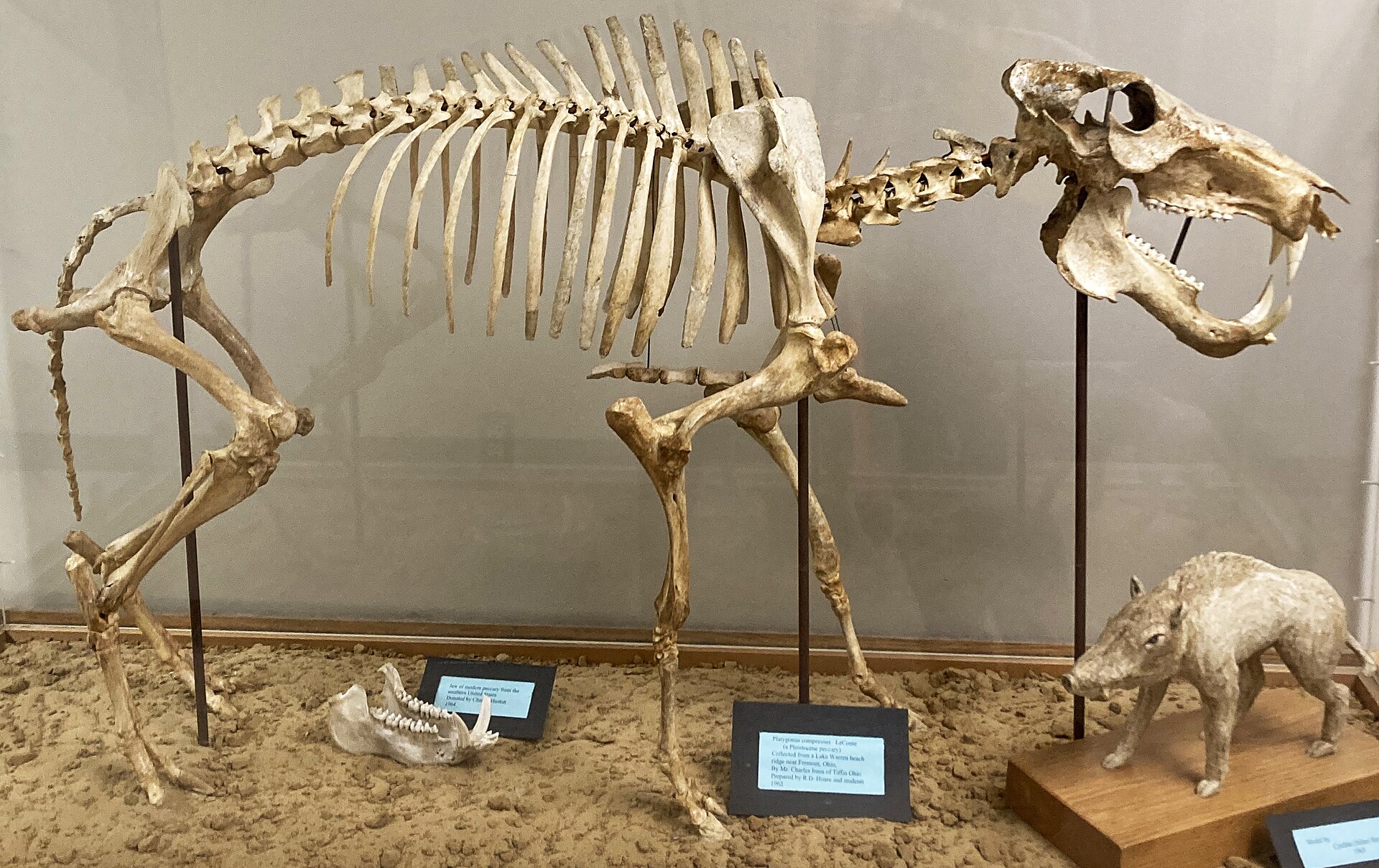
[Fossil skeleton of a prehistoric peccary on display.] Photograph: Wikimedia Commons contributor
Image Credits: Wikimedia Commons
Scientists work out how old a fossil is by combining two kinds of evidence. They study the rock layers the fossil came from, which show whether it is older or younger than fossils in other layers. Then, where possible, they measure radioactive decay in nearby rocks to put a number of years on that layer.
This article explains how scientists date fossils, including relative dating, radiometric dating, carbon dating and its limits, and why a fossil's age is often a bracket between two dated layers rather than a single exact date.
Start with the rock, not the fossil
Fossils are usually found in sedimentary rock, which forms in layers as sand, mud, and silt settle and harden over time. In undisturbed layers, the oldest layers sit at the bottom and the youngest at the top. This principle, called superposition, lets scientists order fossils relative to each other even before any laboratory measurement.
A fossil found between two layers of known age must be younger than the lower layer and older than the upper one. That bracket is often the most honest answer a site can give. The Canadian Museum of Nature notes that dating fossils helps establish when groups such as dinosaurs became extinct and when the first mammals walked the Earth, because age is what turns a collection of bones into a timeline.
Relative dating also uses index fossils. Some species lived for a short geological span but spread widely, so finding one in a layer helps match that layer to the same time period in other places. If the same index fossil appears in rocks on two continents, those rocks are probably close in age, even though they are thousands of kilometres apart.
Radiometric dating: the atomic clock
Radiometric dating measures how much of a radioactive isotope has decayed into its stable daughter product. Radioactive isotopes decay at a fixed rate, described by a half-life: the time it takes for half of the original atoms in a sample to decay. By measuring the ratio of parent to daughter atoms, scientists can calculate how long decay has been going on.
The US National Park Service explains the logic directly: because decay occurs at a fixed rate, scientists can measure the amount of decayed material in a sample, determine the ratio between original and decayed material, and then calculate the sample's age. Different isotope pairs suit different ages, because a clock with a very long half-life is too slow to measure young samples, and a fast clock runs out for old ones.
Fossil-bearing sedimentary rock itself usually cannot be dated this way, because it lacks the right radioactive minerals. Instead, scientists date volcanic ash layers or lava flows above and below the fossil layer.
Volcanic rock forms with a known starting point, since its minerals crystallize as it cools, resetting the clock. A fossil sandwiched between two dated ash layers inherits their age bracket.
Carbon dating and its limits
Carbon dating is the best-known method, and also the most misunderstood. Living things take in carbon from the atmosphere, including a small amount of radioactive carbon-14. When an organism dies, it stops taking in carbon, and the carbon-14 it contains decays to nitrogen-14 with a half-life of 5,730 years.
The Canadian Museum of Nature reports that radiocarbon dating is limited to the last 50,000 years, while the National Park Service puts its effective range at 100 to 50,000 years. Physical Geology gives a similar ceiling of about 60,000 years. After roughly ten half-lives, too little carbon-14 remains to measure reliably, so the method simply cannot reach dinosaur-age fossils.
Carbon dating also dates the organic material itself, not the rock around it. That is why it works well for late Pleistocene fossils, such as mammoth bones or plant remains, and for archaeological material younger than about 15,000 years. The Canadian Museum of Nature notes that palaeontologists often use it for fossils from the latter part of the Late Pleistocene, which spanned roughly 126,000 to 11,700 years ago, where it can date individual fossils even when remains of different ages are mixed together in river deposits.
Clocks for deep time
For fossils millions or billions of years old, scientists use isotope pairs with much longer half-lives. Potassium-40 decays to argon-40 with a half-life of about 1.25 billion years, and the National Park Service lists it for dating volcanic rocks such as lava flows and ash. Uranium-238 decays to lead-206 with a half-life of 4.5 billion years, and is used for minerals such as zircon.
These long clocks are what date the famous fossil sites. A volcanic ash layer dated by potassium-argon at, say, 3 million years gives a firm anchor, and fossils in layers just above or below it can be placed close to that age. Using two or more methods on the same layer cross-checks the result, since agreement between independent clocks is strong evidence the age is right.
Contamination is the main enemy of accuracy. If a sample gains or loses parent or daughter atoms after it forms, the clock gives a wrong reading. Scientists guard against this by choosing fresh, unweathered samples, by dating several minerals from the same rock, and by rejecting results that disagree with the geological context.
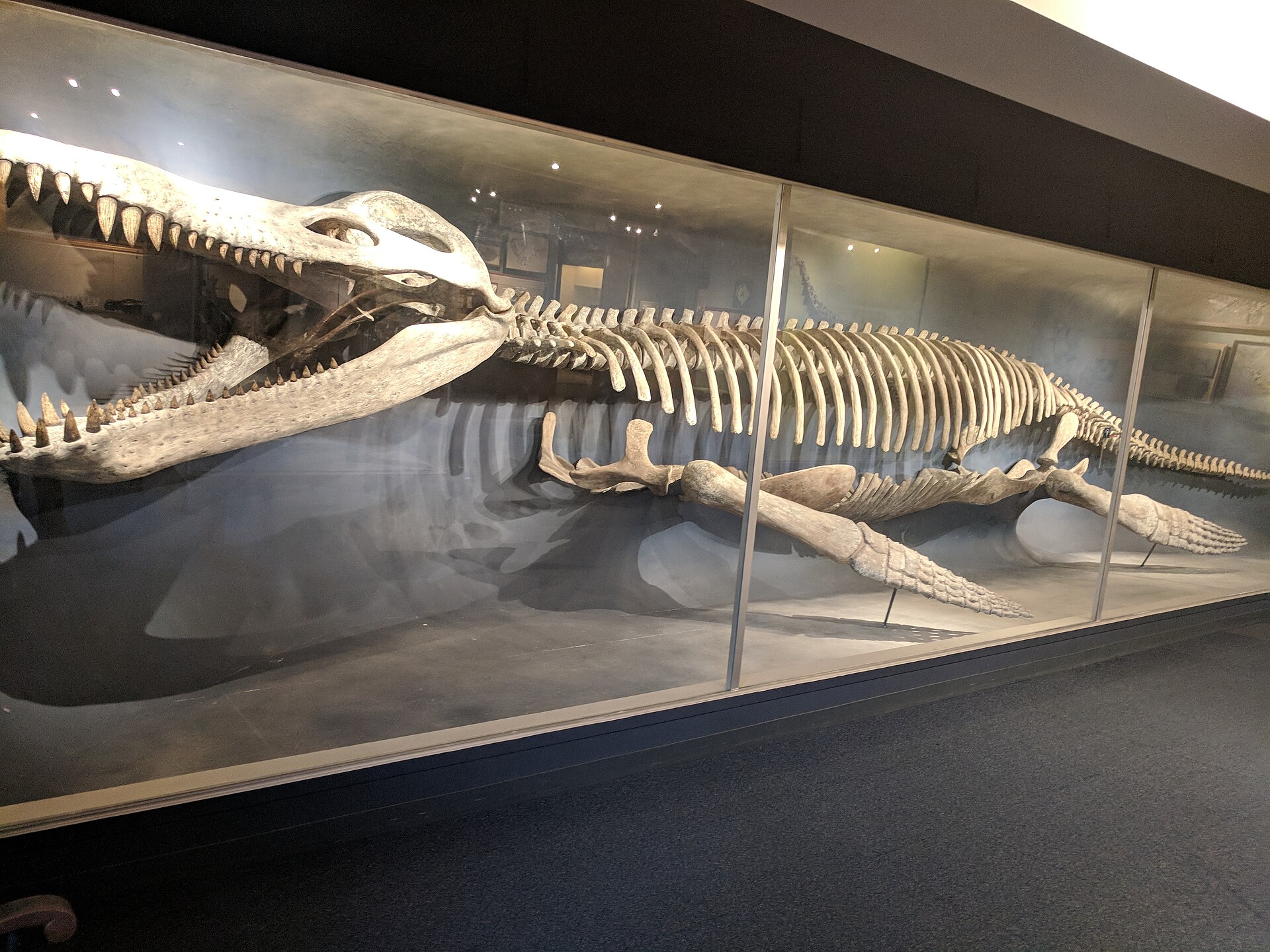
[Ancient whale fossil skeleton displayed in a museum.] Photograph: Wikimedia Commons contributor
Image Credits: Wikimedia Commons
Why ages are sometimes revised
A fossil's published age can change when a nearby layer is re-dated with a better method, or when the fossil is moved to a different layer by new fieldwork. That is not a failure of the science; it is the method working as intended. Each new measurement narrows the bracket or corrects an earlier assumption, and the revised age rests on more evidence than the old one did.
Uncertainty is also reported honestly in proper studies. A radiometric date comes with an error margin, such as 66 million years plus or minus a few hundred thousand, because laboratory measurements are never exact. Popular summaries often drop the margin, which makes the age look more precise than the science claims.
For more on how scientists read other natural records, see what causes earthquakes and whether they can be predicted, how clouds stay up in the sky, and what causes the northern lights.
How the methods fit together
In practice, a fossil's age is rarely the product of one technique. Field geologists record the layer and its position in the sequence, relative dating orders the fossils, and radiometric dates on volcanic layers anchor the sequence in years. Index fossils then let researchers carry those anchors to sites with no datable volcanic rock at all.
A good example of the chain is a fossil found in a sedimentary layer between two ash beds. The lower ash dates to 10 million years, the upper to 9 million years, so the fossil is between 9 and 10 million years old. If the same index fossil appears in another country in a layer of similar character, that layer is probably from the same window of time, even without its own ash beds.
Frequently asked questions
Can scientists carbon-date a dinosaur fossil?
No. Carbon dating reaches only about 50,000 to 60,000 years, while dinosaurs died out about 66 million years ago. Dinosaur fossils are dated through the rock layers around them and through radiometric dates on nearby volcanic rock.
How accurate is radiometric dating?
It is accurate within its stated error margin when samples are fresh and uncontaminated. Cross-checking with a second isotope pair, and with the geological sequence, catches most errors before a date is published.
Why do fossil ages sometimes change?
New measurements, better methods, or revised fieldwork can shift a fossil into a different layer or re-date its anchor layers. The revised age usually rests on more evidence, not less.
What is a half-life in dating?
A half-life is the time for half of a radioactive isotope in a sample to decay into its daughter product. Carbon-14 has a half-life of 5,730 years, while uranium-238 has one of 4.5 billion years.
The bottom line
Scientists date fossils by reading the rock record in two ways at once. Relative dating orders fossils by their layers, and radiometric dating measures decay in nearby volcanic rock to give ages in years.
Carbon dating handles only the youngest fossils, up to roughly 50,000 years, while potassium-argon and uranium-lead clocks reach back billions of years. The result is usually a well-supported bracket rather than a single perfect number, and that bracket is what makes the fossil record a timeline rather than a pile of bones.
Tags: fossils, radiometric dating, geology, palaeontology
Rive News's research desk covers everyday science and home topics from published sources, with no invented experts or first-hand claims.
Related
- What causes earthquakes and can we predict them
- How do clouds stay up in the sky if they are made of water
- What causes the northern lights to appear in the sky
Subscribe to the Rive News newsletter for one practical explainer each week.
Rive News publishes general information only; figures are cited from the sources listed above.
Related stories
Why diamond is hard and graphite is soft when both are carbon
Diamond and graphite are both pure carbon, yet diamond is 10 on the Mohs scale and graphite is 1 to 2. The difference is not the atoms;

Why Hot Water Can Freeze Faster Than Cold: The Mpemba Effect Explained
Hot water can freeze faster than cold under specific conditions. The Mpemba effect, named for a 1963 schoolboy experiment, still divides
How Magnets Work at the Atomic Level: Spins, Domains, and Iron
Magnetism comes from electrons: their spin and orbits make each atom a tiny magnet. In iron, quantum forces align these atomic magnets into