
Why Is the Sea Blue? The Light Trick Behind Ocean Color
Key takeaways
- Water molecules absorb red, orange, and yellow light far more strongly than blue, which scatters back to your eye.
- The sea is not mainly reflecting the sky; ocean and sky are blue through two different physics processes.
- Depth, algae, and sediment shift the color, which is why some waters look turquoise, green, or even red.
Stand on a beach and scoop up a glass of seawater. The glass looks colorless.
Look back at the ocean and it is unmistakably, vividly blue. The water did not change on the way into the glass; your eyes are just seeing a different amount of it.
The short answer is that water itself is faintly blue. Sunlight contains every color, and water molecules absorb the long red, orange, and yellow wavelengths far more strongly than the short blue ones. Over the meters of depth in the sea, that absorption stacks up, and mostly blue light survives the round trip back to your eyes.
This article explains how water filters sunlight, why the sea is not simply mirroring the sky, and what makes ocean color change from turquoise to green to red.
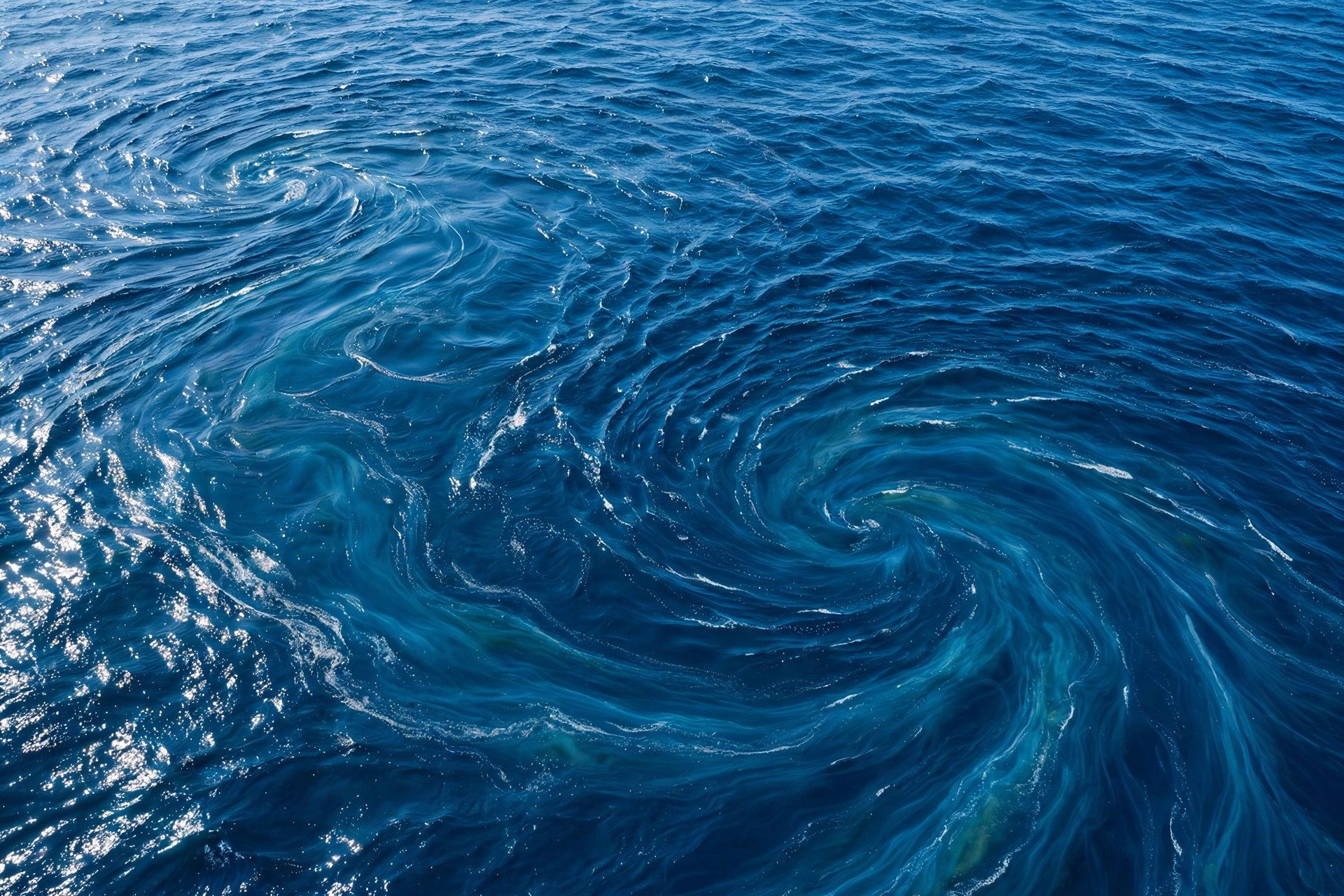
The deep blue of open ocean, where pure water absorbs warm light and returns blue. Illustration: Rive News.
Image Credits: Original illustration, Rive News
The sea is blue because water absorbs red light
The color of any object comes down to which wavelengths of light it reflects and which it absorbs. Water absorbs light in the range of about 600 to 800 nanometers, the band covering orange and red, much more strongly than it absorbs blue light in the 450 to 500 nanometer band.
When white sunlight enters the ocean, the warm colors are steadily filtered out as the rays travel down and back up. Blue survives.
As ScienceABC puts it, the sea does not add blue color; it selectively removes red. A study published in the journal Applied Optics measured exactly this differential absorption across the visible spectrum, confirming that water eats up long wavelengths while short ones pass through.
A single glass of water hides the effect because the light travels only a few centimeters, too short a trip for your eyes to notice the missing red. Look through meters of water, and the absorption adds up into the deep blue you see from the beach.
The surface also reflects a little of the sky, which is why the sea looks greyer under clouds and brighter blue on a clear day. But reflection is a side dish. The main course is absorption, a property of water itself.
It is not mainly a reflection of the sky
The most popular wrong answer is that the sea is blue because it reflects a blue sky. Scientific American addressed this directly: the ocean and the sky are blue for two genuinely different reasons, and the sea would look blue even under a grey sky.
The sky is blue because of Rayleigh scattering. Air molecules are much smaller than the wavelength of light, and they scatter short-wavelength blue light far more than long-wavelength red, in proportion to the fourth power of the light's frequency. That scattered blue arrives from every direction, so the whole sky glows blue.
The sea's blue, by contrast, comes from absorption and selective reflection inside the water. If you could fill an ocean with perfectly clear water and view it under white laboratory light, it would still look blue. The two blues coincide in nature, which makes the myth sticky, but the physics are distinct.
Light does not even travel that far down. According to the US National Ocean Service, hardly any sunlight penetrates deeper than 656 feet (200 meters), and none at all reaches below 3,280 feet (1,000 meters). Since the average ocean depth is around 12,000 feet, most of the ocean is a pitch-black void, and the blue we admire is a surface-layer phenomenon.
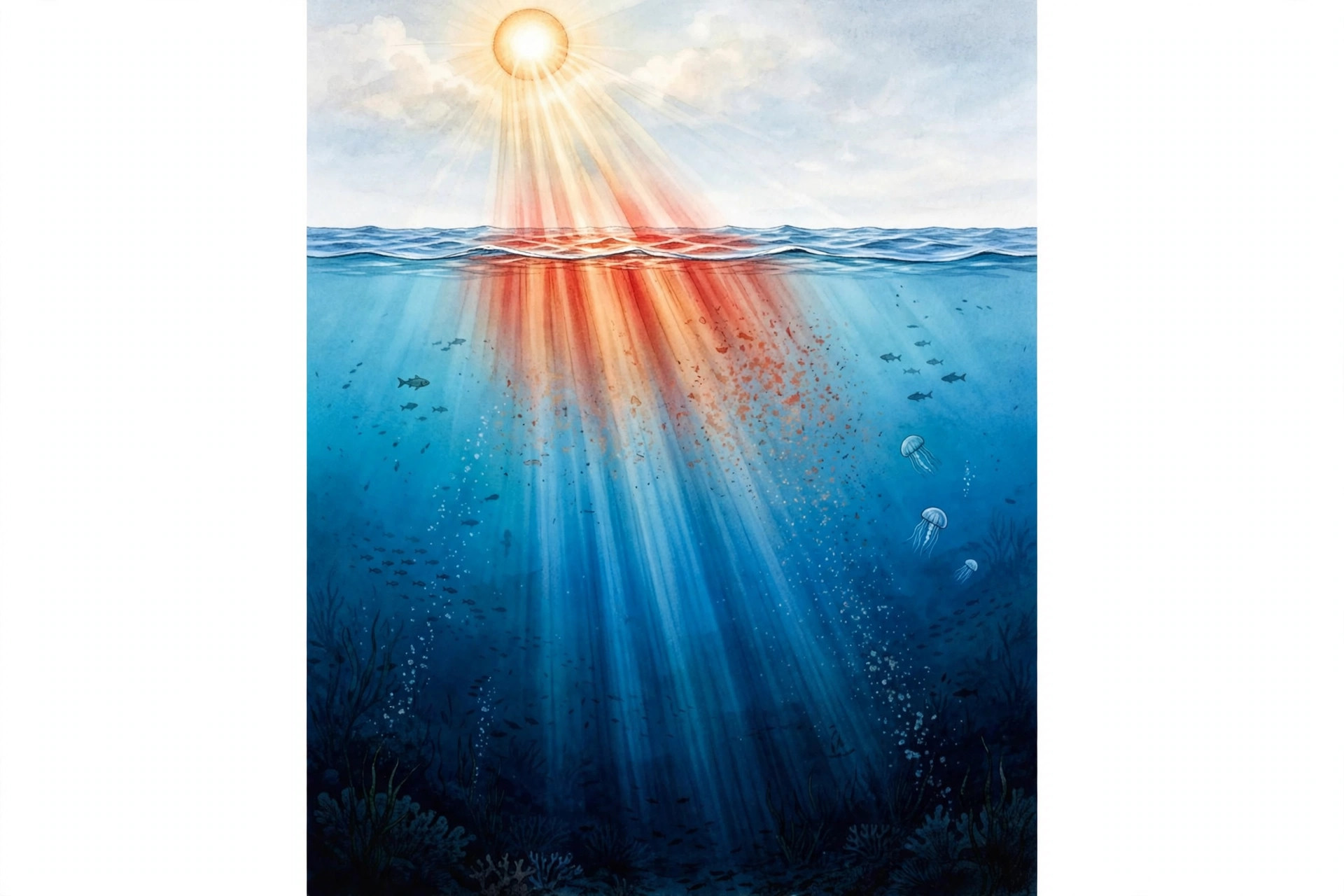
An illustration of selective absorption: red and orange light fade out near the surface while blue travels deeper. Illustration: Rive News.
Image Credits: Original illustration, Rive News
Why the ocean changes color
Pure water is blue, but the real ocean is rarely pure. Two extra ingredients decide the local color: dissolved impurities and suspended particles.
Green water usually means algae and phytoplankton. Plant pigments absorb warm colors like water does but reflect green more strongly than blue, so plankton-rich seas lean emerald. Coastal upwelling zones, where nutrients feed plankton blooms, are famously green for exactly this reason.
Sediment and runoff shift the palette toward brown and grey. After storms or near river mouths, suspended mud scatters light of all wavelengths and overwhelms the water's natural blue. Oil spills and chemical waste do the same, in more alarming ways.
The most dramatic color changes come from red tides: harmful algal blooms whose pigments release toxins and turn the water rust-red. Bristol Aquarium notes that these blooms affect both marine life and humans, and they are a reminder that ocean color is really a report on what the water contains.
What depth and the seafloor add
Depth intensifies the blue because a deeper column of water absorbs more of the long wavelengths. Shallow water over a white sandy seabed looks turquoise or pale blue, since the bright sand reflects light back before much absorption happens. Deep water over a dark seabed looks navy, because little light returns at all.
This is why the same sea can look completely different at noon and at dusk, near shore and far out. The physics never changes; only the depth, the bottom, and the passengers in the water do. Tiny shifts in suspended particles explain why satellite maps of the ocean show swirling greens and blues like marbled paint.
Frequently asked questions
If water is blue, why does a glass of water look clear?
Because the blue is faint and needs distance to show. The absorption per centimeter is tiny, so a glass looks colorless. A swimming pool hints at it, and an ocean, with meters of water for light to travel through, makes it obvious.
Why is the sky blue for a different reason than the sea?
The sky's blue comes from scattering: tiny air molecules bounce blue light in every direction, the same physics that explains why the sky is blue but space is black. The sea's blue comes from absorption: water molecules swallow red light and return blue. Two processes, one coincidence of color.
Why do some beaches look turquoise instead of deep blue?
Turquoise means shallow, clear water over a bright sandy bottom. Sunlight reflects off the sand before much red absorption can happen, mixing the sand's brightness with the water's blue. Deep water over a dark bottom goes navy instead.
Can the sea really turn red or black?
Red, yes: red tides are harmful algal blooms whose pigments color the water. Green, brown, and grey come from algae, sediment, and runoff. In rare "dark water" events, dense organic matter or phytoplankton absorbs even the blue, turning patches of sea nearly black.
Latest in Science
- Why clouds are white but the sky is blue
- Why the sky is blue but space is black
- Why the moon looks bigger on some nights
Subscribe for one clear science explainer a week: physics without the equations.
Related stories

Why diamond is hard and graphite is soft when both are carbon
Diamond and graphite are both pure carbon, yet diamond is 10 on the Mohs scale and graphite is 1 to 2. The difference is not the atoms;

Why Hot Water Can Freeze Faster Than Cold: The Mpemba Effect Explained
Hot water can freeze faster than cold under specific conditions. The Mpemba effect, named for a 1963 schoolboy experiment, still divides

How Magnets Work at the Atomic Level: Spins, Domains, and Iron
Magnetism comes from electrons: their spin and orbits make each atom a tiny magnet. In iron, quantum forces align these atomic magnets into