
Why We See Colours That Are Not Really There in Illusions
Key takeaways
- Colour afterimages come from cone cells in the eye adapting to light, not from opposing colours in the brain.
- The brain judges colour from context and lighting, so identical shades can look different.
- The Dress split viewers because brains made different guesses about the light in the photo.
Stare at a bright colour for a while, then look at a blank wall. A ghost of colour hangs in your vision, even though the wall is plain white. Look at a photo of a dress and argue with a friend about whether it is blue and black or white and gold.
Both of you are looking at the same pixels.
These moments feel like glitches. They are better understood as clues. Colour is not a property stamped on objects.
It is a judgment your visual system makes from light, context, and past experience. This article explains why we see colours that are not really there in optical illusions, including afterimages, context tricks, and famous cases like The Dress.
What colour actually is
Colour starts with light. Different wavelengths of light reach the eye, and the retina turns those signals into something the brain can read. The retina holds three types of cone cells, each tuned to a different part of the spectrum, roughly blue, green, and red.
Together they let us see the full range of hues.
The brain then does a large amount of correction. Sunlight at noon looks yellow. Shade looks bluish.
Light under a green tree canopy picks up a green tint. Yet a white sheet of paper still looks white in all three settings. That stability is called colour constancy, and it is the mechanism that lets us see colours as steady through the day despite changing light.
Illusions happen when that correction system gets the wrong inputs or makes the wrong guess. The system is built to be fast and useful, not perfectly accurate. When it guesses wrong, we see a colour that no instrument would measure in the scene.
Afterimages: the ghost colours
The best-known case is the colour afterimage. Stare at a colour for an extended time, then shift to a neutral image. An illusory colour can linger briefly even though that colour is no longer on screen.
For years, scientists debated where afterimages come from. Some said the cause sat in the cone photoreceptor cells in the eyes. Others argued it came from neural pathways that handle opposing colours.
Others suggested some yet unknown mechanism in the brain.
Research by Christoph Witzel, Associate Professor of Psychology at the University of Southampton, settled much of the debate. His findings appeared in the journal Communications Psychology in 2025.
Across the experiments, the results matched adaptation in the cone photoreceptors rather than an opposing-colour mechanism elsewhere in the visual system. Witzel said the team had found a conclusive answer: colour afterimages are not opposing colours, as many had thought. Instead, those illusory colours reflect precisely what happens in the cone photoreceptors.
In plain terms, staring at a colour tires out the cones that respond to it. When the scene changes, the other cones send stronger signals by comparison. The brain reads that imbalance as a colour that is not really there.
Physicist Helen Czerski described the same idea in a Radio Times piece: when you stare at one colour, one sensor stops sending messages to the brain, and when the light changes, the other two send loads of signals, so the brain sees a colour that is not present.
Context tricks: same shade, different colour
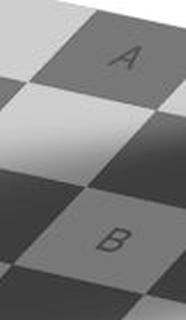
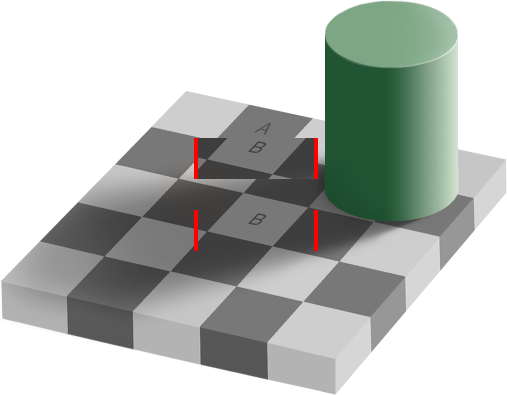
A second family of illusions works through context rather than fatigue. The checker shadow illusion, created by MIT professor Edward Adelson, is the classic case. A checkerboard sits in shadow.
Two squares, labelled A and B, look like very different shades of grey. They are exactly the same shade.
The brain does not measure absolute brightness. It judges each square against its surroundings and against an assumption about the shadow. Square B sits in shadow, so the brain assumes it must be a lighter square darkened by shade.
The correction overshoots, and B looks lighter than A even though the pixels match.
Simultaneous contrast works on the same principle. A grey patch looks lighter against a dark background and darker against a light one. Chromatic induction goes one step further: a colour can make nearby areas look tinted with its complementary colour.
A red patch can make its surroundings look slightly greenish. In each case, the visual system reads a patch relative to its neighbours instead of reading it alone.
Motion can shift colour too. A 2016 study by Sang-Wook Hong and Min-Suk Kang in the journal Nature, described by PetaPixel, found that a moving coloured object changes how a stationary object next to it appears. The perceived saturation of the stationary object drops while the moving object looks more saturated.
Colour perception is not absolute. It shifts with what surrounds the object and how the scene moves.
The Dress: one photo, two colours
In February 2015, a photo of a dress posted on Tumblr split the internet. Some viewers saw blue and black stripes. Others saw white and gold.
The argument felt personal because colour feels like a fact. It is a judgment, and judgments can split.
Research from MIT, cited by Radio Times, found that 57 per cent of people believed the dress was blue and black, while 30 per cent saw white and gold stripes and 10 per cent saw blue and brown. The photo itself was ambiguous about its lighting.
Czerski explained the split as a lighting guess. If your brain assumes the photo was taken in natural light, it interprets the colours one way. If it assumes artificial light, it sees another set of colours.
People who spend their days under harsh office lighting may lean toward the artificial-light guess. Age may play a role too, though the trend is not perfect.
The Dress was not a trick photo. It was an ordinary picture that exposed how much hidden work the brain does. Every photo we look at requires a lighting guess.
Most of the time the guess is easy and everyone agrees. The Dress was the rare case where the guess could go either way.
Why the brain guesses at all
It helps to ask why the visual system works this way. A camera measures light. A brain has to answer a different question: what is out there, and what should I do about it?
That question requires separating the object from the light falling on it.
Colour constancy is the tool for that job. It lets you spot ripe fruit under cloud or sun, and read a friend's face in shade or lamplight. Without it, the colour of the world would swing with every cloud and canopy, as Witzel's team noted in the Medical Xpress report on the afterimage findings.
Guessing comes with a cost. The same machinery that keeps colours stable also produces afterimages, contrast errors, and Dress-style splits. The brain fills in gaps with assumptions drawn from everyday life.
When the scene hides the information the brain needs, the assumption shows.
This is also why illusions fascinate researchers. The World Economic Forum noted that these tricks are not trivial fodder for online arguments. They help scientists understand the complex and sometimes deceptive ways brains work.
Each illusion is a small experiment that reveals a rule the brain normally follows in silence.
Can you train yourself to see through illusions?
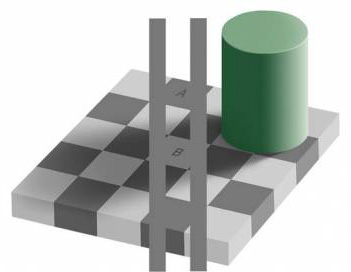
Knowing how an illusion works does not always make it vanish. The checker shadow squares still look different after you learn they match. The afterimage still appears after you stare.
That persistence is a sign that much of this processing happens early and automatically, before conscious thought can override it.
What knowledge does change is your reaction. You can check a suspicious colour by covering the surroundings with your hand or a piece of paper. You can compare patches by moving them side by side.
Designers and photographers use this on purpose. They know that a colour swatch on a screen will look different on a page, and that a product photo under warm shop lights will read differently at home. The same visual rules that power illusions also shape everyday choices about paint, clothing, and lighting.
Frequently asked questions
Why do I see colours after staring at a bright image?
You are seeing a colour afterimage. Staring at a colour adapts the cone cells that respond to it. When you look away, the other cones dominate for a moment, and the brain reads the imbalance as a colour that is not in the scene.
Are afterimages caused by opposing colours in the brain?
That was a long-standing theory. Witzel's 2025 experiments found that afterimages match what cone cells in the eye do as they adapt to light, not an opposing-colour mechanism deeper in the visual system.
Why did people see The Dress in different colours?
The photo left the lighting ambiguous. Brains that assumed natural light read one set of colours. Brains that assumed artificial light read another.
Both groups were looking at the same pixels.
Is seeing an illusion a sign of bad eyesight?
No. Illusions show a healthy visual system doing its normal job of guessing objects from light and context. They reveal the rules of vision, not a defect in it.
Why do identical greys look different in the checker shadow illusion?
The brain corrects for the shadow it sees across the board. It assumes the square in shadow must be lighter than it looks, so it shifts the perceived shade. The correction is useful in real scenes and wrong in this constructed one.
The bottom line
We see colours that are not really there because colour is a judgment, not a measurement. Cone cells adapt to the light they receive, and the brain corrects for context, shadow, and assumed lighting. Those corrections usually keep the world stable and readable.
In illusions, they overshoot or split, and we see ghost colours, mismatched greys, or a dress in two colour schemes at once. The illusions are not failures of vision. They are the machinery of vision, caught in the open.
Tags: optical illusions, colour vision, brain, perception
Latest in Science
- Why does Earth have seasons if distance from the Sun barely changes?
- Why does hot water sometimes freeze faster than cold water?
- What is the difference between a meteor, a meteoroid, and a meteorite?
- Why does a balloon shrink in cold air?
Subscribe to the Rive News newsletter for one clear science explainer each week.
Related stories

Why diamond is hard and graphite is soft when both are carbon
Diamond and graphite are both pure carbon, yet diamond is 10 on the Mohs scale and graphite is 1 to 2. The difference is not the atoms;

Why Hot Water Can Freeze Faster Than Cold: The Mpemba Effect Explained
Hot water can freeze faster than cold under specific conditions. The Mpemba effect, named for a 1963 schoolboy experiment, still divides

How Magnets Work at the Atomic Level: Spins, Domains, and Iron
Magnetism comes from electrons: their spin and orbits make each atom a tiny magnet. In iron, quantum forces align these atomic magnets into