
Why stars appear to move across the night sky
By Rive News / Research desk | Rive News / Published October 29, 2026 at 9:00 AM PKT
Key takeaways
- Stars look like they move because Earth rotates, turning our viewpoint steadily through the night.
- Earth spins west to east, so stars appear to rise in the east and set in the west.
- Near the poles, stars circle overhead without setting; at the equator, they rise and set vertically.
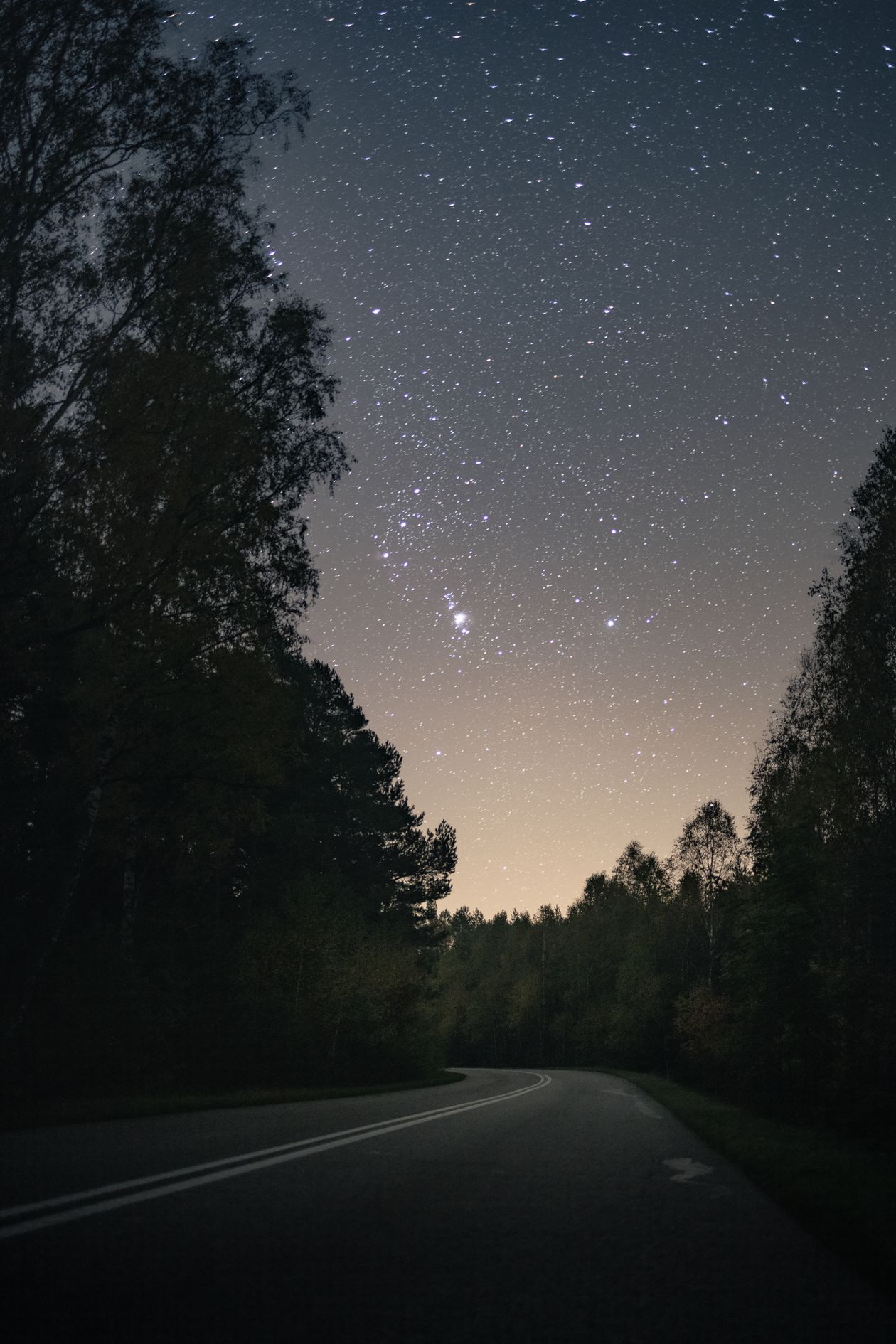
[A starry sky stretches over a winding road lined with trees.] Photograph: Pexels
Image Credits: Pexels
Pick a bright star just after sunset and note where it sits against a rooftop or a tree. Come back two hours later and it has shifted. By dawn it may be gone entirely, below the horizon.
The star did not travel. You did.
Earth rotates on its axis once every 24 hours, and that spin carries your viewpoint around like a slow carousel. This article explains the nightly drift, how latitude changes the pattern, why one star barely moves, and why the sky also shifts a little from night to night.
The short answer: Earth turns, the sky seems to turn
Earth spins from west to east. Because we ride along with the planet, the whole sky appears to move the other way, from east to west. A star rises in the east, climbs, then sinks in the west, following the same broad direction as the Sun and the Moon.
Think of sitting in a moving train and watching trees slide past the window. The trees stand still.
Your motion creates the slide. Stars are vastly farther away than any tree, so their slide looks slow and stately, but the cause is the same kind of relative motion.
The stars themselves do move through space, but that real motion is far too slow to see in one night. What you watch in a single evening is almost entirely Earth's rotation projected onto the sky. Astronomers call it apparent motion, because the motion belongs to the observer, not the star.
One full turn takes about 24 hours against the Sun. Against the distant stars, the turn is slightly shorter, about 23 hours and 56 minutes. That small gap matters, and it explains the nightly shift described below.
What the pattern looks like from different latitudes
Where you stand changes the show. At the North Pole, stars circle around a point overhead, parallel to the horizon.
They neither rise nor set. The sky turns like a record on a turntable, with the celestial pole as the spindle.
At the equator, the pattern flips. Stars rise straight up from the eastern horizon and set straight down in the west. Over one night, an observer at the equator can watch the whole parade pass overhead.
Most readers live between those extremes, at mid-latitudes. There, stars trace tilted arcs.
Some rise in the east and set in the west, as usual. Others, near the pole, circle all night without ever dipping below the horizon.
Those never-setting stars are called circumpolar stars. In the northern hemisphere, the stars of the Big Dipper behave this way for many observers. They wheel around Polaris through the night and are still there at dawn, higher or lower but never gone.
Facing direction changes the apparent shape too. Look north and stars sweep in circles around the pole. Look south and they arc across the sky from east to west.
Look east or west and the motion looks mostly sideways. The sky is one turning sphere; your facing direction picks which slice of it you see.
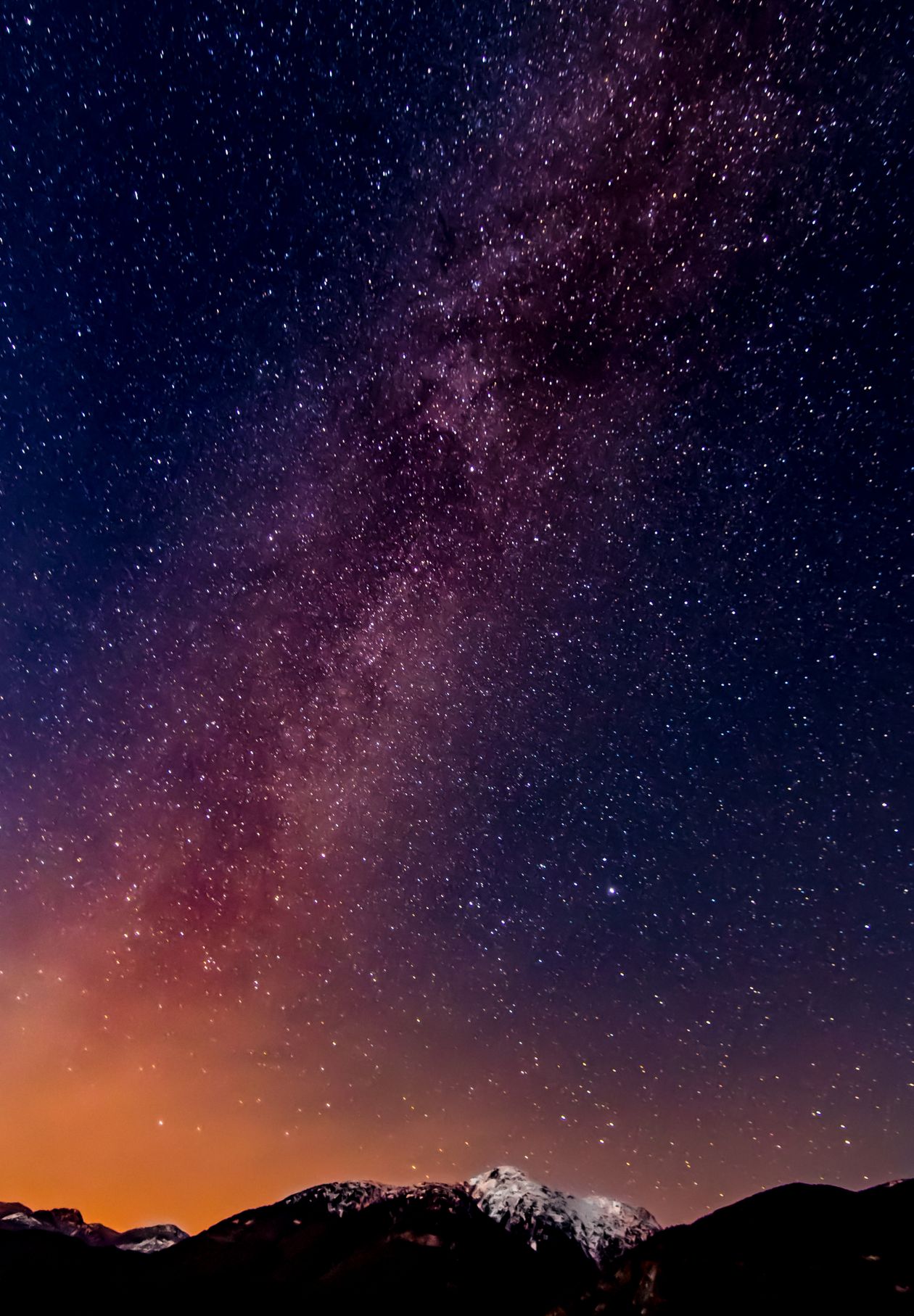
[The Milky Way glows above snow-capped mountains.] Photograph: Pexels
Image Credits: Pexels
Why Polaris barely moves
Polaris, the North Star, sits almost directly above Earth's North Pole. Earth's axis points close to it, so as the planet spins, Polaris stays near the centre of the turning sky.
Other stars circle around it. Polaris itself wobbles in a tiny circle, too small to notice without instruments.
That stability made Polaris a navigator's friend for centuries. Sailors and travellers could find north by finding the star that refused to move. The rest of the sky turned, but Polaris held its post.
Polaris is not perfectly fixed forever. Earth's axis wobbles slowly, a motion called precession, over a cycle of about 26,000 years.
Over a human lifetime the change is tiny, but over thousands of years, different stars take turns as the pole star. For tonight, though, Polaris is the still point.
Why the sky also shifts from night to night
If rotation were the only motion, the same stars would appear at the same time every night. They do not. Each night, stars rise about 4 minutes earlier than the night before.
The reason is Earth's orbit around the Sun. As Earth travels along its year-long path, the night side of the planet faces a slightly different slice of the sky each evening.
After a month, the shift adds up to about two hours. After a year, the cycle returns to where it started.
That is why constellations have seasons. Orion dominates winter evenings in the northern hemisphere, while Scorpius rules summer nights.
The stars have not moved to new seasons. Earth has moved to a new viewpoint, and the Sun's glare hides a different set of stars each season.
Stellar parallax adds a far smaller effect. As Earth moves from one side of its orbit to the other, nearby stars shift slightly against the background of distant ones.
The shift is minute, measured in fractions of an arcsecond, but astronomers use it to measure distances to nearby stars. It plays no part in what the naked eye sees in one night.
How to watch the motion yourself
You need no telescope. Pick a clear, dark evening and a fixed reference, like a chimney or a fence post.
Note a bright star's position against that reference at 9 in the evening, then check again at 11 at night. The star will have moved noticeably westward.
A camera makes the effect dramatic. A long exposure of 30 minutes or more turns each star into a short trail, an arc centred on the celestial pole. Stack exposures across several hours and the arcs grow into sweeping circles.
The photo does not record stars racing through space. It records Earth turning under a patient camera.
Clouds and city lights are the main obstacles. Light pollution washes out faint stars, leaving only the brightest ones visible. A darker site, even a short drive from town, reveals far more stars and far clearer trails.
One more observation repays attention. Watch the Moon on successive nights and it moves against the star background by roughly its own diameter every hour, eastward. That is the Moon's real orbital motion, separate from the nightly westward drift that rotation gives everything in the sky.
Frequently asked questions
Do stars actually move across the sky?
Their real motion through space is far too slow to see in one night. The nightly drift you see is apparent motion, caused by Earth's rotation carrying your viewpoint around.
Why do stars rise in the east and set in the west?
Earth spins from west to east, so the sky appears to move the opposite way. Stars follow the same east-to-west direction as the Sun and the Moon for the same reason.
Why do some stars never set?
Stars near the celestial pole circle it without dipping below the horizon, as seen from mid and high latitudes. These circumpolar stars stay visible all night, every night.
Why are different stars visible in different seasons?
Earth's orbit changes which part of the sky faces away from the Sun at night. Each night, stars rise about 4 minutes earlier, so the seasonal sky cycles through the year.
The bottom line
Stars appear to move across the sky overnight because Earth turns beneath them. One rotation every 24 hours sweeps your viewpoint from east to west, making the whole sky look like it wheels overhead. Latitude shapes the arcs, Polaris anchors the centre, and Earth's orbit adds a slow seasonal shift on top.
Next time you watch a star slide past a rooftop, remember the trick. The star stayed put. You rode a turning planet past it, and the sky put on the show for free.
Tags: stars, Earth rotation, night sky, astronomy
Rive News's research desk covers everyday science questions with sourced explainers, not lab reports.
Related
- Why the sky is blue but space is black
- Why the Earth has seasons if distance is not the cause
- What causes the northern lights to appear
Subscribe for one plain-English science explainer each morning.
Rive News publishes sourced explainers; claims are checked against public sources before publication.
Related stories
Why diamond is hard and graphite is soft when both are carbon
Diamond and graphite are both pure carbon, yet diamond is 10 on the Mohs scale and graphite is 1 to 2. The difference is not the atoms;

Why Hot Water Can Freeze Faster Than Cold: The Mpemba Effect Explained
Hot water can freeze faster than cold under specific conditions. The Mpemba effect, named for a 1963 schoolboy experiment, still divides

How Magnets Work at the Atomic Level: Spins, Domains, and Iron
Magnetism comes from electrons: their spin and orbits make each atom a tiny magnet. In iron, quantum forces align these atomic magnets into