
What is the difference between weather and climate?
Key takeaways
- Weather is the atmosphere's short-term mood: temperature, rain, and wind over hours, days, or weeks.
- Climate is the long-term average, typically measured over 30 years or more, that tells you what a region usually does.
- A single cold snap or heatwave is weather; it cannot confirm or refute a climate trend on its own.

An overnight storm with lightning over a lighthouse: weather is the short-term event, not the long-term pattern. Photograph: Maxime Raynal/Wikimedia Commons
Image Credits: Wikimedia Commons
Look out the window and you see weather. Hot and sunny, cloudy and rainy, snow on the ground: that is the atmosphere right now, in this place. Climate is the bigger picture behind it, the pattern that emerges when you average decades of those daily snapshots.
NASA's education materials open with the classic line: "Climate is what you expect and weather is what you get." This article explains the difference between weather and climate, including what each one measures, the 30-year rule, why one cold snap proves nothing, and how scientists track each.
What is weather?
Weather is the condition of Earth's atmosphere at a particular time and place. NASA's Global Precipitation Measurement education page lists its ingredients: temperature, humidity (moisture in the air), precipitation (rain, snow, and other falling water), cloudiness, visibility, and wind.
The defining trait of weather is how fast it changes. NASA puts it simply: "Weather is only temporary.
For example, a blizzard can turn into a flood after just a few warm spring days. " We talk about weather in terms of the near future: what it is like today, whether it rains this week, what to wear tomorrow.
Eric Fetzer, a scientist at NASA's Jet Propulsion Laboratory, draws the boundary at about a month: weather describes how the atmosphere behaves over weeks or less. Everything shorter than that, from an afternoon thunderstorm to a week-long heatwave, is weather.
What is climate?
Climate is what the weather usually does. NASA defines it as the typical weather conditions in a whole region over a very long time, 30 years or more. To describe a place's climate, you talk about seasonal temperatures, typical rainfall, and long-run patterns rather than today's sky.
Jonathan Martin, a professor of atmospheric and oceanic sciences at the University of Wisconsin-Madison, gave HowStuffWorks the textbook version: "Weather is the day-to-day variation in meteorological (weather-science) conditions. Climate is the aggregate of weather events, resulting in a long-term average."
That word "aggregate" (total collected together) does the heavy lifting. Climate is not a different substance from weather; it is weather added up and averaged. Phoenix has a dry desert climate because decades of daily weather there average out dry, even though any given week can bring rain.
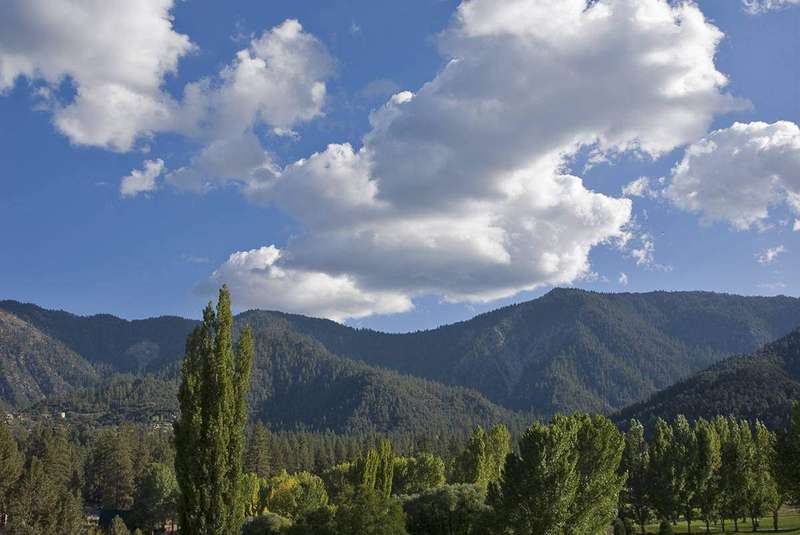
Fair-weather clouds over California: a single day's weather, one data point in a decades-long climate record. Photograph: Damian Gadal/Wikimedia Commons
Image Credits: Wikimedia Commons
The 30-year rule
Scientists don't pick the averaging period at random. The standard climate reference is a fixed 30-year window, long enough to smooth out noisy year-to-year swings but short enough that slow shifts stay visible.
Martin explains that researchers compare daily temperatures against these fixed periods. For years the reference was 1981 to 2010; it has since shifted forward to 1991 to 2020, and it will keep stepping forward by decade. Each new window becomes the "normal" that anomalies (unusual deviations) are measured against.
Thirty years is a compromise, and Martin says so openly. Over 30 years, changes are subtle though not necessarily imperceptible; over 50 years, he notes, you would notice a bigger change. The window is a tool for seeing the signal through the noise, not a law of nature.
This is also why climate can be discussed on longer scales too. NASA notes we talk about climate in terms of years, decades, centuries, even millions of years, depending on the question.
Ice ages are climate. So is the warming trend of the last century.
Why one cold snap doesn't disprove a warming climate
Here is where the distinction earns its keep. A snowy week in Texas is weather: a short-term atmospheric event in one place. The warming of Earth's average surface temperature over decades is climate: a long-term shift in the aggregate.
NASA makes the point with Phoenix: a week of rainy weather wouldn't change the fact that Phoenix typically has a dry, desert climate. Flip it around and the logic holds: a week of unusual cold doesn't change a warming climate either. Single events are data points, not trends.
This confusion has a famous political cameo. In 2015, a US senator tossed a snowball on the Senate floor to mock global warming, as if one winter day in Washington settled a planetary average. As HowStuffWorks noted in its explainer, the stunt mixed up the two categories: weather is what happens this week, climate happens over many years.
Climate scientists expect weather to keep surprising us even as the climate warms. Averages can rise while individual cold snaps still occur, because the average describes the whole spread of weather, not any single day.
How scientists measure each
Weather measurement is about now. Thermometers, barometers (air-pressure meters), radar, and weather satellites capture the atmosphere's current state, and forecast models project it forward days. The goal is precision on short timescales: rain at 3 p.
m. , wind by evening.
Climate measurement is about accumulation. NASA's satellites orbit constantly, collecting data on land, atmosphere, ocean, and ice.
Sea level tracking from space shows how fast the climate is changing as Antarctic and Greenland ice melts. Cloud measurements reveal shifts in the number, size, and location of clouds that signal climate change rather than passing weather.
The two systems feed each other. Decades of daily weather observations become the climate record, and the climate record sets the baseline that makes today's weather meaningful. When scientists call a month "the hottest on record," the weather provided the month and the climate record provided the comparison.
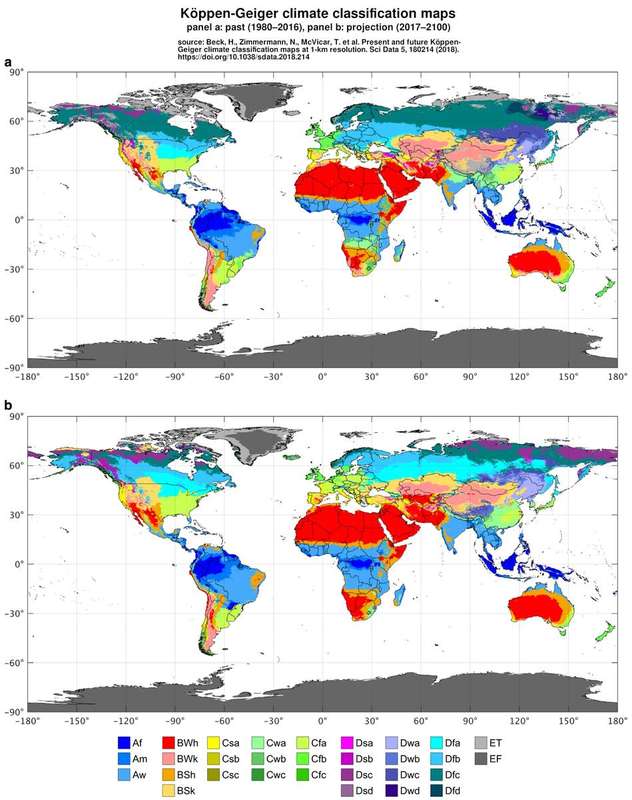
Köppen-Geiger climate classification maps: the world's climates drawn from long-term averages, not single days. Photograph: Hylke E.
Beck et al. /Wikimedia Commons
Image Credits: Wikimedia Commons.
Frequently asked questions
Is climate change the same as global warming?
Not exactly. Global warming refers to the rise in Earth's average surface temperature.
Climate change is the broader set of shifts that follow: rainfall patterns, sea level, ice cover, and extreme weather frequency. Warming is the driver; climate change is the full picture.
Can the climate change in just a few years?
Short-term climate variability exists: El Niño, La Niña, and volcanic eruptions can shift patterns for months or years. But climatologists reserve "climate change" for longer-term shifts in the averages, which is why the 30-year reference periods matter.
What is the Köppen climate classification?
It is the most widely used system for dividing the world into climate zones, based on long-term temperature and rainfall patterns. The map above shows present and projected Köppen-Geiger zones, a purely climate product built from decades of weather data.
Why can't scientists predict weather a month out but can project climate decades out?
Because they are different problems. Weather prediction tracks a fast-changing, hard-to-predict system day by day. Climate projection tracks slow averages and boundary conditions, like greenhouse gas levels, which shape the odds without needing to nail any single day.
The bottom line
Weather is the atmosphere's short-term behavior and climate is its long-term average, usually over 30 years or more. One is what you get today; the other is what you expect.
Keep the categories straight and a lot of confusion evaporates. A storm is weather. A heatwave is weather.
The slow shift in what counts as a normal July, measured across decades of those events, is climate. And when someone offers a single snowy day as evidence about either, you now know exactly which category error they just made.
Tags: weather, climate, NASA, meteorology, climate science
Rive News is the research desk behind this explainer series, covering tech, health, science, and everyday questions with sourced reporting.
Latest in Science
- Why is the sky orange at sunrise and sunset?
- Why Is the Sky Blue but Space Black? Both Answers Side by Side
- Why is the ocean salty but lakes are not?
- How Do Scientists Measure the Age of the Universe?
Subscribe for one evidence-based explainer in your inbox every morning.
Related stories

Why diamond is hard and graphite is soft when both are carbon
Diamond and graphite are both pure carbon, yet diamond is 10 on the Mohs scale and graphite is 1 to 2. The difference is not the atoms;

Why Hot Water Can Freeze Faster Than Cold: The Mpemba Effect Explained
Hot water can freeze faster than cold under specific conditions. The Mpemba effect, named for a 1963 schoolboy experiment, still divides

How Magnets Work at the Atomic Level: Spins, Domains, and Iron
Magnetism comes from electrons: their spin and orbits make each atom a tiny magnet. In iron, quantum forces align these atomic magnets into