
What Causes the Northern Lights? The Science of Auroras Explained
Key takeaways
- The northern lights begin at the sun: solar activity ejects clouds of charged gas that take 2 to 3 days to reach Earth.
- Earth's magnetic field funnels those particles to the poles, where they collide with oxygen and nitrogen in the upper atmosphere.
- Oxygen glows green or red and nitrogen glows blue or purple, depending on the gas and the altitude of the collision.
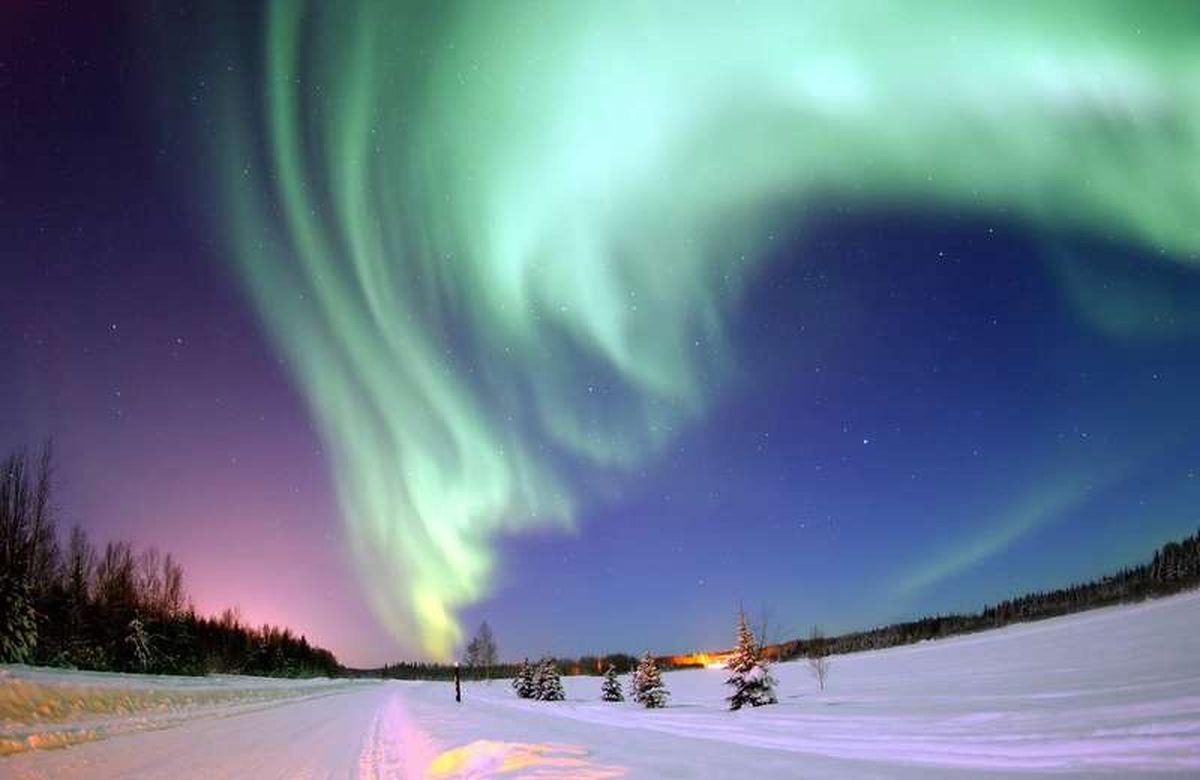
The aurora borealis over Alaska. The light comes from gases in the upper atmosphere, not from the sun directly. Photograph: Senior Airman Joshua Strang, United States Air Force/Wikimedia Commons
Image Credits: Wikimedia Commons
The northern lights are curtains of colored light that appear in the night sky, most often near the poles. Their scientific name is aurora borealis. The southern hemisphere gets its own version, called aurora australis.
They look like magic, but the cause is a collision chain that starts 150 million kilometers away on the sun. This article takes a closer look at that chain, including how solar eruptions begin the process, how Earth's magnetic field redirects the particles, the air collisions that make the light, why the colors differ, and when and where to see it.
It starts at the sun
The origin of the aurora begins on the surface of the sun when solar activity ejects a cloud of gas. Scientists call this a coronal mass ejection, or CME (a burst of solar material thrown into space).
The sun also emits a steady version of the same material: the solar wind, a continuous stream of charged particles, mostly electrons and protons, flowing outward from the sun's upper atmosphere. Science News Explores describes it as a plasma gale that Earth sits in the path of.
When a CME reaches Earth, it takes about 2 to 3 days to make the trip, according to the account astronomer Sten Odenwald gave to the Library of Congress. The cloud then collides with Earth's magnetic field, and the aurora machinery starts turning.
The magnetic detour
Earth's magnetic field acts as a shield. It deflects most of the solar wind away from the planet entirely.
But the field has a weak spot at the poles. Some particles get snagged by the magnetic field and travel along its lines toward the north and south poles. There, the shield funnels them down into the upper atmosphere.
These particles pick up energy as they descend. By the time they reach the atmosphere, they are fast-moving electrons carrying enough punch to knock air gases out of their normal state.
The collision that makes light
The actual glow comes from Earth's own air. When the incoming electrons smash into oxygen and nitrogen molecules in the upper atmosphere, they transfer energy and leave those molecules excited (energized).
Excited atoms are unstable. They quickly relax back to their ground state (normal state), and the extra energy leaves as photons, tiny particles of light. NASA's aurora materials describe it plainly: the collisions energize the gases, and as the molecules return to normal, they release photons.
When billions of these collisions happen at once, the released light becomes bright enough for the eye to detect. That is the aurora: a sky full of atoms dumping their excess energy as visible light.
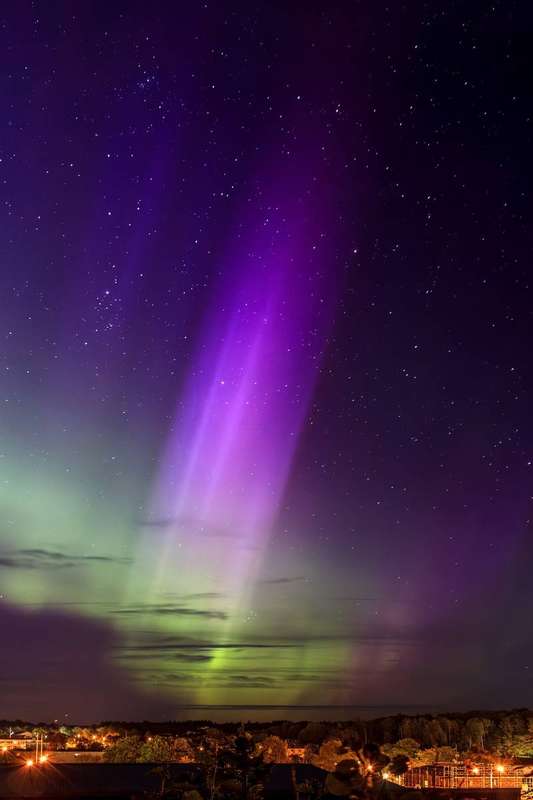
A multicolored aurora pillar over Brastad, Sweden. Different gases and altitudes produce the different colors. Photograph: W.carter/Wikimedia Commons
Image Credits: Wikimedia Commons
Why the colors differ
The color depends on which gas gets hit and at what altitude. Oxygen is the green machine: collisions with oxygen around 100 kilometers up produce the familiar green glow, the most common aurora color.
Nitrogen adds the other tones. Excited nitrogen emits blue or purplish light. Oxygen at higher altitudes glows red, which is why some auroras have red upper fringes.
The Alaska Geophysical Institute adds fine detail. The aurora's lower border sits around 70 miles up, where the greenish-white light comes mostly from atomic oxygen. During strong magnetic storms, electrons sink to lower altitudes and produce the red fringe sometimes seen skirting the bottoms of auroral bands.
Great storms can paint the whole sky red at altitudes of 180 to 240 miles. That "bloody red" aurora, seen as far south as New Mexico during the great storm of 1958, once frightened medieval observers as a sign of war.
When and where to see it
Auroras trace two oval zones around the magnetic poles. The northern lights are most reliably seen from Alaska, northern Canada, Greenland, Iceland, and Norway. The southern lights appear over Tasmania, New Zealand, and Antarctica.
Solar activity follows an approximately 11-year cycle. Near solar maximum (the cycle's peak), stronger CMEs push auroras farther from the poles, which is why mid-latitude sightings cluster around storm seasons.
The same space weather that paints the sky can bite back. The Library of Congress notes that auroral activity can damage technologies both on Earth and in space, disrupting satellites, navigation systems, and power grids. Auroras are beautiful, but they are also a visible sign of a storm hitting the planet's shield.
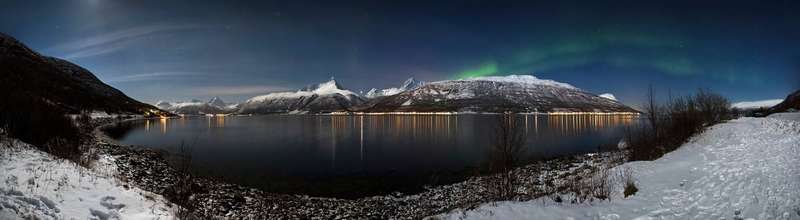
The aurora above Storfjorden, Norway, in moonlight. Near solar maximum, displays grow stronger and reach farther south. Photograph: Ximonic (Simo Räsänen)/Wikimedia Commons
Image Credits: Wikimedia Commons
Frequently asked questions
Can the northern lights be seen from the United States?
Yes, reliably from Alaska, and occasionally much farther south during strong solar storms. The great red aurora of February 1958 was seen as far south as New Mexico.
Do auroras happen every night?
The solar wind flows constantly, so faint auroras occur nearly every night near the poles. Strong, colorful displays need extra solar activity, like a coronal mass ejection aimed at Earth.
Are auroras dangerous to people?
No. They occur far above the breathable atmosphere and the light itself is harmless. The associated space weather can disrupt satellites and power grids, but it poses no direct danger to anyone standing outside.
What is the difference between aurora borealis and aurora australis?
Only the hemisphere. Aurora borealis is the northern lights, aurora australis the southern lights. Both come from the same mechanism: charged particles funneled to the poles by Earth's magnetic field.
The bottom line
The northern lights are sunlight converted into a light show. Charged particles leave the sun, ride Earth's magnetic field to the poles, and excite oxygen and nitrogen in the upper atmosphere. Those gases release the energy as green, red, blue, and purple light.
To catch one yourself, head north on a dark winter night near solar maximum, get away from city lights, and check the aurora forecast. The sky does the rest.
Rive News is the research desk behind these explainers. We verify every claim against public sources before publishing.
Latest in Science
- Why Is the Sky Blue but Space Black? Both Answers Side by Side
- Why is the sky orange at sunrise and sunset?
- How Do Scientists Measure the Age of the Universe?
- What is the difference between weather and climate?
Get one practical explainer in your inbox every morning. Subscribe to the Rive News newsletter.
Rive News follows a public corrections policy. If you spot an error, tell us and we will fix it visibly.
Related stories

Why diamond is hard and graphite is soft when both are carbon
Diamond and graphite are both pure carbon, yet diamond is 10 on the Mohs scale and graphite is 1 to 2. The difference is not the atoms;

Why Hot Water Can Freeze Faster Than Cold: The Mpemba Effect Explained
Hot water can freeze faster than cold under specific conditions. The Mpemba effect, named for a 1963 schoolboy experiment, still divides

How Magnets Work at the Atomic Level: Spins, Domains, and Iron
Magnetism comes from electrons: their spin and orbits make each atom a tiny magnet. In iron, quantum forces align these atomic magnets into