
Why Do We Yawn, and What Makes Yawning So Contagious?
Key takeaways
- The top theory today says yawning cools the brain, not that it fixes low oxygen.
- You catch yawns most easily near 20°C, and a cold forehead can block the urge.
- Catching yawns is linked to empathy and may have helped groups stay alert.

Image Credits: Wikimedia Commons
A yawn is a slow, deep breath in through a wide-open mouth, then a short breath out. Everyone does it: newborns, dogs, tigers, even unborn babies. It is one of the most common behaviors among animals with backbones.
For years, the standard answer was that yawning pulls in extra oxygen when you are tired. That idea is now weak. The leading theory is more interesting: yawning cools the brain, and catching someone else's yawn may be an old trick for keeping a whole group alert.
This article explains what a yawn actually is, why scientists think the brain needs it, and why yawning spreads from person to person.
What is a yawn, really?
A yawn has three phases. First the jaw drops wide and the face stretches.
Then comes a long, deep breath in. It fills the lungs more than a normal breath. Finally there is a short breath out, often with watery eyes.
The stretch matters. When you yawn, the strong jaw stretch increases blood flow in the neck, face, and head, says ZME Science's summary of the cooling theory. The deep breath then pushes spinal fluid and blood down and away from the brain. Cool air drawn into the mouth then cools those fluids.
That sequence is the base of the leading theory. It also goes against the old oxygen story. Experiments showed that raising or lowering oxygen and carbon dioxide in the blood does not make people yawn. That finding came from University at Albany researchers Andrew Gallup and Gordon Gallup in their 2007 work.
Why do we yawn at all? The brain-cooling theory
Your brain is a heat factory. It burns up to a third of the calories you eat, and that work makes heat, the Gallups noted in research reported by ScienceDaily. Like a computer, they argued, the brain runs better when cool.
In this view, yawning is a radiator. The deep breath and jaw stretch pull cooler blood up to the brain and flush warm blood away. This nudges the brain back to its best working temperature. A cooler brain is a sharper one. "According to our hypothesis, rather than promoting sleep, yawning should antagonise sleep," Gordon Gallup told New Scientist in 2007.
The researchers tested the idea with a clever setup. They recruited 44 college students and showed them films of people yawning while they breathed in different ways.
Among students told to breathe normally or through their mouths, 50 percent caught the on-screen yawns. Among students told to breathe only through their noses, not one yawned.
Nasal breathing already cools the brain. Blood vessels in the nose send cool blood upward. With the cooling need already met, the yawn was not needed.
In a second experiment, students who held a cold pack to their foreheads also resisted contagious yawns. Those holding warm or room-temperature packs yawned normally. Both results were published in Evolutionary Psychology, volume 5, page 92.
Why is yawning contagious? Empathy and group alertness
Here the story splits in two. Why we yawn may be about cooling. But why we catch other people's yawns looks social.
Contagious yawning is tied to empathy. People catch yawns more easily from friends and family than from strangers. Research found that coldhearted traits on the PPI-R scale predict less contagious yawning. The PPI-R is a personality test, and ZME Science reported this finding from the Baylor University study.
Autistic children have also been found to yawn less in social settings. None of this makes a non-yawner a psychopath, the researchers warned. It points to a brain link between empathy circuits and the yawn reflex.
Gordon Gallup gave an evolutionary reading: "We think contagious yawning is triggered by empathic mechanisms which function to maintain group vigilance," he told New Scientist. If one group member cools their brain and sharpens up, the rest benefit from doing the same. One yawn tunes the whole group.
That idea got a strong test in 2014. Jorg Massen and colleagues at the University of Vienna studied pedestrians in Vienna and Arizona. They found contagious yawning peaked near an air temperature of about 20°C.
It faded when it was as warm as the body (around 37°C in Arizona summers) or near freezing (Vienna winters). Where yawning would not cool the brain usefully, it stopped spreading.
Massen explained the logic to Medical News Today: "As yawning cools the brain, it gets the brain in optimal homeostasis, which is of course nice when you want to be alert, for example in a threatening situation. In turn, when you see someone in your group yawning... you also want to cool your brain for optimal homeostasis, and thus you yawn, too." Homeostasis means the body's stable inner balance.
The mechanism, he added, is "a completely subconscious mechanism." Subconscious means it happens without you thinking about it.

Image Credits: Wikimedia Commons
Which other animals catch yawns?
Humans are not the only yawn-catchers. Chimpanzees, wolves, and lions have all been seen catching yawns. That fits the group-alertness story: these are social species where shared alertness pays off.
Dogs joined the club in a 2013 study covered by Medical News Today. It found that yawns from owners are contagious to their dogs, driven by empathy rather than stress. Your dog catching your yawn is your dog syncing with you, in a small way.
Not every species does it, and researchers are still mapping the pattern. But the cross-species evidence supports the view that contagious yawning is an old, deep-wired social reflex, not a quirk of human culture.
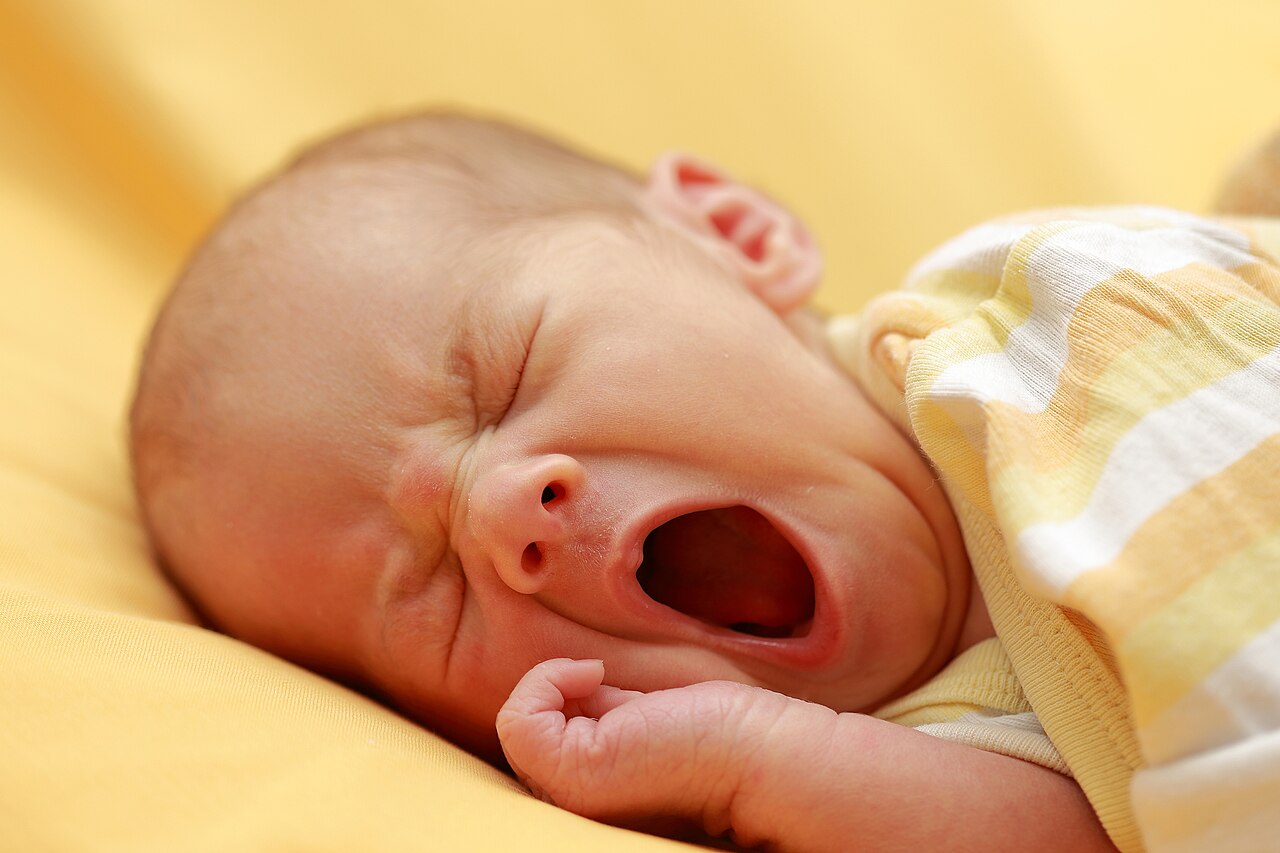
Image Credits: Wikimedia Commons
Frequently asked questions
Does yawning mean you need more oxygen?
Probably not. The Gallups' experiments showed that changing blood oxygen and carbon dioxide levels does not trigger yawning. That is why the oxygen theory lost ground to the brain-cooling theory.
Why do I yawn when I'm bored but not sleepy?
Boredom often comes with low stimulation and a warming brain during long focus. If yawning cools the brain to protect focus, a dull meeting is exactly the kind of situation that would trigger it.
Can you stop a contagious yawn?
Research suggests cooling your forehead or breathing through your nose can reduce contagious yawning. Both cool the brain and remove the need for the yawn. But it is not a reliable party trick.
Is it rude that I yawn around people?
It is involuntary, and it may even be a compliment. Involuntary means you cannot control it. People catch yawns most easily from those they feel close to. It says more about empathy than manners.
The bottom line
Yawning is most likely the brain's way of cooling itself to stay sharp, not a cry for oxygen. And catching someone else's yawn looks like an empathy-driven reflex that once helped groups stay alert together. The next time a yawn ripples across a room, you are watching very old social hardware at work.
---
Rive News's research desk covers everyday science with cited studies and no hype.
Latest in science
- Why Metal Feels Colder Than Wood at the Same Temperature
- What Causes Déjà Vu? What Neuroscience Says Happens in the Brain
- Why Does Time Feel Faster as You Get Older?
- How the Placebo Effect Works
Subscribe for one clear science explainer in your inbox every morning.
Rive News follows a corrections policy: factual errors are fixed promptly and noted. This article is for general information only.
Related stories

Why diamond is hard and graphite is soft when both are carbon
Diamond and graphite are both pure carbon, yet diamond is 10 on the Mohs scale and graphite is 1 to 2. The difference is not the atoms;

Why Hot Water Can Freeze Faster Than Cold: The Mpemba Effect Explained
Hot water can freeze faster than cold under specific conditions. The Mpemba effect, named for a 1963 schoolboy experiment, still divides

How Magnets Work at the Atomic Level: Spins, Domains, and Iron
Magnetism comes from electrons: their spin and orbits make each atom a tiny magnet. In iron, quantum forces align these atomic magnets into