
Do Baseballs Really Carry Farther in Humid Air? Physics Answers
Key takeaways
- Yes, humid air is less dense than dry air, so baseballs fly farther, but the full 0-100% humidity swing adds only about 1 meter.
- Temperature matters far more: physicist Alan Nathan calculates a 50°F (28°C) rise adds 15 to 20 feet to a well-hit fly ball.
- Damp-stored balls do the opposite of humid air: absorbed moisture lowers the ball's bounciness, cutting exit speed and costing about 15 feet.
Ask any broadcast booth why the ball is flying on a sticky August night, and you will hear that humid air is "heavy" and knocks balls down. The physics says the opposite.
Water vapor is lighter than the nitrogen and oxygen it pushes out of the way, so humid air is actually less dense than dry air. Less dense air means less drag, and less drag means a batted ball carries farther.
This article breaks down the claim step by step, including the short answer, why humid air is lighter, what physicists measured on real fly balls, and the humidor twist that flips the story.
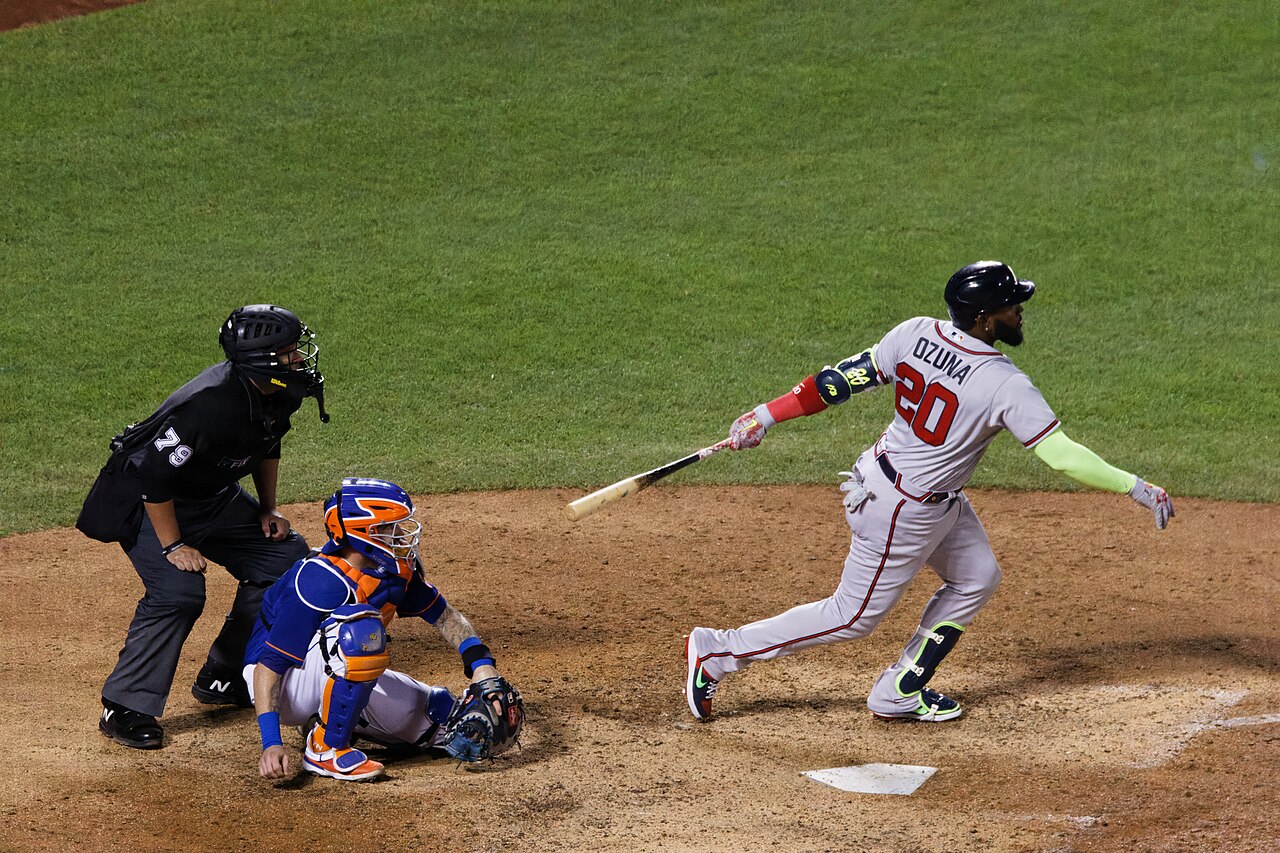
Marcell Ozuna watches a fly ball he hit during a 2022 game. Photograph: D. Benjamin Miller/Wikimedia Commons
The short answer: yes, but only by a hair
Yes. Baseballs carry farther in humid air than in dry air at the same temperature. Humid air is less dense, and thinner air fights the ball less.
The surprise is how small the effect is.
Physicist Alan Nathan, professor emeritus at the University of Illinois, has spent decades studying baseball flight. He calculates that going from completely dry air to fully saturated air adds only about 1 meter to a long fly ball, as he told the American Chemical Society's ChemMatters magazine.
Temperature does the heavy lifting instead. The same analysis shows a 50°F (28°C) jump, like an April game versus an August game, adds roughly 15 to 20 feet. So muggy summer nights do carry balls farther, but the heat deserves most of the credit.
Why humid air is actually lighter than dry air
This is the part that breaks brains. Air that feels "heavy" on a humid day is physically lighter than dry air at the same temperature and pressure. Your skin is lying to you.
Dry air is mostly nitrogen and oxygen. A nitrogen molecule weighs 28 atomic mass units and an oxygen molecule weighs 32, according to the WeatherSTEM lesson on baseball and weather. A water molecule weighs only 18.
Avogadro's law says a fixed volume of gas holds a fixed number of molecules at constant temperature and pressure. So when water vapor enters the air, it must kick out some nitrogen and oxygen to make room, and the lighter replacements make the whole mixture less dense. It is a straight trade, and water vapor wins on the scale.
Drag is directly proportional to air density. Fewer, lighter molecules to collide with means the ball loses less energy on each hit and holds its speed longer. Cyclists who ride in a peloton chase the same principle: less resistance to push through, more distance for the effort.

Dodger Stadium on a warm night in September 2024. Photograph: Sammythecat7/Wikimedia Commons
What physicists measured on real fly balls
Nathan's numbers put hard limits on barroom theories. As he puts it, "The distance that [fly balls] travel depends very much on the air density," and he calls that "a very noticeable effect" in baseball.
His model starts from a simple picture: every time a baseball plows through air, it collides with molecules, and each collision costs a tiny bit of energy.
Temperature is the biggest knob. A 50°F (28°C) rise between spring and summer games is worth 15 to 20 feet on a well-hit ball, per his calculations reported by ChemMatters. That is why late-summer games feel like launching pads.
Altitude dwarfs both. At Denver's Coors Field, a mile above sea level, the air is only about 82% as dense as at sea level, and that alone adds roughly 26 to 32 feet to a well-hit fly ball regardless of weather. Denver's thin air also leaves some athletes gasping, so the park's reputation cuts both ways.
Humidity, by comparison, is a footnote on the stat sheet: the full range from 0% to 100% relative humidity is worth only about 1 meter. As ChemMatters reports, Nathan's point is that heat and humidity work together to thin the air, but temperature is "the bigger driver of the two." Baseball is not the only sport where air decides the outcome; the science behind a perfect golf swing leans on the same aerodynamics.
The humidor twist: wetter balls fly shorter
Here is where the bar debate gets genuinely confusing, because two different humidity effects push in opposite directions. Humid air helps the ball fly. A humid ball flies worse.
Baseballs soak up moisture from the air. A ball stored in damp conditions gets slightly heavier and, more importantly, less bouncy. Physicists call bounciness the coefficient of restitution, or COR.
The Colorado Rockies learned this first. Denver's dry air, around 30% humidity, made balls light and lively, so the team installed a humidor in 2002 to store game balls at 50% humidity and 70°F, according to The Hardball Times.

Coors Field in Denver, the mile-high park where the humidor experiment began in 2002. Photograph: kla4067/Wikimedia Commons
Lab measurements showed the balls stored at 50% humidity gained 1.6% in weight and lost 3.7% of their COR, dropping from 0.537 to 0.513. For a typical 100 mph batted ball, exit speed fell by about 3 mph and carry dropped from 415 feet to 402 feet.
The scoreboard agreed. Home runs at Coors fell from 3.20 per game (1995-2001) to 2.39 per game (2002-2010), a 25% reduction that matched Nathan's predicted 27 plus-or-minus 4%, The Hardball Times reported. Single-season totals told the same story: 268 homers in 2001 versus 185 in 2002.
The experiment worked so well that MLB made it league-wide. In 2022 the league required all 30 clubs to store baseballs at 70°F and 57% relative humidity, Nathan explained in a dehumidifiers.com interview, to keep ball properties constant from park to park and through the season.
Why your instincts say the opposite
If the physics is settled, why does everyone "know" humid air is heavy? Because humid days feel awful. Damp air slows sweat evaporation, so the day feels oppressive, and the brain files that sensation under the wrong word: heavy.
There is also a confounding variable: humid nights are usually hot nights. When a ball sails out on a muggy evening, the heat is doing most of the work, but humidity gets the credit. Separating the two takes a physicist, not a feeling.
And the "heavy air" line is one of baseball's most repeated myths. It survives because it feels true when you are getting caught in the rain on a hike, dripping and miserable, even though the air around you is at its lightest.
FAQ
Does humid air really weigh less than dry air?
Yes. A water molecule (18 atomic mass units) is lighter than the nitrogen (28) and oxygen (32) molecules it displaces, so humid air is less dense at the same temperature and pressure. That density difference is what drives atmospheric circulation around the globe.
How much farther does a baseball actually fly in humid air?
About 1 meter from bone-dry to fully saturated air, according to physicist Alan Nathan's calculations. Temperature swings are far more dramatic: a 50°F rise adds 15 to 20 feet to a well-hit fly ball.
What is a humidor and why do teams use one?
A humidor is a climate-controlled room where teams store game baseballs at fixed temperature and humidity. The Rockies' 2002 humidor cut Coors Field home runs by 25%, and MLB required all 30 teams to store balls at 70°F and 57% relative humidity starting in 2022.
If humid air helps, why do humid-stored balls fly shorter?
Because the ball itself absorbs water, which makes it heavier and less bouncy. Air density helps the ball in flight, but a soggier ball leaves the bat slower. The bat-ball collision effect wins, costing about 15 feet of carry.
The bottom line
Baseballs do carry farther in humid air, but the effect is tiny, about a meter across the full humidity range. Heat and altitude move the needle far more.
And remember the twist: humid air helps the ball, while a humid ball hurts the hitter. Next time someone at the bar says the air is heavy, you know exactly which part of the story they have backward.
Latest in Sports
- The science behind the perfect golf swing
- Why altitude sickness hits some athletes harder
- How cyclists in a peloton cut through the air
- What to do when rain catches you on the trail
Get one myth-busting sports science story in your inbox every morning.
Image Credits: Wikimedia Commons / D. Benjamin Miller, kla4067, Sammythecat7
Related stories

Why Is Altitude Sickness Worse for Some People?
Altitude sickness hits some people harder because of genetics, ascent speed, and prior history, not fitness level. Here is what raises risk
Why Do You Get Blisters When Hiking and How to Prevent Them
Friction plus moisture plus heat equals a blister. Learn why hiking breeds all three, and the boots, socks, and tape system that keeps
How to choose hiking boots for beginners: fit, features, and break-in
Beginners should buy for fit first: snug everywhere, tight nowhere, with a thumb's width at the toes. Here is how to size, test,