
Why cyclists ride in a peloton and save energy
By Rive News / Research desk | Rive News / Published October 29, 2026 at 9:00 AM PKT
Key takeaways
- A peloton is the main group in a road race, and riders shelter behind others to cut air resistance.
- Computer simulations of a 121-rider peloton found drag in the middle rear fell to 5 to 10 percent of a solo rider.
- Riders share the hard work at the front in rotating turns, saving energy for climbs and sprints.
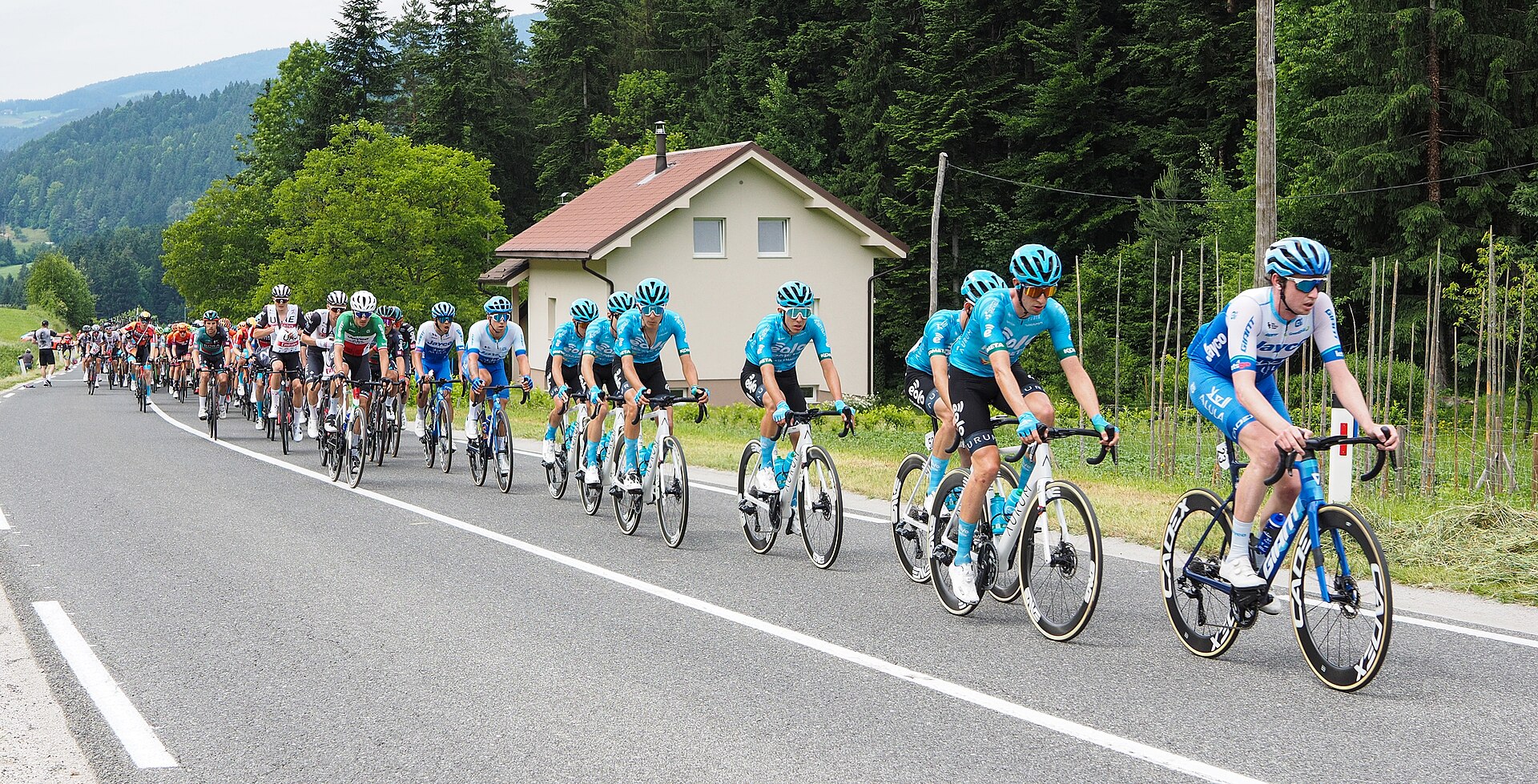
[A large group of road cyclists rides in a tight pack during a stage race.] Photograph: Tour of Slovenia stage
Image Credits: Wikimedia Commons
A peloton is the main bunch of riders in a road cycling race. The word comes from French, where it can mean a small ball or a platoon, and in cycling it means the group that rides together for much of a stage.
This article explains why cyclists ride in a peloton, including how drafting works, what the research measures, how riders share the front, and what happens in crosswinds.
What drafting does to air resistance
A cyclist pushing through still air has to overcome drag, and drag grows quickly as speed rises. At professional race speeds, overcoming air resistance takes most of a rider's power, so any shelter matters.
Drafting means riding in the low-pressure wake behind another rider or group of riders. The rider ahead parts the air, and the rider behind travels through disturbed air that pushes back less hard.
The saving is not a single fixed number. It changes with speed, the gap to the rider ahead, the size of the group, and where a rider sits inside the group.
Closer is better, up to a point. Riders in professional races often sit within centimetres of the wheel ahead, which is why crashes can spread through a group so fast.
What the studies actually measured
Early field work gave more modest numbers than the famous peloton claims. In coast-down tests reported in the cycling aerodynamics literature, a trailing cyclist used 33 percent less power than the leader at 40 kilometres per hour, which corresponded to about a 38 percent aerodynamic improvement once rolling resistance was accounted for.
Outdoor oxygen-uptake tests told a similar story for small groups. Drafting at 32 kilometres per hour cut oxygen use by 18 percent, while drafting at 37 and 40 kilometres per hour cut it by more than 27 percent, according to McCole and colleagues as summarised in the same literature.
Wind-tunnel work with two riders found a maximum drag reduction of 49 percent for the trailing rider directly behind the leader. The same work found a 37 percent reduction when the trailing rider sat 0.10 metres to the side, a safer staggered position.
Researchers at Monash University and the Australian Institute of Sport then tested small formations in a wind tunnel. They found that a trailing rider in a two-rider draft could see drag fall by up to 49 percent, while the lead rider gained up to 5 percent, according to ScienceDaily's report of the study.
Nathan Barry, a PhD student in the Monash Wind Tunnel Sports Group, said at the time that typical professional racing speeds were 45 kilometres per hour and reached 65 kilometres per hour or more in a sprint. He added that over 90 percent of an athlete's power at those speeds went into overcoming drag, and that cutting drag would significantly improve performance.
Why a big peloton saves far more than a pair
The numbers above come mostly from pairs or small groups. A full peloton behaves differently, because dozens of riders shape the air together rather than one rider sheltering one other.
Professor Bert Blocken of Eindhoven University of Technology and KU Leuven simulated a peloton of 121 riders with computational fluid dynamics software on a Cray supercomputer. The project, reported by TOP500 in 2018, was described as the largest numerical simulation ever done in cycling at the time.
The simulation found that air resistance in the middle rear of the peloton fell to only 5 to 10 percent of the drag on a solo cyclist. That corresponds to an equivalent cycling speed 3.2 to 4.5 times lower than the peloton's speed, according to the published summary of the work by Blocken and colleagues.
Wind-tunnel tests with 121 quarter-scale models backed the simulation. The result surprised many in the sport, because older simple models had suggested middle-of-the-pack riders saved only 40 to 50 percent of their energy.
The practical meaning is plain. A rider deep inside a big group can hold race speed while producing far less power than a rider alone, which leaves energy for the decisive moments of a race.
The leader still benefits a little. Trailing riders fill in the low-pressure wake behind the leader, which reduces the suction pulling backward on the rider at the front, and the Monash work measured that small gain at up to 5 percent.
How riders share the work at the front
Shelter only helps if someone rides in the wind. Teams and groups solve this by rotating: riders take short turns at the front, then drift back into the shelter to recover while others pull.
In a paceline, the rotation is orderly. The lead rider pulls off to one side and rejoins at the back, and the next rider takes over without the group slowing.
Teammates protect a leader by keeping that leader sheltered and by chasing down attacks. A team with several riders near the front can control the pace, while a lone rider in the wind burns energy with every kilometre.
Breakaways work the same way on a smaller scale. Riders who escape the peloton must cooperate and share pulls, because a lone escapee faces the full wind and rarely survives to the finish against an organised chase.
Riders also fight for position inside the group. The middle rear offers the most shelter, but riders near the front react faster to attacks and avoid being caught behind crashes. That trade-off shapes much of race tactics.
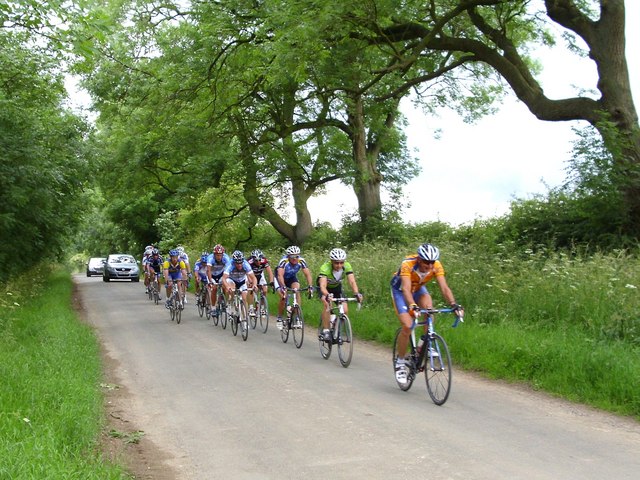
[A group of cyclists rides together in formation on an open road.] Photograph: Geograph contributor
Image Credits: Wikimedia Commons
What crosswinds do to the peloton
A headwind or tailwind rewards sitting directly behind the rider ahead. A crosswind moves the shelter to one side, and the group must reshape itself to keep finding it.
The result is an echelon: a diagonal line of riders fanned across the road, each sitting slightly to the sheltered side of the rider ahead. Canadian Cycling Magazine describes the rotation as fluid, with riders moving sideways as they take their turn and filter back.
Road width sets a hard limit. Only so many riders can fit in the diagonal before the road runs out, and riders who miss the echelon end up in the gutter, riding in single file in the full wind.
That is why crosswind stages split races. Teams drive hard at the front to form the first echelon, and rivals caught behind it must produce similar power with no shelter, which quickly opens gaps that are hard to close.
Crashes are the other cost of close riding. Overlapping wheels in an echelon or a tight pack means one touch can bring down several riders, so group riding demands steady handling and constant attention.
Why amateurs ride in groups too
The same physics applies on a club ride, just at lower speeds. A group travelling at 30 kilometres per hour still gives shelter, and weaker riders can hold a pace they could not sustain alone.
Group rides also share navigation, mechanical help, and company. A rider with a puncture gets a wheel or a pump from the group, and a dropped rider can often be waited for on a social ride.
Safety rules differ from racing. Club groups ride two abreast where the road allows it, call out hazards, and avoid sudden braking, because the rider behind is trusting the wheel ahead.
Beginners should learn the basics before joining a fast group. Holding a steady line, avoiding overlapping wheels, and signalling turns matter more than fitness, and a steady rider is a safer rider to follow.
Do riders still need to be strong
Drafting does not remove fitness from cycling. The sheltered rider still pedals hard, and the riders who take turns at the front, climb hills, and sprint for the finish need real power.
What drafting changes is where power gets spent. A smart rider spends less energy in the middle of a stage and more at the moments that decide the result: the climb, the crosswind split, or the final sprint.
Teams are built around that idea. Domestiques ride in the wind for a leader, fetch bottles, and chase breaks, so the leader arrives at the finish with the most energy left.
Frequently asked questions
How much energy does riding in a peloton save?
It depends on group size and position. Small-group studies measured savings around 27 to 49 percent, while the 121-rider simulation found drag in the middle rear at 5 to 10 percent of a solo rider.
Does the rider at the front get any benefit?
Yes, a small one. Research from Monash University found the lead rider in a two-rider draft gained up to 5 percent, because trailing riders partly fill the wake behind.
Why do riders crash so often in a peloton?
Riders sit centimetres apart at high speed, so one touch of wheels or sudden braking can spread through the group. Position near the front lowers the risk of being caught behind a crash.
What is an echelon in cycling?
An echelon is a diagonal formation used in crosswinds, with each rider sheltered to the side of the rider ahead. Road width limits how many riders fit, so the group can split.
The bottom line
Cyclists ride in a peloton because the group cuts air resistance, shares the hard work at the front, and lets riders save energy for the moments that decide a race. The saving grows with group size, from roughly a third in a pair to a dramatic reduction deep inside a large bunch, and crosswinds turn the same idea into the diagonal echelon. For anyone riding in a group, the lesson is simple: hold a steady line, take your turn at the front, and respect the wheel ahead.
Tags: cycling, peloton, drafting
Rive News's research desk covers everyday science and sport explainers from published studies and official sources.
Related
- How to choose a bike size without a shop fitting
- Why bike gears click and skip under load
- How to start cycling to work safely every day
Subscribe to Rive News for one plain-English explainer every weekday.
Rive News publishes explainers based on cited public sources; corrections are welcomed and noted on the article.
Related stories
Why Is Altitude Sickness Worse for Some People?
Altitude sickness hits some people harder because of genetics, ascent speed, and prior history, not fitness level. Here is what raises risk
Why Do You Get Blisters When Hiking and How to Prevent Them
Friction plus moisture plus heat equals a blister. Learn why hiking breeds all three, and the boots, socks, and tape system that keeps
How to choose hiking boots for beginners: fit, features, and break-in
Beginners should buy for fit first: snug everywhere, tight nowhere, with a thumb's width at the toes. Here is how to size, test,