
Why football pitches have stripes on match days
By Rive News / Research desk | Rive News / Published October 29, 2026 at 9:00 AM PKT
Key takeaways
- Pitch stripes are not painted: they come from mowing grass in alternating directions.
- A roller behind the mower bends blades one way, changing how light reflects off each band.
- Stripes help players, officials, and viewers judge distance and movement on television.

[Light and dark mowing stripes run across a lawn, created by mowing in alternating directions.] Photograph: Striped lawn at Cambridge
Image Credits: Wikimedia Commons
Turn on a televised match and the pitch looks like a green barcode: alternating bands of light and dark grass running across the field. The pattern looks designed, and in a sense it is, but no paint is involved.
This article explains why football pitches have stripes, including how grounds teams create them, which grasses stripe best, and what the pattern does for players and viewers.
The short answer: bent grass, not paint
Stripes come from the direction of mowing. A grounds team mows one band in one direction, turns around, and mows the next band in the opposite direction, repeating the pattern across the whole pitch.
The mower carries a roller behind its cutting unit. As it passes, the roller bends the grass blades in the direction of travel, pressing them flat for a short time.
Blades bent toward the viewer reflect more light and look pale. Blades bent away from the viewer show their shaded sides and the gaps between blades, so they look dark.
That is the whole trick. Two bands of identical grass, cut to the same height, look like two different shades of green purely because of the direction the blades lean.
BrightView, a commercial grounds-care company, states the point directly: lawn stripes are not painted, nor are they achieved by mowing at different heights. Rolling, brushing, or bending the grass changes how light reflects off each blade, which creates stripes and even checkerboard or diamond patterns.
The effect fades as the grass springs upright again, which is why stripes look sharpest on match day, shortly after mowing.
The equipment behind the pattern
Professional grounds teams use cylinder mowers, also called reel mowers, rather than the rotary mowers common on home lawns. A reel mower cuts with a spinning cylinder of blades against a fixed bottom blade, giving a clean, scissor-like cut.
The roller matters as much as the cut. Heavy rollers on the back of professional mowers press the grass firmly in one direction, producing a stronger contrast than a light domestic mower can manage.
Home lawns can show stripes too. A walk-behind reel mower often leaves faint bands, and striping kits that attach to rotary mowers add a roller or brush to bend the grass. The principle is identical; only the contrast differs.
Direction changes create the pattern. Mowing straight bands in alternating directions gives stripes, while mowing in two directions at right angles gives a checkerboard. Some grounds teams create diamonds, circles, or club crests by varying the mowing route, though match pitches usually stick to simple stripes or checks.
Why stripes help the game
Stripes began as a side effect of careful mowing, but they now serve the game in several ways.
First, they help viewers and officials judge distance. Alternating bands give the eye fixed reference lines across the pitch, which makes it easier to see how far a pass travelled or whether a player timed a run.
Second, they help players track movement. A ball rolling across contrasting bands is easier to follow at speed, and the bands give defenders a sense of where they stand relative to the goal.
Third, they signal quality. A crisp, even pattern shows the pitch was mowed in straight lines at a consistent height, which usually means the surface is even and the ball will roll true.
Broadcasters benefit as well. Television cameras show the pattern clearly from high angles, and the stripes have become part of football's visual identity, instantly marking a surface as a professional pitch.
There is also a claimed psychological effect. Some coaches and writers suggest the alternating bands can make a pitch look larger or the ball look faster, though that effect is speculative and has no firm measurement behind it. The practical benefits for visibility are enough on their own.
Grass that stripes well, and grass that does not
Not every grass shows stripes equally. The effect depends on blade width, stiffness, and growth habit.
Northern grasses such as bluegrass and fescues stripe well, according to BrightView, because their blades bend and hold the bend long enough to show contrast. Dormant Bermuda grass overseeded with ryegrass, a combination common in warmer regions, also stripes well.
Bermuda grass in summer is harder. It tends to grow in a grain, meaning the blades lean in a fixed direction regardless of mowing, which can interrupt the pattern and even affect ball roll on a sports field.
Professional pitches usually use perennial ryegrass, often blended with other species, because it recovers fast from wear, tolerates close mowing, and holds a stripe. The choice of grass is a compromise between durability, ball speed, and appearance.
Under the grass sits an engineered base. Football pitches typically use a sand-based rootzone, often 80 to 100 percent sand with little organic matter, layered over gravel and drainage pipes. That construction drains rain fast and keeps the surface playable after storms, which matters far more than the pattern on top.
How short is a match pitch cut
Professional football grass is kept much shorter than a home lawn. One grounds-care account puts the usual range at 1 to 2.5 inches, compared with 3 inches or more for a home lawn.
Short grass makes the ball travel faster and bounce more predictably. It also improves traction for players changing direction, and it keeps the surface clear for officials judging offside and fouls.
Cutting short has a cost. Short grass has less leaf area for photosynthesis, so it needs more water, fertiliser, and recovery time than a longer lawn. Grounds teams balance the cut against the fixture list, raising the height slightly during heavy schedules or dry spells.
Mowing frequency matters as much as height. Allett, a mower manufacturer, notes that regular mowing encourages lateral growth and a denser mat of grass with deeper roots, which makes the pitch more resistant to wear. A consistent schedule also makes patterns easier to hold, because alternating direction only works when the grass is cut often enough to stay upright between cuts.
The size of the canvas
Stripes cover a large surface. FIFA recommends a field of play measuring 105 metres long and 68 metres wide for professional matches, which is about 7,140 square metres of grass.
The Laws of the Game, maintained by the International Football Association Board, allow a wider range: 90 to 120 metres long and 45 to 90 metres wide for general play, with international matches usually built between 100 and 110 metres long and 64 to 75 metres wide.
That size explains why mowing a match pitch is a serious job. A grounds team may spend hours cutting, marking lines, and checking the surface before kickoff, and the stripe pattern is the visible proof of that work.
White lines are painted separately. The touchlines, goal lines, penalty areas, centre circle, and corner arcs are marked with paint or chalk, and the Laws require lines no wider than 12 centimetres. Stripes sit underneath those markings and never replace them.
Do stripes change how the ball rolls
A common question is whether the pattern affects play. The honest answer is: barely, if the pitch is well maintained.
Because both bands are cut to the same height, the ball meets the same grass length in each stripe. The difference is only the direction the blades lean, and a rolling ball flattens blades as it passes anyway.
Poorly maintained stripes can cause trouble. If one band is cut at a different height, or if Bermuda grain builds up in one direction, the ball can check or speed up unevenly. That is a maintenance fault, not an effect of striping itself.
Grounds teams avoid the problem by keeping the cut height consistent, alternating the mowing route so no band is always bent the same way, and rolling the pitch after heavy rain.
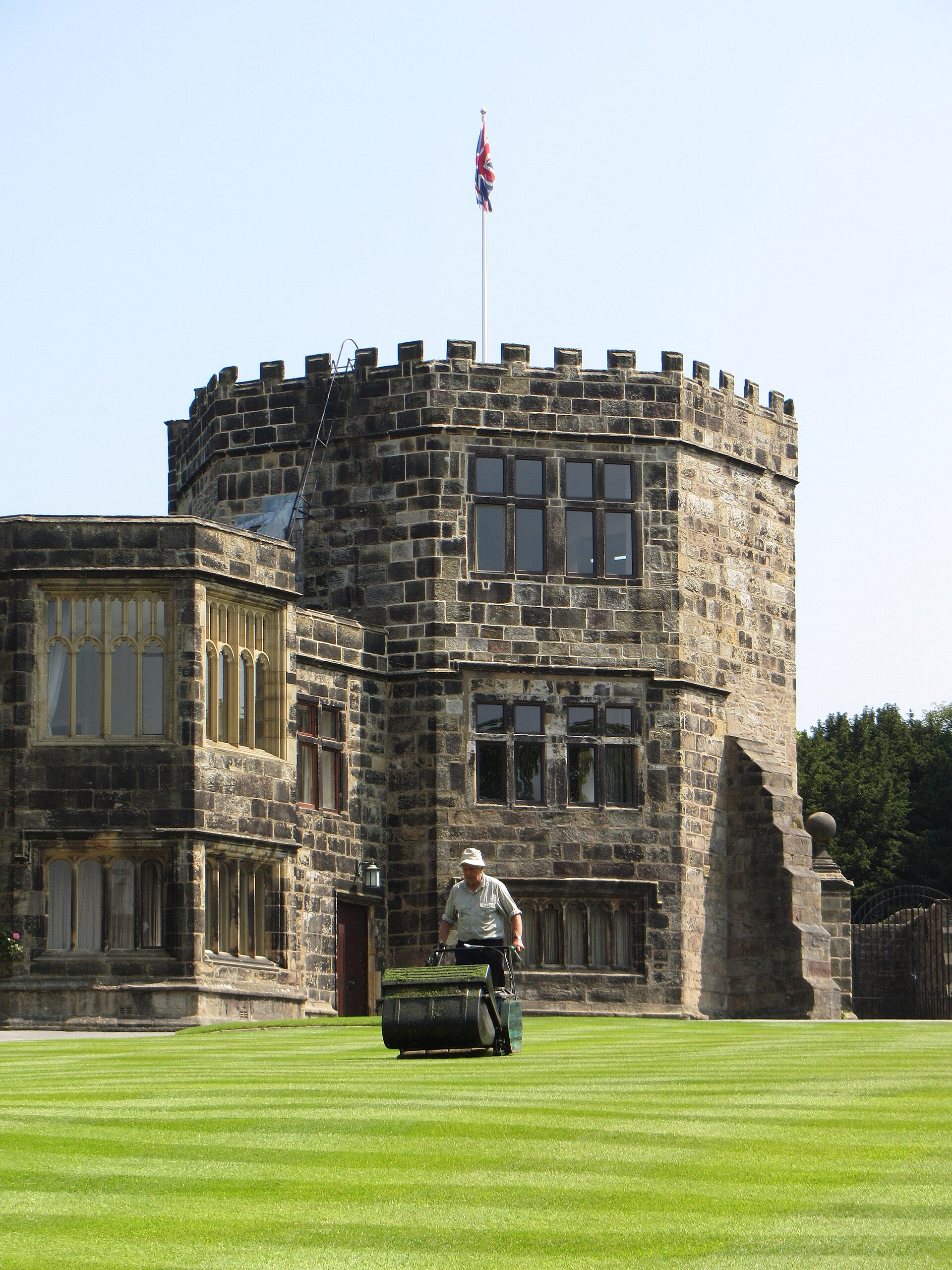
[A worker mows stripes into a lawn with a roller mower, the same equipment technique used on pitches.] Photograph: Lawn mowing at Skipton Castle
Image Credits: Wikimedia Commons
Why some pitches look checkered instead
Checkerboards use the same method with an extra pass. The team mows stripes in one direction, then mows again at right angles, bending alternate squares the other way.
The result is a grid of light and dark squares that looks striking on television. Some clubs use checks for big matches and stripes for routine games, and a few create elaborate designs for finals.
Both patterns serve the same purpose. They show even mowing, help viewers judge distance, and mark the pitch as professionally prepared.
Artificial turf pitches cannot be striped this way, because plastic blades do not bend and stay bent. Manufacturers instead weave two shades of green fibre into the carpet to imitate the look, which shows how closely stripes are now tied to football's image.
Stripes beyond football
The same technique appears across sport. Baseball outfields show stripes, checkerboards, and team logos, golf fairways carry mowing patterns, and American football fields use alternating bands.
Each sport uses the pattern for the same reasons: even cutting, visual reference, and presentation.
Frequently asked questions
Are football pitch stripes painted on?
No. Stripes come from mowing in alternating directions with a roller that bends grass blades, changing how light reflects off each band.
Why do some pitches have checkerboards?
Checkerboards come from mowing twice at right angles, bending alternate squares in opposite directions, using the same light-reflection effect as stripes.
Do stripes affect how the ball rolls?
Not when the pitch is cut evenly, because both bands are the same height. Uneven cutting or heavy grass grain can affect roll, but that is a maintenance problem.
How big is a professional football pitch?
FIFA recommends 105 metres by 68 metres, within the Laws of the Game range of 90 to 120 metres long and 45 to 90 metres wide.
The bottom line
Football pitches have stripes because grounds teams mow in alternating directions, and the roller behind the mower bends the grass so that neighbouring bands reflect light differently. The pattern started as a by-product of careful mowing, but it now helps players, officials, and viewers judge distance and movement, and it proves the surface was cut evenly. Next time the pattern catches your eye, remember it is not decoration added on top of the pitch but the pitch itself, combed one way and then the other.
Tags: football, pitches, groundskeeping
Rive News's research desk covers everyday science and sport explainers from published studies and official sources.
Related
- Why do footballers wear shin guards? Rules, history and safety
- How to do a proper warm-up before a football match
- How to improve your stamina for football without a gym
Subscribe to Rive News for one plain-English explainer every weekday.
Rive News publishes explainers based on cited public sources; corrections are welcomed and noted on the article.
Related stories

Why Is Altitude Sickness Worse for Some People?
Altitude sickness hits some people harder because of genetics, ascent speed, and prior history, not fitness level. Here is what raises risk

Why Do You Get Blisters When Hiking and How to Prevent Them
Friction plus moisture plus heat equals a blister. Learn why hiking breeds all three, and the boots, socks, and tape system that keeps
How to choose hiking boots for beginners: fit, features, and break-in
Beginners should buy for fit first: snug everywhere, tight nowhere, with a thumb's width at the toes. Here is how to size, test,