
Why do footballers wear shin guards? Rules, history and safety
Key takeaways
- Footballers wear shin guards because the shin bone is one of the body's most exposed bones, and football constantly puts it near other players' boots.
- The idea dates to 1874, when Nottingham Forest's Sam Widdowson cut down cricket pads; FIFA made them compulsory in 1990.
- Under IFAB Law 4, guards must be a suitable material and size, worn under the socks; lab studies show they absorb more than 90 percent of impact force.
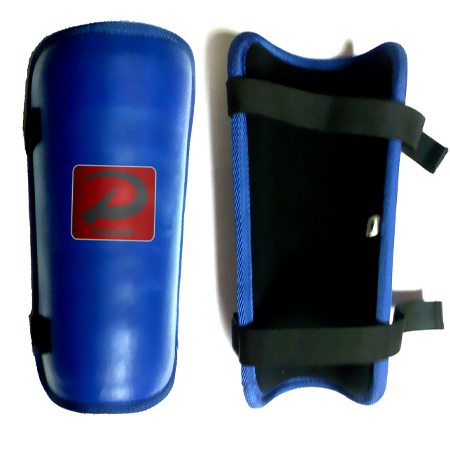
A pair of football shin pads, the basic protection every player must wear under the socks.
Image Credits: Wikimedia Commons, uploaded by Tibaexpo
Look at any professional footballer and you will find two thin pads strapped or tucked under the socks. They are easy to overlook, yet no player is allowed on the pitch without them.
The reason is straightforward. Football is played with feet, which means twenty-two pairs of boots are constantly swinging near unprotected shins. The shin bone sits close to the skin with almost no muscle to cushion it, making it one of the most painful and vulnerable places to take a kick.
This article explains why footballers wear shin guards, including what they actually protect against, the Victorian invention behind them, what the rules require today, and how to choose the right pair.
What shin guards actually protect
A shin guard spreads the force of a direct impact across a wider area. Studies cited by football publications have found that well-made guards protect bones from more than 90 percent of the force load in many impacts, cutting the risk of fractures, deep bruising and cuts.
The scale of the problem is real. Research on football injuries has found that nearly 63 percent of players are injured over the course of a season, with almost 83 percent of those injuries in the lower extremities. Fractures make up roughly 2 to 11 percent of football injuries, and about a third of those fractures are in the lower leg.
Guards have limits, and honest ones matter. They cover only the front of the lower leg, so they do nothing for ankle sprains, knee ligament damage or Achilles injuries.
Those come from twisting and awkward landings, not direct impacts, and no pad changes those mechanics. Anyone twisting an ankle in a match quickly learns the difference.
Modern guards are usually moulded plastic such as polypropylene, sometimes with foam backing for comfort. Laboratory comparisons have suggested carbon fibre absorbs impact better than standard polypropylene, though carbon models remain rare and expensive.
The 1874 invention that started it all
Shin guards were invented in 1874 by Sam Widdowson, who played both cricket and football for Nottingham Forest. Early football was a rough game with few protections, and serious shin injuries were common.
Widdowson's solution was practical: he cut down a pair of cricket leg pads and strapped them to the outside of his socks with leather straps. Other players criticised him for it at first. But the logic was hard to argue with, and protective pads spread through the game over the following decades.
Despite being around since the 1870s, shin guards were not compulsory for over a century. Photographs of great players from the 1960s through the 1980s show bare shins with socks rolled down, because the rules simply did not require them.
Why do footballers wear shin guards: what the rules say today
In 1990, FIFA made shin guards a mandatory part of a player's kit. The requirement now sits in the Laws of the Game under Law 4, maintained by the International Football Association Board (IFAB).
Law 4.2 states that shin pads must be made of a suitable material and be of an appropriate size to provide reasonable protection, and they must be covered by the socks. Referees check equipment before matches, and a player whose socks sag or whose guard becomes exposed must leave the field to fix it before returning.
One detail surprises many fans: the law does not define a minimum size. Each player is personally responsible for choosing guards that are suitable, which is why youth and amateur leagues enforce the rule strictly while leaving the size to the player.
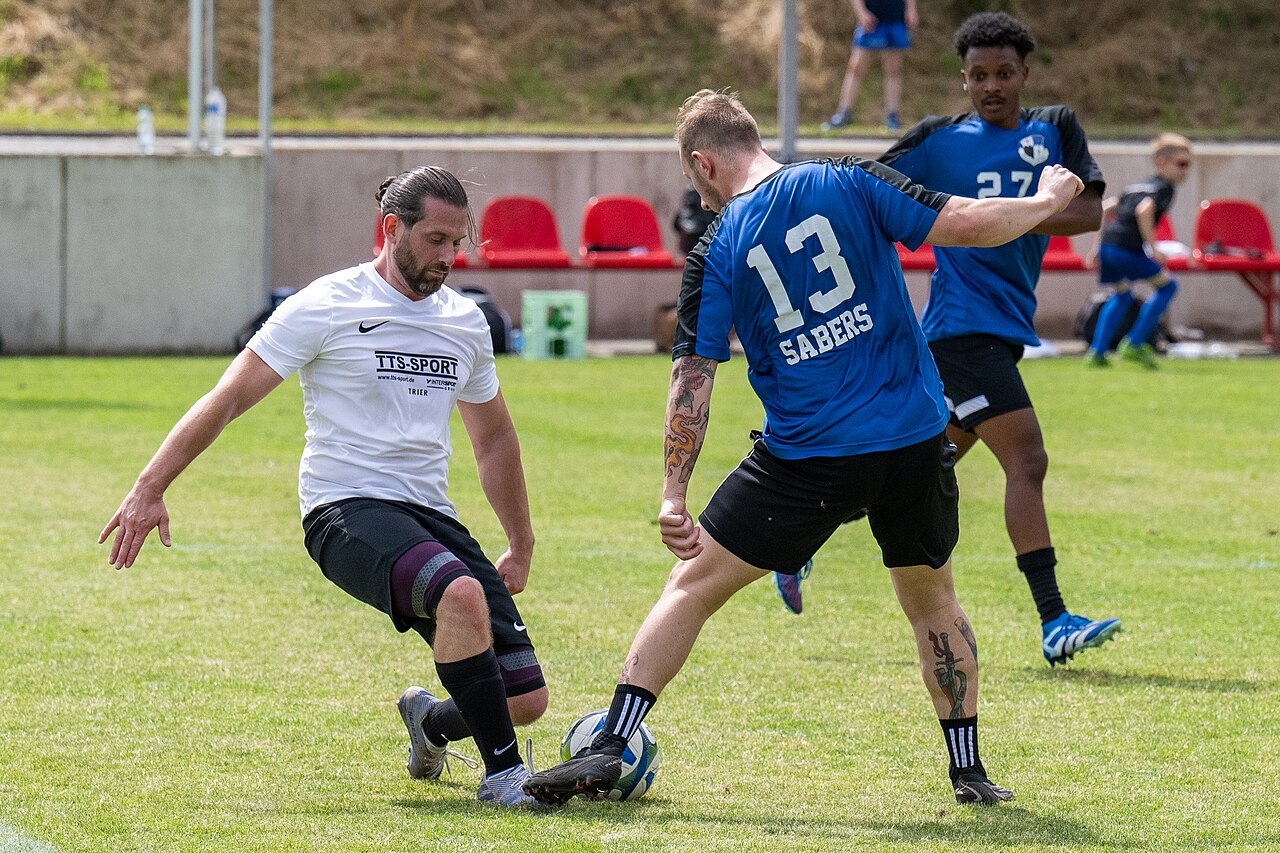
Two players contesting the ball, with every shin on the pitch protected under the socks.
Image Credits: Wikimedia Commons, uploaded by OptimusPrimeBot
That flexibility explains the recent trend toward tiny pads. In October 2026, BBC Sport's Ask Me Anything team examined why players such as Liverpool's Lewis Koumas, Burnley's Marcus Edwards and Brighton's Harry Howell have appeared wearing "micro" shin pads, barely visible under low socks. The answer is that the law allows it: as long as the referee accepts the pad as suitable, the player decides.
Different countries adopted the rule on their own timelines. The Netherlands, for example, required guards for professionals from 1992 and extended the rule to all amateur players only in the 1999/2000 season.
Choosing the right pair
For anyone buying guards, fit matters more than branding. The guard should cover from just below the knee to just above the ankle without restricting movement, and it should sit flat against the shin.
Ankle-strap models suit younger players and hard tacklers who want the pad to stay put. Slip-in guards, held by the sock alone, are the professional standard and the reason modern football boots are designed to work with minimal kit. Replace cracked guards, because a damaged pad can splinter on impact and injure the wearer.
Youth players should be sized properly rather than handed oversized hand-me-downs. A guard that slides around on contact protects nothing, and referees at junior level will send a player off to fix loose equipment.
Good footwork helps too: players who work on their balance for sport take fewer awkward contacts, which means fewer impacts for the guards to absorb in the first place.
Goalkeepers usually skip guards in favour of padded shorts and elbow protection, because they face different impacts. Outfield players at every level, from Sunday league to the World Cup, wear the same basic piece of kit. It costs little, weighs almost nothing, and it is the one item of equipment whose job is entirely about safety.
Frequently asked questions
Can I play without shin guards if I forget them?
Not in any organised match. Referees must check equipment before kickoff, and a player without guards cannot take the field. In most youth and amateur leagues, forgetting them means you do not play.
Do goalkeepers have to wear shin guards?
The law applies to all players, but goalkeepers rarely wear them. They face different impacts, mostly dives and collisions rather than kicks to the shin, so padded shorts and elbow protection matter more to them.
Are the tiny shin pads some pros wear actually legal?
Yes. The law requires guards of an appropriate size but leaves the judgement to the player and the referee. Micro pads pass inspection as long as the referee accepts they offer reasonable protection.
How often should shin guards be replaced?
Replace them when they crack, warp or no longer sit flat against the shin. A damaged guard can splinter on impact, and an old compressed foam backing absorbs far less force than a new one.
The bottom line
Footballers wear shin guards because a swinging boot against a bare shin is one of football's most predictable injuries, and a thin piece of plastic absorbs most of the force. Invented in a Victorian cricket bag, made compulsory in 1990, and now worn in every size from full coverage to micro, the shin guard is the smallest piece of kit with the clearest job on the pitch.
Rive News is the site's research desk, covering sports topics from public rules and reporting.
Latest in Sports & Outdoors
- What to do when you twist your ankle playing sport
- What to eat before a morning match or race
- How to watch a match tactically instead of just following the ball
- The difference between football boots and running shoes
Subscribe for one practical sports and outdoors tip every morning.
© 2026 Rive News. Reporting follows public-source verification standards.
Related stories

Why Is Altitude Sickness Worse for Some People?
Altitude sickness hits some people harder because of genetics, ascent speed, and prior history, not fitness level. Here is what raises risk
Why Do You Get Blisters When Hiking and How to Prevent Them
Friction plus moisture plus heat equals a blister. Learn why hiking breeds all three, and the boots, socks, and tape system that keeps
How to choose hiking boots for beginners: fit, features, and break-in
Beginners should buy for fit first: snug everywhere, tight nowhere, with a thumb's width at the toes. Here is how to size, test,