
How Does a Cricket Ball Swing in the Air? Seam Aerodynamics
Key takeaways
- The ball's raised seam, with 80 to 90 stitches standing about 1 mm proud, trips the airflow on one side into turbulence.
- Turbulent air clings to the ball longer before separating, creating lower pressure on that side and a sideways force.
- Speed and ball age decide the type: conventional swing needs 90 km/h or more, while reverse swing needs 135 km/h or more.
A cricket ball that starts straight and then bends late is one of sport's great puzzles. Batsmen play for the line, then watch the ball slide sideways at the last moment.
There is no spin involved, and the bowler's wrist does nothing exotic. The curve comes from the ball's own construction meeting the air.
This article takes a closer look at how a cricket ball swings in the air, including what swing means, how the seam creates uneven pressure, the difference between conventional and reverse swing, and what bowlers do to make it happen.
What swing means in cricket
Swing is the lateral deviation of the ball's trajectory as it travels toward the batsman. Unlike spin bowling, where the fingers rotate the ball, swing happens to a ball delivered with the seam upright and stable. The ball curves in the air, usually in the last third of its flight, which is why it troubles even set batsmen.
The cause is not the Magnus effect, which explains curveballs in football or tennis through spin. A cricket ball's curve comes from asymmetry built into the ball itself. That asymmetry is the seam, and it is the bowler's main tool.
The research community has studied this for decades. Rabindra Mehta, a NASA scientist and former club fast bowler, has studied cricket-ball aerodynamics for nearly three decades, according to a writeup of his work on Indian Cricket Fans. His wind-tunnel experiments pinned down exactly how the seam bends the airflow.
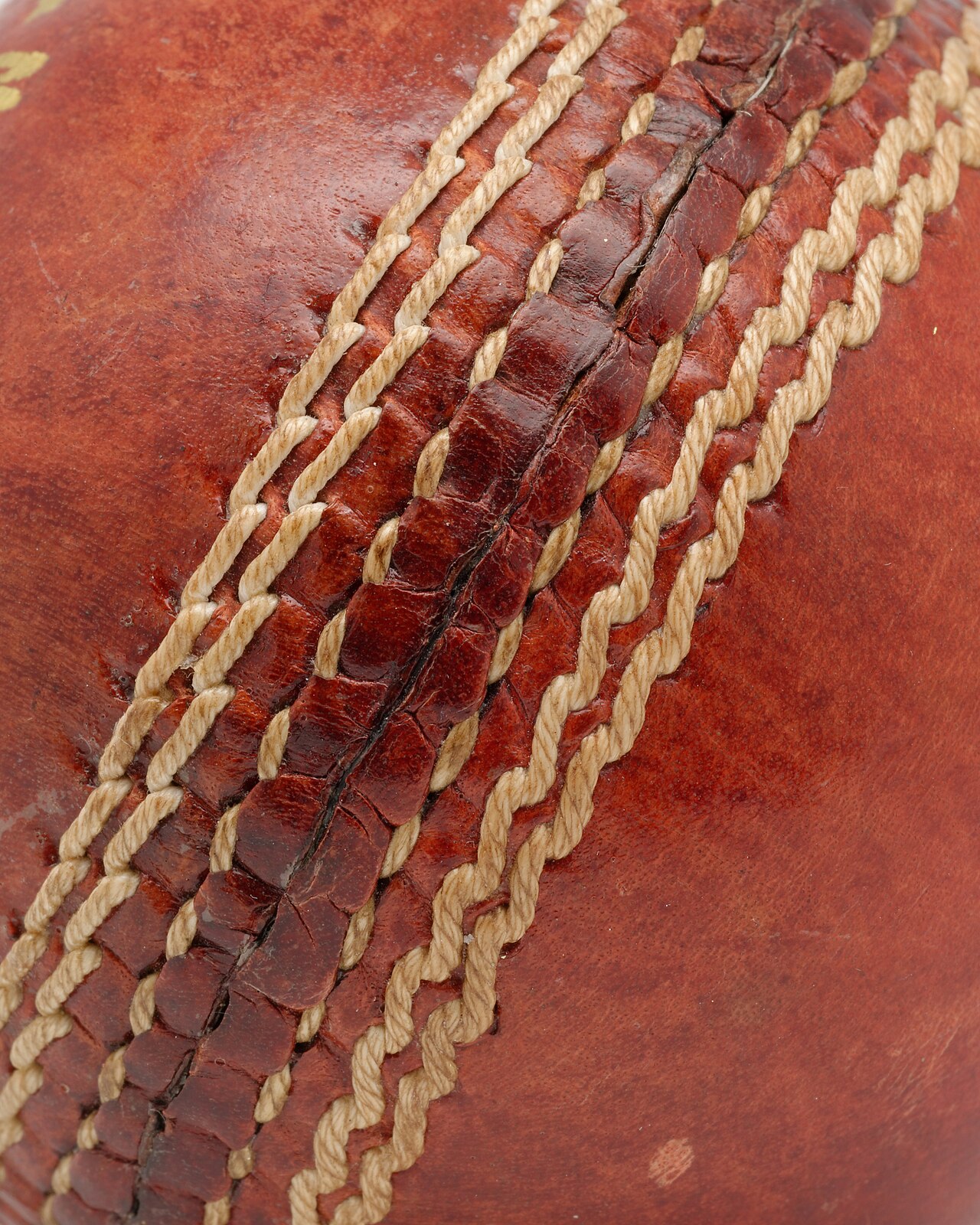
A cricket ball with its raised seam visible. Photograph: Marie-Lan Nguyen/Wikimedia Commons
How the seam makes air pressure uneven
A cricket ball is asymmetric by design. It has six seams of 80 to 90 encircling stitches, protruding approximately 1 millimeter proud of the surface, according to Scobie, Pickering, Almond, and Lock in their paper "Fluid dynamics of cricket ball swing," published in the Proceedings of the IMechE Part P: Journal of Sports Engineering and Technology.
As the ball flies, a thin layer of air called the boundary layer clings to its surface. At typical bowling speeds, that boundary layer is about a millimeter thick. It cannot stay attached all the way around the ball; it separates from the surface at some point, and where it separates decides the pressure.
Here is where the seam does its work. When the bowler angles the seam, the raised stitches on one side trip the boundary layer into a turbulent state on that side, while the smooth side keeps a laminar, orderly flow.
Turbulent air clings to the ball's surface longer before separating. The later separation on the seam side creates lower pressure there.
A pressure difference between the two sides is a sideways force. The ball moves toward the low-pressure area. Mehta explains that a side force will only be generated if there is a pressure difference between the two sides of the ball, and the angled seam is what creates it.
Recent research has sharpened the picture. Scobie and colleagues report new measurements showing that the seam acts more like a series of vortex generators than a simple trip, and that a laminar separation bubble forms on the seam side of the ball. The details have been refined, but the core mechanism stands: asymmetric separation, skewed wake, sideways force.
Conventional swing versus reverse swing
Swing comes in two flavors, and the ball's age decides which one shows up.
Conventional swing happens with a relatively new ball. One side is kept shiny through polishing; the other is allowed to roughen naturally.
The ball swings toward the rough side. Best Balls' guide to swing bowling notes that conventional swing works across roughly the first 1 to 40 overs, depending on conditions.
The mechanism is the one above. The seam trips the boundary layer on the shiny side into turbulence, separation is delayed on that side, and the ball curves toward the rough side where the pressure is lower. For an outswinger to a right-handed batter, the bowler holds the shiny side facing the batter and angles the seam toward the slips.
Reverse swing is the older ball's trick. As both sides roughen with age, the ball suddenly starts swinging in the opposite direction, toward the shiny side.
It needs real pace: a literature review by Varanasi Sai Subhankar of IIT Kharagpur reports the threshold as a velocity greater than 135 km/h with the seam angle at not less than 20 degrees. Conventional swing, by contrast, needs about 90 km/h or more.
There is even a third type, contrast swing, where the swing direction is decided by bowling speed rather than seam and surface orientation. The details are still being worked out, and the 2012 paper by Scobie and colleagues notes that published understanding does not fully explain everything seen in professional matches.
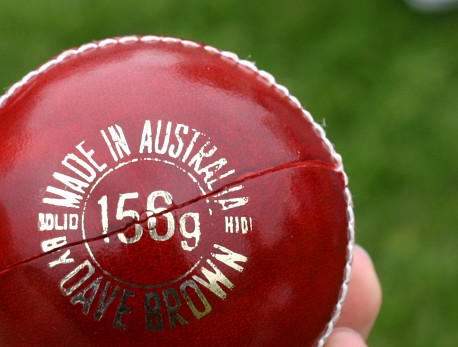
A red leather cricket ball. Photograph: Wikimedia Commons
What bowlers do to get it moving
Swing bowling is a craft built on small margins. The release comes first: the seam must be upright and stable, angled toward the intended direction of swing. A wobbling seam scrambles the airflow and kills the curve.
Ball maintenance is a legal science of its own. Bowlers and fielders polish one side on their clothing to keep it shiny while letting the other side roughen through contact with the pitch. They never pick at the seam, since a proud seam aids swing, and they keep the ball dry, because moisture disturbs the boundary layer.
Weather is the great debate. Conventional wisdom says overcast, humid conditions help swing, and the IIT Kharagpur review lists weather among the most controversial topics in the field, since the existing notions about overcast and cold conditions lack solid scientific accounting. The humidity story may be more myth than mechanism.
Speed discipline matters most. Conventional swing lives between about 90 km/h and the reverse-swing threshold.
Too slow and the seam cannot trip the boundary layer; too fast on a new ball and the flow regime shifts. Great swing bowlers learn the speed band for each ball they hold.
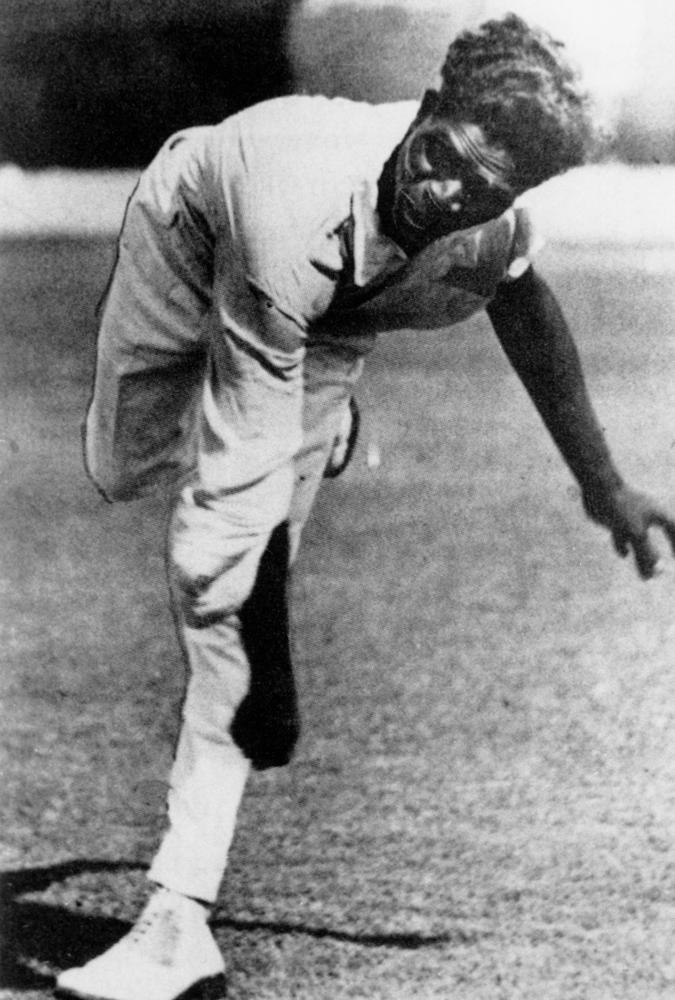
A fast bowler delivering. Photograph: State Library of Queensland/Wikimedia Commons
Frequently asked questions
Why does a cricket ball swing in the air?
Its raised seam, about 1 mm proud of the surface, trips the airflow on one side into turbulence. Turbulent air separates later from the ball, lowering the pressure on that side. The pressure difference pushes the ball sideways into a curve.
What is the difference between swing and seam bowling?
Swing is movement through the air before the bounce, caused by asymmetric airflow. Seam bowling is movement off the pitch after the bounce, when the ball lands on its raised seam and deflects. A bowler can get both from the same delivery.
What speed does a cricket ball need to swing?
Conventional swing needs roughly 90 km/h or more, according to the IIT Kharagpur literature review. Reverse swing with an older ball needs more than 135 km/h and a seam angle of at least 20 degrees.
Does humid weather really help swing?
That is the traditional belief, but researchers call it one of the most controversial topics in swing science. The proposed mechanisms for humidity helping have not been solidly verified. Ball condition, seam angle, and speed matter more than the forecast.
The bottom line
A cricket ball swings because its raised seam trips the boundary layer on one side, delaying separation, lowering pressure, and pushing the ball sideways into a late curve. Conventional swing needs a newish ball and 90 km/h or more; reverse swing needs an old ball, 135 km/h or more, and a 20-degree seam.
The batsman's nightmare is really just fluid dynamics with a leather cover. For more on sports physics, see why climbers tape their fingers, why archers put long rods on bows, and how your body switches from walking to running.
Latest in Sports & Outdoors
- Why do climbers tape their fingers?
- Why do archers put long rods on their bows?
- How does your body switch from walking to running without thinking?
Subscribe for one clear explainer every morning.
Image Credits: Wikimedia Commons / Marie-Lan Nguyen, State Library of Queensland
Related stories

Why Is Altitude Sickness Worse for Some People?
Altitude sickness hits some people harder because of genetics, ascent speed, and prior history, not fitness level. Here is what raises risk
Why Do You Get Blisters When Hiking and How to Prevent Them
Friction plus moisture plus heat equals a blister. Learn why hiking breeds all three, and the boots, socks, and tape system that keeps
How to choose hiking boots for beginners: fit, features, and break-in
Beginners should buy for fit first: snug everywhere, tight nowhere, with a thumb's width at the toes. Here is how to size, test,