
Why marathon runners hit the wall at mile 20
By Rive News / Research desk | Rive News / Published October 27, 2026 at 9:00 AM PKT
Key takeaways
- The wall is glycogen depletion: the body runs out of stored carbohydrate and must switch to slower-burning fat.
- A typical runner stores about 1,800 calories of glycogen and burns roughly 100 calories per mile, which points to mile 18 to 20.
- Eating carbohydrate during the race, at roughly 60 to 90 grams per hour, can prevent the wall for most runners.
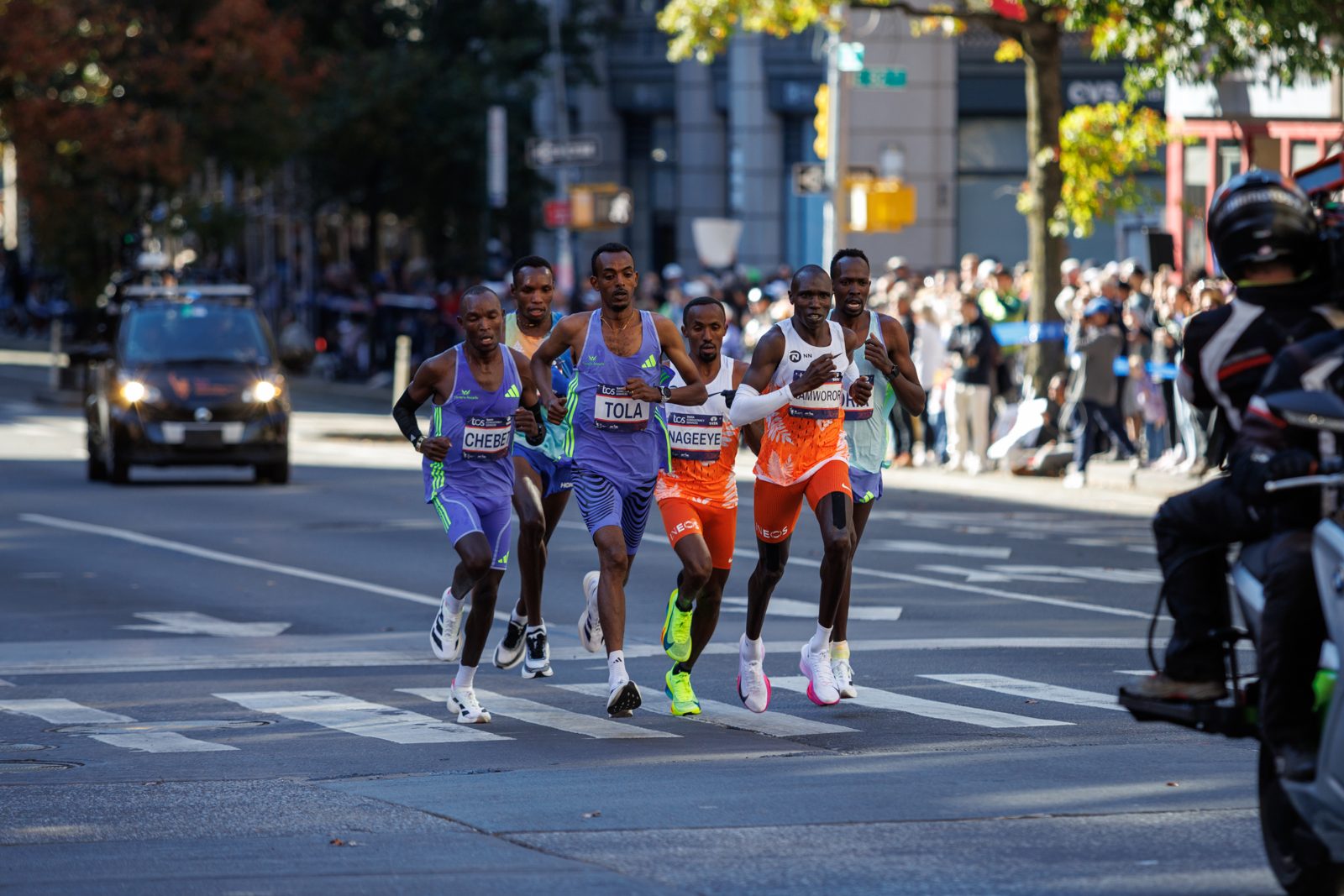
[Elite runners lead the pack during a city marathon.] Photograph: the subject
Image Credits: Wikimedia Commons
Hitting the wall is a sudden wave of exhaustion during a long endurance event, when legs feel heavy, pace collapses, and one more step feels hard to find. In a marathon it usually arrives near mile 20, with about 6.2 miles still to run. The runner has not simply got tired in the ordinary sense, and the feeling is not only in the mind.
The cause is fuel. Muscles run largely on glycogen, a stored form of glucose kept in muscle and liver tissue, and that store is limited. When it runs out, the body must switch to fat, which burns more slowly and cannot sustain marathon pace.
This article explains what glycogen is, why the maths points to mile 20, what the wall feels like, how the brain joins in, and how runners avoid it.
What glycogen is and why it runs out
Glycogen is the body's quick-access carbohydrate store. During high-intensity exercise, muscles break glycogen down into glucose, and that glucose powers movement. Fat is also available, and even a lean runner carries a large fat reserve, but fat burns less efficiently and cannot fuel fast running on its own.
The problem is size. The average person stores around 1,800 calories worth of glycogen in muscle, according to Live Science, and a runner burns around 100 calories per mile. Divide one number by the other and the result is 18 miles, which is why the wall typically appears around the 18- to 20-mile mark rather than at the start or the finish.
Training raises the store somewhat, and fuelling during the race tops it up, but neither removes the limit entirely. A four-hour marathon costs roughly 2,800 to 3,400 calories in total, depending on body mass, and total glycogen reserves for a typical trained marathoner sit around 1,800 to 2,200 calories. Without food or drink during the race, the stored carbohydrate simply cannot cover the whole distance at marathon effort.
Why mile 20, and not mile 10 or 26
Time matters as much as distance. At marathon pace, glycogen stores last approximately 90 to 120 minutes for most recreational runners, and a four-hour runner reaches mile 20 after roughly three hours of running. By that point the tank has been draining for far longer than its comfortable range, and the last miles run on whatever the runner has managed to replace.
A research model by Benjamin Rapoport at Harvard University, published in PLOS Computational Biology in 2010, formalised this picture. The model showed that athletes running at 80 to 95 percent of their aerobic capacity hit glycogen depletion around mile 20 to 21, which matches where most runners report hitting the wall. The model also showed that eating 60 to 90 grams of carbohydrate per hour essentially removes glycogen-depletion wall physiology for most four-hour finishers.
Pace changes the maths. A faster runner reaches mile 20 sooner, but burns carbohydrate at a higher rate, so the wall can still arrive near the same place.
A slower runner takes longer to reach mile 20, which gives more time to eat and drink, but also more time for the store to drain. Either way, mile 20 is not a magic line painted on the road, and it is not a rule about willpower.

[Runners exit a road tunnel during a city marathon.] Photograph: the subject
Image Credits: Wikimedia Commons
What the wall feels like
The classic symptoms are intense exhaustion, muscle cramping, and a rising heart and breathing rate as the body tries to keep going. Laura Richardson, a clinical associate professor in applied exercise science and movement science at the University of Michigan, told Live Science that the body works harder to keep things going once the fuel runs low.
The switch to fat explains the sudden pace drop. Fat cannot produce energy fast enough for marathon pace, so a runner who was holding steady speed can lose as much as 30 percent of pace when the switch happens. Legs feel like lead because the muscles are no longer getting fuel at the rate the pace demands, and the change can feel abrupt rather than gradual.
The brain joins in because it also depends on blood glucose derived from glycogen. When glucose falls, thinking gets foggy, decisions get harder, and pain feels harder to manage. That mental fog is real physiology, not a lack of toughness, and it explains why runners at the wall often struggle with simple choices like whether to walk, drink, or keep going.
How runners avoid the wall
The main defence is eating during the race, starting early rather than waiting for trouble. Gels, chews, sports drinks, and other carbohydrate sources all count, and the commonly cited target is 60 to 90 grams of carbohydrate per hour for a marathon. Practising that intake in training matters, because a stomach that has never handled gels at pace may rebel on race day.
Hydration sits alongside fuelling, though it does not replace it. Fluid losses build through the race, core temperature climbs, and heart rate drifts upward at the same pace, so holding speed costs more late in the race than it did early. Drinking to a plan, rather than waiting for thirst alone, helps keep that drift under control.
Pacing is the third defence. Starting too fast burns glycogen at a higher rate and brings the wall forward, while an even pace spreads the store across the distance. Many training plans also cap the longest training run at 20 miles, which means the last 6.2 miles of a marathon are new territory, and a conservative early pace leaves something in reserve for that stretch.
Recovery after the wall is simple in principle, though slow in practice. A runner who walks, drinks, and eats carbohydrate can get moving again as glycogen returns, but the lost pace rarely comes back in full. That is why prevention beats rescue, and why experienced marathoners treat fuelling as part of the race plan rather than an afterthought.
The bottom line
Marathon runners hit the wall near mile 20 because the body's glycogen store covers roughly 18 to 20 miles of running, and no amount of determination stretches that store further. The wall is a measurable fuel event, with heavy legs, a pace drop, and a foggy brain as its signature. Eating 60 to 90 grams of carbohydrate per hour, drinking to a plan, and pacing evenly are the practical defences, and they work because they attack the maths rather than the mood.
Tags: marathon, running, endurance
Rive News is a research desk that writes plain-English explainers from public sources. It does not replace coaching or medical advice for an individual runner.
Related
- Why do runners hit the wall in marathons
- How to prevent chafing on long runs
- How to choose running shoes for beginners in 2026
- How to train for your first 5K run
Subscribe for one plain-English explainer each morning.
Rive News follows a simple standard: named sources, no invented quotes, and corrections noted openly.
Related stories

Why Is Altitude Sickness Worse for Some People?
Altitude sickness hits some people harder because of genetics, ascent speed, and prior history, not fitness level. Here is what raises risk

Why Do You Get Blisters When Hiking and How to Prevent Them
Friction plus moisture plus heat equals a blister. Learn why hiking breeds all three, and the boots, socks, and tape system that keeps

How to choose hiking boots for beginners: fit, features, and break-in
Beginners should buy for fit first: snug everywhere, tight nowhere, with a thumb's width at the toes. Here is how to size, test,