
Why sprinters start from blocks for faster acceleration
By Rive News / Research desk | Rive News / Published October 29, 2026 at 9:00 AM PKT
Key takeaways
- Starting blocks give sprinters a firm, angled surface to push against from a crouched start.
- Blocks replaced holes dug in dirt tracks after Australian Charlie Booth and his father built them in 1929.
- At elite meets, pressure sensors in the blocks flag any reaction faster than 0.100 seconds as a false start.
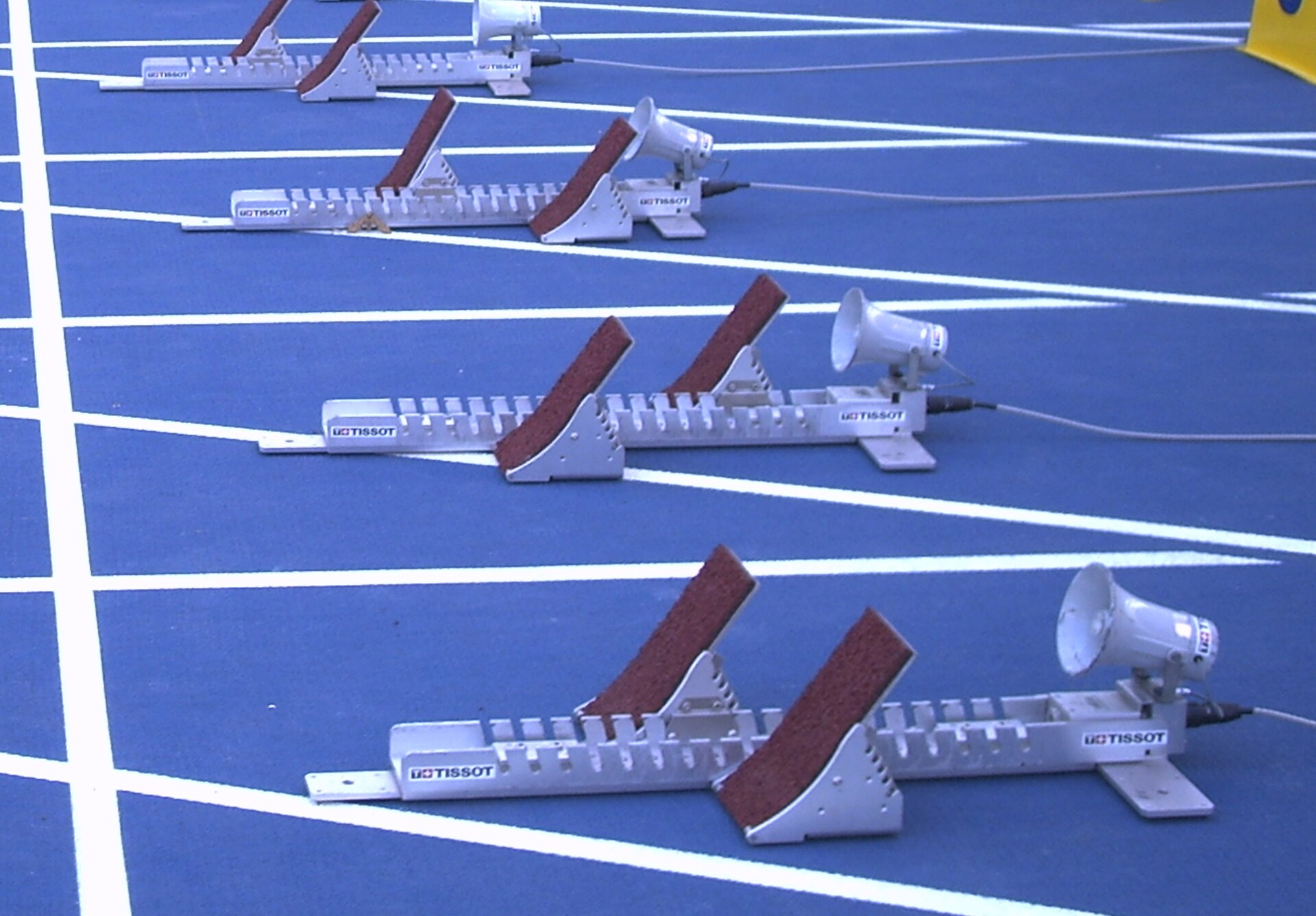
[Starting blocks with pressure sensors sit on the track at the start line.] Photograph: Starting blocks
Image Credits: Wikimedia Commons
A starting block is a device that braces a sprinter's feet at the start of a race. It usually has two angled foot plates mounted on an adjustable frame, one for each foot, fixed to the track.
This article explains why sprinters start from blocks, including how the blocks turn muscle force into forward speed, where they came from, and how modern sensors police the start.
The problem blocks solve
A sprint starts from a standstill. The athlete must overcome inertia and build speed as fast as possible, and the first few steps decide much of the race.
Without a firm surface, a sprinter's feet can slip backward when they push. Early sprinters dug small holes in dirt tracks with trowels to brace their feet, but the holes varied in depth and shape and damaged the track surface.
A block solves that with a fixed, angled plate. The sprinter places each foot against a plate, crouches, and drives forward when the gun sounds, pushing against something that does not move.
The crouched position matters as much as the plate. It lets the sprinter lean forward, keep the body low, and direct force horizontally along the track instead of upward.
Coaches describe the key action as triple extension: the ankle, knee, and hip extend together to produce maximum power from the legs. Blocks let the sprinter reach that position under load before the race even starts.
A short history of the block
Before blocks, sprinters improvised. At the first modern Olympic Games in Athens in 1896, runners chose their own starting style, and on dirt tracks the standard method was to dig starting holes.
The invention of the modern starting block is credited to Australian Charlie Booth and his father in 1929. Wood was the first material, and some tracks even had wooden blocks built permanently into the start line.
Acceptance was slow and contested. When American George Simpson became the first person to run 9.4 seconds for the 100-yard dash in 1930, his record was disallowed because he had used starting blocks.
Britannica records that sprinters began using blocks from a crouched position after 1884 in earlier forms, and that the device was legalised in the 1930s. The governing body, then the International Association of Athletics Federations and now World Athletics, sanctioned blocks in 1937, turning an experimental aid into standard equipment.
By the 1950s and 1960s, blocks were normal at every level of sprinting. Portable metal blocks replaced wooden ones, though early metal designs were heavy and their adjusting screws often broke or rusted.
The 1968 Mexico City Olympics gave blocks their most famous showcase. Jim Hines ran the first officially recognised sub-10-second 100 metres there, from a start that the block made possible.
How a modern block works
A modern block is a light metal frame with two foot plates that slide along a rail. The sprinter adjusts the distance between the plates and their distance from the start line to fit their leg length and preferred posture.
The front plate usually sits closer to the line, and the rear plate further back. Research on block clearance has found that longer spacing between the plates can produce greater push-off velocity, because the push lasts longer, though coaches generally recommend an intermediate spacing for most athletes.
Foot-plate angle matters too. Studies summarised in a peer-reviewed paper on the centre of pressure found that better sprint start performance was linked to a higher and more rearward centre of pressure on the block surface, close to the heel during the middle of the push.
That finding has a plain meaning. The sprinter should press through the whole foot with force directed into the plate, not glance off it, and small changes in plate angle or foot position change how cleanly that force transfers.
At high-level meets, the blocks also carry sensors. Pressure-sensitive plates and loudspeakers behind each lane give every runner the starter's signal at the same instant, and the sensors record exactly when force changes after the gun.
The 0.100-second rule
World Athletics treats any reaction faster than 0.100 seconds as a false start at meets using a certified Start Information System. The reasoning is that the human brain cannot hear the gun and process the signal in less time, so a faster movement counts as anticipation rather than reaction.
The rule is strict. Since 2010, a single false start means immediate disqualification at elite level, replacing earlier systems that warned the whole field or allowed one false start per race.
Famous disqualifications show how harsh the rule feels in practice. Usain Bolt false-started in the 100 metres final at the 2011 World Championships in Daegu and left the track without racing. Zharnel Hughes was disqualified from the 100 metres final at the Tokyo Olympics in 2021 for the same reason.
Block slippage is a recognised exception. If a block slips, officials can recall the race without charging the athlete with a false start, because the equipment, not the athlete, failed.
At lower-level meets without sensor blocks, officials judge false starts by eye. The 0.100-second threshold still guides the idea, but the call rests on what the starter sees.
Which races use blocks
Starting blocks are mandatory at most levels of competition for sprint races. That covers the 100 metres, 200 metres, and 400 metres, plus sprint hurdles and relay legs that start from blocks.
Longer races do not use them. In the 800 metres and above, runners start from a standing position, because the start matters less over a longer distance and a crouched start would waste energy.
Swimming uses a different device with the same name: a low platform that swimmers dive from. The idea is the same, a firm surface to push against, but the design and the rules are entirely separate.
Young athletes usually learn blocks once they start racing sprints seriously. Coaches adjust the plates to the athlete's size and practise the "on your marks" and "set" positions until the start feels automatic.
The start sequence, step by step
The starter gives two commands before the gun. At "on your marks," the sprinter walks to the blocks, places the hands on the track behind the line, and puts the feet on the plates.
At "set," the sprinter raises the hips above shoulder height and holds still. Weight shifts forward onto the hands and feet, muscles preload, and the body becomes a coiled spring aimed down the track.
The gun fires, and the sprinter drives the front leg forward while the rear leg extends. The first steps stay low and short, then lengthen as the body rises gradually into full sprinting posture.
Top sprinters reach maximum speed, above 40 kilometres per hour, at around 55 to 65 metres into a 100 metres race, according to Britannica's summary of sprinting. The start does not decide the whole race, but a poor start can cost a medal in a race decided by hundredths of a second.
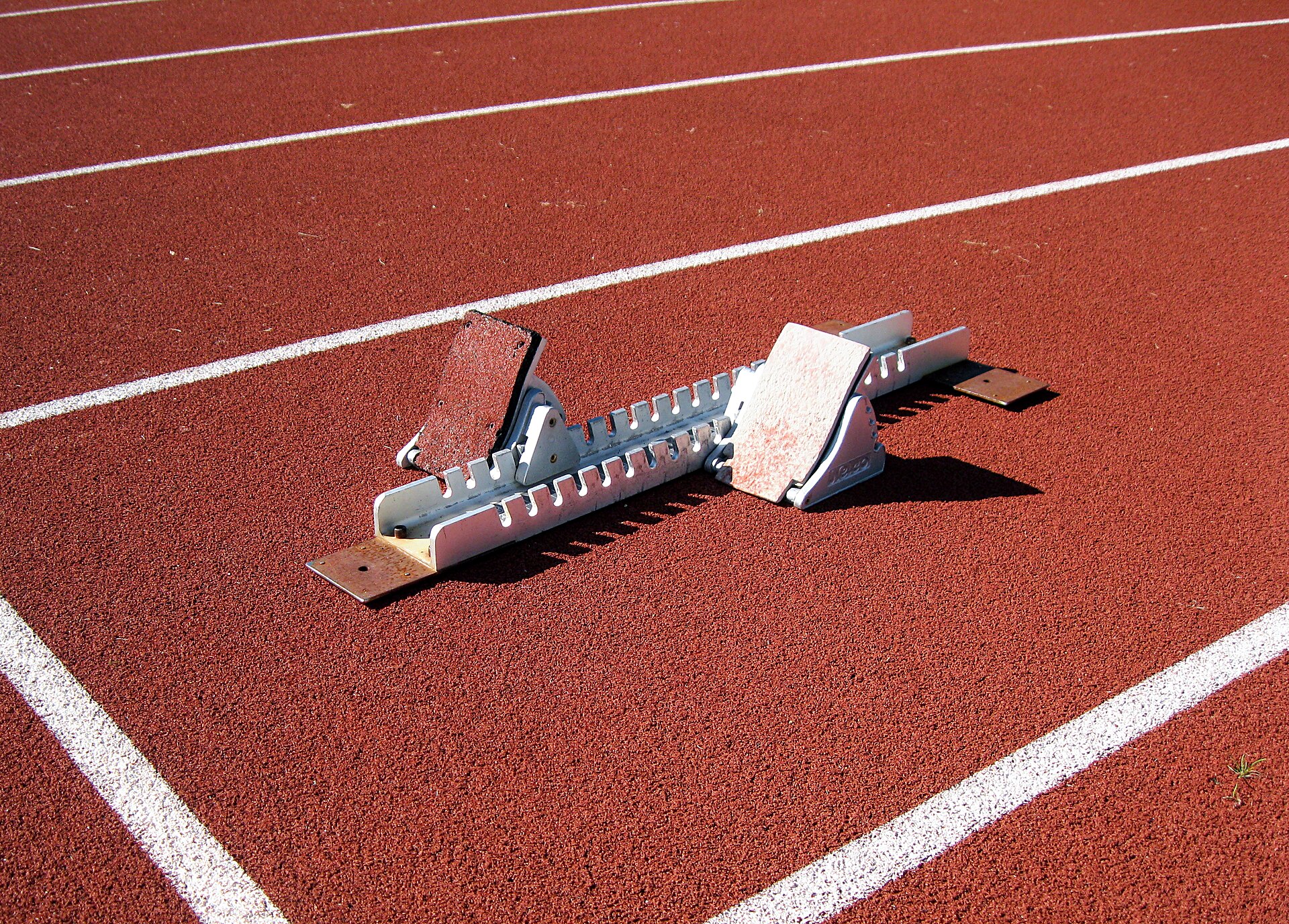
[Starting blocks rest on the track surface at the start line.] Photograph: Starting blocks
Image Credits: Wikimedia Commons
Why not just start standing up
A standing start is simpler, but it wastes the first instants of a sprint. The runner must first shift weight forward and find grip, and the push comes from a flat foot on the ground rather than an angled plate.
The crouched block start preloads the muscles isometrically, meaning the muscles tense without moving, before the gun. That stored tension converts into a more powerful first push.
Blocks also make starts fairer. Every lane has the same equipment, adjusted to the athlete, instead of holes that differ in depth or a surface that varies from lane to lane.
That fairness role grew with the sensors. Blocks now measure reaction time to the thousandth of a second, which no official's eye can match, and they give every athlete the gun sound at the same moment through lane speakers.
Frequently asked questions
Are starting blocks compulsory in sprints?
At most levels of competition, including all high-level international meets, blocks are mandatory equipment for sprint races such as the 100, 200, and 400 metres.
Who invented the starting block?
The modern block is credited to Australian Charlie Booth and his father in 1929, replacing the practice of digging holes in dirt tracks.
What counts as a false start?
Under World Athletics rules at sensor-equipped meets, any reaction faster than 0.100 seconds after the gun counts as a false start and leads to disqualification.
Do blocks help slower runners too?
Yes, in proportion. A firm, angled surface improves the first push for any sprinter, though the gain is largest for athletes trained to use the crouched position well.
The bottom line
Sprinters start from blocks because a firm, angled surface turns leg power into forward speed from a standstill, and because the crouched position preloads the muscles for the first explosive push. The device began as a 1929 wooden invention, survived a fight over legality in the 1930s, and now doubles as a precision sensor that enforces the 0.100-second false-start rule. For a race that can be decided by a hundredth of a second, that combination of power and fairness is why the block never went away.
Tags: sprinting, starting blocks, athletics
Rive News's research desk covers everyday science and sport explainers from published studies and official sources.
Related
- How to choose running shoes for beginners in 2026
- Dynamic vs static stretching before sport explained
- Why do athletes ice bath after training? The evidence explained
Subscribe to Rive News for one plain-English explainer every weekday.
Rive News publishes explainers based on cited public sources; corrections are welcomed and noted on the article.
Related stories

Why Is Altitude Sickness Worse for Some People?
Altitude sickness hits some people harder because of genetics, ascent speed, and prior history, not fitness level. Here is what raises risk
Why Do You Get Blisters When Hiking and How to Prevent Them
Friction plus moisture plus heat equals a blister. Learn why hiking breeds all three, and the boots, socks, and tape system that keeps
How to choose hiking boots for beginners: fit, features, and break-in
Beginners should buy for fit first: snug everywhere, tight nowhere, with a thumb's width at the toes. Here is how to size, test,