
Why Do Planes Leave White Trails Some Days but Not Others
Key takeaways
- Contrails are ice-crystal clouds made when hot, wet engine exhaust mixes with air colder than about -40°C.
- Whether a trail appears at all depends on the temperature and humidity at the plane's exact altitude, which is why two jets in the same sky can look different.
- Dry air erases a trail in seconds; humid air can keep it visible for hours, and the longest-lived ones spread into cirrus-like cloud with a small net warming effect.
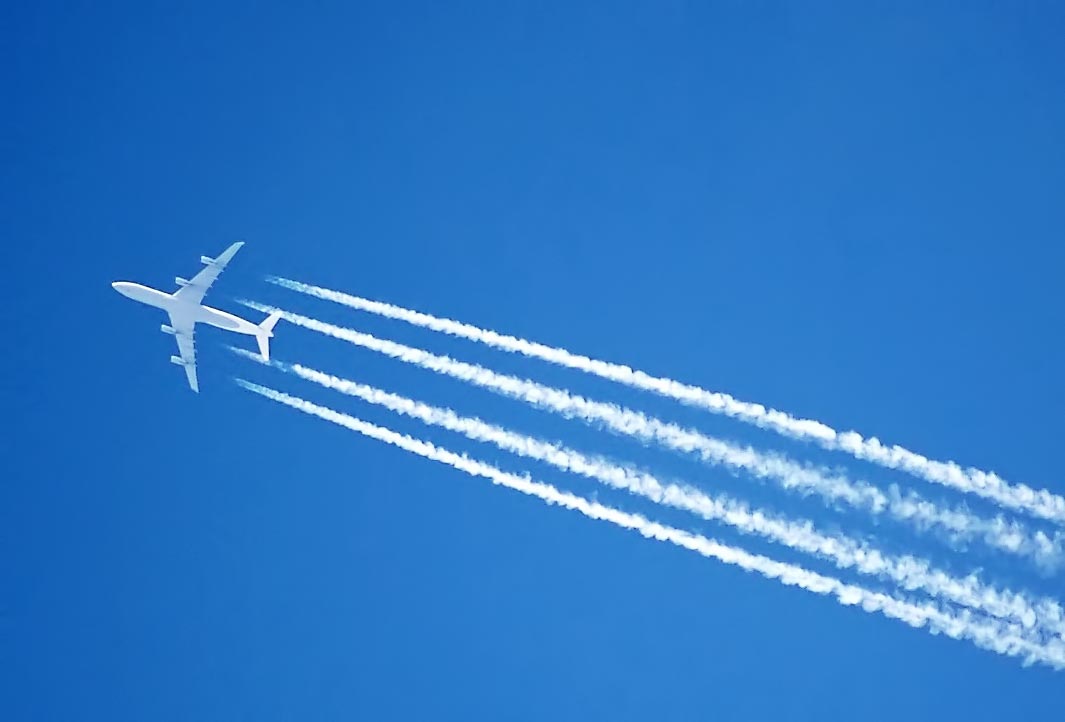
A white trail stretching behind a cruising jet is a familiar sight, and so is the puzzle of it: one plane draws a long chalk line across the sky while another, flying nearby, leaves nothing at all. The trail even changes by the day, with the same flight path producing thick ribbons one morning and a clean blue sky the next.
The short answer is that the white trail, called a contrail, is a small man-made cloud, and clouds need the right weather. A contrail is not smoke, fuel, or anything sprayed from the plane. It forms only when the air at cruising altitude is cold and humid enough to turn the water vapor in the engine exhaust into ice crystals.
This article explains what contrails are made of, why some flights produce them and others do not, why some vanish in seconds while others linger for hours, and what scientists know about their effect on the climate. It also answers the most common questions travelers ask about them.
What a contrail actually is
A contrail is short for "condensation trail," and its recipe is the same as any natural cloud: moisture, cold air, and tiny particles for the water to cling to. The jet engine simply supplies all three at once, as NASA researchers describe it.
Burning jet fuel produces mostly two things. According to the FAA, airplane engine exhaust is about 71 percent carbon dioxide and 28 percent water vapor, with less than 1 percent made up of soot, sulfur oxides, nitrogen oxides, carbon monoxide, and unburned hydrocarbons. That water vapor is the raw material of a contrail.
Leaving the engine, the exhaust is hot and humid.
Within a fraction of a second it mixes with the frigid air at cruising altitude, where temperatures routinely drop below minus 40°C. If that mixture gets cold and wet enough, the vapor condenses onto the soot particles in the exhaust and freezes into ice crystals, as the EPA describes the process.
Billions of those microscopic ice crystals together create the visible white line trailing behind the aircraft.
Turbulence from the exhaust drives the mixing, which is why trails typically appear right behind each engine rather than from the aircraft as a whole.
The physics is governed by a principle called the Schmidt-Appleman criterion, first formulated in the 1940s. It defines the balance between the heat and water the exhaust adds and the temperature and humidity of the surrounding air.
If the criterion is met, generally when the air is colder than roughly minus 40°C, a trail forms. If it is not met, no trail appears, no matter how much exhaust the engine produces.
Why some planes make trails and others do not
The FAA puts it simply: a contrail will not form if the air at the aircraft's altitude is too warm or too dry. Everything else follows from those two conditions.
Temperature explains the big pattern. Air cools with height, so jets cruising in the upper troposphere are the ones that make trails.
Contrails usually form above about 26,000 feet, where the air is colder than roughly -34°F (-36.5°C). That is the same band where most commercial jets cruise, between 30,000 and 40,000 feet.
Crop dusters, firefighting tankers, and most light propeller planes fly in air far too warm for exhaust water to freeze, so they leave no trail.
Humidity explains the day-to-day puzzle. Two planes flying at different altitudes can meet very different temperature and humidity just a few thousand feet apart, so one draws a trail and the other does not.
The same flight path can behave differently on different days as upper-air moisture shifts. Humidity also explains the curious way boarding order and altitude interact with the invisible weather up there: the sky looks uniform from the ground, but it is layered like a cake.
There is one more quirk worth knowing. In very humid conditions near the ground, some aircraft produce wingtip vortices, which look like small spiraling trails behind the wings. Low-flying planes at airshows sometimes generate what look like trails, but those are special effects created by smoke, not contrails.
Why some trails vanish and others linger for hours
How long a contrail lasts depends almost entirely on how much moisture is already in the surrounding air. Scientists sort them into three rough types.
Short-lived trails form in air that is cold but fairly dry. The ice crystals quickly evaporate back into invisible vapor, and the trail vanishes within seconds to a few minutes, often erasing itself just behind the plane. If you have watched a trail seem to delete itself as the aircraft moves forward, this is what was happening.
Persistent trails form when the surrounding air is already nearly saturated with moisture, at or above 100 percent humidity relative to ice. The ice crystals have no reason to evaporate and can even grow by pulling in more moisture from the air. These trails can last several hours or longer as thin white lines.
Persistent spreading trails are the third type. In cold, very humid, turbulent air, the lines widen over time into hazy sheets that look indistinguishable from natural high-altitude cirrus clouds. Research indicates that for a trail to survive more than about 10 minutes and spread into a broader cloud, the surrounding air generally needs to be at or near ice-saturation.
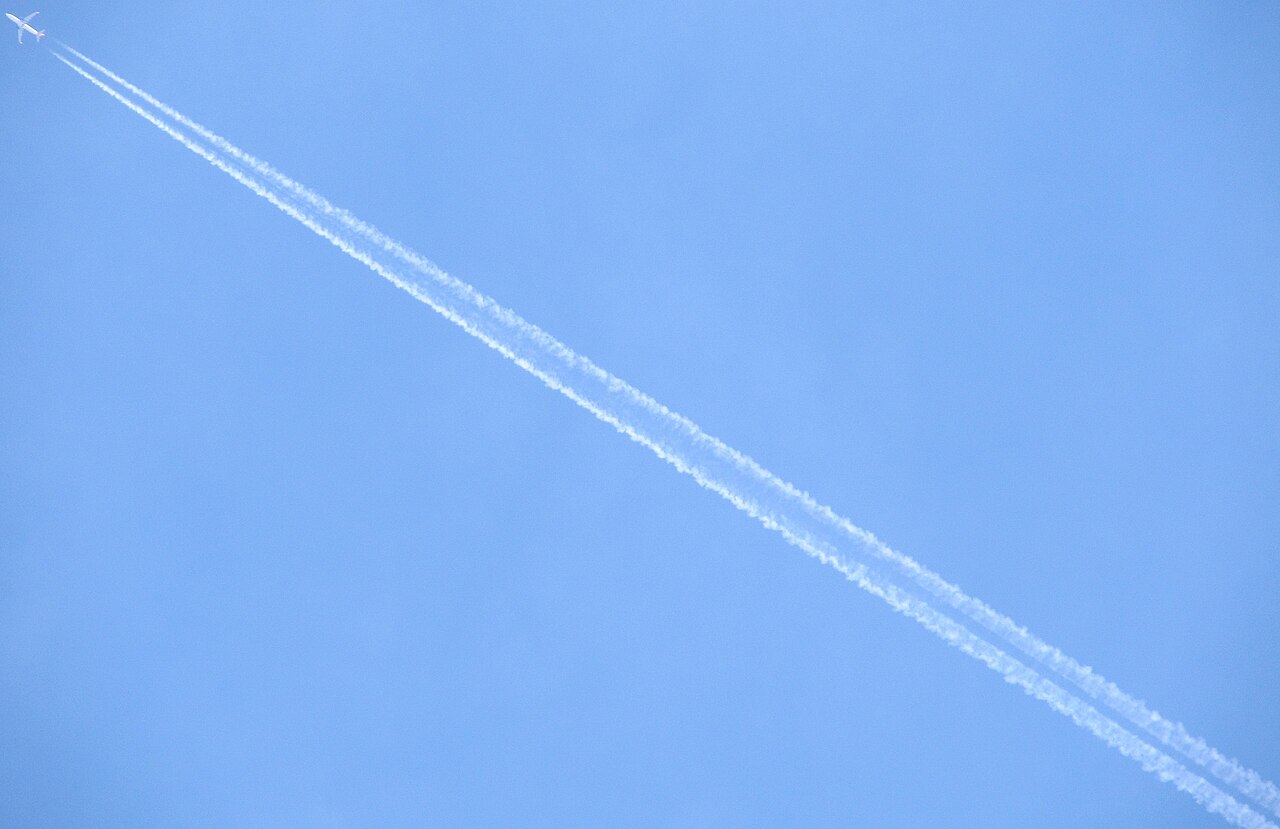
Altitude matters here in a specific way. NASA research has found that between 30,000 and 35,000 feet, the chance of persistent trails increases with altitude.
Above 40,000 feet the trend reverses: the atmosphere becomes so dry that persistent trails grow less common, even though it is colder. The sweet spot for long-lasting trails sits in the middle band, where the air is extremely cold yet still holds enough moisture for ice crystals to survive.
Do contrails affect the climate?
The long-lasting trails are not just a curiosity. When they spread into thin cirrus-like cloud, they trap heat, and by one major estimate they warm the planet more than all the carbon dioxide aviation has ever emitted. That estimate comes with large uncertainties, and NASA scientists frame the effect more cautiously.
More than 90,000 flights cross the globe each day, and NASA researchers Sarah Bedka and Douglas Spangenberg have used satellite data to measure what their trails do. Their finding: contrails have an overall warming effect, acting like a light blanket, because they trap more heat in the atmosphere than they reflect away as sunlight. They also stress that the effect is still small compared with all human-caused climate forcing, "one of the smaller effects, compared to carbon dioxide," as the pair put it in a 2020 NASA feature.
Because the warming comes mostly from the persistent, spreading type, researchers are exploring ways to avoid making them, such as shifting flights a few thousand feet up or down to dodge the humid layers where long-lived trails form. The short-lived kind that fades in seconds has essentially no climate impact.
Frequently asked questions
Are contrails the same as chemtrails?
No. Contrails are well-understood ice-crystal clouds formed from engine exhaust water vapor, documented by agencies including NASA, the FAA, and the EPA. The "chemtrail" idea, that planes secretly spray chemicals, has no supporting evidence and contradicts the measured physics of how trails form and fade with humidity.
Why do contrails sometimes stop and start along the same flight path?
The plane is flying through patches of air with different humidity. Where the air is moist enough, the trail forms; where it is too dry, the exhaust leaves no visible mark. The engines run the same throughout.
Can you predict whether you will see contrails on a given day?
Roughly, yes. Cold, humid upper air favors long trails, which is why crisp winter days often show the most dramatic skies. Aviation weather forecasts include upper-air humidity, and some hobbyist tools map likely contrail zones, though they are approximate.
Do military jets make contrails too?
Any jet flying high enough in cold, humid air makes them, military or civilian. That is also why contrails were first studied seriously during World War II, when high-altitude bomber formations left trails visible for miles.
The bottom line
A plane leaves a white trail when its hot, water-rich exhaust hits air cold enough to freeze that vapor into ice crystals, and the trail's lifespan is set by the humidity around it.
Dry air erases it in seconds; moist air can stretch it across the sky for hours.
The next time one flight draws a line and another does not, the difference is not the planes. It is the invisible weather, thousands of feet above your head.
Image Credits: Wikimedia Commons / Adrian Pingstone (Arpingstone); Raquel Baranow; russavia (Flickr transfer)
Latest in Travel
- Why airport codes look nothing like their city names
- Why you have to put your seat upright for landing
- Why planes fly at 35,000 feet
- Why trains have gaps between the rails
Subscribe for one plain-English science explainer like this every morning.
Related stories

The 3-1-1 liquids rule for planes: what each number means
TSA's 3-1-1 rule limits carry-on liquids to 3.4-ounce containers in one quart bag. Where the 2006 rule came from, what counts, and how
Why Is Airplane Food So Bland at Altitude?
A 2010 Fraunhofer study found altitude cuts sweet and salty perception by up to 30 percent. Low humidity, cabin pressure, and noise all
Carry-on size limits: why airlines each set their own
Airlines set their own carry-on limits because the FAA only requires each carrier to have a policy, not one global size. Why 22 x 14 x