
Why some car headlights look blue on the road
By Rive News / Research desk | Rive News / Published October 28, 2026 at 9:00 AM PKT
Key takeaways
- Blue headlights mostly come from HID xenon or LED lamps rated at 6,000 Kelvin or higher.
- Factory HID lamps are usually near 4,300 Kelvin and look white, not blue; the blue look often means aftermarket bulbs.
- Your eyes also play a part: cooler light looks brighter than warm light at the same output.
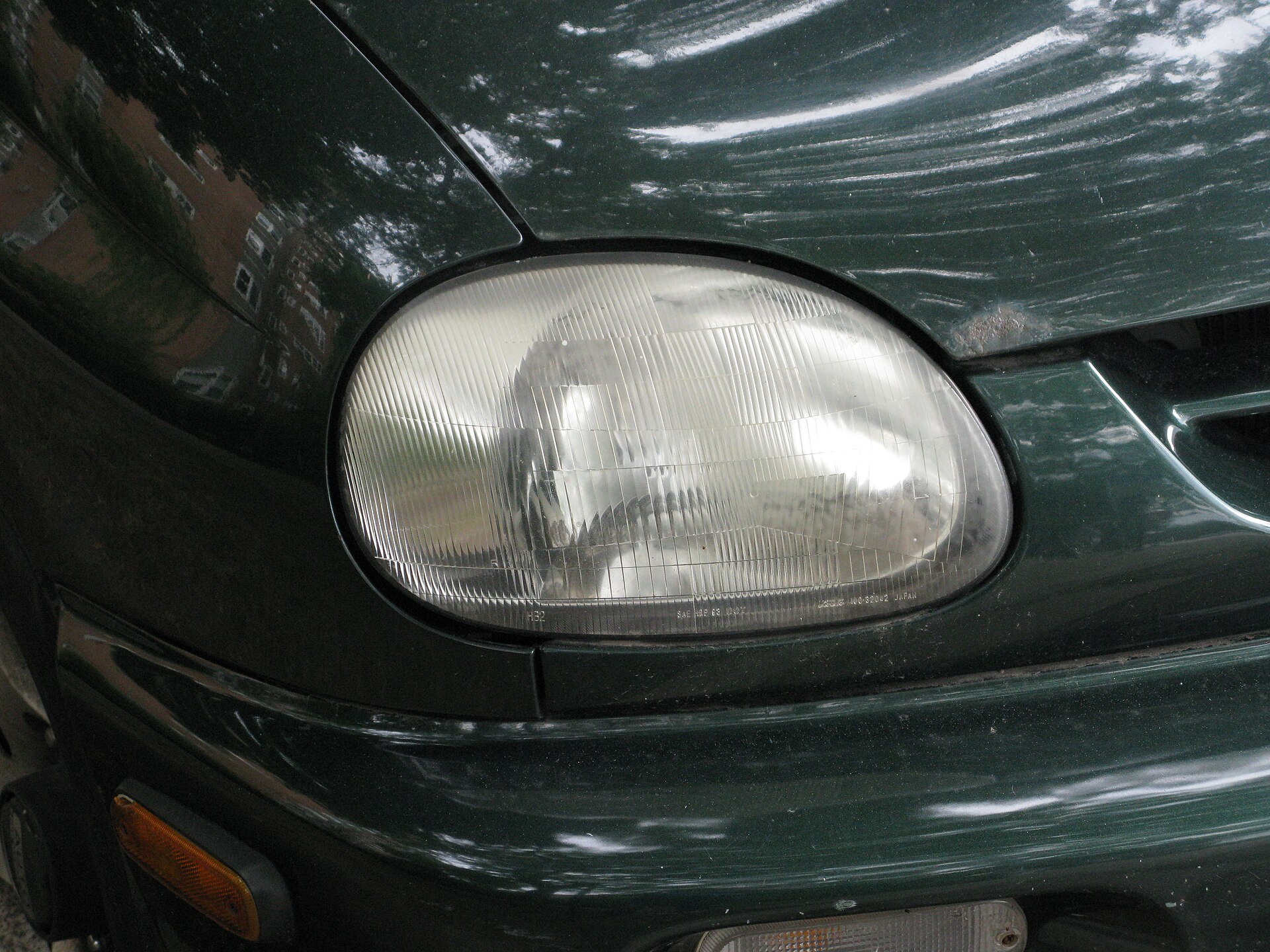
[A close-up of a car headlight unit, showing the lens and reflector assembly.] Photograph: Wesha
Image Credits: Wikimedia Commons
On a dark road, some headlights glow warm yellow while others shine with a cold blue-white edge. The blue ones are not a different colour of bulb paint. They are a different technology, tuned to a different colour temperature, and your eyes exaggerate the effect.
This article explains why some car headlights look blue, including the Kelvin scale, how HID and LED lamps produce their colour, why factory lamps usually look white, and when blue headlights become a problem.
The Kelvin scale in plain terms
Light colour is measured in Kelvin, written as K. The scale describes the colour of light from a heated object, and it runs from warm yellow at low numbers to cool blue at high numbers.
A traditional halogen headlight sits around 3,200 Kelvin and looks warm yellow. An ordinary household incandescent bulb is lower still, around 2,800 Kelvin, according to ORACLE Lighting's HID guide.
Natural sunlight at noon measures about 4,870 Kelvin on that guide's figures, while another specialist chart puts midday sunlight near 5,770 Kelvin. The exact number varies with measurement method, but both place daylight well above halogen yellow.
As the Kelvin rating rises, light shifts from yellow to pure white and then toward blue. Around 5,000 Kelvin the light looks pure white, at 6,000 Kelvin it takes on a noticeable blue tint, and at 8,000 Kelvin and above it looks distinctly ice blue.
Colour temperature is not brightness. Brightness is measured in lumens, and two lamps with the same lumen output can look very different if their Kelvin ratings differ.
How halogen lamps make yellow light
A halogen lamp works like an old-fashioned light bulb. Electricity heats a tungsten filament until it glows, and the hot filament gives off warm, yellowish light.
That warm colour is a property of the filament's temperature. A glowing filament simply cannot reach the colour temperatures of gas-discharge or LED lamps without burning out.
Halogen lamps also draw more power for their output. A typical halogen headlight bulb uses about 55 watts, compared with about 35 watts for an HID lamp, according to ORACLE Lighting.
The result is a familiar warm beam: adequate, cheap, and yellow. When every car used halogen, nobody noticed the colour, because there was nothing cooler to compare it with.
How HID lamps make blue-white light
High-intensity discharge lamps, usually called HID or xenon lamps, work completely differently. They have no filament. Instead, an electrical arc jumps between two electrodes inside a sealed capsule filled with xenon gas and metal salts.
The arc produces an intense light that is naturally much closer to daylight than a filament can manage. Factory HID lamps are commonly rated around 4,300 Kelvin, which looks warm white with only a slight cool edge.
Aftermarket HID bulbs often aim higher, commonly 6,000 Kelvin, which produces a noticeably cooler, bluish-white light. Some go to 8,000 Kelvin or beyond, where the blue becomes the point rather than a side effect.
There is a trade-off hidden in that choice. Above about 6,000 Kelvin, lamps trade usable brightness for colour, because more of their energy shifts toward the blue and ultraviolet end of the spectrum where human eyes are less sensitive. A 10,000 Kelvin bulb looks very blue but lights the road worse than a 5,000 Kelvin lamp.
Where LED lamps fit in
LED headlights use semiconductor chips that emit light at engineered wavelengths, which gives designers precise control over colour temperature. Modern LED systems commonly sit in the 5,000 to 6,000 Kelvin range, producing the crisp cool white that many drivers read as blue.
That cool white is partly a styling choice. Car makers know that cool-white light reads as modern and premium, and LED technology lets them hit that look exactly, car after car.
LED lamps also produce more light per watt than halogen, so the beam is both cooler and stronger. The combination of a cooler colour and a stronger beam is what makes modern headlights stand out so sharply against older yellow ones.
Laser headlights, fitted to a small number of premium cars, push the same logic further, using laser-excited phosphor to produce an intense white beam for high-beam use.
Why your eyes exaggerate the blue
The blue look is not only about the lamp. Human vision plays a real part in it, and it explains why blue headlights seem brighter than they measure.
In a test reported by ABC3340 and cited by MotorBiscuit, two cars were parked side by side, one with LED headlights and one with halogen. Both sets of headlights produced identical lumen output.
Onlookers still reported the LED car as brighter. The reason, according to lighting specialists cited in the report, is that cooler-toned blue light looks brighter than warmer light at the same output, partly because of how the eye's colour-sensitive cells respond.
Blue light also scatters more inside the eye than yellow light, because its wavelength is shorter. That scatter creates a halo around the lamp, which reads as glare even when the measured brightness is not extreme.
Viewing angle adds another twist. A lamp that looks pure white from the driver's seat can show a blue fringe when seen from the side, because projector lenses split the light slightly at their edges. Oncoming drivers see that fringe more than the driver does.
[A road sign on a dark highway is picked out by the beam of passing headlights at night.] Photograph: Daniel Schwen
Image Credits: Wikimedia Commons
Factory white versus aftermarket blue
Most of the strikingly blue headlights on the road are not factory equipment. Factory lamps are tuned near the daylight range, around 4,300 to 5,000 Kelvin, because that range gives the best usable visibility.
Deeply blue lamps usually mean one of three things: aftermarket bulbs rated at 8,000 Kelvin or higher, cheap LED conversions fitted into housings designed for halogen, or worn projector lenses scattering the beam.
Road legality varies by country, but most regulations require headlights to be white or selective yellow, and deeply blue lamps can fail inspections or attract fines. A lamp that looks blue to other drivers is often already outside the legal colour range.
If your own headlights look bluer than they used to, check for condensation or clouding in the lens first. Both scatter light and shift its apparent colour, and both are cheaper to fix than a bulb change.
Are blue headlights brighter than yellow ones?
Not necessarily. Two lamps can share the same lumen output while the cooler one looks brighter, because human eyes perceive blue-toned light as brighter than warm light.
What Kelvin rating looks blue?
Around 6,000 Kelvin produces a blue-tinted white, and 8,000 Kelvin and above looks distinctly ice blue. Factory lamps usually sit near 4,300 to 5,000 Kelvin and look white.
Are blue headlights legal?
Rules vary by country, but most require white or selective yellow headlights. Deeply blue lamps often fall outside the legal range and can fail inspections.
Do HID headlights last longer than halogen?
Yes, typically. HID lamps have no filament to burn out, and they draw about 35 watts compared with about 55 watts for a halogen bulb.
Why do some LED headlights look blue only from the side?
Projector lenses can split light slightly at their edges, producing a blue fringe visible from an angle. The driver, looking straight through the beam, usually sees white.
The bottom line
Some car headlights look blue because HID and LED lamps run at higher Kelvin ratings than old halogen filaments, and aftermarket bulbs push that rating further into the blue range than factory lamps ever do. Your eyes finish the job, perceiving cooler light as brighter and scattering its short wavelengths into glare. A white beam near daylight colour lights the road best, while a deeply blue beam mostly advertises itself.
Tags: car headlights, HID headlights, LED headlights, colour temperature
Rive News's research desk writes evidence-based explainers on motoring and study science, drawing on published research and public sources.
Related
- How to clean car headlights that have gone cloudy
- Why headlights dim when you start your car
- Why do headlights dim when you use power windows?
- 12V battery in an electric car: what it powers
Subscribe to the Rive News newsletter for one explainer each week.
Rive News publishes general educational explainers based on public sources; claims are attributed in the text.
Related stories

Why Does Tire Pressure Drop in Cold Weather?
Cold weather can cut tire pressure by 1 psi for every 10°F drop, thanks to the ideal gas law. Here is what happens inside the tire and what

Why Do Brake Rotors Warp, or Do They Actually?
Mechanics rarely see a truly warped rotor. The shudder usually comes from uneven pad deposits a few thousandths of an inch thick. Here

How to Buy a Used Car Without Getting Scammed: The Checklist
Over 450,000 cars a year have rolled-back odometers, NHTSA says. This checklist covers VIN checks, title washing, and the inspection that