
Why tires lose pressure when it gets cold
By Rive News / Research desk | Rive News / Published October 25, 2026 at 9:00 AM PKT
Key takeaways
- Tire pressure falls about 1 PSI for every 10 degrees Fahrenheit the temperature drops, because cold air molecules move more slowly and push less hard on the tire walls.
- No air has escaped in a pure temperature drop, so the pressure comes back when the tire warms up.
- Check pressure when tires are cold and inflate to the vehicle placard number, not the maximum printed on the sidewall.
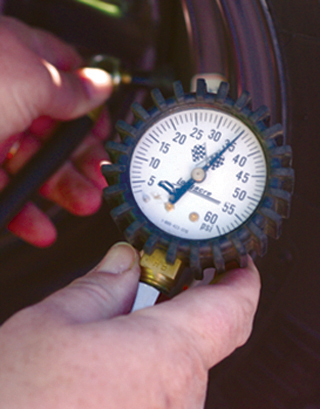
A service member checks tire pressure with a gauge. Photograph: Airman Frank Snider of the US Air Force
Image Credits: Wikimedia Commons
Tire pressure is the force of the air inside the tire pushing outward against the rubber. When the temperature falls, that air loses energy, its molecules slow down, and they strike the inner walls less often and with less force. The gauge reads a lower number even though the same amount of air is still inside.
This article explains why tires lose pressure when it gets cold, including the gas law behind the drop, why the dashboard warning light often clears after driving, and how to tell a temperature drop apart from a slow leak.
How cold air lowers tire pressure
The relationship comes from the ideal gas law, usually written as PV = nRT. In plain terms, the pressure of a gas rises and falls with its absolute temperature when the volume stays roughly the same. A tire is stiff enough that its volume barely changes, so a temperature fall shows up almost entirely as a pressure fall.
The rule of thumb used across the tire industry is about 1 PSI lost for every 10 degrees Fahrenheit (about 5.6 degrees Celsius) of temperature drop. The Traffic Safety Resource Center notes that this rule is cited by Tire Rack, Michelin, Goodyear, NHTSA, and the US Tire Manufacturers Association. It is a rule of thumb, not an exact law for every tire, because real tires flex slightly and real air contains moisture.
A concrete example makes the size of the effect clear. Tires set to 35 PSI on a 70 degree Fahrenheit autumn afternoon can read around 30 PSI after an overnight low of 20 degrees. That 5 PSI loss happens before the car moves at all.
On a larger swing, from 60 degrees down to 10 degrees, the drop can reach 5 PSI or more from temperature alone.
Why the TPMS light comes on in the morning
Most cars carry a tire pressure monitoring system, or TPMS, that warns when a tire falls well below its recommended pressure. Under the federal standard cited in tire guidance, the warning typically triggers when pressure falls about 25 percent below the vehicle placard value. A tire already sitting a few PSI low in autumn can cross that line on the first genuinely cold night.
Driving warms the tires back up. Friction with the road and flexing of the rubber can raise tire temperature by 40 to 60 degrees Fahrenheit, according to the Traffic Safety Resource Center. As the air inside warms, it expands and the pressure reading climbs again.
That is why the warning light often switches off partway through a morning commute.
The light going off does not mean the tires were correctly inflated. It means they warmed enough to climb back above the warning threshold. Once the car sits overnight and the tires cool again, the pressure will fall back to the same low reading.
The only fix is to add air to the placard pressure while the tires are cold.
Temperature drop or slow leak: how to tell
A temperature drop affects all four tires in a similar way. If all four readings fall by a similar amount after a cold night, physics is the likely explanation. If one tire falls much further than the others, or keeps falling after you top it up, suspect a leak.
Cold can also expose a leak that was too slow to notice in warm weather. Rubber stiffens in the cold, and a seal around the valve or the bead where the tire meets the wheel may let a little more air past. The Motoring Chronicle notes that stiffening rubber can make minor leaks more apparent in winter, even when the leak itself is not new.
A tire that needs air every few days has a problem that temperature alone cannot explain.
The practical test is simple. Inflate all four tires to the placard pressure on a cold morning. Recheck them the next cold morning before driving.
Tires that hold their pressure have passed. A tire that has lost pressure again, while the others held steady, needs a closer look at a tire shop.
How to check and inflate correctly
Check pressure at least once a month, and after any temperature swing of about 20 degrees Fahrenheit. Guidance from AAA, NHTSA, and tire makers converges on that monthly habit, according to the Traffic Safety Resource Center. Winter is the season when the habit matters most, because swings are larger and more frequent.
Check when the tires are cold. That means the car has been parked for at least three hours or driven less than a mile. A warm tire reads higher than a cold one, and inflating to the placard number on a warm tire leaves it underinflated once it cools.
Use a reliable digital or dial gauge rather than guessing from the look of the tire, since a tire can be several PSI low and still look normal.
Inflate to the vehicle placard pressure. The placard sits on the driver's door jamb or inside the fuel filler door, and the owner's manual lists the same number. Do not use the maximum pressure printed on the tire sidewall.
That number is the tire's rated maximum, not the pressure your car was designed to run on.
Some shops and tire guides suggest adding 3 to 4 PSI above the placard in extreme cold, then returning to normal in spring. That advice appears in the Traffic Safety Resource Center's cold-weather tips, attributed to Tire Rack. Treat it as optional.
The core habit, monthly cold checks at placard pressure, covers most drivers.
What underinflation costs you
An underinflated tire flexes more as it rolls, and that extra flexing builds heat inside the rubber. Over time the heat and flex wear the tire unevenly and shorten its life. Handling also changes: steering response gets softer, braking distances grow, and the tire's grip on wet or icy roads falls.
Fuel economy suffers too. A soft tire has higher rolling resistance, so the engine works harder to keep the car moving. The US Department of Energy has linked underinflation to higher fuel consumption, a point the Traffic Safety Resource Center cites alongside its winter guidance.
None of this requires a dramatic pressure loss. A few PSI below placard, sustained for months, is enough to cost money and tread.
Winter tires deserve a separate note. Dedicated winter tires outperform all-season tires below about 45 degrees Fahrenheit even when both are inflated correctly, according to Consumer Reports as cited by the Traffic Safety Resource Center. Pressure still matters on winter tires.
The softer compound helps grip, but it cannot compensate for a tire running well below its placard pressure.
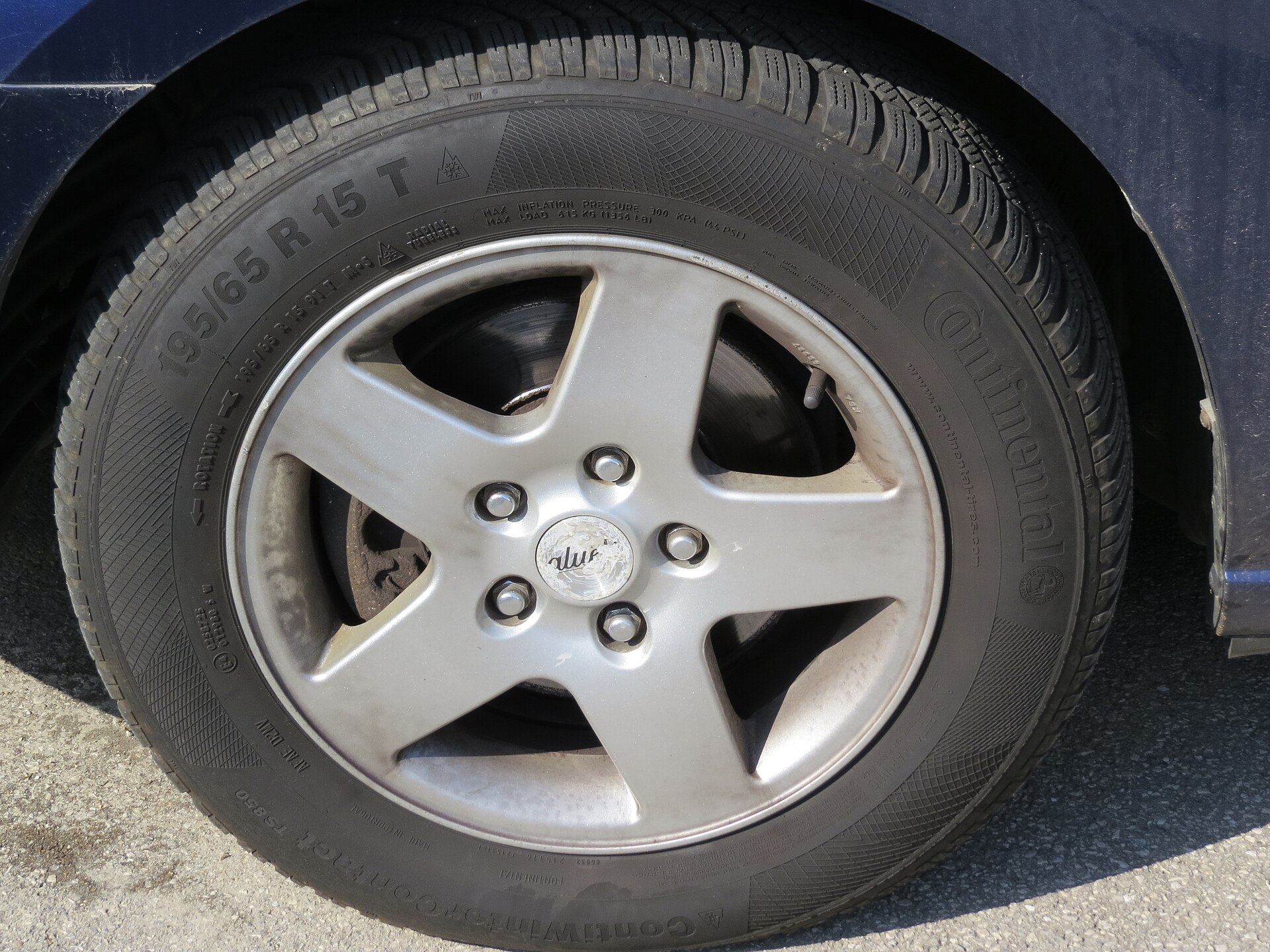
A winter tire, built for grip below freezing. Photograph: GT1976
Image Credits: Wikimedia Commons
Nitrogen: does it help?
Regular air is already about 78 percent nitrogen. Pure nitrogen filling is sold on the claim that it leaks more slowly and swings less with temperature. The Traffic Safety Resource Center cites Goodyear for a reduction in temperature swings of roughly 30 to 40 percent with nitrogen.
That is a real but modest effect.
For most drivers, regular air plus monthly checks beats nitrogen plus neglect. Nitrogen does not remove the need to check pressure, because even nitrogen-filled tires lose pressure over time and still respond to temperature. If your shop offers nitrogen free, take it.
Do not pay a premium for it and then skip the gauge.
Why does tire pressure drop overnight but not during the day?
Overnight lows are the coldest part of the day, and a parked car sits for hours at that temperature. Daytime sun and driving warm the tires, pushing pressure back up. The overnight reading is the honest one, which is why morning checks before driving give the most useful number.
Should I overinflate my tires before a cold snap?
A small margin above placard, around 3 to 4 PSI in extreme cold, is suggested by some tire guides. Do not go far beyond that. Overinflation shrinks the contact patch, wears the center of the tread faster, and gives a harsher ride.
Placard pressure, checked cold, is the safe default.
Why do all four tires drop but only one warning light shows?
TPMS warns per tire, and tires rarely sit at identical pressures. The tire that was already lowest crosses the warning threshold first. The others may be low too without tripping the light yet.
Check all four when any warning appears.
Does cold weather damage the tire itself?
Cold alone does not ruin a healthy tire, but it makes rubber stiffer and less forgiving of existing damage. Cracks, old valves, and bead corrosion show up faster in winter. A tire that loses pressure repeatedly in cold weather deserves an inspection, not just another top-up.
The bottom line
Cold weather lowers tire pressure because cold air pushes less hard on the inside of the tire, not because air has leaked out. Expect roughly 1 PSI of loss per 10 degrees Fahrenheit of temperature drop, check pressure cold at least once a month, and inflate to the placard number on the door jamb. When one tire falls faster than the rest or keeps losing air after a top-up, that is a leak, and it needs a shop rather than a gauge.
Tags: tire pressure, cold weather driving, TPMS
Rive News's research desk covers practical explainers across cars, work, study, fitness, and home, drawing on public sources and industry guidance.
Related
- Why tire pressure falls as temperatures drop
- How to keep a car battery alive through winter
- Why electric cars lose range in winter
- How to make tires last longer with simple care
Subscribe for one practical explainer each week, drawn from real sources and written in plain language.
Rive News publishes explainers based on public sources. Corrections are noted on the article when verified.
Related stories
Why Does Tire Pressure Drop in Cold Weather?
Cold weather can cut tire pressure by 1 psi for every 10°F drop, thanks to the ideal gas law. Here is what happens inside the tire and what
Why Do Brake Rotors Warp, or Do They Actually?
Mechanics rarely see a truly warped rotor. The shudder usually comes from uneven pad deposits a few thousandths of an inch thick. Here

How to Buy a Used Car Without Getting Scammed: The Checklist
Over 450,000 cars a year have rolled-back odometers, NHTSA says. This checklist covers VIN checks, title washing, and the inspection that