
How to keep your car battery from dying this winter
By Rive News / Research desk | Rive News / Published October 24, 2026 at 9:00 AM PKT
Key takeaways
- Cold cuts battery strength by about 35% at 32°F and 60% at 0°F, per AAA figures.
- Test the battery in the fall and replace it at 3-5 years old, before the first freeze.
- Clean terminals, full charges, and the right cold cranking amps rating keep starts reliable.
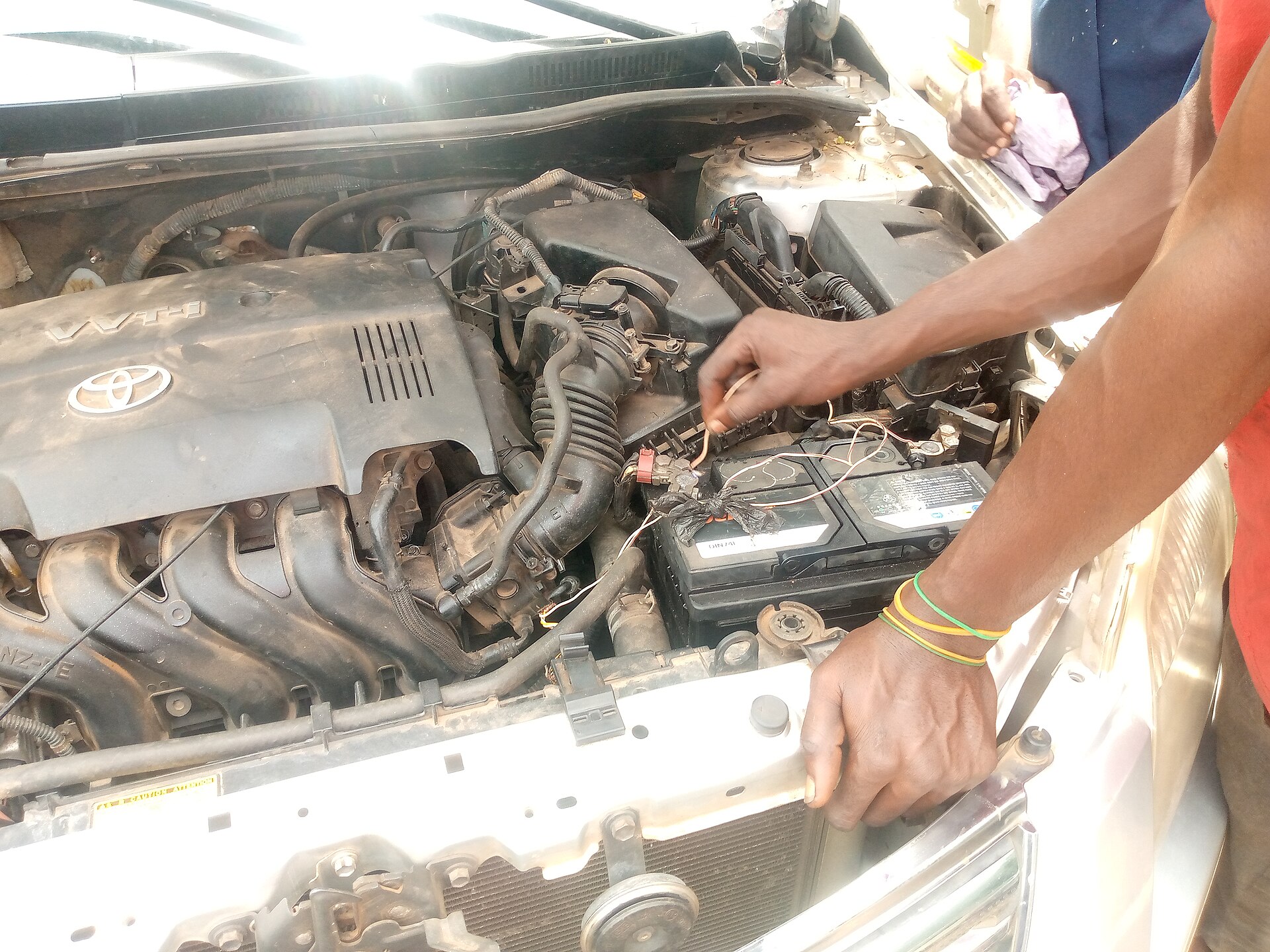
[A car battery with its terminals and cables visible in an engine bay. Photograph: Azorbli]
Image Credits: Wikimedia Commons
A car battery dying in winter is not bad luck. It is chemistry losing a fight against physics. Cold slows the chemical reactions inside a lead-acid battery, so it delivers less power at exactly the moment the engine demands more: cold oil is thicker, and the starter motor has to work harder to turn it over.
The fix is not one trick but a short system: test the battery before the season, understand what cold cranking amps mean, fix the short-trip problem that slowly drains the charge, clean the terminals, and keep the battery charged through the coldest months. This article explains why cold hits batteries so hard, how short trips drain what little charge remains, why clean and tight terminals matter, how to check the CCA rating and battery age, and which winter charging options actually work.
Why cold hits batteries so hard
Two things happen at once on a cold morning. The battery delivers less, and the engine asks for more.
AAA puts numbers on the first half: a battery loses about 35% of its strength at 32°F (0°C) and about 60% at 0°F (-18°C), according to AAA figures reported by Vigiroad. On the demand side, AAA notes a car may need up to twice the normal current to start when temperatures drop, because cold oil resists the starter.
A low charge makes everything worse. Interstate Batteries explains that a fully charged battery will not freeze until it gets far below zero, but a discharged one can freeze at about 15°F (-9°C). A frozen battery can suffer permanent internal damage.
Battery Tender gives even sharper thresholds: a battery at 50% charge can begin freezing at 10°F (-12°C), and a fully discharged battery may freeze at 32°F (0°C). Keeping the battery charged is therefore the single most important winter defense. It matters more than any accessory or additive.
Batteries also age out quietly. AAA puts average battery life at three to five years.
Consumer Reports, citing AAA data, reports that batteries last 58 months or more in the coldest northern parts of the United States but fewer than 41 months in the hottest southern regions. If your battery is approaching that window, test it in the fall, not in January.
How short trips drain what little charge remains
Starting the engine is the most expensive thing a battery does. The alternator repays that energy while you drive, but the repayment takes time.
Short hops to the store and back, with the heater, defroster, headlights, and seat warmers all drawing power, often end the trip with the battery poorer than when it started. Repeat that pattern for weeks and the charge ratchets downward.
This is why the cars that die first in winter are often the ones driven least and shortest. The owner of a commuter car with a 30-minute highway drive rarely has battery trouble; the owner who moves the car around the block does. Vigiroad flags short trips and small parasitic drains as the combination that pushes an already weakened battery over the edge.
The practical fix depends on the pattern. If the car sits for days, a smart maintainer (often called a battery tender) compensates for self-discharge.
Battery tenders deliver a small, continuous current, typically 1 to 2 amps, that holds the battery at full charge without overcharging, according to winter-storage guidance. If the car is driven daily but only in short bursts, take it for one longer run each week so the alternator can finish the recharge, and keep electrical loads off during the first minutes after startup when possible.
Clean terminals and tight connections matter more than you think
Corrosion on battery terminals is a resistor in series with everything. The white or green crust that builds up around the posts reduces the voltage that reaches the starter, and in cold weather the battery has no spare voltage to waste. Loose cable clamps do the same thing by a different route: they starve the starter of current and starve the battery of recharge.
Cleaning is straightforward and cheap. Disconnect the negative cable first, then the positive.
Scrub the posts and the inside of the clamps with a wire brush or a dedicated terminal-cleaning tool until bare metal shows, wipe away the residue, reconnect positive first, then negative, and tighten firmly. A thin coat of dielectric grease or a terminal protector spray slows the corrosion from returning.
Check the whole cable while you are there. Cracked insulation, swollen sections, or green crust creeping under the insulation all mean the cable is failing from the inside. A battery that tests fine can still refuse to start if the cable cannot carry the current, and a car that hesitates when accelerating from a stop can trace to similar electrical gremlins elsewhere in the system.
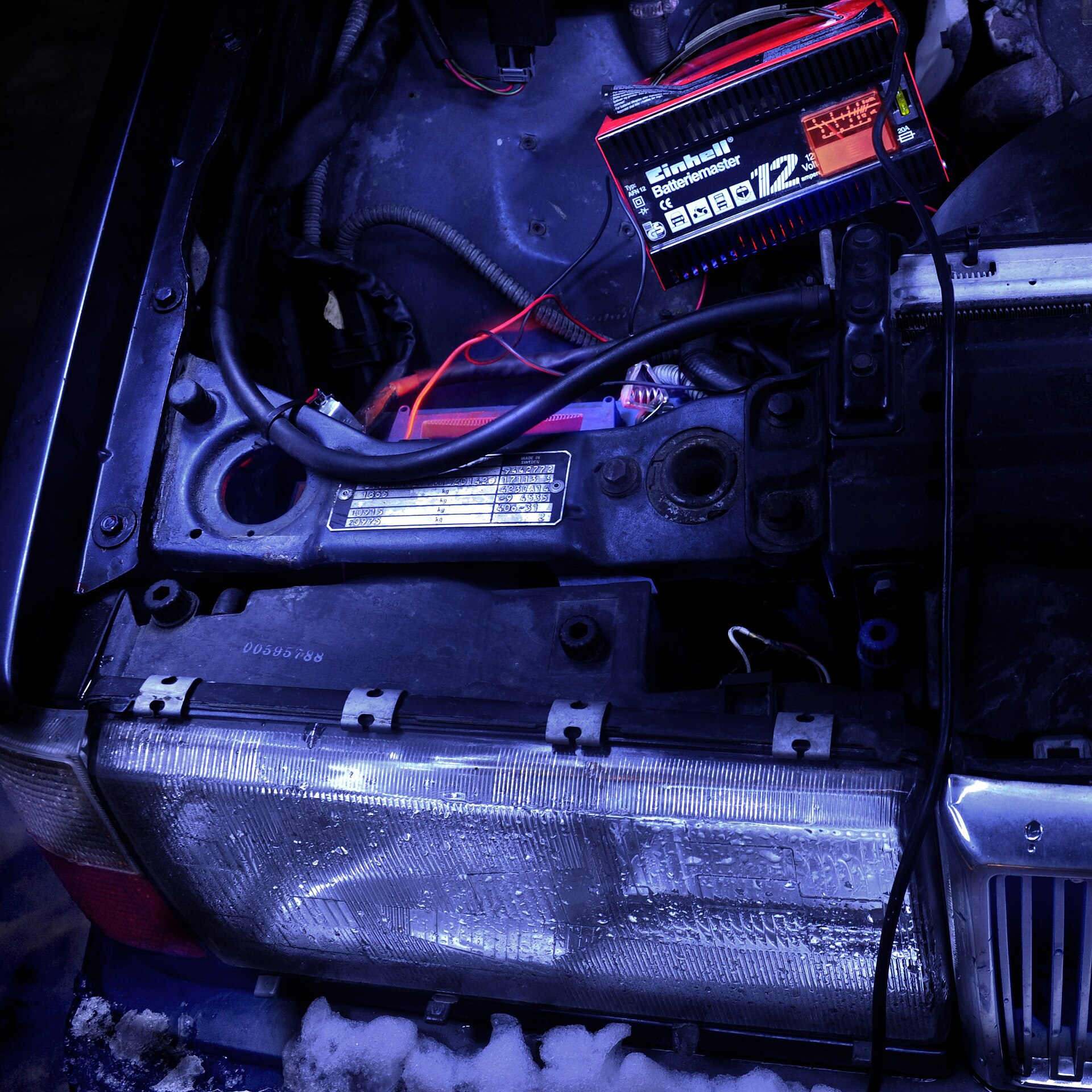
[A battery charger connected to a car battery for maintenance charging. Photograph: Tatu Kosonen]
Image Credits: Wikimedia Commons
Check the CCA rating and the battery's age
Cold cranking amps is the rating that matters in winter. The test is standardized: a new, fully charged battery is chilled to 0°F (-18°C), and its CCA is the current it can deliver for 30 seconds while staying at or above 7.2 volts, according to OPTIMA Batteries' explanation of the test. Match or beat the CCA your vehicle maker specifies, which you will find in the owner's manual or on the old battery's label.
Typical bands give a rough map. Mid-size sedans commonly sit at 550 to 750 CCA; full-size trucks and SUVs at 650 to 850; diesels at 850 to 1000 or more, because diesels need roughly 30% more starting power, per Battery Tender's guide. One rule of thumb from battery makers: about 1 CCA per cubic inch of gasoline-engine displacement, double that for diesels.
Bigger is not always better. OPTIMA notes that a large surplus, such as an extra 300 CCA over the specification, is usually unnecessary.
The spec is the spec; the age of the battery matters more than oversizing it. And remember the lifespan numbers: at three to five years, with a hard winter ahead, replacement is maintenance, not defeat.
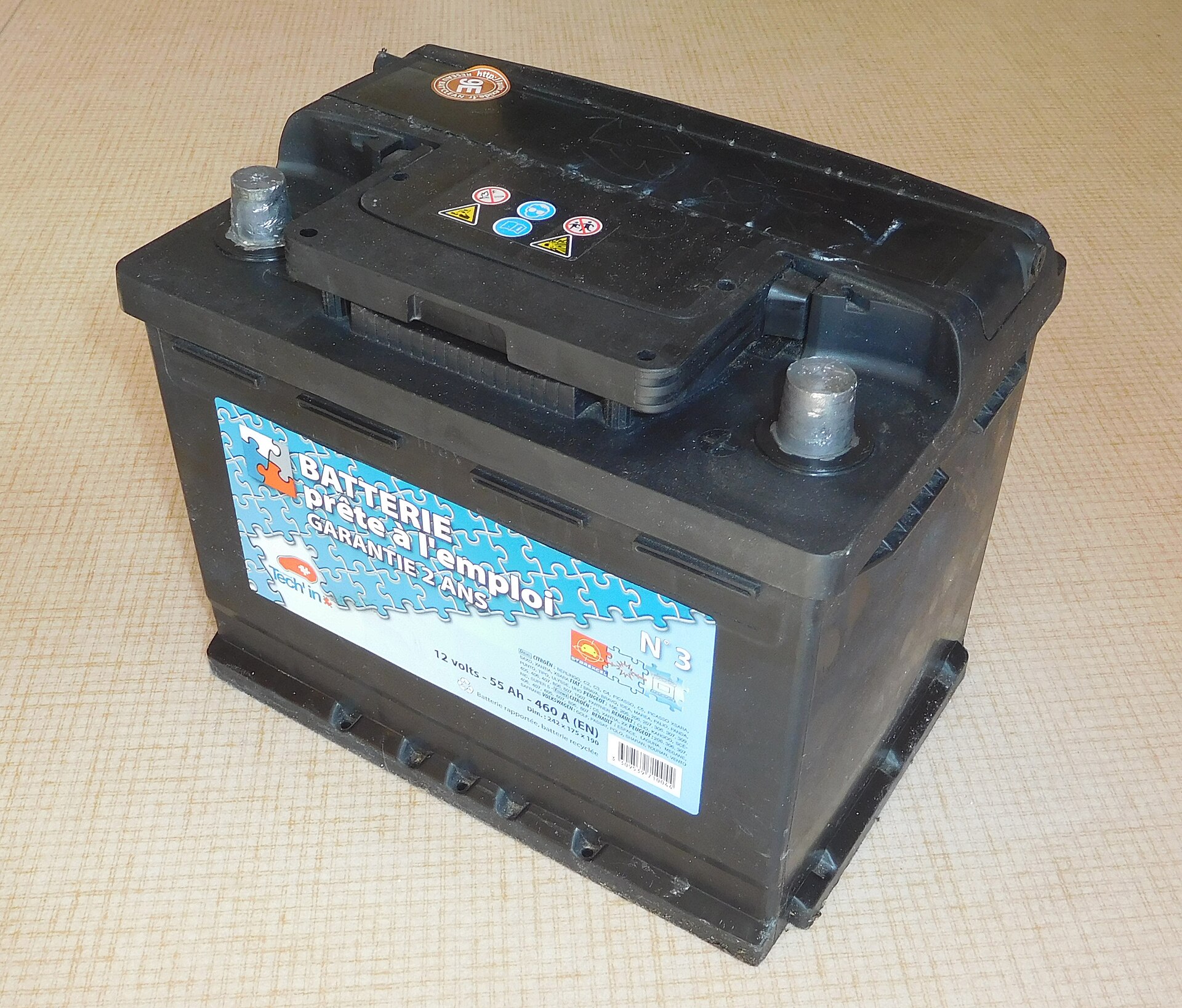
[A lead-acid automotive battery showing its label and terminal posts. Photograph: Cjp24]
Image Credits: Wikimedia Commons
Winter charging options that actually work
When driving patterns cannot keep up, charge the battery deliberately. Three options cover most situations.
A smart maintainer for parked cars. The tender-style maintainer is the right tool for a car that sits for days or weeks. It watches the voltage and tops up as needed, which prevents the slow self-discharge that leaves a battery vulnerable to freezing. Battery Tender's winter guidance treats maintainers as the standard defense for seasonal and infrequently used vehicles.
A full charger for a drained battery. If the battery is already flat, a maintainer may be too slow or may refuse to start on a deeply discharged unit. A proper charger brings it back in hours. Note that a battery that has been frozen, or one that will not hold a charge after a full cycle, is done; charging cannot reverse internal damage.
The alternator, given time. For a daily driver, the alternator is the charger. The catch is that it needs sustained driving, not idling. Idling recharges very slowly and burns fuel for little gain.
A weekly longer drive at road speed does more for the battery than a few minutes of warm-up idling every morning. (The reasons EVs lose range in winter are different in chemistry but identical in lesson: cold punishes every energy store.)
Vehicles with start-stop systems deserve a note. They need enhanced flooded (EFB) or absorbed glass mat (AGM) batteries built for frequent restarts, and winter makes their job harder: each restart in the cold demands substantial cranking amperage while the heater and defroster draw heavily. If your car has start-stop, do not downgrade the battery type when replacing it.
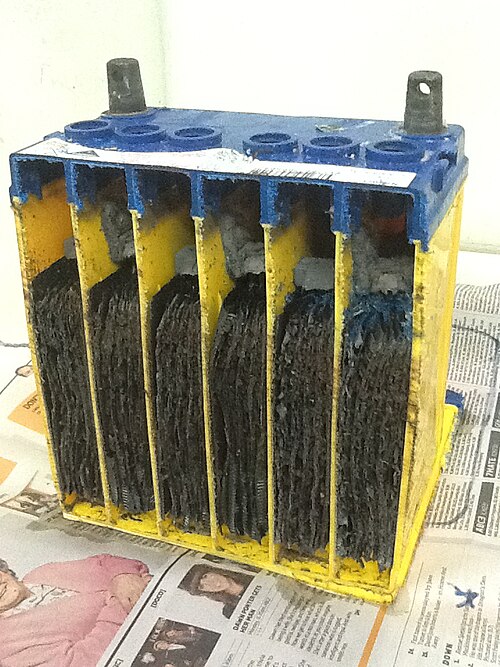
[A cutaway view of a car battery showing its internal plate construction. Photograph: a cutaway view of a car battery]
Image Credits: Wikimedia Commons
Frequently asked questions
Should I disconnect the battery in winter?
Only if the car will sit unused for months and you cannot use a maintainer. A disconnected battery self-discharges slowly and may still freeze if the charge drops. For a car in regular use, leave it connected and keep it charged instead.
Does a battery warmer or blanket help?
It helps at the extremes. A warmer keeps the battery closer to the temperature where its chemistry works best, which preserves cranking power on sub-zero mornings. It is a supplement to a healthy, charged battery, not a rescue for a dying one.
Can I jump-start a frozen battery?
Do not try. A frozen battery can crack, leak, or burst when current is forced through it, and the acid inside is dangerous.
If you suspect the battery froze, replace it. The 15°F freezing threshold for a discharged battery from Interstate Batteries is the reason this happens more often than people expect.
How do I know the battery is the problem and not the starter?
A battery issue usually shows as slow cranking that gets worse in the cold, or a click with no turn-over. If the engine cranks strongly but will not catch, or if the check engine light comes on and off by itself, the problem likely sits elsewhere. A free load test at an auto parts store settles the question in minutes.
Is a higher CCA battery worth the money?
Up to the vehicle maker's specification, yes. Beyond it, the returns flatten fast. Money is better spent on a fresh battery of the correct spec and a maintainer than on the biggest CCA number on the shelf.
The bottom line
Winter does not kill batteries so much as expose them. Cold halves the available power, thick oil doubles the demand, and short trips quietly drain the reserves.
Test the battery in the fall, clean the terminals, match the maker's CCA spec, replace it before the five-year mark, and keep it charged with a maintainer or a weekly long drive. Do that and the first hard freeze becomes a non-event.
Tags: car battery, winter car care, cold cranking amps, battery maintenance
Rive News is a research desk covering automotive and consumer topics from primary sources. Every figure above is cited to its source.
Related
- Why do EVs lose range in winter? Causes and fixes
- Why does my car hesitate when accelerating from a stop?
- Why does the check engine light come on and off by itself?
- Why does your car smell like petrol after starting
Get one plain-English car-care explainer each week: subscribe to the Rive News newsletter.
Standards: every fact traced to a named public source; corrections welcomed and dated.
Related stories
Why does your car make a squealing noise when starting
A squeal at startup usually means a slipping serpentine belt. Learn the causes, the checks you can do, and when to get a mechanic involved
Why Does Your Car Smell Like Petrol After Starting
A brief petrol smell at startup can be normal cold-start enrichment, but a strong or lingering smell can mean a fuel leak. Learn the causes
What is the difference between petrol, diesel and hybrid cars?
Petrol, diesel and hybrid cars differ in fuel use, torque and running costs. Diesel uses 15-20% less fuel, hybrids win in town, and rules