
Why Swiss cheese has holes that form inside wheels
By Rive News / Research desk | Rive News / Published October 29, 2026 at 9:00 AM PKT
Key takeaways
- The holes in Swiss cheese are called eyes, and they are bubbles of carbon dioxide gas.
- A bacterium named Propionibacterium freudenreichii releases that gas as it ferments lactic acid.
- Warm ripening rooms, acidity, and time together decide how large the eyes grow.
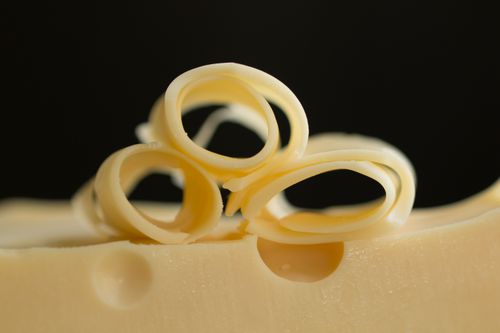
[Close-up of Swiss cheese slices on a dark background.] Photograph: Swiss cheese
Image Credits: Pexels
Cheese has holes because gas gets trapped inside it while it ripens. In Swiss cheese, that gas is carbon dioxide, released by a specific bacterium as it ferments lactic acid during ageing. The bubbles cannot escape through the firm cheese, so they grow into the round openings cheesemakers call eyes.
This article explains how those eyes form, including the bacteria involved, the warm-room stage where gas appears, why modern Swiss cheese often has smaller holes, and which holes count as quality and which count as faults.
First, not every cheese is supposed to have holes
Most cheeses have no large holes at all, and that is the first clue that Swiss eyes are deliberate. Cheddar, Gouda, and mozzarella are pressed and aged in ways that leave little trapped gas, so their interiors stay dense. Swiss-type cheeses, led by Emmental from Switzerland, are made with an extra bacterial culture whose whole job is to make gas.
In the United States, the cheese sold as "Swiss" is a version of Emmental, while in Switzerland the classic cheese is called Emmental itself. Baby Swiss and Jarlsberg are related forms of the same family, differing in moisture, fat, and sometimes in the bacteria used. Their holes vary, but the mechanism behind them is shared.
The distinction matters for shoppers. A hole in a cheese that should be dense can signal a fault, such as unwanted gas from contaminating bacteria. A hole in Emmental is a mark of the style, and its size and spread are watched as quality signs.
The bacteria that do the work
Swiss cheese making starts with milk and starter cultures. Lactic acid bacteria, including Streptococcus thermophilus and Lactobacillus helveticus, ferment lactose, the sugar in milk, into lactic acid. That acid helps the milk curdle and sets the cheese on its way.
The key player arrives in the second act. Propionibacterium freudenreichii, sometimes named with the subspecies shermanii, ferments the lactic acid left by the first bacteria. Its products are propionic acid, acetic acid, and carbon dioxide gas, according to the US Dairy explainer and the DailyCheese account of Emmental production.
Propionic acid gives the cheese much of its sweet, nutty flavour, which is why the same bacterium shapes both the look and the taste of Swiss cheese. Acetic acid adds a sharper note. Carbon dioxide, the third product, is the one that makes the holes, because gas has nowhere to go inside a firm wheel.
Mark Johnson, a scientist at the Center for Dairy Research at the University of Wisconsin, described the process to Reader's Digest in coverage quoted by Chowhound: the bacterium ferments lactic acid and produces carbon dioxide, which collects in spots in the cheese and forms a large bubble, or eye. The quote captures the whole mechanism in one sentence.
The warm room where eyes grow
After pressing and brining, Swiss wheels move to a warm ageing room, often called a curing cellar. Temperatures around 21 degrees Celsius, about 70 degrees Fahrenheit, wake the propionic bacteria into their most active phase. The cheese is firm enough by then to trap gas, yet soft enough for bubbles to expand without cracking the wheel.
Time in the warm room is a lever cheesemakers pull deliberately. A longer warm period generally produces larger eyes and a more pronounced nutty flavour, because the bacteria have more time to ferment lactic acid and release gas. A shorter or cooler period produces smaller eyes and a milder cheese.
Texture is the quiet constraint. If the curd is too dry, gas escapes before bubbles can form, and the cheese stays flat.
If the cheese is too soft, bubbles may merge or collapse rather than holding their round shape. Cheesemakers aim for a curd elastic enough to stretch around a growing bubble and hold it, which is why temperature, humidity, and timing are recorded so closely during eye development.
Why modern holes are smaller
Visitors to a cheese counter may notice that today's Swiss cheese often has smaller holes than the cartoon version, and there is a documented reason. Tiny hay particles in milk once gave gas bubbles easy starting points, known as nucleation sites, where bubbles could gather and grow. Cleaner modern dairy production leaves far fewer of those particles in the milk.
With fewer nucleation sites, bubbles form in fewer places and stay smaller, even when the bacteria and the warm room are unchanged. The change is not a flaw, and it does not mean the cheese is less authentic. It reflects cleaner milk handling, which removes the debris that once helped bubbles grow large.
Regulation still watches the result. In Swiss production, the number, size, and spread of eyes are monitored, and properly formed eyes are treated as a mark of quality. A wheel with no eyes at all, or with eyes that are wildly uneven, tells the cheesemaker something went wrong in fermentation or ripening.
Eyes, cracks, and faults: telling them apart
Not every opening in cheese is an eye. True Swiss eyes are smooth, round, and evenly spread, with clean walls of cheese around them. They form slowly, as gas pressure builds and the curd stretches around the bubble.
Cracks, slits, and ragged holes usually point elsewhere. Mechanical cracks come from pressing or cutting, while irregular gas pockets can come from unwanted bacteria producing gas at the wrong stage. A cheese with a sour or off smell alongside ragged holes deserves suspicion, while a clean-smelling Emmental with round eyes is doing exactly what its makers intended.
Some styles carry small holes of a different kind. Gouda may show tiny round holes from its own cultures, and blue cheeses show veins where mould grew along pierced channels. Those are separate traditions with separate causes, and they should not be confused with Swiss eyes, even though they look similar on a plate.
A short history of the discovery
American chemist William Clarke was the first person to attribute the porous appearance of Swiss cheese to bacteria, publishing his findings in a 1917 edition of the Journal of Dairy Science, according to Chowhound's account. Clarke could show that bacteria caused the holes, but he could not pin down the exact origin of the bacteria themselves.
Later work identified the propionic bacteria and their role in fermenting lactic acid, and the mechanism is now standard dairy science. The bacteria occur naturally in hay, grasses, and soil, and they can be present in raw milk, as US Dairy notes.
Pasteurisation kills most bacteria, so cheesemakers add the propionic culture back deliberately to make sure the characteristic bubbles develop.
That history explains a paradox in the cheese aisle. The holes look natural, almost accidental, yet they are the product of a controlled culture added on purpose. Swiss cheese is not cheese that happened to get holes; it is cheese designed to make them.
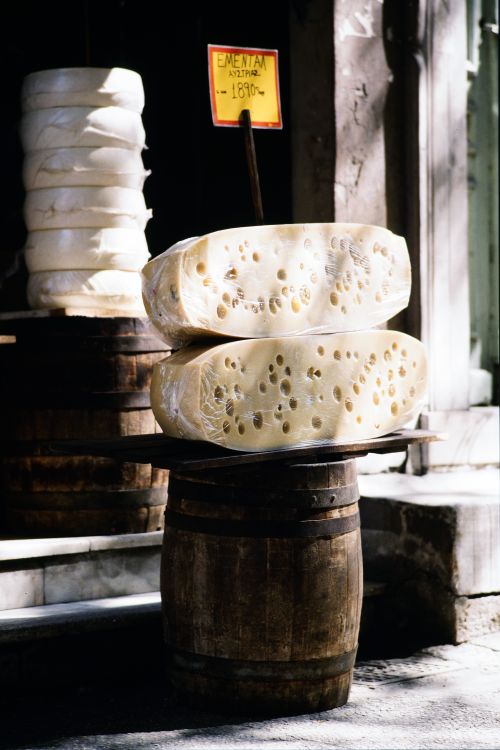
[Cheese wheels stacked outside a rustic shop.] Photograph: Cheese wheels
Image Credits: Pexels
Frequently asked questions
Are the holes in Swiss cheese a defect?
No. In Swiss-type cheeses such as Emmental, the holes are called eyes and are a deliberate, desired feature. In cheeses that should be dense, unexpected holes can signal a fault instead.
What gas makes the holes?
Carbon dioxide, released when Propionibacterium freudenreichii ferments lactic acid during ripening. The gas cannot escape the firm cheese, so it collects into bubbles that become eyes.
Why does some Swiss cheese have bigger holes than other Swiss cheese?
Warm-room temperature, acidity, culture amount, and ripening time all affect eye size. Longer warm ripening generally means larger eyes, while cleaner modern milk, with fewer hay particles to seed bubbles, tends to mean smaller ones.
Do the holes affect the flavour?
Indirectly, yes. The same fermentation that releases carbon dioxide also produces propionic acid, which gives Swiss cheese its sweet, nutty flavour. The holes themselves are gas pockets, not flavour, but they mark the process that creates the flavour.
The bottom line
Swiss cheese has holes because a second fermentation fills it with gas. Lactic acid bacteria first turn milk sugar into lactic acid, then Propionibacterium freudenreichii turns that acid into propionic acid, acetic acid, and carbon dioxide. Trapped in a firm wheel in a warm room, the gas becomes eyes.
The next time a slice of Swiss lands on a sandwich, the holes are worth a second look. They are not damage, and they are not decoration. They are the visible record of bacteria at work, and the reason the cheese tastes the way it does.
Tags: cheese, food science, Swiss cheese
The Rive News research desk writes plain-language explainers drawn from public sources, with every key claim tied to a named source.
Related
- Why cheese melts differently depending on the type
- Why cheese melts differently: mozzarella vs cheddar vs parmesan
- Why milk curdles when you add it to hot tea, explained
Subscribe for one clear explainer each morning on the everyday things cooks wonder about.
Rive News publishes explainers from public sources and corrects errors when readers point them out.
Related stories
Why Does Bread Go Stale Faster in the Refrigerator?
Bread goes stale faster in the fridge because starch recrystallizes fastest near 4°C. Here is the retrogradation science and the right way
Baking soda and baking powder: what's the difference?
Baking soda is pure sodium bicarbonate; baking powder adds two dry acids for double-acting lift. Learn when to use each, plus exact
What Is the Maillard Reaction in Simple Terms?
The Maillard reaction is the browning chemistry between amino acids and sugars above 140 C that creates the crust, color, and rich flavor