
Why cheese melts differently depending on the type
By Rive News / Research desk | Rive News / Published October 28, 2026 at 9:00 AM PKT
Key takeaways
- Cheese melts in stages: fat liquefies near 32 degrees Celsius, then casein bonds loosen at higher temperatures.
- Soft cheeses flow near 54 degrees Celsius, cheddar types near 65, and parmesan near 82.
- Moisture, fat, age, and calcium bonds decide whether a cheese flows, stretches, greases, or holds its shape.

[Melted cheese pulling in strands from a hot dish.] Photograph: melted cheese
Image Credits: Wikimedia Commons
Put mozzarella on a pizza and it flows into a stretchy blanket. Put parmesan on the same pizza and it mostly sits there, browning in place.
Both are cheese, both meet the same heat, yet they behave like different materials. The difference is not magic; it is chemistry.
This article explains why cheese melts differently depending on the type, including what actually happens inside cheese as it heats, why moisture and fat matter, how age and acidity change the melt, and which cheeses to pick for which dish.
Cheese is a protein net, not a single substance
Ice melts cleanly because it is one substance: water. Cheese is a mixture of protein, fat, and water, held together in a network, so it softens in stages rather than flipping from solid to liquid.
The protein is casein, found in mammals' milk. During cheese-making, casein forms a network held together by weak bonds and studded with molecules of water and fat, as Scientific American explained. Heat loosens that network in stages, and each stage changes the texture.
America's Test Kitchen describes the structure as a network of proteins like tiny cages surrounding bits of fat and water. When cheese heats up, the fat turns from solid to liquid, then the proteins loosen, and the cheese flows like a thick liquid. It never becomes as runny as water, because the protein net never fully disappears.
Melting happens in stages
Harold McGee, in On Food and Cooking, sets out the sequence precisely. First, at around 90 degrees Fahrenheit (32 degrees Celsius), the milk fat melts, which makes the cheese more supple and often brings little beads of fat to the surface.
Then, at higher temperatures, enough of the bonds holding the casein proteins together break that the protein matrix collapses and the piece sags and flows. McGee gives the thresholds: around 130 degrees Fahrenheit (55 degrees Celsius) for soft cheeses, 150 degrees Fahrenheit (65 degrees Celsius) for cheddar and Swiss types, and 180 degrees Fahrenheit (82 degrees Celsius) for parmesan and pecorino.
Scientific American describes the same stages. First the fats melt and seep out, which is why cheese gets "sweaty" even near room temperature.
Then, as the cheese reaches the temperature of water from a hot tap, the proteins start losing water, shrinking and softening. By around 160 degrees Fahrenheit, the melting process is complete.
With continued high heat, moisture evaporates from the liquefied cheese, which gets progressively stiffer and eventually resolidifies, McGee notes. That is why overheated cheese turns rubbery and then hard: the water that made it flow has gone.
Moisture is the biggest lever
McGee's central rule is simple: melting behaviour is largely determined by water content. Low-moisture hard cheeses require more heat to melt because their protein molecules are more concentrated and more intimately bonded to each other, and when melted, they flow relatively little.
Separate pieces of grated moist mozzarella will melt together, McGee writes, while flecks of parmesan remain separate. The water in mozzarella acts as a plasticiser, letting protein strands slide past each other instead of locking together.
Culture Cheese Magazine makes the same point from the casein side. In fresh mozzarella, the casein bonds are loose and elastic, so when the cheese heats up it oozes and spreads smoothly. In a harder, parmesan-style cheese, the casein bonds are tough, so it takes a higher temperature to start breaking down the matrix, and the pieces collapse unevenly into larger chunks.
Low-moisture mozzarella, the kind sold for pizza, is a deliberate compromise. It has less water than fresh mozzarella, so it melts without flooding the pizza, but enough to flow. Fresh mozzarella melts beautifully and then weeps, which is why pizza makers often prefer the low-moisture version.
Fat lubricates, but too much greases
Fat plays a subtler role than moisture. Melted fat lubricates protein strands, helping them slide, and it carries flavour. But fat that escapes the protein net pools on the surface as grease, which is the classic cheddar problem.
McGee quantifies the difference. The ratio of fat to surrounding protein is just 0.7 in part-skim parmesan, around 1 in mozzarella and the alpine cheeses, but 1.3 in Roquefort and cheddar. Cheddar and Roquefort are therefore especially prone to exuding fat when melted.
America's Test Kitchen found the same pattern in its own kitchen tests. Its mozzarella melted into gooey perfection, its cheddar was melty but greasy, and its parmesan did not really melt at all. The test matched the chemistry: moderate fat and high moisture flow, high fat greases, low moisture resists.
Blending cheeses is the cook's workaround. A little cheddar adds flavour to a mozzarella base without tipping the whole dish into grease, and a little parmesan adds savoury depth to a flowing cheese sauce without being asked to melt on its own.
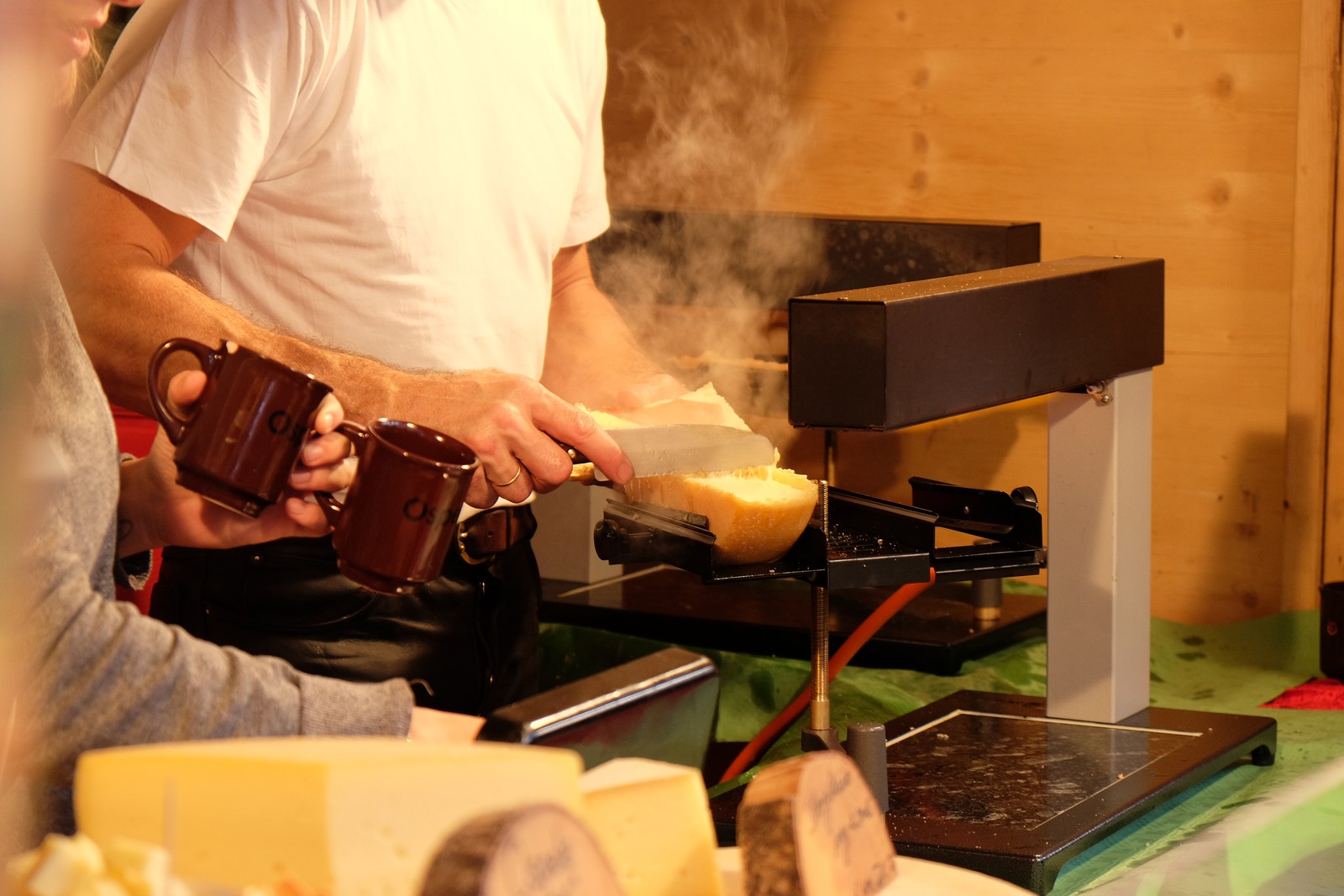
[Melted raclette being scraped from the wheel onto a plate.] Photograph: melted raclette cheese
Image Credits: Wikimedia Commons
Age hardens the net
As cheese ages, its protein structure changes, making it less elastic and more crumbly. Culture Cheese Magazine explains that the longer a cheese ages, the more enmeshed the casein micelles become and the stronger their bonds grow.
That is why young cheeses melt best. Fresh mozzarella, young Monterey Jack, and young Gouda flow readily, while the same styles aged for a year or more resist melting and grate into crumbs instead.
Age also drives moisture out. A wheel loses water steadily during ageing, so an aged cheese faces two obstacles at once: a tighter protein net and less water to loosen it. Parmesan, aged for 12 to 36 months, is the extreme case, and its melting point near 82 degrees Celsius reflects both factors.
Acidity adds a third ageing effect. Cheeses with higher acidity, such as cheddar, melt more slowly and evenly, according to cooking-science summaries. Acid changes the charge on casein proteins, which changes how tightly they grip each other and how calcium bonds behave.
Calcium bonds set the Goldilocks zone
Scientific American's key insight concerns calcium. The casein network is locked together by calcium phosphate bonds, and melting needs a Goldilocks level of those bonds.
As the article's researcher Sharma puts it, "If you have too much calcium content, cheese will not melt. If there is too little calcium, then it will melt very fast, so it will be runny."
Cheese-makers control calcium through acidity and through the make process. Acid-set cheeses such as paneer, halloumi, and ricotta have protein structures that resist melting even when heated hard, which is why paneer cubes hold their shape in a hot pan while mozzarella stretches into ribbons.
Rennet-set cheeses, by contrast, form an elastic web that softens with gentle heat. Mozzarella, cheddar, Swiss, provolone, Gruyère, and Monterey Jack all belong to this family, and all are known as good melting cheeses for exactly that reason.
Why some cheeses never melt
A few cheeses refuse to melt on principle. Halloumi and paneer soften and brown but keep their shape, because their protein networks were set by heat or acid in ways that heat alone cannot undo. Feta softens and crumbles rather than flowing, for similar reasons.
These cheeses are not failures; they are designed for different jobs. Halloumi is made to be grilled, paneer to be simmered in sauce without dissolving, and feta to crumble over a salad. Asking them to melt like mozzarella is asking them to do a job they were never built for.
Processed cheese, at the other extreme, melts almost too well. Manufacturers add emulsifying salts that break calcium bonds and keep fat and water mixed, which is why processed slices flow smoothly without greasing. It is a laboratory shortcut to the same chemistry, not a different science.
Choosing the right melt
For pizza and toasties, low-moisture mozzarella is the workhorse: it flows, stretches, and browns without flooding. For a cheese sauce, a blend of a flowing cheese with a flavourful one works best, since the flowing cheese carries the flavour cheese through the sauce.
For gratins and baked pasta, Gruyère and fontina offer a middle path, flowing well while adding nutty, savoury notes that mozzarella lacks. For finishing, parmesan and pecorino should be grated over the finished dish, not relied on to melt into it.
Grating matters too. Finely grated cheese melts faster and more evenly than thick slices, because heat reaches more surface at once. Letting cheese come to room temperature before cooking also helps, since cold cheese faces a longer climb to its melting threshold.
Frequently asked questions
Why does mozzarella melt better than parmesan?
Mozzarella is young and moist, with loose, elastic casein bonds that loosen near 54 degrees Celsius. Parmesan is aged and dry, with tight bonds that need about 82 degrees Celsius, and even then it flows little.
Why does cheddar get greasy when it melts?
Cheddar has a high fat-to-protein ratio, about 1.3 according to Harold McGee, compared with about 1 for mozzarella. When its protein net loosens, excess fat escapes and pools on the surface.
Why does paneer not melt?
Paneer is an acid-set cheese whose protein network resists heat. Its curds were set in a way that hot cooking cannot undo, so it softens and browns but keeps its shape.
Does aged cheese melt worse than young cheese?
Yes. As cheese ages, casein bonds grow stronger and moisture leaves the wheel, both of which resist melting. Young versions of the same style flow far more readily.
What is the best cheese for a smooth cheese sauce?
A blend works best: a flowing cheese such as mozzarella, Gruyère, or fontina for texture, plus a flavourful cheese such as cheddar for taste. Grating finely and cooking gently prevents greasing and graininess.
The bottom line
Cheese melts differently because no two cheeses share the same balance of water, fat, protein bonds, and age. Mozzarella flows because it is young, moist, and loosely bonded; cheddar greases because it carries more fat than its net can hold; parmesan resists because age and dryness have locked its net tight.
The cook's rule follows from the chemistry: match the cheese to the job, blend for flavour and flow, and never ask a crumbling or acid-set cheese to do a flowing cheese's work. The melt will tell you, quickly, whether you chose well.
Tags: cheese, cooking science, melting
Rive News's research desk covers everyday systems and the rules behind them, from travel documents to household technology, using public sources and named authorities.
Related
- Why cheese melts differently: mozzarella vs cheddar vs parmesan
- Why milk curdles when heated or mixed with acid
- Why onions make you cry
- What is the Maillard reaction in simple terms
Subscribe to the Rive News newsletter for one plain-English explainer each morning.
Rive News publishes research-based explainers; facts are attributed to named public sources, and corrections are welcomed.
Related stories
Why Does Bread Go Stale Faster in the Refrigerator?
Bread goes stale faster in the fridge because starch recrystallizes fastest near 4°C. Here is the retrogradation science and the right way

Baking soda and baking powder: what's the difference?
Baking soda is pure sodium bicarbonate; baking powder adds two dry acids for double-acting lift. Learn when to use each, plus exact
What Is the Maillard Reaction in Simple Terms?
The Maillard reaction is the browning chemistry between amino acids and sugars above 140 C that creates the crust, color, and rich flavor