
Why Does Coffee Bloom When You Pour Water on Fresh Grounds
Key takeaways
- Coffee blooms because hot water forces trapped carbon dioxide out of freshly roasted grounds.
- A standard 30-45 second bloom with twice the coffee's weight in water clears most of the gas.
- A lively bloom signals fresh coffee, but the biggest bloom does not always mean the best cup.
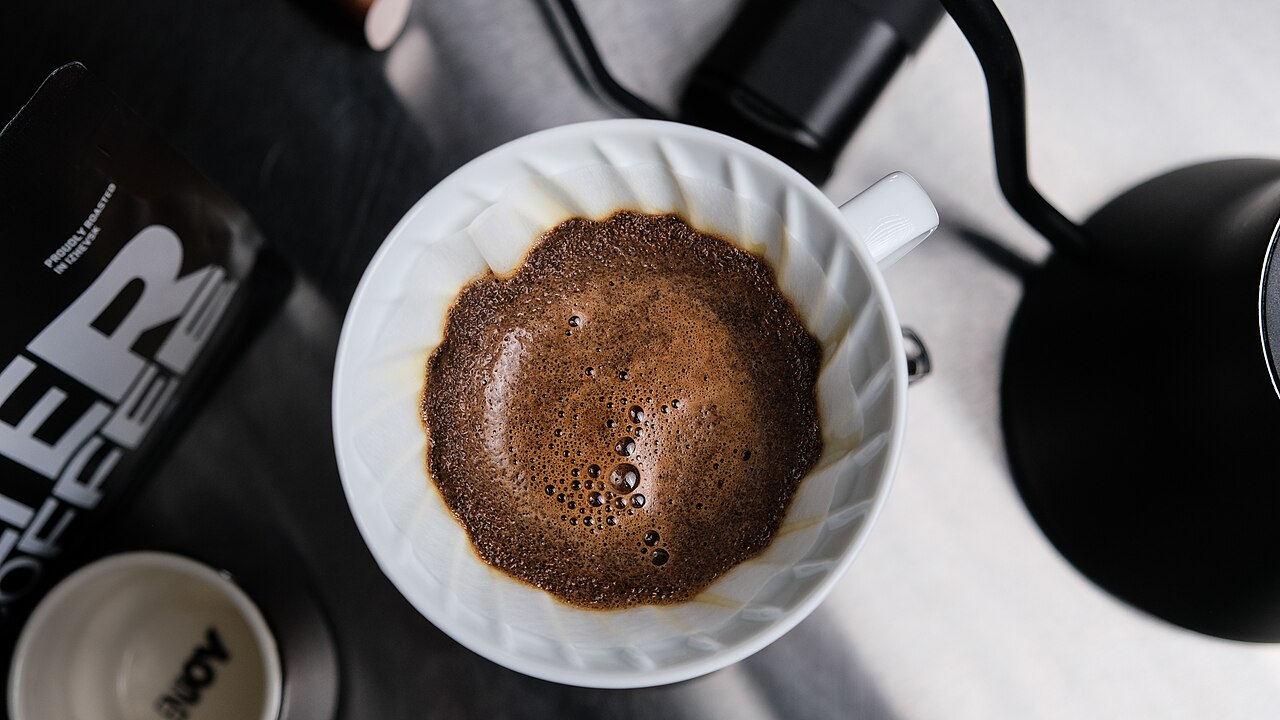
A V60 pour-over mid-bloom: the coffee bed swells and bubbles as trapped carbon dioxide escapes. Image: Wikimedia Commons.
Image Credits: Wikimedia Commons
Pour hot water over freshly ground coffee and the bed swells, domes, and fizzes like it is breathing out. In a sense, it is. That dramatic bubbling is called the bloom, and it is one of the few moments in brewing where you can watch chemistry happen in real time.
The gas escaping is carbon dioxide, loaded into the beans during roasting and released in a rush when hot water arrives. Understanding the bloom explains both why fresh coffee behaves differently from stale coffee and why pour-over recipes all begin with the same small first pour.
This article takes a closer look at why coffee blooms when you pour water on fresh grounds, including where the gas comes from, what the fizzing actually does in the brewer, and how to bloom properly.
Where the gas comes from
Roasting is violent chemistry. As beans heat, sugars and amino acids react through the Maillard reaction, generating water vapor and carbon dioxide inside the bean's cellular structure. The gas pressure builds until the beans audibly crack in the roaster, the moment roasters use to judge doneness, according to Coffee Informer's bloom guide.
A lot of that CO2 stays trapped after roasting. Coffee Brew Hub's brewing science guide reports that a standard bag of freshly roasted specialty coffee can retain up to 10 liters of gaseous CO2 per kilogram of whole beans. From the moment roasting ends, the beans slowly leak that gas through microscopic pores, a process called degassing.
Coffee Brew Hub notes degassing typically peaks within the first 7 to 14 days after the roast.
Grinding accelerates everything. It shatters the bean structure and exposes far more surface, so gas escapes faster.
Hot water accelerates it further still: the sudden heat and wetting drive CO2 out of the particles in seconds. That rush of escaping gas is the bloom.
This is why the bloom doubles as a freshness indicator. Coffee roasted within roughly 4 to 14 days carries a high concentration of trapped gas and blooms energetically. Coffee roasted months ago, or bought pre-ground, has already shed its CO2 and sits flat and lifeless when water hits it, as Coffee Brew Hub explains.
Extremely fresh coffee under about 3 days off roast can hold so much gas that it actually brews worse, which is why roasters rest beans for several days before selling.
What the fizzing does in the brewer
The bloom is not just a show. Escaping gas interferes with brewing in a concrete way: carbon dioxide pushes water away. When gas is still rushing out, bubbles form between the grounds and the water, so some parts of the coffee bed stay dry while water channels through others, according to Coffee Informer's guide.
Astrophysicist and brewing author Jonathan Gagne describes the mechanism precisely in The Physics of Filter Coffee, as summarized by Jayarr Coffee: as water enters a coffee particle through its pores by capillary action, carbon dioxide stored in the coffee's cells is pushed out through other pores. That displacement is the fizzing you see. Gagne's measurements also showed the grounds keep absorbing water for about 2 minutes, and that lighter roasts, with smaller pores between cells, absorb more slowly.
The practical job of the bloom, then, is wetting plus degassing. A small first pour gets every particle wet before the bulk of the water arrives.
If the main pour starts while parts of the bed are still dry, water keeps taking the wet paths, over-extracting the coffee along them and leaving the rest under-extracted. The bloom evens the playing field.
How much taste difference this makes is honestly debated. Apothecary Coffee's 2026 review of bloom experiments concludes the degassing science is solid, backed by peer-reviewed work including Smrke and colleagues' 2018 time-resolved gravimetric study in the Journal of Agricultural and Food Chemistry, while the flavor payoff from exactly how you bloom rests on smaller, mostly single-variable tests. The consistent direction of results is encouraging, but a 1-2 percentage-point shift in extraction can move with grinder, water, and technique.
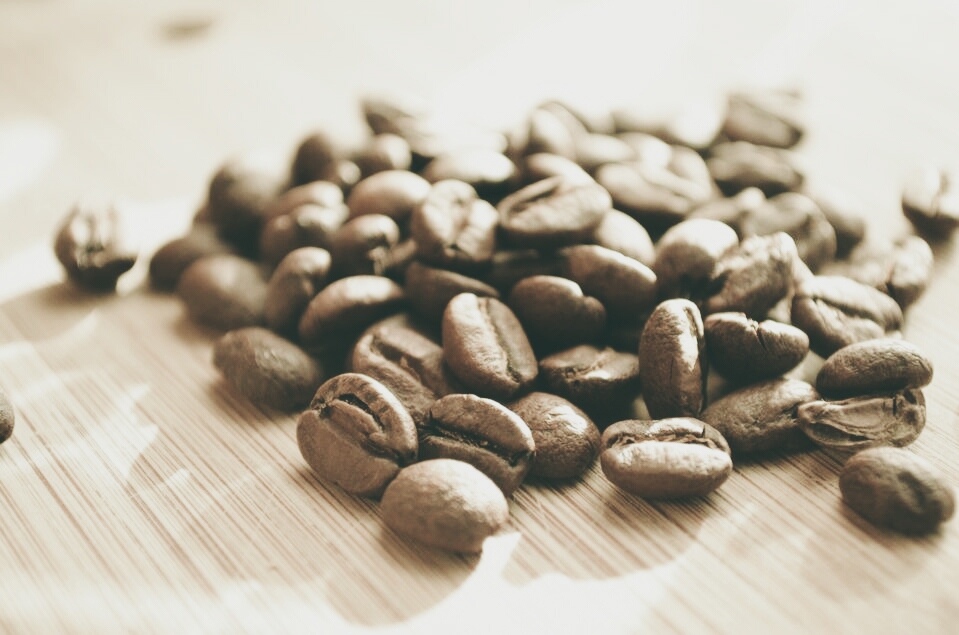
Fresh beans carry the most trapped CO2, which is what the bloom releases. Image: Wikimedia Commons.
How to bloom properly
The standard method is simple. Coffee Informer's quick answer: pour about twice the coffee's weight in water (30 grams of water for 15 grams of coffee), make sure every ground is wet, wait 30 to 45 seconds for the bubbling to settle, then continue the brew.
Cumbre Coffee's pour-over guide gives a worked example: 20 grams of coffee, 40 to 60 grams of bloom water, bloom lasting 30 to 45 seconds from the first pour, then continue the recipe. They note that Hario's published James Hoffmann V60 recipe uses twice the coffee's weight in bloom water with a bloom of up to 45 seconds.
A few details improve the result. Swirl or stir gently if dry clumps sit above the waterline, especially with very fresh coffee. Use water just off the boil, around 90 to 96°C, since cooler water extracts less during the bloom window.
In full-immersion methods like the French press, the grounds sit in water the whole time, so a separate bloom does less distinct work, as Apothecary Coffee notes.
Note that competitors are now experimenting. A September 2025 Perfect Daily Grind round-up cited by Apothecary Coffee found Brewers Cup competitors dropping the dedicated bloom in favor of several small continuous pours, effectively blooming and brewing at once. The dedicated pause is not the only way to manage degassing.
The bloom also explains other kitchen phenomena driven by trapped gas, like why bread has its crust or why eggs crack when you boil them: heat moves gases and steam, and the container, bean, shell, or loaf, responds.
How long should I bloom my coffee?
Thirty to 45 seconds covers most cases. Most of the CO2 escapes in that window, and going much longer mainly cools the brewer. For very fresh coffee under a week off roast, lean toward 45 seconds; for older coffee, 30 seconds is plenty because there is less gas to clear.
Does a bigger bloom mean better coffee?
Not automatically. A dramatic bloom means substantial retained gas, which signals freshness, but cup quality depends on the bean, roast, grind, and water too. Coffee under 3 days off roast can bloom violently yet taste harsh and gassy, which is why the sweet spot for most light to medium roasts is 10 to 21 days after roasting.
Do I need to bloom coffee in a French press?
Not really as a separate step. In immersion brewing the grounds are surrounded by water the entire time, so degassing and wetting happen together. A quick stir after a minute achieves most of what a pour-over bloom does.
Why does my old coffee not bloom at all?
Because it has finished degassing. Weeks-old or pre-ground coffee has already lost its internal CO2 through its pores, so there is no trapped gas left to rush out. A flat bed is a reliable sign the coffee is past its freshest window, though it can still brew a decent, if less vibrant, cup.
The bottom line
Coffee blooms because roasting packs the beans with carbon dioxide, and hot water forces that gas out in a visible rush. A 30 to 45 second bloom with about twice the coffee's weight in water lets most of the gas escape so the rest of the brew wets the bed evenly. Treat the bloom as what it is: a freshness signal and a practical wetting step, not magic.
Grind size, water, temperature, and technique still decide the cup.
Latest in Food & Cooking
New to the lab? Get one plain-English explainer like this in your inbox every morning.
Related stories
Why Does Bread Go Stale Faster in the Refrigerator?
Bread goes stale faster in the fridge because starch recrystallizes fastest near 4°C. Here is the retrogradation science and the right way
Baking soda and baking powder: what's the difference?
Baking soda is pure sodium bicarbonate; baking powder adds two dry acids for double-acting lift. Learn when to use each, plus exact

What Is the Maillard Reaction in Simple Terms?
The Maillard reaction is the browning chemistry between amino acids and sugars above 140 C that creates the crust, color, and rich flavor