
What Is Gluten and Why Kneading Develops It in Dough
By Rive News
Research desk | Rive News
Key takeaways
- Gluten is the stretchy protein network that forms when two wheat proteins, glutenin and gliadin, meet water.
- Kneading organizes that network by repeatedly breaking and rebuilding disulfide bonds (sulfur links) between protein chains.
- A developed network traps the carbon dioxide from yeast, which is why bread rises instead of spreading.
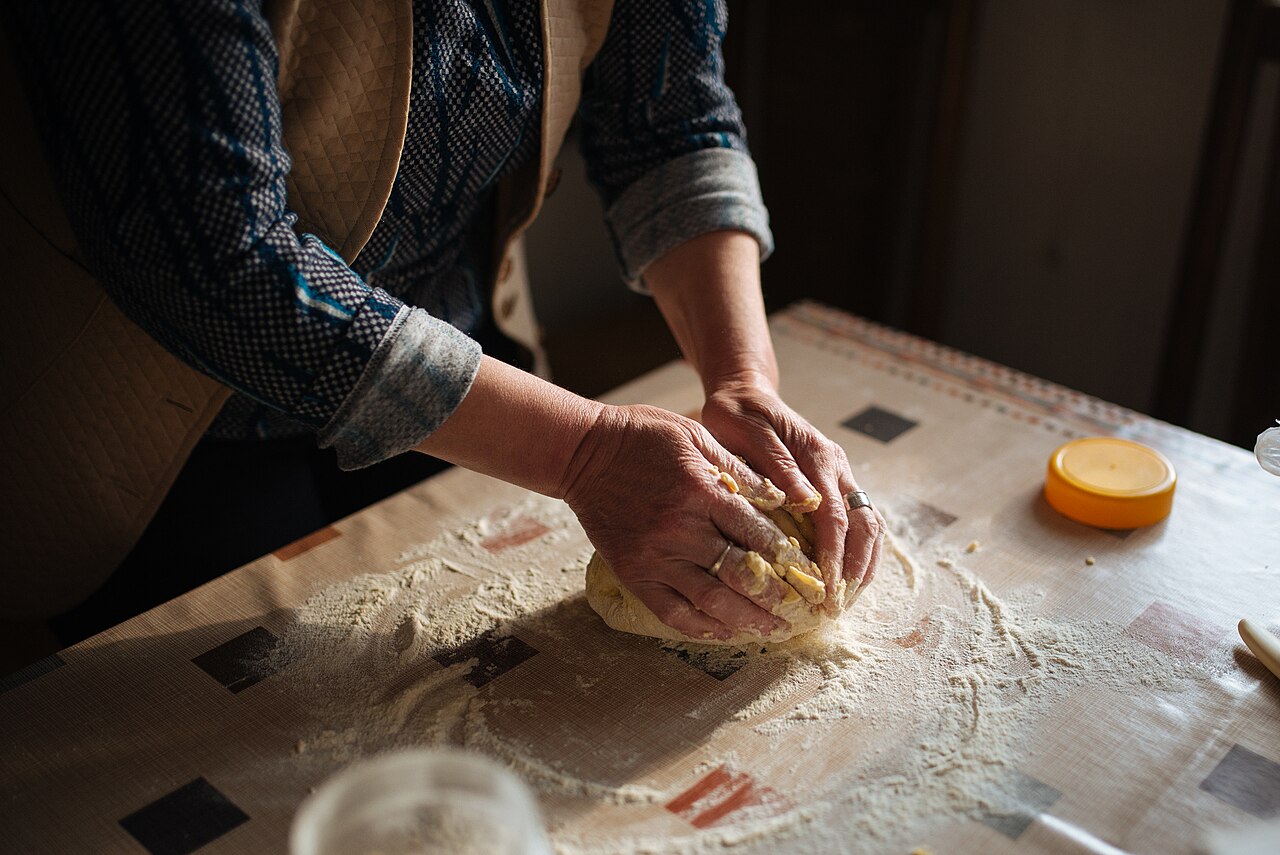
Hands kneading bread dough on a floured surface. Photograph: Wikimedia Commons
Image Credits: Wikimedia Commons (CC BY 2.0)
Gluten is not an ingredient you add to a recipe. It is a structure your dough builds for itself, out of proteins already sitting in the flour.
The moment water touches wheat flour, two proteins called glutenin and gliadin begin linking up into a single elastic web. That web is gluten, and every chewy crumb of bread depends on it.
Kneading is the physical work that takes that raw, tangled web and turns it into something organized and strong. Without it, dough stays slack and weak.
Yeast can pump out all the gas it wants, but a weak network cannot hold it, so the loaf stays flat. This article explains what gluten is, how kneading develops it, how to tell when the dough has had enough, and what happens when kneading goes too far.
What is gluten?
Wheat flour is mostly starch, but roughly 8 to 14 percent of it is protein, and two of those proteins matter most for bakers: glutenin and gliadin. When flour is dry, these proteins sit folded up and separate. Add water, and they unfold, swell, and start grabbing onto each other, forming the continuous network bakers call gluten, as explained in CCC's Curious Kitchen's gluten primer.
Each protein plays a different role in the partnership. Glutenin forms long chains that give dough its strength and elasticity, the snap-back quality you feel when you pull dough and it resists.
Gliadin is smaller and more compact, and it contributes viscosity (thickness) and extensibility, the ability of dough to stretch without tearing. A proper balance of the two is what makes a loaf both tall and tender, according to the flour-chemistry notes compiled by Testbook from standard food-science references.
It helps to picture gluten as a rubber balloon. A weak, underdeveloped network is like old, brittle rubber: it stretches a little, then pops, and the gas escapes.
A well-developed network is like fresh latex: it inflates several times over and springs back. That balloon image comes from the Curious Kitchen explainer, and it captures the three properties bakers care about, strength, extensibility, and elasticity, in one picture.
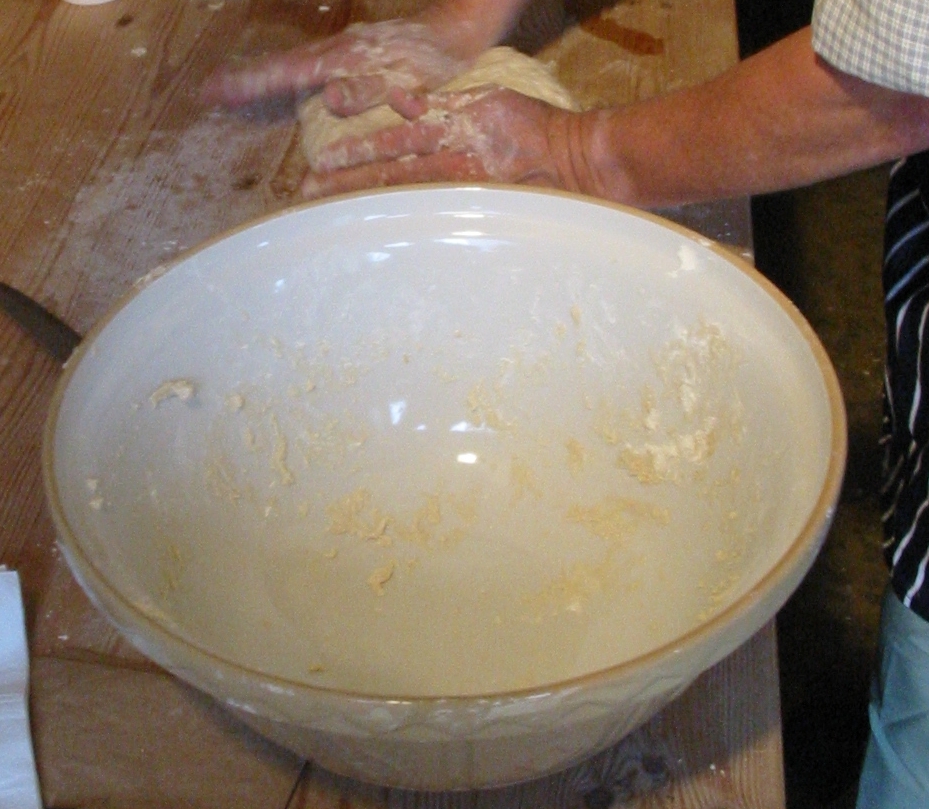
Unkneaded bread dough, with its gluten network still weak and unordered. Photograph: Wikimedia Commons
Image Credits: Wikimedia Commons (public domain)
How does kneading develop gluten?
Freshly mixed dough has gluten, but it is a mess. The proteins are hydrated and linked, yet the strands point in every direction and the bonds between them are short and random.
The dough feels shaggy, tears easily, and will not hold its shape. Kneading, the repeated pushing, folding, and turning of the dough, fixes that disorder through straightforward mechanics.
The key chemistry is the disulfide bond. Glutenin chains carry sulfur-containing amino acids called cysteines. When two cysteines on neighboring chains meet, their sulfur atoms link, forming a disulfide bridge.
As a phys.org science piece on gluten chemistry describes it, the more cysteines that pair up, the larger the network grows, and the longer the kneading, the stronger it gets. Kneading does not just stretch the dough; it constantly breaks these bridges and lets them reform in longer, better-aligned chains, until the proteins settle into a three-dimensional network with gliadin molecules nestled between the glutenin sheets. That break-and-rebuild cycle is documented in the Grains Research and Development Corporation's dough-quality research, which draws on electron-microscopy studies of dough at different kneading stages.
Flour choice sets the ceiling. Bread flour carries 12 to 14 percent protein, notably more than all-purpose or cake flour, which is why it builds a stronger network and supports a higher rise, per the phys.org explainer. Strong flours from certain wheat varieties also demand longer mixing before they give up a cohesive dough, while weak flours break down sooner, a point the food-science references emphasize.
There is a reason the technique has a rhythm to it: push with the heel of the hand, fold, rotate a quarter turn, repeat. Each cycle stretches the strands a little further into alignment.
Commercial bakeries do the same thing with spiral mixers, which develop gluten gently and evenly without overheating the dough, according to CKitchen's professional guide to gluten development. Home bakers do it by hand in roughly 8 to 12 minutes for a typical loaf.
How to tell when kneading is done
Bakers do not knead by the clock alone. They test the network, and the classic test is the windowpane. Pinch off a small piece of dough and stretch it slowly between your fingers.
If the membrane becomes thin and translucent enough for light to pass through without tearing, the gluten is fully developed. If it rips early, the network needs more work, as both the Curious Kitchen primer and the CKitchen guide describe.
The dough gives other signals too. Under-kneaded dough feels rough and tears when you pull it.
Properly developed dough turns smooth and satiny, springs back slowly when poked, and holds its shape instead of slumping. Those changes are the strands finishing their alignment, and they are easier to read than any timer once you have felt the transition a few times.
Overnight or long-fermentation doughs complicate the clock rule. Time and hydration continue developing gluten even without mechanical work, which is why some high-hydration doughs are folded gently rather than kneaded hard. The principle is the same, though: the network needs to reach the point where it can trap gas and hold structure.
What happens with too much kneading?
Gluten development has a limit. Past a certain point of mechanical energy, the same disulfide bonds that kneading built start breaking faster than they reform, and the network breaks down.
The dough goes from smooth and elastic to slack, sticky, and lifeless. Food-science references note that weak flours hit this wall sooner than strong ones, and that the breakdown accelerates without enough air in the mix.
Overdevelopment is more common than most home bakers think, just under a different name. Over-mixed muffin batter builds a strong gluten web that traps extra air, so the muffins rise high, but the crumb turns tough and rubbery.
An overworked pie crust shrinks back in the oven because the elastic gluten pulls the edges toward the center. Both examples come from the Curious Kitchen explainer, and both show the same lesson: gluten strength is only a virtue up to the point the recipe wants.
The practical fix is restraint. Knead until the dough passes the windowpane test, then stop. If a dough has gone slack and will not recover its elasticity after a rest, it has likely been pushed past the limit, and the kindest thing is to let it rest, reshape it, and accept a denser loaf.
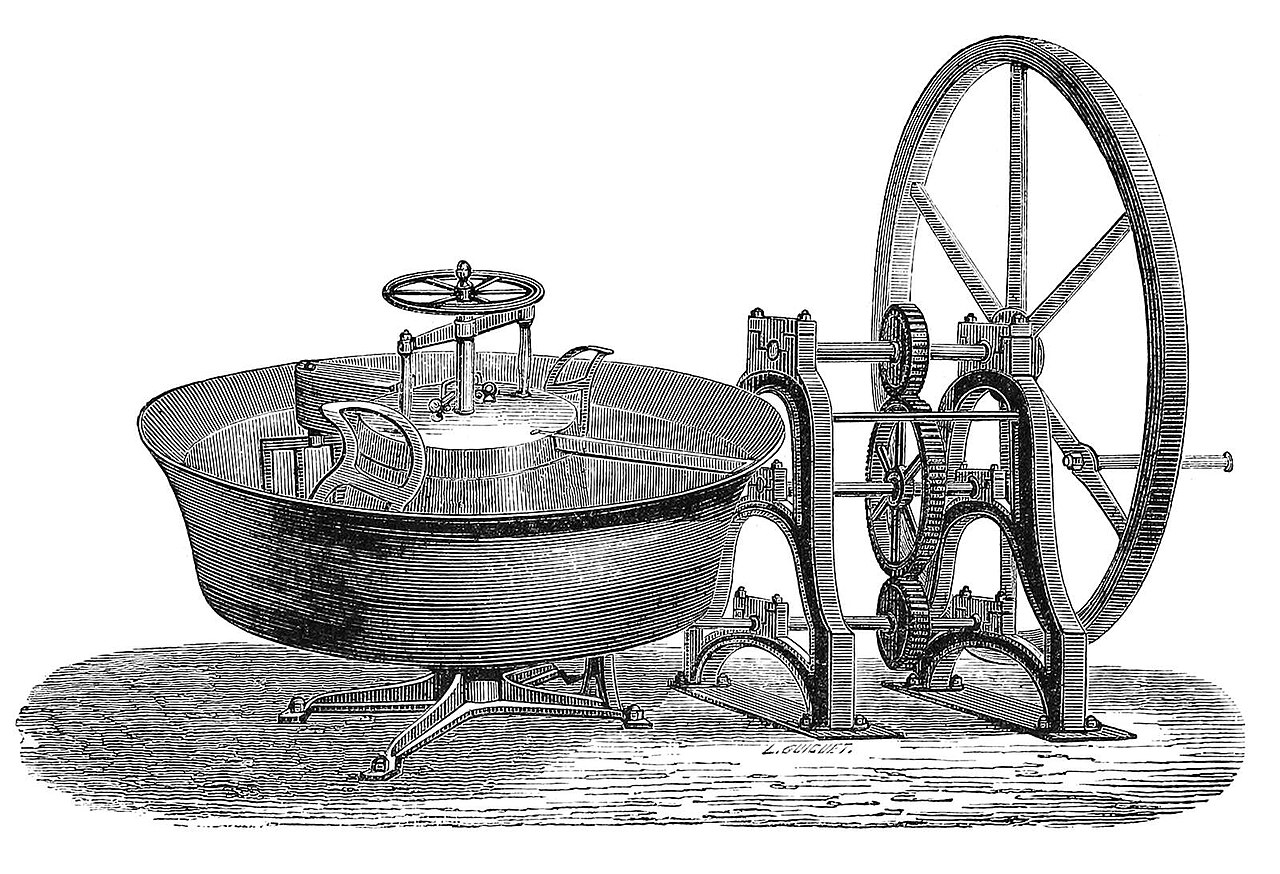
An 1877 mechanical dough kneader, an early attempt to automate gluten development. Photograph: Wikimedia Commons
Image Credits: Wikimedia Commons (public domain)
The bottom line
Gluten is the elastic web that glutenin and gliadin form in water, and kneading is what organizes it: stretching, breaking, and rebuilding protein bonds until the dough can trap gas and hold a rise. The windowpane test tells you when you have arrived, and the dough's smooth, springy feel confirms it.
For your next loaf, it is a good idea to check the flour's protein content before you start, since bread flour in the 12 to 14 percent range needs more kneading than all-purpose. Work the dough until it stretches translucent, then stop and let the yeast do the rest. For more on the chemistry that makes bread rise and brown, read our explainers on why milk curdles when heated and the Maillard reaction.
Frequently asked questions
Does higher-protein flour need more kneading?
Generally yes. Bread flour at 12 to 14 percent protein has more gluten-forming material to organize, so it typically needs a longer, more vigorous knead than all-purpose flour before the network fully develops. That extra work is what buys the chewier crumb and taller rise.
Why does my dough tear when I stretch it?
Tearing means the gluten network is still weak and unordered. The strands have not yet aligned into long, stretchy sheets. A few more minutes of kneading usually fixes it, and the windowpane test will confirm when the dough stretches thin without ripping.
Can you over-knead dough by hand?
It is difficult but possible, especially with weaker flours. Hand kneading rarely delivers the sustained energy of a stand mixer, but if a dough turns slack, sticky, and refuses to spring back even after resting, the network has likely broken down from too much work.
Is gluten the same in all wheat flours?
No. The total protein percentage and the ratio of glutenin to gliadin vary by wheat variety and milling. That variation is why bread flour, all-purpose flour, and cake flour behave so differently in the same recipe, and why strong flours tolerate longer mixing.
---
Rive News is the research desk behind these explainers. We read the primary sources, check the numbers, and write what we can verify.
Latest in Food
- Why Does Milk Curdle When Heated or Mixed With Acid?
- Why Do Cakes Sink in the Middle After Baking?
- Why Does Cheese Melt Differently: Mozzarella vs Cheddar vs Parmesan?
- The Maillard Reaction in Simple Terms
Subscribe for one verified food-science explainer in your inbox every morning.
Corrections: spotted an error? We fix verified mistakes promptly and note the update. Standards: every claim traced to a named source; no invented quotes, statistics, or experts.
Related stories

Why Does Bread Go Stale Faster in the Refrigerator?
Bread goes stale faster in the fridge because starch recrystallizes fastest near 4°C. Here is the retrogradation science and the right way t

Baking soda and baking powder: what's the difference?
Baking soda is pure sodium bicarbonate; baking powder adds two dry acids for double-acting lift. Learn when to use each, plus exact substitu

What Is the Maillard Reaction in Simple Terms?
The Maillard reaction is the browning chemistry between amino acids and sugars above 140 C that creates the crust, color, and rich flavor of